How to test an AI search monitoring tool before you buy
AI search monitoring tool checklist: platforms, daily scans, mentions vs citations, source URLs, a five-step trial test and the cost traps to ask about.

Managing Director at Alexandrya.AI
You test an AI search monitoring tool in two passes before you buy. First, check it against four criteria: five platforms, daily runs, mentions and citations reported separately, and visible source URLs. Then run it for a week on 20 to 30 of your own buying-intent prompts and compare a sample of its answers with answers you pull yourself. Price comes into it only after that.
Alexandrya.AI is our own product, so this checklist contains no ranking, only a test you can apply to any tool, ours included. For an overview of individual vendors, see our comparison of the best AI search monitoring tools. In Alexandrya.AI’s own measurement for the prompt “ai search monitoring tools”, ChatGPT, Gemini, Perplexity, Google AI Mode and Microsoft Copilot named 26 different tools across 14 answers on three days, 25 to 27 October 2026. Alexandrya.AI appeared in none of them.
What should you look for in an AI search monitoring tool?
An AI search monitoring tool is worth buying if it meets four criteria. It queries at least ChatGPT, Gemini, Perplexity, Google AI Mode and Google AI Overviews, it runs daily, it reports mentions in the answer text separately from citations in the source list, and it shows the cited source URLs. Only a trial with your own buying and comparison prompts tells you whether a tool meets all four.
Once a tool clears those four, three more points count:
- It shows every answer it measured in full, so you can read a mention for yourself.
- It compares your brand with competitors you choose, inside the same answers.
- It turns missing mentions into tasks, such as missing content or sources to get onto.
Treat price as a filter: tools outside your budget drop out before the trial. Our piece on cost per answer works out what the common entry plans deliver per euro.
Which AI platforms does an AI search monitoring tool need to cover?
An AI search monitoring tool should cover at least ChatGPT, Gemini, Perplexity, Google AI Mode and Google AI Overviews, because each system answers the same question with a different set of vendors. In Alexandrya.AI’s own measurement on 27 October 2026, ChatGPT, Gemini, Perplexity, Google AI Mode and Microsoft Copilot did not name a single tool in common for the German buying prompt “Tool für KI-Suchmaschinen-Monitoring kaufen”.
For the English prompt “ai search monitoring tools” the five systems shared four tools that day, yet their lists ran from six tools in ChatGPT to ten in Microsoft Copilot.
Google AI Mode and Google AI Overviews are separate surfaces, and several vendors price them separately. Otterly.AI bills in credits: its Lite plan at €29 a month includes 2,000 credits, which its calculator shows as 20 prompts a day on three of the seven platforms or 16 on four. Every platform uses credits, and a Claude answer counts three times (Otterly.AI pricing, as of 12 November 2026). Add Microsoft Copilot and Claude if you know your buyers use them.
Watch offered versus active models. Several plans run only three models at a time from a longer list: Alexandrya.AI on Starter, Peec AI on every plan below Enterprise. A fourth model costs €30 a month on Peec AI Starter, or €25 on annual billing (as of 12 November 2026). Five platforms therefore mean add-on models or a larger plan.
Is a weekly scan enough, or does the tool need to run daily?
An AI search monitoring tool should check buying and comparison prompts daily, because the answers change from one day to the next. In Alexandrya.AI’s own measurement, Gemini named 15 different tools for “ai search monitoring tools” on three consecutive days, 25 to 27 October 2026, and only six of them on every day. A weekly scan would have captured one of those three days.
| AI system | Different tools across three daily scans | Named on every day |
|---|---|---|
| Gemini | 15 | 6 (Ahrefs Brand Radar, Nightwatch, Otterly.AI, Peec AI, Profound, Semrush) |
| Microsoft Copilot | 13 | 8 (Ahrefs Brand Radar, AthenaHQ, Hall, Otterly.AI, Peec AI, Profound, Scrunch, SE Ranking) |
| Google AI Mode | 12 | 4 (Otterly.AI, Peec AI, Profound, Semrush) |
| Perplexity | 10 across two scans | 5 (Ahrefs Brand Radar, Otterly.AI, Peec AI, Profound, Semrush) |
| ChatGPT | 7 | 5 (Ahrefs Brand Radar, Otterly.AI, Peec AI, Profound, Semrush) |
Alexandrya.AI’s own measurement for “ai search monitoring tools”, daily scans on 25, 26 and 27 October 2026, counting tools named in the answer text. Perplexity returned no result on 25 October.
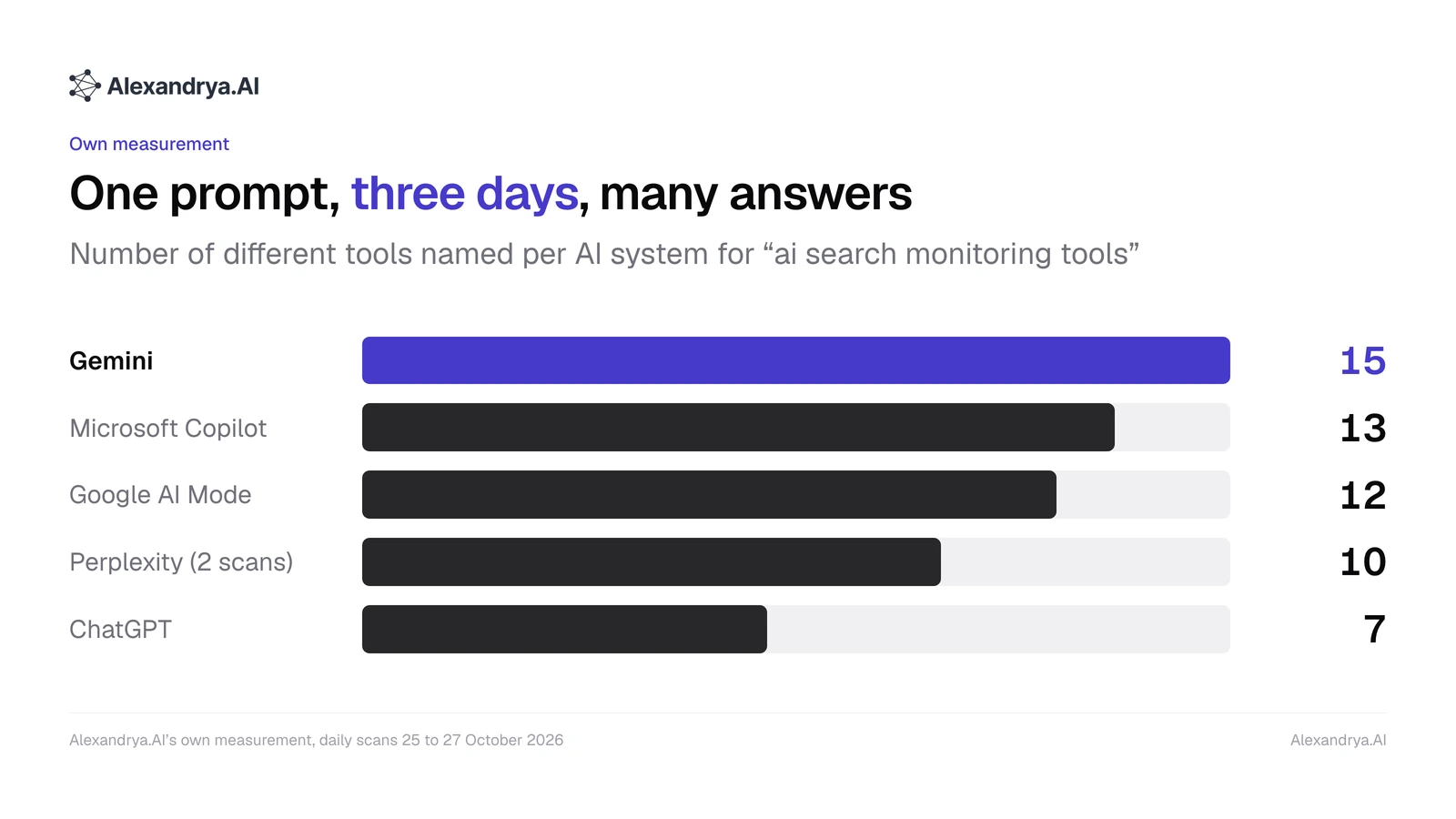
ChatGPT kept five of its seven tools on every day, while more than half of the tools in Gemini and Google AI Mode appeared on only one or two of the three days.
Weekly runs are enough for informational prompts that rarely name vendors and for brands that only follow quarterly trends. For the 10 to 20 prompts buyers ask shortly before a decision, daily remains the standard. Rankscale’s pricing page offers frequencies from hourly to monthly, while Alexandrya.AI runs daily on Starter to Business and daily or weekly on Enterprise.
Why must a monitoring tool report mentions and citations separately?
A monitoring tool has to report mentions and citations separately, because they occur independently and call for different work. A mention is the brand name in the answer text. A citation is one of the brand’s URLs in the source list. Across 42 answers in Alexandrya.AI’s own measurement (three prompts, 25 to 27 October 2026), Otterly.AI was mentioned 38 times, but otterly.ai was counted as a source in only seven answers.
SE Ranking had 20 mentions and ten answers listing seranking.com. Our own brand shows the same split: Alexandrya.AI’s own measurement (as of 27 October 2026, 43 tracked prompts) finds it mentioned for 10 prompts, cited for 11 and listed first in the sources for four, and the two groups of prompts do not match.
The split decides the work. Cited but not mentioned means the model uses your page as evidence without recommending you, so the work lies in comparisons and lists on other sites. Mentioned but not cited means you need your own page that answers the question directly enough to be linked.
Ask every vendor what counts as a citation: only the source list, links inside the answer text, or footnotes too. The figures here follow the citation definition of the Alexandrya.AI dashboard. Our guide to GEO metrics explains how citation rate and share of voice are calculated.
Does the tool show cited source URLs or only domains?
An AI monitoring tool should show every cited source as a full URL, because only the URL tells you which page is winning. For “ai search monitoring tools”, ChatGPT cited the same technologyadvice.com guide to AI search monitoring tools on all three days from 25 to 27 October 2026, at positions 1, 3 and 1. A domain count would have shown technologyadvice.com and nothing about the page you need to beat.
The URL also shows whether a guide, a product page or a pricing page is cited. ChatGPT listed that article twice in one answer, once with utm_source=chatgpt.com and once without, so check whether a tool merges such variants. Turning positions into an average per domain is covered in our source analysis by platform.
How to test data quality during the trial
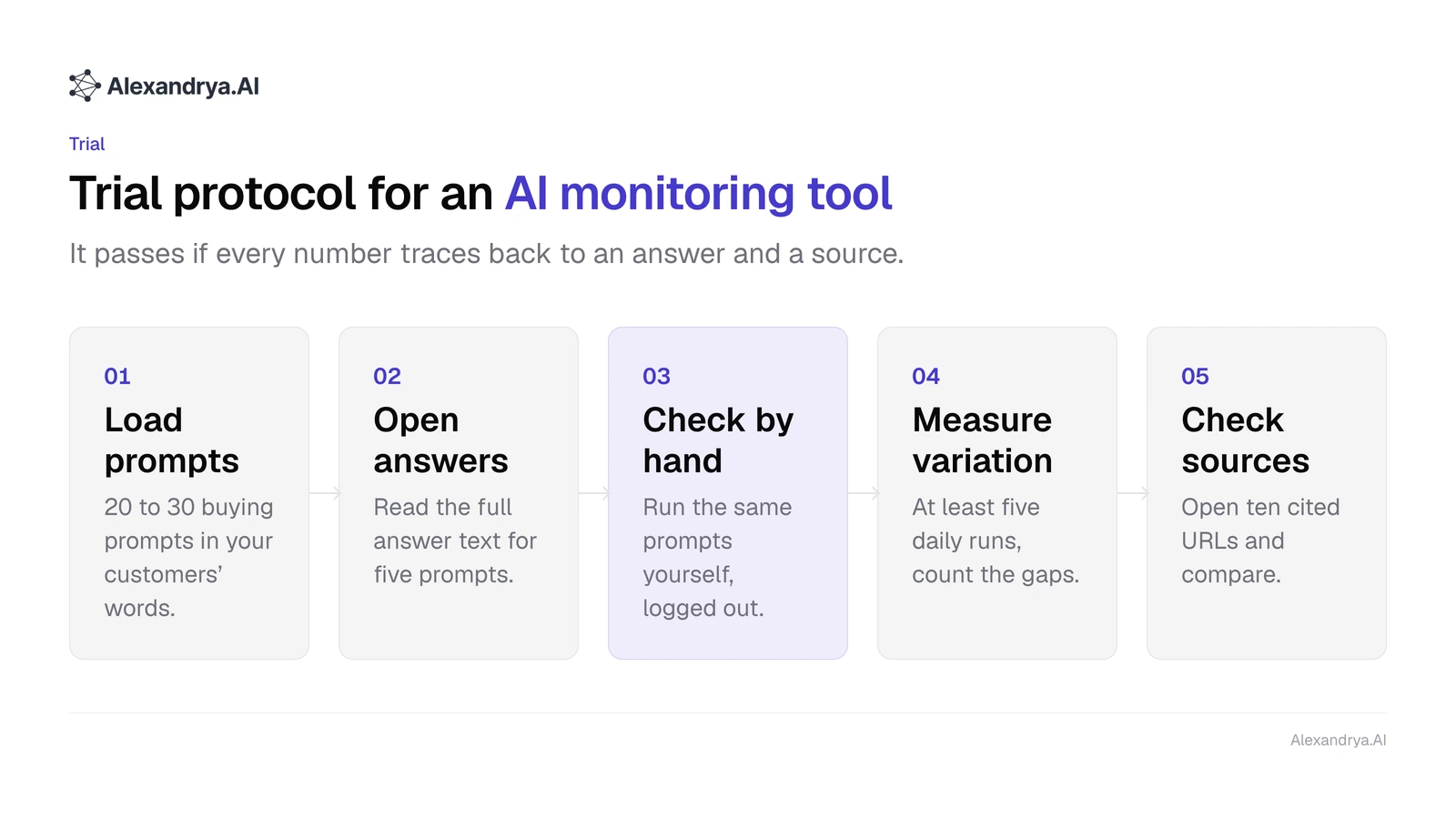
You test the data quality of an AI monitoring tool in five steps during the trial: load your own prompts, open the full answers, check five prompts by hand, watch the variation over at least five daily runs and open ten cited URLs. A tool passes if you can trace every number in the dashboard back to a single answer and a single source.
| Step | What you do | It passes if |
|---|---|---|
| 1. Load prompts | 20 to 30 buying and comparison prompts in your customers’ words, plus three to five competitors | Wording, country and language stay as entered |
| 2. Open answers | Read the stored answer per AI system for five prompts | Every mention in the dashboard appears in the answer text |
| 3. Check by hand | Run the same five prompts yourself that day in ChatGPT, Perplexity and Google, logged out | Most vendors the tool reports also appear in your sample |
| 4. Measure variation | Compare at least five daily runs and count answers delivered per day | History per prompt and system, missing answers flagged |
| 5. Check sources | Open ten cited URLs | Every page exists, and mentions and citations are reported separately |
Step 1 fails most often on wording. Asked the short German prompt “ki suchmaschinen monitoring”, Perplexity replied on 26 October 2026 by asking whether machine monitoring was meant. Such an answer counts as one without a mention and lowers your rate while saying nothing about your visibility. Write prompts the way buyers ask, with the buying intent in the sentence.
Do not expect identical wording when you check by hand: each answer is generated afresh, and login, history and location can change it. Look for patterns. If the tool reports four vendors and your query shows entirely different ones, ask which country, language and mode it uses. Our comparison with manual AI tracking sets out what this costs in time at scale.
Check what the trial includes. Alexandrya.AI offers seven days with all features and no credit card. SE Ranking offers 14 days but caps the trial at 20 AI prompts a day (SE Ranking pricing). Profound’s seven-day trial covers 50 prompts on ChatGPT, Gemini and Google AI Overviews, without API access, exports or, according to Profound’s pricing page, history. All figures are as of 9 November 2026. Plan to analyse your data before the trial ends.
Which questions should you ask a vendor before you buy?
Before you buy an AI monitoring tool, get written answers on how many platforms run at once, how countries and users are billed, what counts as a citation, whether full answers can be exported, what happens to missing answers and where the data is processed. Pricing pages rarely cover this in full, yet it decides your real cost and whether you can trust the numbers. The eight questions:
- How many platforms run at once on this plan, and what does each extra one cost?
- Does the same prompt in two countries count as one prompt or two?
- What does the tool count as a citation, and does it report mentions separately?
- Can I view and export every full answer with all source URLs?
- How long are answers and history kept, also after cancellation?
- If a platform returns nothing on a given day, is the query retried, and is the gap visible?
- How many users are included, and do extra seats cost more?
- Where are prompts and answers stored, and will you sign a data processing agreement (DPA) under the GDPR?
Where are the cost traps?
The cost traps in AI monitoring tools sit in four places the list price does not show: add-on models, credits, countries and users. The table gives one example per trap from vendor pricing pages, as of 9 November 2026.
| Cost trap | How to spot it | Example from the vendor’s page |
|---|---|---|
| Add-on models | The entry plan includes only some platforms, or only a few run at once | Otterly.AI Lite at €29: 2,000 credits for 20 prompts on three platforms, Claude counts three times, extra credits only from Standard (as of 12 November 2026). Peec AI Starter: choose three models, each extra one €30 a month, €25 on annual billing |
| Credits | Usage depends on engine, prompt and frequency | Rankscale Pro at €99: 1,200 credits, 0.25 credits per prompt on ChatGPT, Perplexity, Gemini and AI Mode, 2 credits on Claude |
| Countries | A second country uses up quota or requires a larger plan | Peec AI: no charge per country, pricing stays tied to prompts, one country on Starter, three on Pro and Advanced |
| Users | Seats are charged per head | SE Ranking Core at €109: one manager seat included, more from €14.40 |
Before comparing quotes, write down your target setup, say 30 prompts on five platforms in two countries for four users, and ask every vendor to price exactly that.
AI search monitoring tool checklist for buyers
An AI search monitoring tool checklist needs six weighted criteria and one filter: data quality in the trial (25%), separate mentions and citations (20%), source URLs, platforms on the plan and a path to action (15% each) and daily runs (10%). Price carries no weight and screens tools out before the trial. The weights are ours: data quality leads because every other number depends on it.
| Criterion | Test question | Minimum requirement | Weight |
|---|---|---|---|
| Data quality in the trial | Can I trace every number back to an answer? | Full answers, a plausible manual check, gaps flagged | 25% |
| Mentions and citations separate | Does the tool show both per prompt and system? | Two metrics, citation definition documented | 20% |
| Source URLs | Can I see the full URL and its position? | URL level with position in the source list | 15% |
| Platforms on the plan | Do the systems I need run at the same time? | ChatGPT, Gemini, Perplexity, Google AI Mode, Google AI Overviews | 15% |
| Path to action | Does a gap become a task? | Recommendations tied to a prompt and a source | 15% |
| Run frequency | How often do buying prompts run? | Daily | 10% |
| Price | Does your target setup fit the budget? | Filter before the trial | no weight |
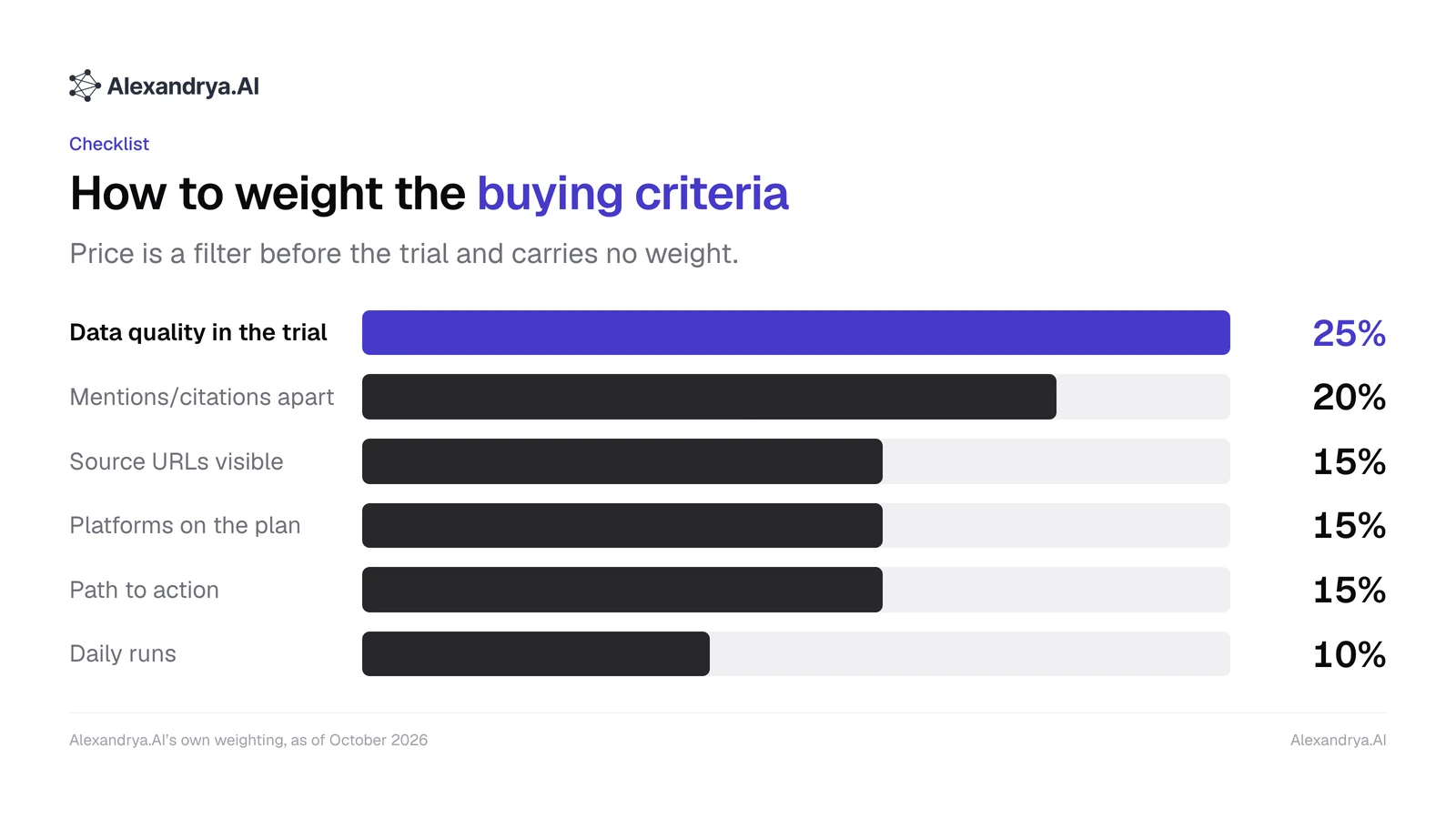
Give half the weight for a criterion met only in part. A tool that fails on data quality is out, whatever its total.
Where Alexandrya.AI meets the checklist, and where it doesn’t
Alexandrya.AI is an AI visibility tool from Munich that measures brand mentions in ChatGPT, Gemini, Perplexity and Bing Copilot and turns them into content and citation tasks. Against the checklist, every plan runs daily. You choose from ChatGPT, Gemini, Google AI Mode, Google AI Overviews, Perplexity, Microsoft Copilot and Claude, plus Meta AI and Grok, with three active at once on Starter and five on Professional and Business.
Mentions and citations appear separately as the GEO Brand Score and the GEO Link Score. Sources & Domains shows the citation mix by source type and the position in the source list. Every answer is stored, and from Professional your AI assistant reads it word for word through MCP. An action plan with content briefs, outreach targets and quick wins becomes tasks marked Open, In Progress and Done.
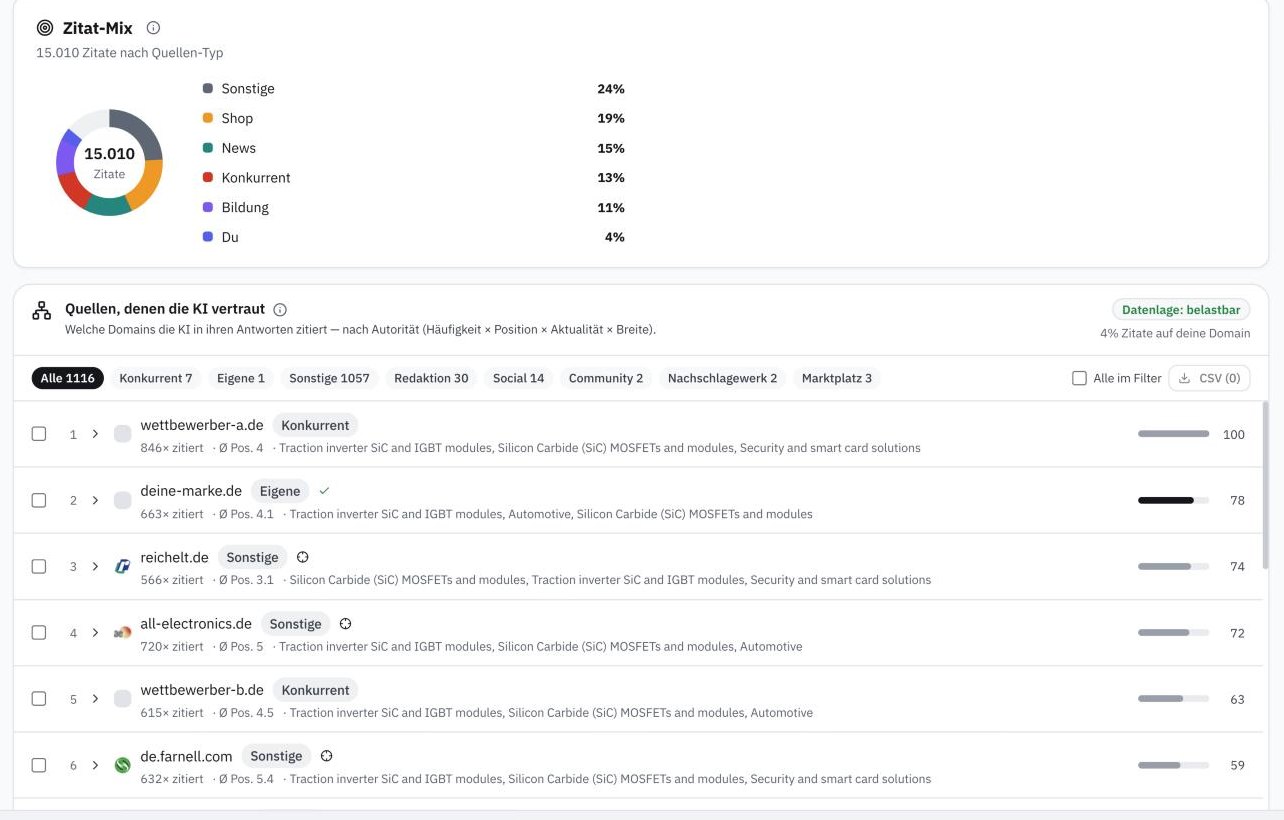
Alexandrya.AI does not cover ChatGPT Shopping or SKU tracking, crawler logs, prompt search volume, alerts or a Slack connection, and API access is limited to Enterprise. Alexandrya.AI is hosted in Germany, processing is GDPR-compliant, and a DPA is available on request. Plans cost €79, €199 and €399 a month for 50, 150 and 350 prompts, with full details on the Alexandrya.AI pricing page.
Frequently asked questions
How much does an AI search monitoring tool cost?
According to vendor pricing pages on 12 November 2026, entry plans for AI search monitoring include Otterly.AI Lite at €29 a month for 2,000 credits, or 20 prompts on three platforms, Alexandrya.AI Starter at €79 for 50 prompts and SE Ranking Core at €109, which adds 25 daily tracked AI prompts to its SEO features. Plans only become comparable once you add platforms, countries and users.
How long should you trial an AI visibility monitor?
Allow for at least five daily runs on the same prompts to see how much the answers vary. A seven-day trial is enough if you load your prompts on day one. Alexandrya.AI and Profound offer seven days. SE Ranking offers 14 days but, according to its pricing page, limits the trial to 20 AI prompts a day.
Can you monitor AI search manually?
Manual checks work for spot samples but hardly for ongoing measurement. Twenty prompts across five AI systems produce 100 answers a day that someone has to pull, read and score for mentions and sources. Running prompts by hand still has a place, as a cross-check on the numbers an AI search monitoring tool reports.
What is GEO monitoring?
GEO monitoring tracks, through fixed prompts on a fixed schedule, how often a brand is mentioned and cited as a source in answers from ChatGPT, Gemini, Perplexity and the AI features in Google Search. GEO stands for generative engine optimisation, the work of improving that visibility. Monitoring supplies the baseline and shows whether the work is paying off.
How is AI search monitoring different from rank tracking?
A rank tracker measures positions in the classic results list, while an AI monitoring tool reads generated answers and counts mentions, citations and competitors in them. Several SEO suites now sell this as an extra, SE Ranking for example with 25 daily tracked prompts on its Core plan. Alexandrya.AI specialises in AI answers and turns them into tasks.
Free GEO audit with your own trial protocol
Load your 20 to 30 buying-intent prompts into Alexandrya.AI during the free trial and work through the protocol over seven days: read the full answers, check samples by hand, open the source URLs. No credit card needed. Start your free GEO audit
Frequently asked questions
How much does an AI search monitoring tool cost?
According to vendor pricing pages on 12 November 2026, entry plans for AI search monitoring include Otterly.AI Lite at €29 a month for 2,000 credits, or 20 prompts on three platforms, Alexandrya.AI Starter at €79 for 50 prompts and SE Ranking Core at €109, which adds 25 daily tracked AI prompts to its SEO features. Plans only become comparable once you add platforms, countries and users.
How long should you trial an AI visibility monitor?
Allow for at least five daily runs on the same prompts to see how much the answers vary. A seven-day trial is enough if you load your prompts on day one. Alexandrya.AI and Profound offer seven days. SE Ranking offers 14 days but, according to its pricing page, limits the trial to 20 AI prompts a day.
Can you monitor AI search manually?
Manual checks work for spot samples but hardly for ongoing measurement. Twenty prompts across five AI systems produce 100 answers a day that someone has to pull, read and score for mentions and sources. Running prompts by hand still has a place, as a cross-check on the numbers an AI search monitoring tool reports.
What is GEO monitoring?
GEO monitoring tracks, through fixed prompts on a fixed schedule, how often a brand is mentioned and cited as a source in answers from ChatGPT, Gemini, Perplexity and the AI features in Google Search. GEO stands for generative engine optimisation, the work of improving that visibility. Monitoring supplies the baseline and shows whether the work is paying off.
How is AI search monitoring different from rank tracking?
A rank tracker measures positions in the classic results list, while an AI monitoring tool reads generated answers and counts mentions, citations and competitors in them. Several SEO suites now sell this as an extra, SE Ranking for example with 25 daily tracked prompts on its Core plan. Alexandrya.AI specialises in AI answers and turns them into tasks.
How visible is your brand in AI?
Try Alexandrya.AI free for 7 days and see how ChatGPT, Gemini, Perplexity, AI Overviews and Copilot talk about your brand.
- 7 days free
- No credit card required
- All features included
- Cancel anytime
About the author
Talaal Max Habib
Managing Director at Alexandrya.AI
Talaal Max Habib has advised companies in industry, the Mittelstand and e-commerce on SEO and Generative Engine Optimization since 2015. With his team he built Alexandrya.AI, the Munich-based platform that measures how brands appear in ChatGPT, Perplexity and Gemini.
LinkedIn