What to do when AI answers portray your brand negatively
Negative brand mentions in AI answers come from sources: narrow down prompts and platforms, check what is cited, then publish a dated passage with proof.

Managing Director at Alexandrya.AI
Negative brand mentions in AI answers are fixed at the source, because ChatGPT, Perplexity, Gemini and Microsoft Copilot give brands no way to delete or rewrite what they say. Three steps work: narrow down which prompts and platforms produce the negative statement, check the sources those answers cite, and publish a dated passage on your own site that answers the disputed question with evidence.
Alexandrya.AI tracks the German version of this question, “marke wird in mehreren ki-plattformen negativ bewertet was tun”, every day in five AI systems. In the scan on 27 October 2026, none of the five answers mentioned Alexandrya.AI. Perplexity and Microsoft Copilot both ranked the same geneo.app guide first in their source lists. ChatGPT linked to OpenAI’s help centre, a Semrush guide, a summary of a German Federal Court of Justice ruling and a chamber of commerce page on disparaging competitors (Alexandrya.AI’s own measurement, as of 27 October 2026, 43 tracked prompts). The top spots went to guides with the topic in their title, plus legal sources in ChatGPT.
What to do when several AI platforms rate your brand negatively
When several AI platforms rate a brand negatively, three immediate steps help, in a fixed order. First, narrow down which prompts and which systems produce the negative statement. Second, check the sources that ChatGPT, Perplexity, Gemini or Microsoft Copilot link to in their answers. Third, publish a dated passage on your own website that answers the disputed question with evidence. Until that passage exists, no source on the web contradicts the criticism.
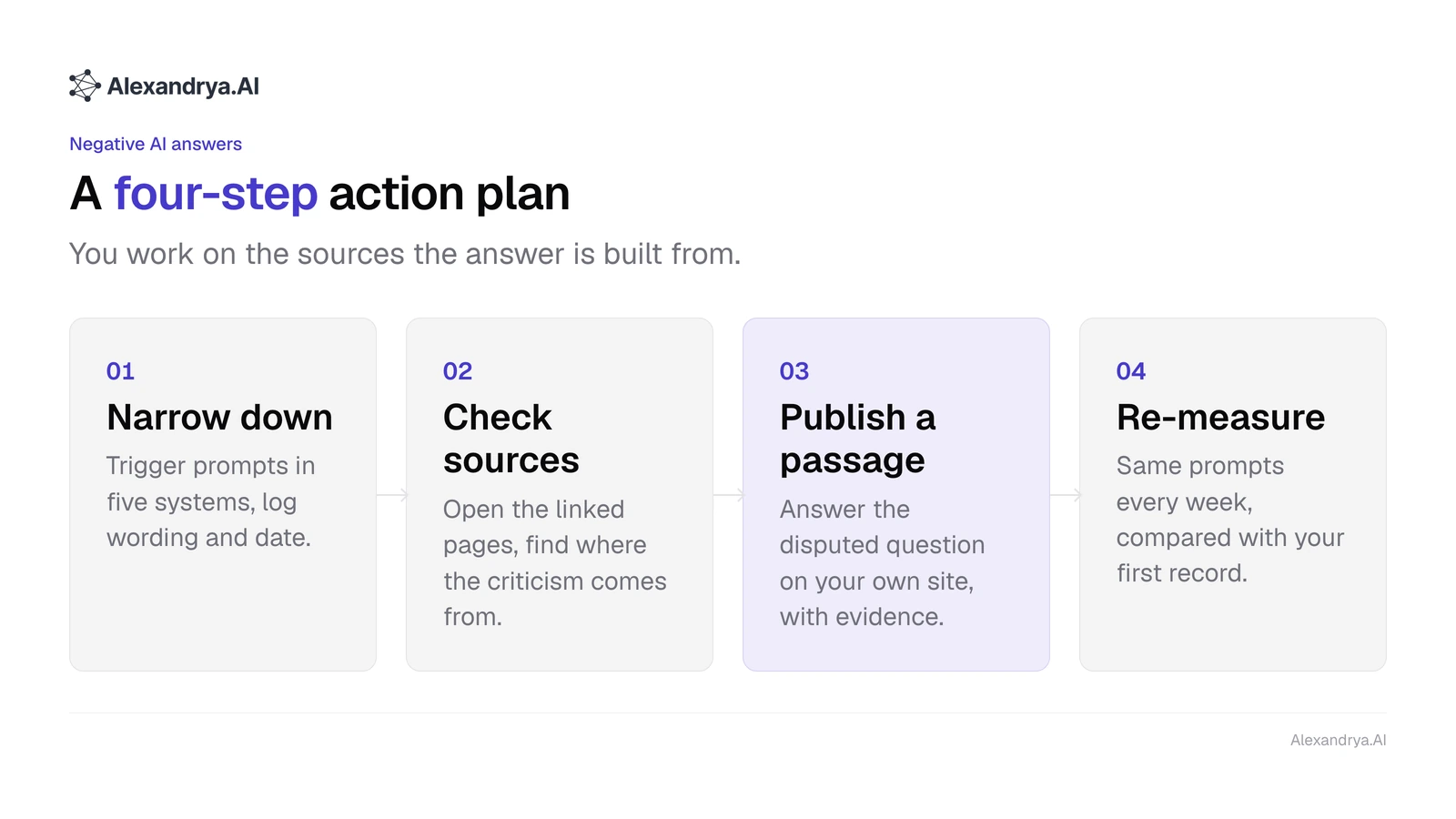
A four-step action plan for negative AI answers. Alexandrya.AI’s own framework, October 2026.
- Narrow down prompts and platforms. Run trigger prompts such as “[brand] reviews” in ChatGPT, Perplexity, Gemini, Google AI Mode and Microsoft Copilot, each in a fresh chat, and log the wording, the date and every linked source.
- Check the sources. Open every linked page and find the passage the negative statement comes from. Note its age, its type and whether the statement is true.
- Publish your own passage. Answer the disputed question on your website in a single paragraph with a date, a figure and evidence, for example in your product FAQ.
Then re-measure the same prompts against your record from step 1.
Where negative brand mentions in AI answers come from
To fix a negative portrayal in AI answers, first identify the sources that ChatGPT, Perplexity or Microsoft Copilot draw the picture from. Perplexity and Copilot usually show their sources right next to the answer, and so does ChatGPT whenever it has searched the web. Typical triggers are outdated reviews, single forum threads, old comparison articles and confusion with companies of the same name. If a statement appears in none of the linked sources, report it through the platform’s feedback function.
The countermeasure depends on the source type; which domains each system prefers is in our per-platform AI source analysis.
| Source type | How you recognise it | First countermeasure |
|---|---|---|
| Review site such as Google, Trustpilot or G2 | star ratings or recurring complaints are quoted | fix the cause, reply publicly, report only policy violations |
| Forum or community such as Reddit | one person’s experience is presented as typical | reply openly as the company, document the fix |
| Old test report or comparison article | outdated prices, discontinued products, fixed flaws | ask the editor for an update, with evidence |
| Press article | coverage of an incident, recall or legal dispute | publish a dated statement with the current status |
| Your own outdated page | old prices or terms on your domain | update or redirect the page |
| No matching source | the statement is on none of the linked pages | report it, publish a passage on the question |
Almost every row ends with a measure you can take yourself. The exception is fair criticism: if the complaint is true, source work will not change the picture for good, and the job sits with the product or service. Your passage then describes the fixed state, with a date. Google’s Business Profile Help puts it plainly: “Do not report a review just because you disagree with it or dislike it” (accessed 27 October 2026).
How to spot negative sentiment in AI answers early
You spot negative sentiment in AI answers early with trigger prompts that ask for criticism directly, run on a fixed schedule. Typical trigger prompts are “[brand] reviews”, “[brand] downsides”, “is [brand] legit?” and “alternatives to [brand]”. One warning sign is the same negative statement in two or more AI systems, because a shared source becomes likely. Another is a domain that keeps appearing in the source lists across several trigger prompts.
Log each statement’s aspect, such as price, service or reliability, with its polarity and source. One answer can be an outlier, since answers vary between runs, but a negative statement in a buying prompt like “alternatives to [brand]” is worth tracing at first sight.
Alexandrya.AI is an AI visibility tool from Munich that measures brand mentions in ChatGPT, Gemini, Perplexity and Bing Copilot and turns them into content and citation tasks. Brand Perception shows categories with sentiment, strengths, gaps and evidence quotes and saves each evaluation as a snapshot. Sources & Domains shows the citation mix by source type and the position in the source list. The Action Plan turns findings into content briefs, outreach targets and quick wins, worked through as tasks marked Open, In Progress or Done. There are no alerts and no Slack integration, so a new negative statement shows up in the dashboard and the next snapshot. See the product page for details.
Strategies against negative reviews of your brand on AI platforms
Four strategies help against negative reviews of a brand on AI platforms: your own answer passage on your website, consistent entity facts, active work on review sites and forums, and new third-party sources that support your side. Your own passage works fastest, because you can publish it today. New third-party sources, known as earned citations, take the longest, but they change the source base that every platform draws from.
Publish your own answer passage
An answer passage is a paragraph on your website that answers the disputed question in its first sentence and contains a date, a figure and evidence. If the criticism is “too expensive”, the passage states the price, what is included and the basis of comparison. If it is about an outage, it gives the period, the cause and the fixed state. Claims like “highest quality” give a language model nothing to check. Our GEO content framework shows how to build paragraphs like this.
Align your entity facts
If the negative picture rests on wrong facts, such as an old price or a discontinued product, align the details across your website, profiles and directories. The five-step correction process, including the rules for Wikipedia and the Knowledge Panel, is covered in our guide to brand monitoring in AI answers. Aligning facts does not help against judgements like “inflexible”, which no directory can correct.
Work on review sites and forums
Review sites and forums appear in AI source lists: in Alexandrya.AI’s own measurement, reddit.com had 486 citations and g2.com had 87 (as of 27 October 2026, 43 tracked prompts). Reply to criticism publicly and specifically, fix the cause, and ask customers for a review once their case is solved. Reporting only pays off for policy violations. According to its Business Profile Help, Google only removes reviews that violate its policies, review evaluation typically takes several days, and you can appeal a rejection once. Buying reviews is no shortcut: the US Federal Trade Commission announced a final rule banning fake reviews on 14 August 2024.
Build earned citations
Earned citations are mentions on other people’s pages that an AI system picks up as a source: trade articles, studies with original data, customer stories, interviews and videos. youtube.com was the second most cited domain in our own measurement, with 1,785 citations (as of 27 October 2026). This lever is the slowest, but it shifts the source base for every platform at once. It pays off most when the criticism rests on a few sources and nobody independent supports your side yet.
Measures by effort and impact
The table is Alexandrya.AI’s own assessment, October 2026.
| Measure | Effort | Impact | When to use it |
|---|---|---|---|
| Publish your own answer passage | low, hours to days | high, once the page is crawled | always first |
| Align entity facts | low to medium | medium to high | wrong or conflicting facts |
| Reply to reviews and forum posts | low, ongoing | medium | review sites or forums are cited |
| Get an outdated third-party source corrected | medium | high, if the source is cited often | old reviews and comparisons |
| Build earned citations | high, over months | high, across all platforms | independent evidence is missing |
| Send feedback to the platform | very low | low, no commitment | statements without a source |
| Legal action | high | limited to the specific statement | false statements of fact, after legal review |
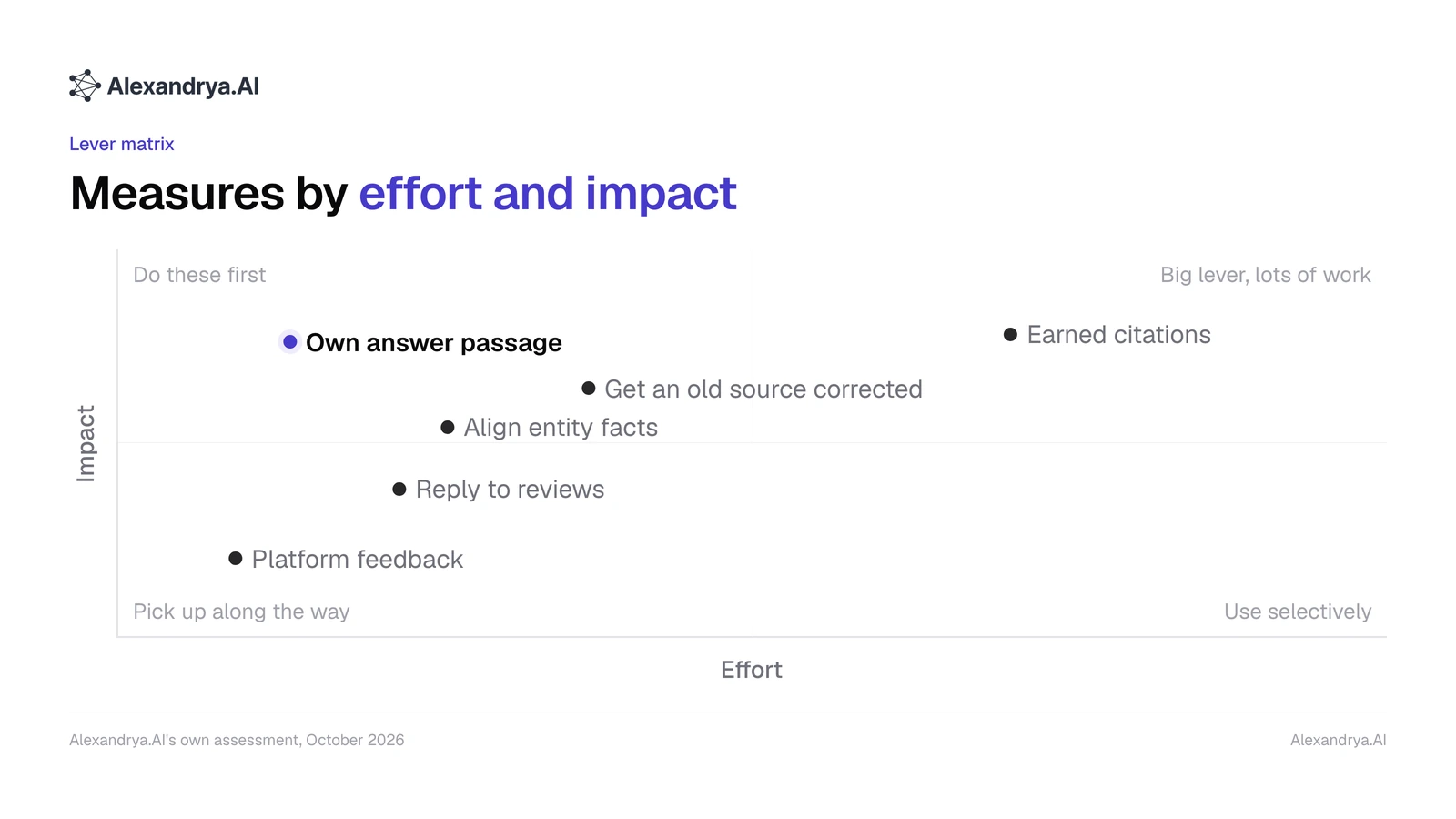
Your own answer passage offers the best ratio of effort to impact; earned citations are the biggest but slowest lever. Alexandrya.AI’s own assessment, October 2026.
The last two rows stand out: platform feedback and legal action against the operator target the answer, while the source behind it stays unchanged, so both only affect that one statement.
How this differs from classic online reputation management
Reputation work for AI answers has to reach the passages that get cited, because pushing a negative page down in Google does not remove it from the source pool. AI assistants cite many pages outside Google’s top 10: in an Ahrefs analysis of 15,000 prompts from August 2025, only 12% of cited links on average ranked in Google’s top 10 for the same prompt. Classic online reputation management, which pushes negative results off page one, only partly reaches those sources.
| Aspect | Classic online reputation management | Reputation work for AI answers |
|---|---|---|
| Goal | the first results page for the brand name | passages AI systems cite for trigger prompts |
| Metric | share of positive results in the top ten | statement, sentiment and source per prompt and platform |
| Typical lever | push your own pages and profiles up | correct the source, answer passage, new third-party sources |
| Limit | results on page two can still be found | model knowledge only changes with a new model |
In the Ahrefs data, around 80% of cited links did not rank at all for the original query. Google itself describes a “query fan-out” technique for AI Overviews and AI Mode that runs several related searches (Google Search Central, accessed 27 October 2026). Ahrefs sells an AI visibility tool of its own, Brand Radar.
How long until corrections reach AI answers?
How fast a correction reaches AI answers depends on whether the system searches the web live or answers from model knowledge. Answers with web search can pick up a corrected source once it has been recrawled, and Google puts recrawling at a few days to a few weeks. Answers from model knowledge only change with a new model, because, as OpenAI explains, models only know data up to their knowledge cutoff.
| Correction route | Affects | Documented timeframe | Source |
|---|---|---|---|
| Have a changed page recrawled | Google AI Overviews, AI Mode | a few days to a few weeks | Google Search Central |
| Lift a robots.txt block on OAI-SearchBot | ChatGPT search | around 24 hours | OpenAI crawler overview |
| Report a review on Google | Google Business Profile | evaluation typically takes several days | Google Business Profile Help |
| Model knowledge without web search | answers without search | none given, only with a new model | OpenAI Help Center |
| Get a third-party source corrected | every platform that cites it | none given, depends on the editor | none |
All sources accessed 27 October 2026. No platform says how long a corrected source takes to show up. Timeframes like “4 to 12 weeks” circulate in guides, but we found them in no vendor documentation. OpenAI says web search is on by default for all ChatGPT models, so a corrected source has a route into the answer. Measure the effect yourself, repeating the same prompts at least weekly.
Can you get an AI answer corrected?
You cannot have an AI answer deleted or rewritten, but you can report it. ChatGPT, Google AI Overviews, Gemini, Perplexity and Microsoft Copilot all offer a feedback or report function with every answer. None of them promises in its help pages to correct a reported statement. OpenAI says reported domains may be reviewed and filtered so that ChatGPT avoids unreliable sources in future responses. Reporting is therefore an add-on to working on the sources.
| Platform | Route according to its help page | What the help page commits to |
|---|---|---|
| ChatGPT | thumbs down and select “Safety or Legal concern”, or OpenAI’s content reporting form | reported domains may be reviewed and filtered |
| Google AI Overviews | thumbs down and “Report a problem”, or the three-dot menu | feedback includes your most recent query, no commitment to correct |
| Gemini | thumbs down with feedback | no commitment to correct |
| Perplexity | flag icon below the answer, or a support ticket from your account settings | asks for the query link, the error and the expected result |
| Microsoft Copilot | flag icon below each response, or long-press and “Report” in the app | no commitment to correct |
Sources: OpenAI Help Center, Google Search Help, Gemini Apps Help, Perplexity Help Center and Microsoft Copilot, all last checked 9 November 2026. Perplexity asks for the query link, the error and the expected result, which is a good template for any report.
False statements of fact can also be challenged in court. On 28 May 2026, the Regional Court of Munich I barred Google in summary proceedings from repeating specific false statements about two publishing companies in an AI overview. The court treated the overview as Google’s own content (case 26 O 869/26). The appeal ended in a settlement. On 24 September 2026, the Regional Court of Aachen ordered Google in summary proceedings to stop attributing, in AI Mode, allegations to a senior hospital doctor that concerned a different doctor at the same clinic. Google had ignored both the removal request and a lawyer’s cease-and-desist letter, and the court held it liable as the party responsible for the interference (case 8 O 268/26, accessed 9 November 2026). Whether legal action works in your case is a question for a lawyer; this article is not legal advice.
Frequently asked questions
Can I get negative reviews removed so AI stops picking them up?
Only reviews that break the platform’s rules can be removed. Google’s Business Profile Help says only reviews that violate its policies are eligible for removal and asks owners not to report a review just because they disagree with it. Review evaluation typically takes several days. For fair criticism, a factual public reply is what every reader will see.
Is it legal to buy positive reviews to balance out AI answers?
Buying fake reviews is banned in the US and in Germany. The Federal Trade Commission announced a final rule on 14 August 2024 that bans fake reviews, including AI-generated ones. Germany’s Act against Unfair Competition lists submitting or commissioning fake consumer reviews as prohibited. Asking satisfied customers for honest reviews remains fine, and a lawyer can check individual cases.
What if ChatGPT confuses my brand with another company?
You fix brand confusion with unambiguous entity facts. Company name, legal form, location, category and domain should read the same on your website, LinkedIn and business directories, backed by Organization schema with sameAs links to your profiles. Then test with a prompt that names your brand together with its city or category and check which company the answers describe.
How much does it cost to monitor negative AI answers?
Doing it by hand mostly costs time: ten trigger prompts across five AI systems give you 50 answers per run to read and log with their sources. Alexandrya.AI runs 50 prompts daily on its Starter plan for €79 a month, with a seven-day free trial and no credit card. Brand Perception adds sentiment and evidence quotes by category.
Should I reply to criticism on Reddit myself?
Reply on forums if you identify yourself openly as the company and stick to facts. Forums are among the cited sources: reddit.com had 486 citations in Alexandrya.AI’s own measurement (as of 27 October 2026, 43 tracked prompts). Posing as a customer is off the table, and the FTC rule also targets undisclosed reviews from company insiders.
Free GEO audit for your brand image
During the free seven-day trial, Alexandrya.AI runs your own prompts, including trigger prompts about reviews or alternatives, with no credit card. You see what ChatGPT, Perplexity and Gemini say about your brand, with sentiment, evidence quotes and the domains they cite. See the pricing page for plans. Check your brand image for free
Frequently asked questions
Can I get negative reviews removed so AI stops picking them up?
Only reviews that break the platform’s rules can be removed. Google’s Business Profile Help says only reviews that violate its policies are eligible for removal and asks owners not to report a review just because they disagree with it. Review evaluation typically takes several days. For fair criticism, a factual public reply is what every reader will see.
Is it legal to buy positive reviews to balance out AI answers?
Buying fake reviews is banned in the US and in Germany. The Federal Trade Commission announced a final rule on 14 August 2024 that bans fake reviews, including AI-generated ones. Germany’s Act against Unfair Competition lists submitting or commissioning fake consumer reviews as prohibited. Asking satisfied customers for honest reviews remains fine, and a lawyer can check individual cases.
What if ChatGPT confuses my brand with another company?
You fix brand confusion with unambiguous entity facts. Company name, legal form, location, category and domain should read the same on your website, LinkedIn and business directories, backed by Organization schema with sameAs links to your profiles. Then test with a prompt that names your brand together with its city or category and check which company the answers describe.
How much does it cost to monitor negative AI answers?
Doing it by hand mostly costs time: ten trigger prompts across five AI systems give you 50 answers per run to read and log with their sources. Alexandrya.AI runs 50 prompts daily on its Starter plan for €79 a month, with a seven-day free trial and no credit card. Brand Perception adds sentiment and evidence quotes by category.
Should I reply to criticism on Reddit myself?
Reply on forums if you identify yourself openly as the company and stick to facts. Forums are among the cited sources: reddit.com had 486 citations in Alexandrya.AI’s own measurement (as of 27 October 2026, 43 tracked prompts). Posing as a customer is off the table, and the FTC rule also targets undisclosed reviews from company insiders.
How visible is your brand in AI?
Try Alexandrya.AI free for 7 days and see how ChatGPT, Gemini, Perplexity, AI Overviews and Copilot talk about your brand.
- 7 days free
- No credit card required
- All features included
- Cancel anytime
About the author
Talaal Max Habib
Managing Director at Alexandrya.AI
Talaal Max Habib has advised companies in industry, the Mittelstand and e-commerce on SEO and Generative Engine Optimization since 2015. With his team he built Alexandrya.AI, the Munich-based platform that measures how brands appear in ChatGPT, Perplexity and Gemini.
LinkedIn