What a ChatGPT tracking tool has to measure in 2026
A ChatGPT tracking tool should scan daily, count mentions and citations separately and show source positions, backed by 30 days of our own data.

Managing Director at Alexandrya.AI
A good ChatGPT tracking tool runs a fixed list of prompts in ChatGPT at least once a day, counts brand mentions in the answer text and links in the source list separately, shows where each source sits and stores the full answer. Next come competitors within the same answer, a selectable country and the other AI platforms. Sentiment, exports and an API are extras.
One prompt from our own tracking shows how much ChatGPT can move. On 26 October 2026, ChatGPT answered “chatgpt tracking tool” with a follow-up question and three privacy results. The next day, the same prompt produced three visibility tools: Searchable, Otterly.AI and Rankscale. Alexandrya.AI appeared on neither day. Alexandrya.AI is our own product, and every figure here comes from the project in which we track our own brand.
What makes a good ChatGPT tracking tool
A ChatGPT tracking tool is software that sends a fixed set of prompts to ChatGPT on a schedule and records whether and how your brand appears in the answers. The output is only useful if the tool counts brand mentions and source links separately, shows where each source sits in the source list and stores the full answer text. Without the text, you cannot tell whether ChatGPT listed any vendors at all or simply asked a follow-up question.
The table ranks eight functions by what they give you. “Must have” means the data cannot be trusted without it. The third column tells you how to check it yourself during the trial.
| Function | What you get | How to check it during the trial | Priority |
|---|---|---|---|
| Daily runs of a fixed prompt list | Trends rather than lucky hits | Compare the same prompt on two consecutive days | Must have |
| Mentions and citations counted separately | Whether ChatGPT recommends you or only uses you as evidence | Read both values for a single answer | Must have |
| Source list with positions | Which pages carry the answer | Check that in-text citations are kept apart from plain list entries | Must have |
| Full answer text | Follow-up questions, misreadings and tone become visible | Open one answer in full and compare it with the score | Must have |
| Competitors per answer | Who is named instead of you, and in which position | Add your competitors and check an answer that lists vendors | Important |
| Selectable country and language | Answers for your target market | Set the project country and the prompt language | Important |
| Other platforms besides ChatGPT | Comparison with Perplexity, Gemini, Google AI Mode and Copilot | View the same prompt side by side across platforms | Important |
| Sentiment, export, API or MCP | Tone and reuse of the data in your own systems | Check access and export options in the plan you want | Nice to have |
All four must-haves depend on the same raw material: the stored answer together with its source list. A tool that only reports a visibility score cannot deliver any of them in a form you can verify.
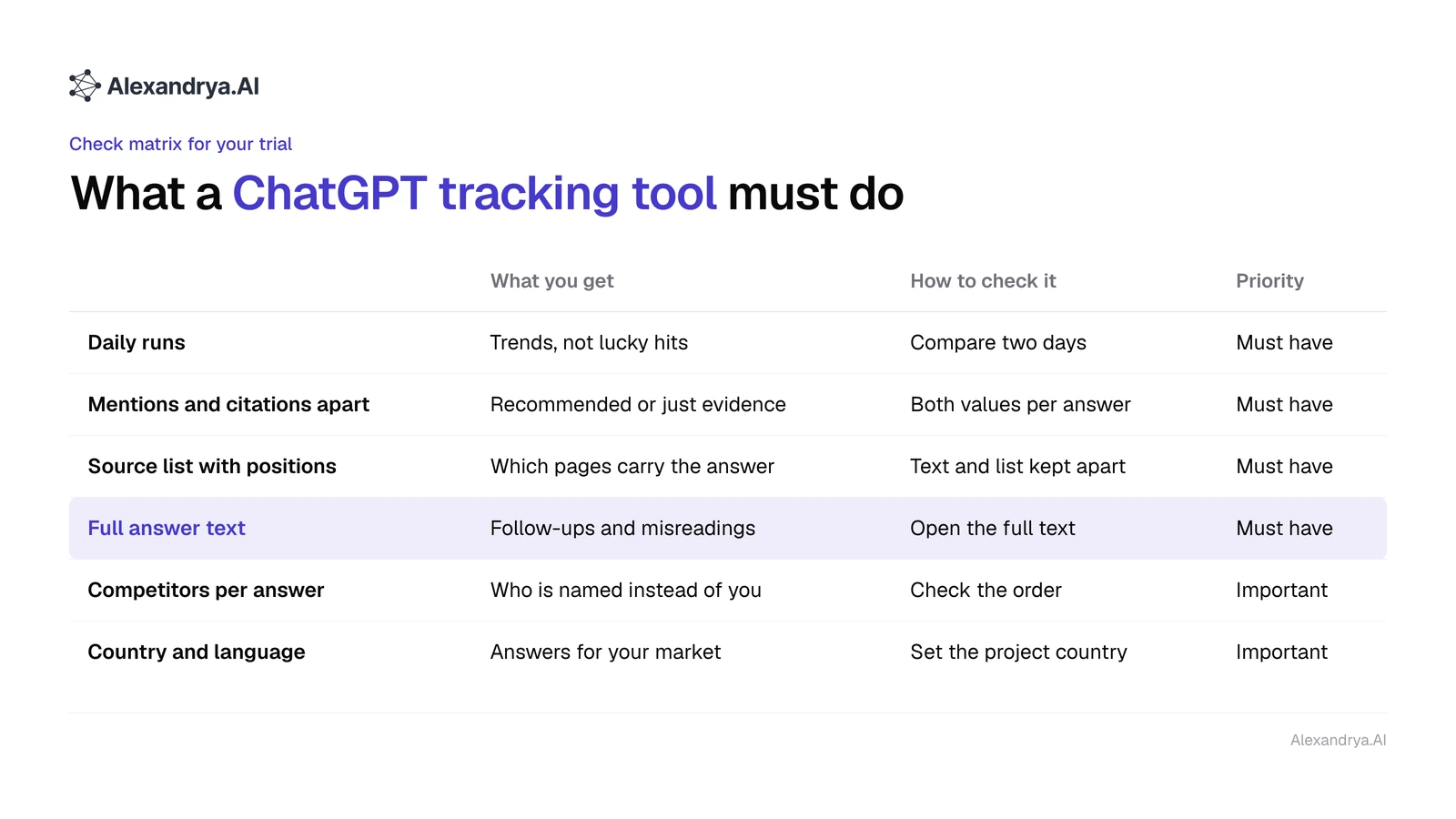
Check matrix for a ChatGPT tracking tool, Alexandrya.AI’s own assessment, October 2026.
ChatGPT answers with or without web search, depending on location, memory and model
ChatGPT does not always reach an answer the same way. According to OpenAI, ChatGPT searches the web on its own when a question benefits from current information, rewrites the question into one or more search queries and uses an approximate location based on the IP address. With memory switched on, saved memories can shape those queries. A ChatGPT tracking tool therefore has to fix and disclose the country, language and context of every run.
These points come from the OpenAI Help Center article Searching the web with ChatGPT (accessed 27 October 2026). It also says search answers may include citations, while the Sources button shows further links: two separate lists for a tracker. Memory can draw on past chats, saved memories, custom instructions, files and connected apps, depending on the plan (Memory in ChatGPT). A tracker running inside a personal account measures that history too.
Models change as well. OpenAI’s model release notes list more than a dozen entries on new, updated or retired ChatGPT models between January and October 2026. GPT-5.6 Sol has been limited to paid plans since 9 July 2026, and GPT-5.5 left ChatGPT on 14 October 2026. On 29 October 2026, an update set out to make GPT-6 answers in ChatGPT more concise for Free and Go users.
The answer language is not fixed either. In our German-market project, ChatGPT answered the English prompt “llm visibility tool” in German on 26 October 2026 and in English on 27 October.
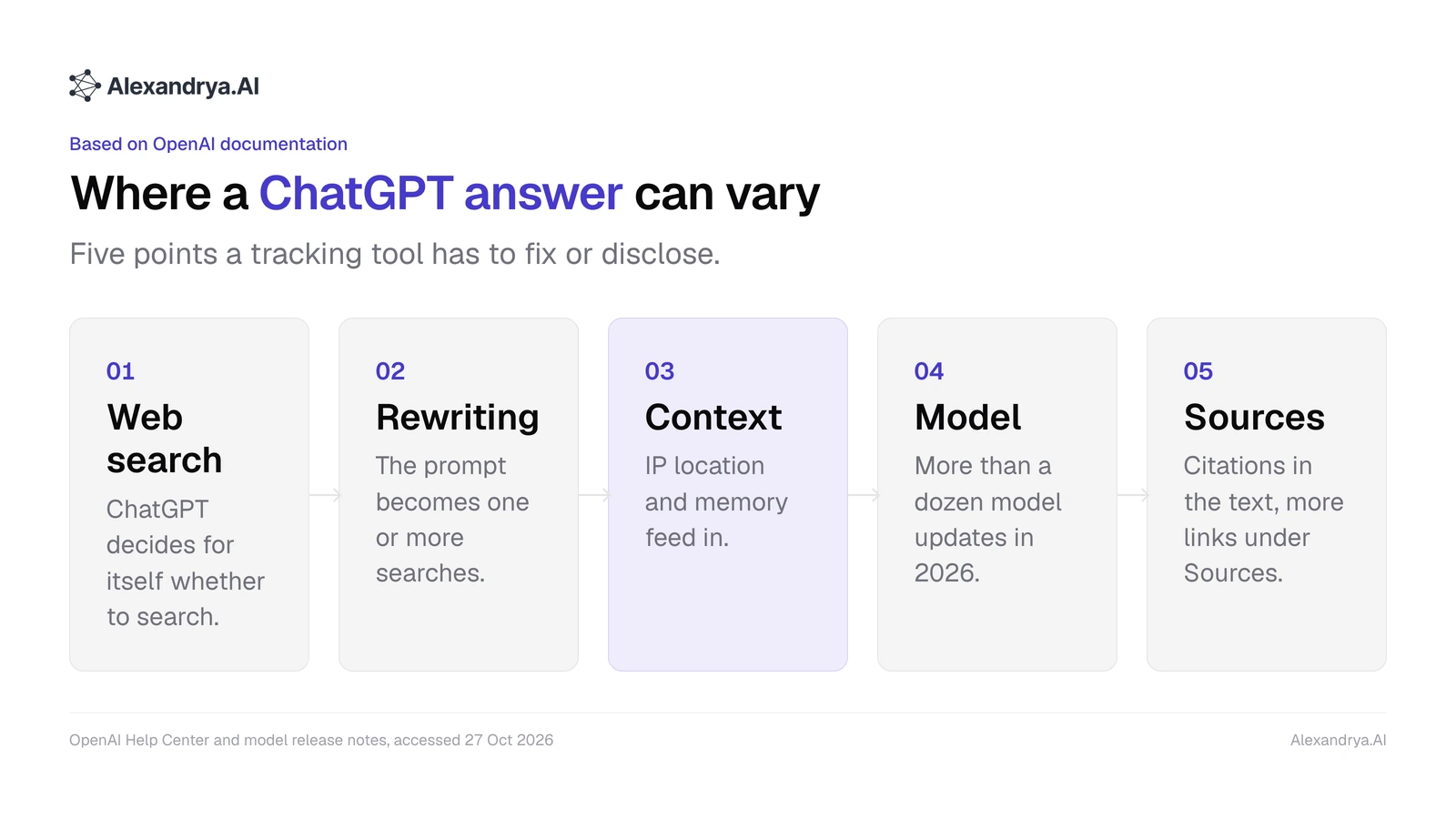
Where a ChatGPT answer can vary, based on the OpenAI Help Center and model release notes, accessed 27 October 2026.
Four questions are worth putting to any vendor before you buy:
- Which country and language do the runs use?
- Do the runs happen without memory or earlier chats?
- Does the tool record whether an answer had sources, and which were cited in the text?
- Can you read every answer in full, with its date?
How often should a ChatGPT tracking tool scan?
A ChatGPT tracking tool should run every prompt at least once a day. Daily data gives more reliable trends than a weekly sample, because model updates, live search and changing sources alter answers from one day to the next. In Alexandrya.AI’s own measurement, the brand appeared in ChatGPT on 6 of 30 days. A weekly check on a fixed weekday would have caught one of those days at most.
The data covers 1,119 ChatGPT answers to 38 to 43 prompts tracked daily between 28 September and 27 October 2026 (Alexandrya.AI’s own measurement, recalculated from the dashboard’s daily values per model). ChatGPT named Alexandrya.AI on 7, 25, 26 and 27 October and linked to it on 8, 16, 25, 26 and 27 October. Those six days fall on six different weekdays. If you only checked on Mondays, you would have seen exactly one of them: 26 October.
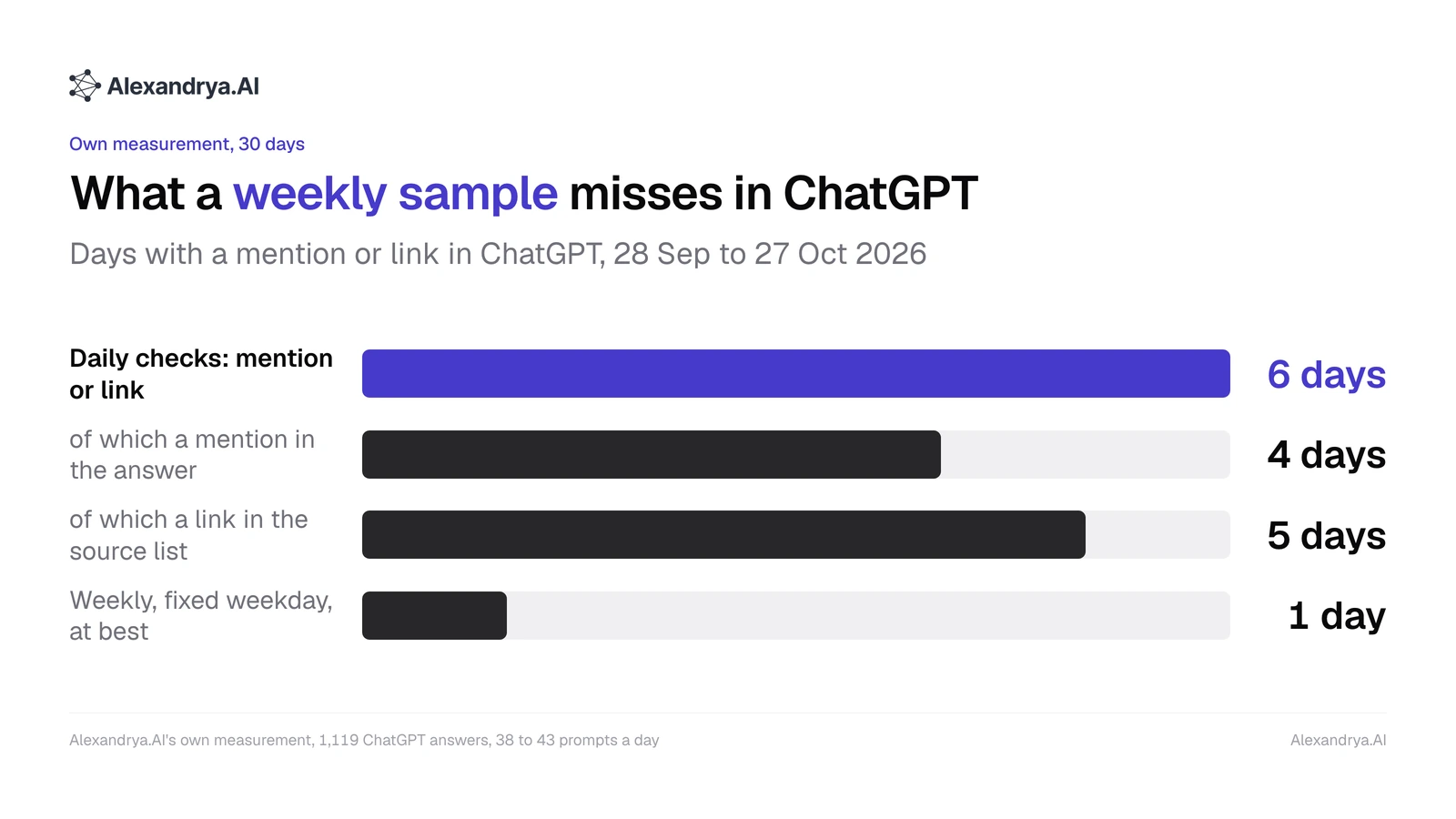
Days with a mention or link in ChatGPT, daily versus weekly checks. Alexandrya.AI’s own measurement, 28 September to 27 October 2026.
Daily tracking uses up quota. Fifty prompts run daily in ChatGPT add up to about 1,500 answers a month, against just over 200 when run weekly. On Alexandrya.AI’s Starter plan, 50 prompts across three models, tracked daily, cost €79 a month. The staff time for the same volume by hand is worked out in our comparison of Alexandrya.AI and manual AI tracking.
Does the tool track mentions and citations separately?
A ChatGPT tracking tool has to record mentions and citations separately. A mention is your brand name in the answer text; a citation is a link to your domain in the source list. The two move independently. In Alexandrya.AI’s own data, ChatGPT named the brand on 7 October 2026 without linking it, and linked the domain on 8 and 16 October without naming the brand.
The pattern holds across all five platforms we track. Alexandrya.AI is mentioned in the answer text for 10 of 43 prompts, cited as a source for 11 and listed first in the source list for 4 (Alexandrya.AI’s own measurement, as of 27 October 2026, 43 tracked prompts). A citation without a mention means ChatGPT reads your page as evidence but does not recommend you. A mention without a citation means the recommendation rests on other people’s pages, which stay invisible unless the tool shows the source list.
Can it compare competitors inside a single ChatGPT answer?
A ChatGPT tracking tool should record, for every answer, which competitors appear, in what order and whether ChatGPT gave a list of vendors at all. Competitors can only be compared within the same answer, because the selection and order shift from day to day. For “llm visibility tool”, ChatGPT named five vendors on 26 October 2026 and four on 27 October, with a different vendor in first place.
| Prompt | Date | ChatGPT’s answer | Vendors named, in order |
|---|---|---|---|
| chatgpt tracking tool | 26 Oct 2026 | Follow-up question, three results on privacy and tracking by ChatGPT | none |
| chatgpt tracking tool | 27 Oct 2026 | Follow-up question, then a list of vendors | Searchable, Otterly.AI, Rankscale |
| chatgpt monitoring tool | 27 Oct 2026 | Follow-up question with three readings: safety monitoring, visibility monitoring, API monitoring | none |
| llm visibility tool | 26 Oct 2026 | List of vendors, in German | Profound, Peec AI, Otterly.AI, Ahrefs Brand Radar, Semrush |
| llm visibility tool | 27 Oct 2026 | List of vendors, in English | Peec AI, Profound, Otterly.AI, Semrush |
Alexandrya.AI’s own measurement, stored ChatGPT answers from the daily scans of 26 and 27 October 2026. Alexandrya.AI was not named in any of these answers.
Two of the five answers contained no list of vendors at all. A tool that files them as “brand not mentioned” confuses a misread question with a real loss to a competitor. For “llm visibility tool”, Ahrefs Brand Radar dropped off the list on day two, and all three sources ChatGPT relied on had changed.
What this means for your prompt list: short, ambiguous prompts such as “chatgpt monitoring tool” mostly measure how ChatGPT interprets the question. Pair each of them with an unambiguous version, for example “tool that measures how often my brand is mentioned in ChatGPT”, and report the two separately.
Reading the source list by position and domain type
The source list of a ChatGPT answer is read on three dimensions: position (where the source sits), placement (cited in the answer text or only listed under Sources) and domain type (vendor site, comparison article, forum or documentation). A ChatGPT tracking tool should report all three separately and merge duplicate entries. On 27 October 2026, one ChatGPT source list held 25 entries but only 13 distinct pages.
The 25-entry list belonged to the answer for “ki suchmaschinen monitoring” (German for AI search engine monitoring). Almost every URL appeared twice, once with utm_source=chatgpt.com appended. The six in-text citations sat in positions 1 to 6 and were all comparison articles, for example from saaswelt.de, octoparse.de and drweb.de. For “chatgpt tracking tool” on the same day, the gap was wider still: 34 entries, only 2 cited in the text (a best-of list on searchable.com and a guide on listablelabs.com). Nineteen entries came from OpenAI’s own pages such as help.openai.com, and none of them was cited in the text.
A source in position 1 in the answer text counts for more than an entry in position 30 under Sources, and a tool that treats both the same overstates your citation rate. The domain type shows where effort pays off: for “ki suchmaschinen monitoring”, presence in comparison articles decides who gets an in-text citation. Our AI source analysis by platform shows how to turn this into an average position per domain.
ChatGPT monitoring tool or LLM visibility tool for every platform?
An LLM visibility tool measures a brand’s presence across several language models at once, typically ChatGPT, Perplexity, Gemini, Google AI Mode, Google AI Overviews and Microsoft Copilot. ChatGPT-only monitoring is enough only if you know your audience uses ChatGPT almost exclusively. For everyone else, ChatGPT belongs inside cross-platform LLM monitoring, because the same question produces different sources and different vendors in every system.
On 27 October 2026, ChatGPT met “chatgpt monitoring tool” with a follow-up question and named no tool, while Perplexity answered the same prompt with a definition and a table of seven vendors. Links differ too: between 28 September and 27 October 2026, Google AI Mode linked to alexandrya.ai on 9 days, Gemini on 7, ChatGPT on 5 and Copilot on one (Alexandrya.AI’s own measurement). Perplexity returned results on only 19 days, so it is not directly comparable. Our comparison of ChatGPT, Perplexity and Google AI explains why the systems choose so differently, and the basics are in our guide on what AI visibility is.
Best SEO tracking tools for LLM visibility in 2026
For LLM visibility in 2026, you can choose between SEO suites with an AI module and dedicated trackers. Semrush says its AI Visibility Toolkit costs $99 a month for 25 prompts in ChatGPT and Google AI Mode. Ahrefs Brand Radar starts at $50 for custom prompts, and Nightwatch at €99 a month for 50 prompts tracked daily. With any of them, check whether mentions and citations are kept apart and whether you can read the full answer.
| Tool | Entry price (vendor) | Prompts at entry level | AI platforms for custom prompts |
|---|---|---|---|
| Semrush AI Visibility Toolkit | $99 a month | 25 | ChatGPT, Google AI Mode |
| Ahrefs Brand Radar (Custom Prompts) | from $50 a month | 5 daily prompts on every paid Ahrefs plan from Lite | ChatGPT, Google AI Overviews, Google AI Mode, Gemini, Perplexity, Copilot, Claude |
| Nightwatch Starter | €99 monthly, €79 billed yearly | 50, daily (1,500 answers a month) | ChatGPT, Gemini, Perplexity, Google AI Mode, Google AI Overviews |
| Alexandrya.AI Starter | €79 a month | 50, daily | 3 selectable models, including ChatGPT, Gemini, Google AI Mode, Google AI Overviews, Perplexity, Microsoft Copilot |
Sources: Semrush help article on the AI Toolkit, ahrefs.com/brand-radar, nightwatch.io/pricing, alexandrya.ai/en/pricing. As of 9 November 2026.
Nightwatch started as a classic rank tracker, and its Starter plan also includes 500 keywords tracked daily. The AI modules in Semrush and Ahrefs make most sense if your team already uses the suite for SEO. Our article on Semrush and Ahrefs for AI visibility tracking looks at when the two suites are enough and when a specialist tool fits better.
Where Alexandrya.AI fits and where it doesn’t
Alexandrya.AI is an AI visibility tool from Munich that measures brand mentions in ChatGPT, Gemini, Google AI Mode, Google AI Overviews, Perplexity, Microsoft Copilot and other models and turns them into content and citation tasks. For ChatGPT monitoring, that means daily tracking, mentions and links counted separately per model, sources with a citation mix by type and position in the source list, competitor benchmarking and brand perception backed by quotes.
Answers are stored word for word and can be queried through the MCP server from the Professional plan. The data feeds recommendations that your team works through as tasks with a status.
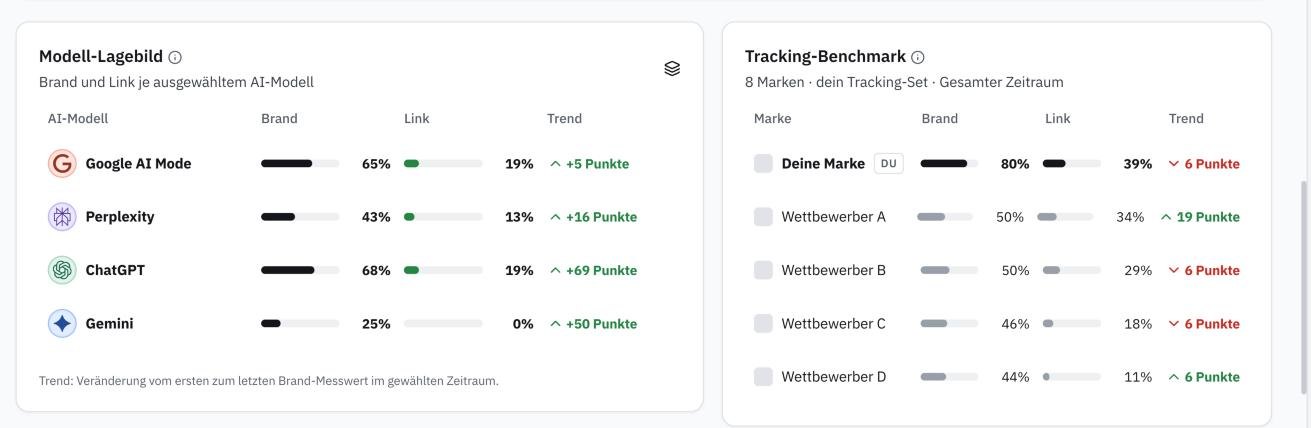
The Starter plan costs €79 a month for 50 prompts, three selectable models and one country; Professional costs €199 for 150 prompts, five models and three countries. The free trial runs for seven days without a credit card, and the details are on the pricing page.
What Alexandrya.AI does not offer today: no ChatGPT Shopping tracking, no alerts and no Slack integration, no search volume per prompt, no crawler log analysis, and an API only on the Enterprise plan. If you want an automatic warning whenever visibility drops, a tool with alerts will suit you better. And in our own measurement, ChatGPT does not yet name Alexandrya.AI for the three target prompts of this guide.
Frequently asked questions
What are the best SEO tracking tools for LLM visibility in 2026?
For LLM visibility, you can choose SEO suites with an AI module or dedicated trackers. Semrush says its AI Visibility Toolkit tracks prompts in ChatGPT and Google AI Mode, and Ahrefs Brand Radar runs custom prompts on seven platforms, Claude included (as of 9 November 2026). Dedicated tools such as Alexandrya.AI link the measurement to recommendations that your team works through as tasks.
Can you measure ChatGPT visibility without a tool?
You can measure ChatGPT visibility by hand as long as your prompt list is short. Switch memory off and note the date, country, mention, citations and competitors named for each answer. The effort grows quickly, because 20 prompts a day add up to 600 answers a month. At that volume, a tool such as Alexandrya.AI pays for itself.
How many prompts do you need to track ChatGPT?
Twenty to 50 prompts that reflect real buying and comparison questions from your audience are enough to start. Add a short and an unambiguous version for each core topic, because ChatGPT interprets short prompts in different ways. Alexandrya.AI’s Starter plan covers 50 prompts for €79 a month, and Professional covers 150 prompts for €199.
How much does a ChatGPT tracking tool cost?
Entry prices on the vendors’ own pages range from $50 to $99 a month, or €79 to €99 (as of 9 November 2026). Ahrefs Brand Radar starts at $50 for custom prompts, and the Semrush AI Visibility Toolkit costs $99 with 25 prompts. Alexandrya.AI starts at €79 for 50 prompts and three selectable models, with a seven-day free trial.
Does a ChatGPT tracking tool also show how ChatGPT describes your brand?
Good ChatGPT tracking tools analyse the tone of each answer as well as the mention itself. In Alexandrya.AI, this area is called Brand Perception and shows categories, sentiment, strengths, gaps and supporting quotes, saved as snapshots over time. During a trial, check that every rating is backed by a quote from the answer, otherwise you cannot verify it.
Free GEO audit for your ChatGPT visibility
Want to see how ChatGPT reads your key prompts today and who it names instead of you? During the free seven-day trial, Alexandrya.AI runs your own prompts every day with no credit card and shows mention, citation and source list for each answer. Start your free GEO audit
Frequently asked questions
What are the best SEO tracking tools for LLM visibility in 2026?
For LLM visibility, you can choose SEO suites with an AI module or dedicated trackers. Semrush says its AI Visibility Toolkit tracks prompts in ChatGPT and Google AI Mode, and Ahrefs Brand Radar runs custom prompts on seven platforms, Claude included (as of 9 November 2026). Dedicated tools such as Alexandrya.AI link the measurement to recommendations that your team works through as tasks.
Can you measure ChatGPT visibility without a tool?
You can measure ChatGPT visibility by hand as long as your prompt list is short. Switch memory off and note the date, country, mention, citations and competitors named for each answer. The effort grows quickly, because 20 prompts a day add up to 600 answers a month. At that volume, a tool such as Alexandrya.AI pays for itself.
How many prompts do you need to track ChatGPT?
Twenty to 50 prompts that reflect real buying and comparison questions from your audience are enough to start. Add a short and an unambiguous version for each core topic, because ChatGPT interprets short prompts in different ways. Alexandrya.AI’s Starter plan covers 50 prompts for €79 a month, and Professional covers 150 prompts for €199.
How much does a ChatGPT tracking tool cost?
Entry prices on the vendors’ own pages range from $50 to $99 a month, or €79 to €99 (as of 9 November 2026). Ahrefs Brand Radar starts at $50 for custom prompts, and the Semrush AI Visibility Toolkit costs $99 with 25 prompts. Alexandrya.AI starts at €79 for 50 prompts and three selectable models, with a seven-day free trial.
Does a ChatGPT tracking tool also show how ChatGPT describes your brand?
Good ChatGPT tracking tools analyse the tone of each answer as well as the mention itself. In Alexandrya.AI, this area is called Brand Perception and shows categories, sentiment, strengths, gaps and supporting quotes, saved as snapshots over time. During a trial, check that every rating is backed by a quote from the answer, otherwise you cannot verify it.
How visible is your brand in AI?
Try Alexandrya.AI free for 7 days and see how ChatGPT, Gemini, Perplexity, AI Overviews and Copilot talk about your brand.
- 7 days free
- No credit card required
- All features included
- Cancel anytime
About the author
Talaal Max Habib
Managing Director at Alexandrya.AI
Talaal Max Habib has advised companies in industry, the Mittelstand and e-commerce on SEO and Generative Engine Optimization since 2015. With his team he built Alexandrya.AI, the Munich-based platform that measures how brands appear in ChatGPT, Perplexity and Gemini.
LinkedIn