What answer engine optimization means and how AEO differs from GEO and SEO
Answer engine optimization (AEO) shapes content so Google and AI assistants use it as the direct answer to a question, and it overlaps heavily with GEO.

Managing Director at Alexandrya.AI
Answer engine optimization (AEO) is the work of getting search engines and AI assistants to use your content as the direct answer to a question, whether as a featured snippet, a spoken answer or a cited source in ChatGPT, Perplexity and Google AI Overviews. AEO overlaps heavily with generative engine optimization (GEO). The two terms differ mainly in origin and in what counts as success, hardly at all in the work involved.
The term is older than the AI chat tools it now describes, and vendors use it loosely. HubSpot treats AEO as its umbrella term and notes that others give that role to GEO (HubSpot blog, updated 11 September 2026). For the work on your own site the label barely matters: if you do GEO, you are doing AEO. Keeping the terms apart still pays off, because each one points you to a different metric.
What is answer engine optimization? A definition
Answer engine optimization is the work of making a website the source of the direct answer an answer engine gives to a question. Answer engines are systems that return an answer instead of a list of links: Google with featured snippets and AI Overviews, voice assistants, and ChatGPT, Perplexity, Gemini and Microsoft Copilot. AEO only applies to searches that have an answer. Someone typing the name of an online shop wants the site itself, so there is nothing to optimise for.
In practice, the optimisation side comes down to four things: the answer in the first sentence, a subject spelled out, facts that can be checked, and a page the system can reach.
Google treats that last point as a hard condition. Its documentation on AI features says a page must be indexed and eligible to be shown with a snippet in Google Search before it can appear as a source in AI Overviews or AI Mode (Google Search Central, page last updated 10 December 2025, accessed 27 October 2026). For Google's answers, AEO starts with a page that ordinary search can find.
Where does the term answer engine optimization come from?
The term answer engine optimization grew up in the SEO trade when featured snippets and voice assistants began returning single answers instead of lists of links. Who used it first cannot be confirmed independently. SEO consultant Jason Barnard states on the website of his company Kalicube that he coined the term in 2017, and names a Search Engine Watch piece from February 2018 as the first third-party coverage (Kalicube, updated 15 May 2026, accessed 9 November 2026). That is his own account. The setting is well documented, though. In January 2018 Google described featured snippets as a format that reverses the usual order and puts the answer before the link. It called the format especially useful for people on mobile or searching by voice (Google, 30 January 2018).
| Date | Event | What it meant for AEO |
|---|---|---|
| 30 January 2018 | Google re-explains featured snippets: answer first, source named in spoken results too | The target is the single answer box above the results |
| 30 November 2022 | ChatGPT is released | Answers come from a language model, with no results page |
| 16 November 2023 | The research paper “GEO: Generative Engine Optimization” appears on arXiv | The term GEO describes visibility in generated answers |
| 14 May 2024 | Google rolls out AI Overviews to everyone in the US | An AI answer sits above the list of results |
The gap between 2018 and 2023 is telling. For years AEO meant individual answer boxes, until language models started assembling answers from several sources. That shift is what the paper by Pranjal Aggarwal and colleagues, accepted at KDD 2024, named GEO. The authors report that targeted changes to content can raise visibility in generative engine responses by up to 40% (arXiv 2311.09735). Since then the two terms have run in parallel, often for the same work.
What is the difference between AEO and GEO?
The difference between AEO and GEO lies in the unit of success. Answer engine optimization aims for the single answer passage a system lifts from your page; generative engine optimization aims for your brand to be named and your domain cited in an answer that a language model assembles from several sources. A featured snippet usually comes from one page. In ChatGPT or Perplexity several sources sit side by side, and a brand can be named without being linked.
On the ground the line blurs, because the practices are almost identical: a question as a heading, the answer in the first sentence, checkable facts and a consistent description of the brand. The difference only shows when you measure. Thinking in AEO terms, you ask whether your passage gets used. Thinking in GEO terms, you also ask whether your brand is named when nobody links to you, and where your domain sits in the source list.
Our view: a marketing team gains nothing from running separate AEO and GEO programmes. What works is one shared prompt set with separate metrics for mention, citation and position. The GEO side, with retrieval, source selection and the main levers, is covered in What is generative engine optimization.
AEO vs GEO vs SEO compared
SEO, AEO and GEO differ in goal, unit of success, signals and measurement. Search engine optimization (SEO) works towards a click from a list of results, answer engine optimization towards the answer a system uses, and generative engine optimization towards being named in generated answers. All three assume that crawlers may read the page and that the content actually answers the question being asked.
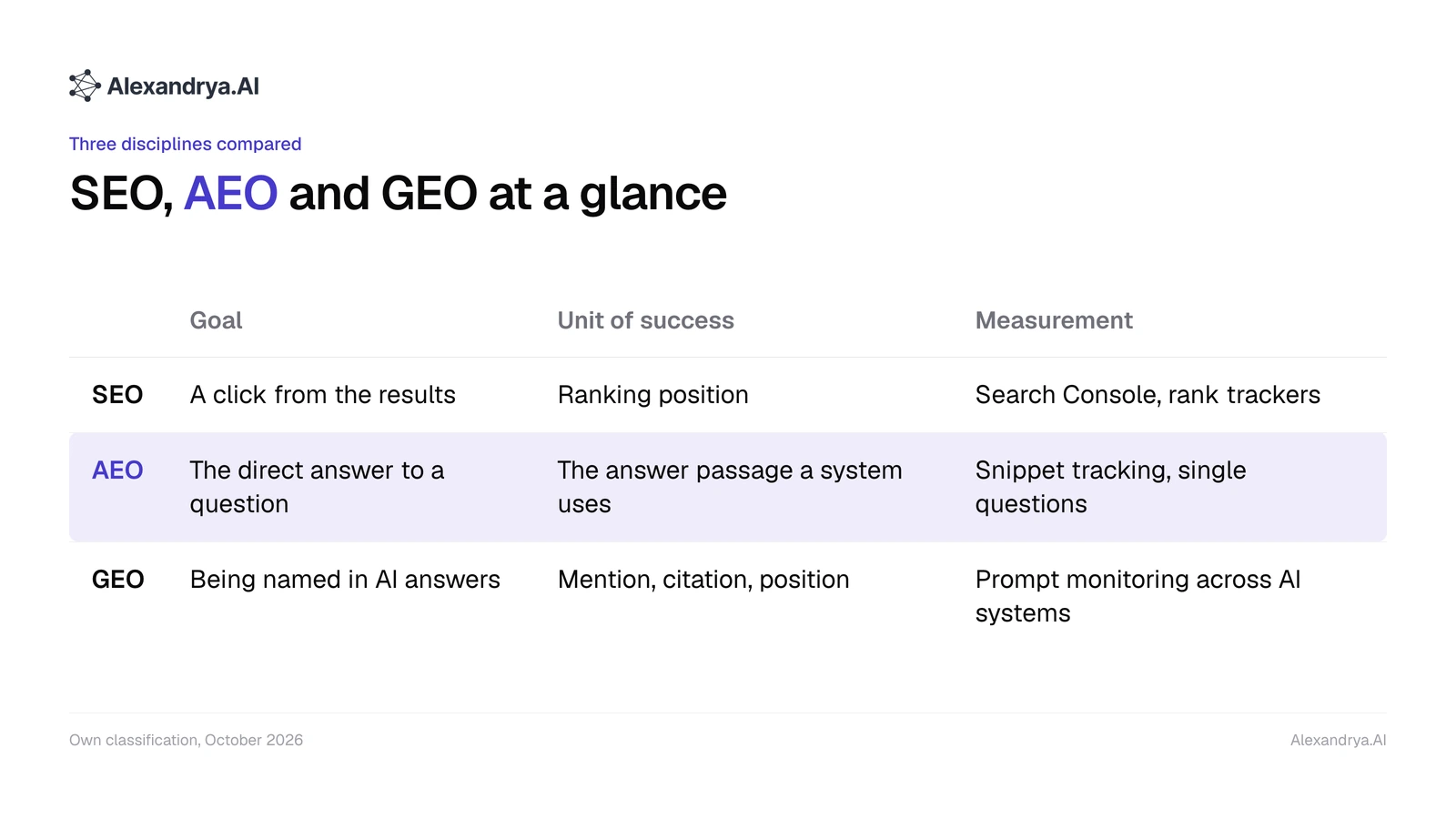
SEO, AEO and GEO compared by goal, unit of success and measurement. Alexandrya.AI's own classification, October 2026.
| Attribute | SEO | AEO | GEO |
|---|---|---|---|
| Goal | A place in the results and a click to the site | Supply the direct answer to a question | Be named in AI answers and cited as a source |
| Unit of success | Ranking position and click | The passage a system uses: featured snippet, spoken answer, answer citation | Mention in the answer text, citation of the domain, position in the source list |
| Typical surface | Organic results page | Featured snippet, voice assistant, AI answer to a single question | ChatGPT, Perplexity, Gemini, Google AI Overviews and AI Mode, Microsoft Copilot |
| Main signals | Relevance, internal and external links, technical access | Question as heading, answer in the first sentence, FAQ, structured data that matches the text | Citable passages, consistent brand facts, mentions on third-party sources |
| Measurement | Search Console, rank trackers | Snippet tracking, checking individual questions | Prompt monitoring across several AI systems for mention, citation and position |
| Origin of the term | Classic web search | Featured snippets and voice search | 2023 research paper on generative engines |
The measurement row stands out. SEO has Search Console, a data source run by the search engine itself. Google reports AI Overviews and AI Mode traffic in the Performance report under the “Web” search type, and its documentation describes no separate filter for it. Whether ChatGPT or Perplexity cite your page for a given question, you only find out by asking the question and reading the answer. That is the job AEO and GEO tools automate.
Answer engine optimization practices on and beyond your own site
Answer engine optimization covers five practices on your own site and one beyond it: questions as subheadings, answer passages of 40 to 80 words, a visible FAQ block, structured data that matches the visible text, and consistent facts about your brand across your own profiles. Off-site, what counts is being mentioned on the pages answer engines already cite for your questions. The technical precondition is a page that is indexed and eligible for snippets.
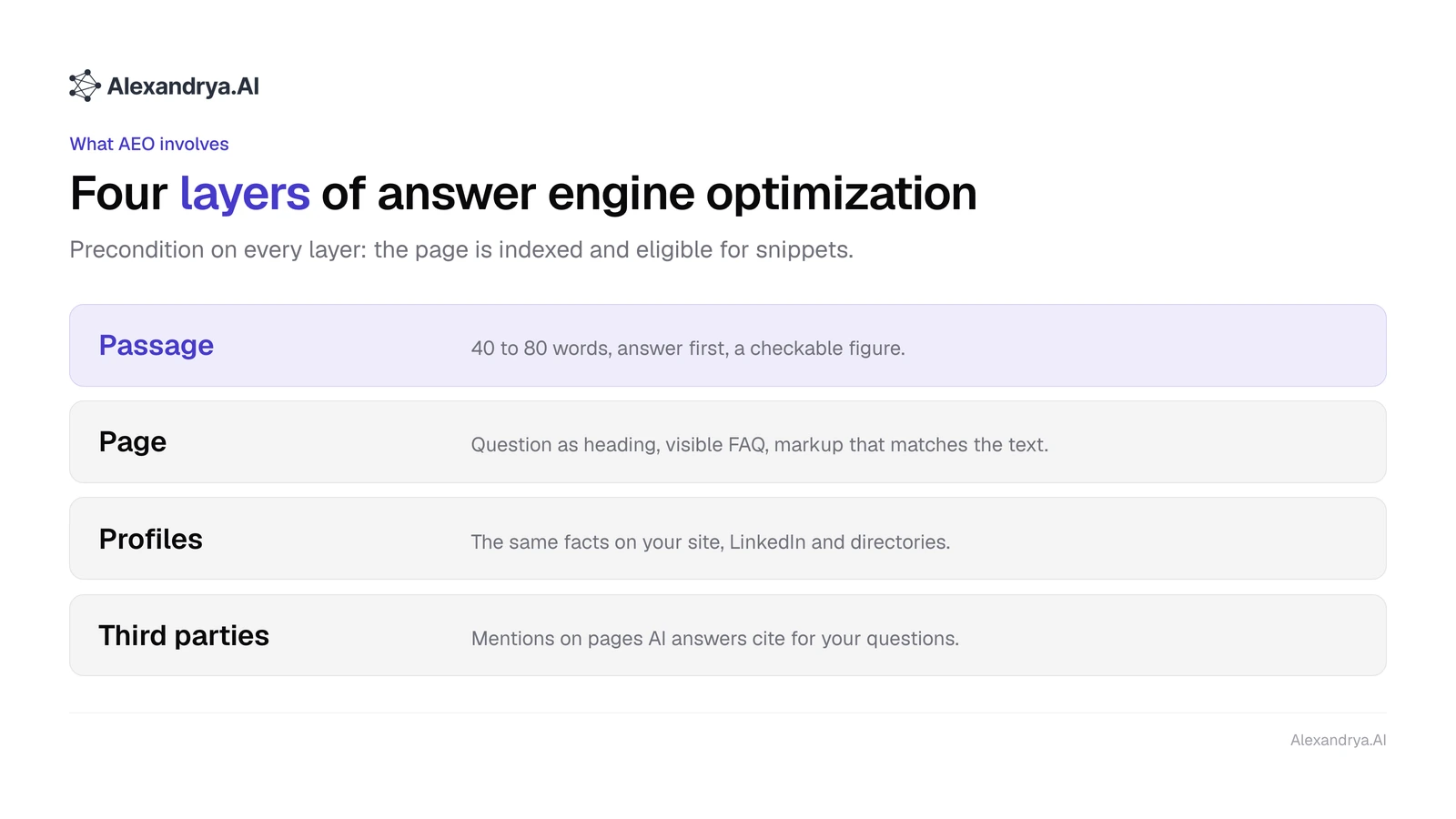
The four layers of answer engine optimization, from a single passage out to other people's websites. Alexandrya.AI's own illustration, October 2026.
- A question as a subheading, in your customers' words, with the answer in the first sentence below.
- An answer passage of 40 to 80 words: the answer with its subject spelled out, the condition, a checkable figure or boundary.
- A visible FAQ block, with any FAQPage markup matching the text word for word.
- Structured data only for visible content. Google explicitly requires no special schema markup for AI Overviews and AI Mode.
- The same name, category, offer and location on your website, legal notice, LinkedIn, directories and review sites.
- Mentions in trade media, on comparison sites, in forums and on video platforms that get cited for your questions.
The opening paragraph of this article follows the passage pattern: it spells out AEO, answers the title question in its first sentence, separates it from GEO in the second and works without the rest of the page. How to plan such passages across whole pages is set out in the GEO content framework.
How AEO monitoring measures mentions, citations and position
AEO monitoring means sending a fixed list of questions to several AI systems at a regular rhythm and checking every answer for three values: whether the brand is named in the answer text, whether your domain is cited as a source, and where it sits in the source list. A single query is not enough, because answers vary between systems and from day to day. For a first baseline, 20 to 50 questions from real customer conversations will do.
How far mentions and citations can drift apart shows in Alexandrya.AI's own project. Of 43 prompts tracked daily, AI answers name the brand in the answer text for 10, link to alexandrya.ai as a source for 11, and put the domain first in the source list for 4 (Alexandrya.AI's own measurement, as of 27 October 2026, 43 tracked prompts). With more citations than mentions, at least one prompt must cite the site without naming the brand in the text. Position varies too: of the 11 prompts with a citation, alexandrya.ai is listed first for 4 and further down for 7. A report that only counts mentions shows neither the prompts with a citation but no mention nor the 7 citations below first place.
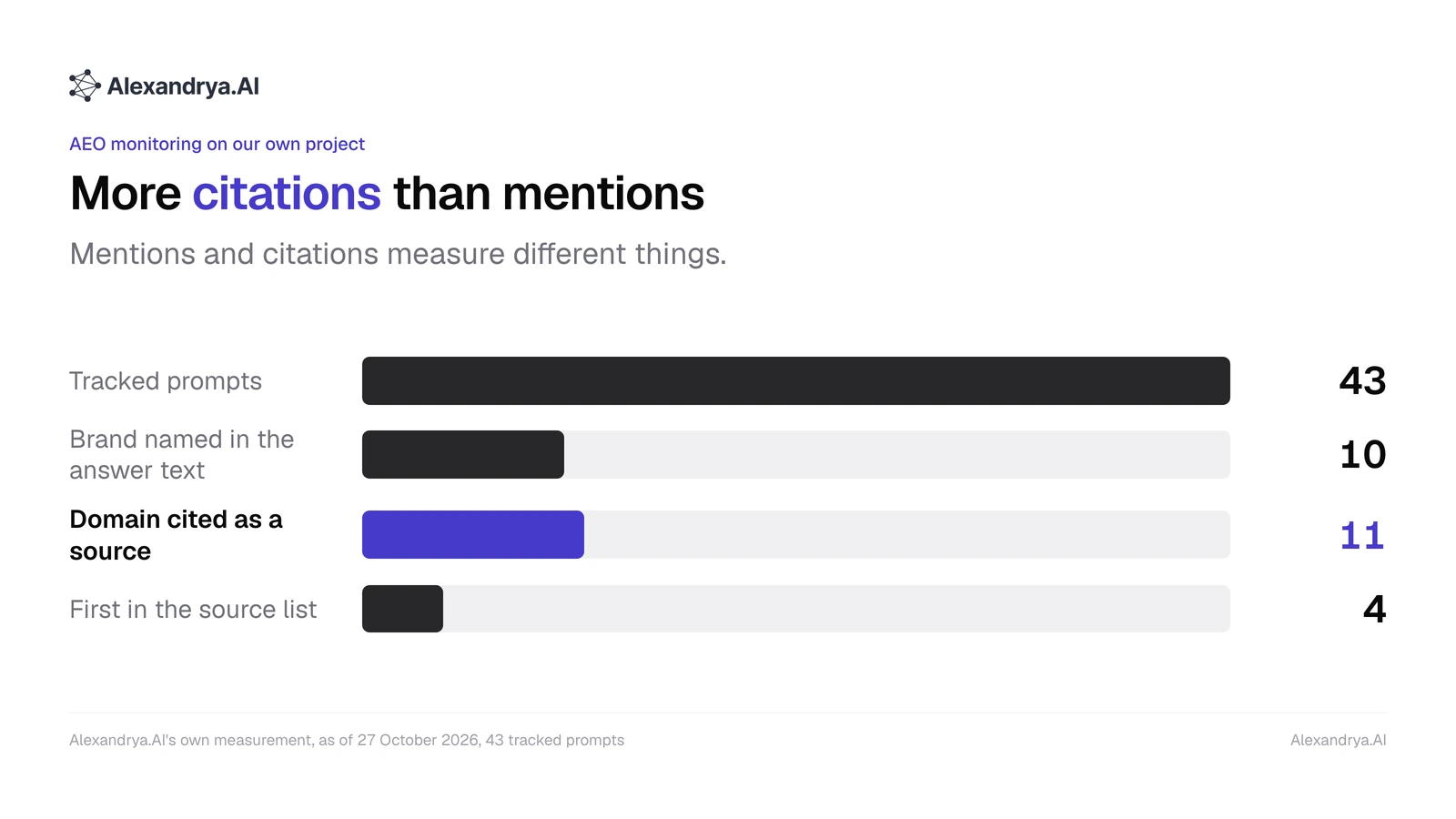
Mentions, citations and first places across 43 tracked prompts. Alexandrya.AI's own measurement, as of 27 October 2026, 43 tracked prompts.
For AEO in the narrow sense, the passage a system uses, citation is the right metric. GEO adds the mention in the text, because a recommendation in the answer is something different from a link in the source list. Expressed as rates, the project's mention rate is 23% (10 of 43), its citation rate 26% (11 of 43) and its share of first places 9% (4 of 43).
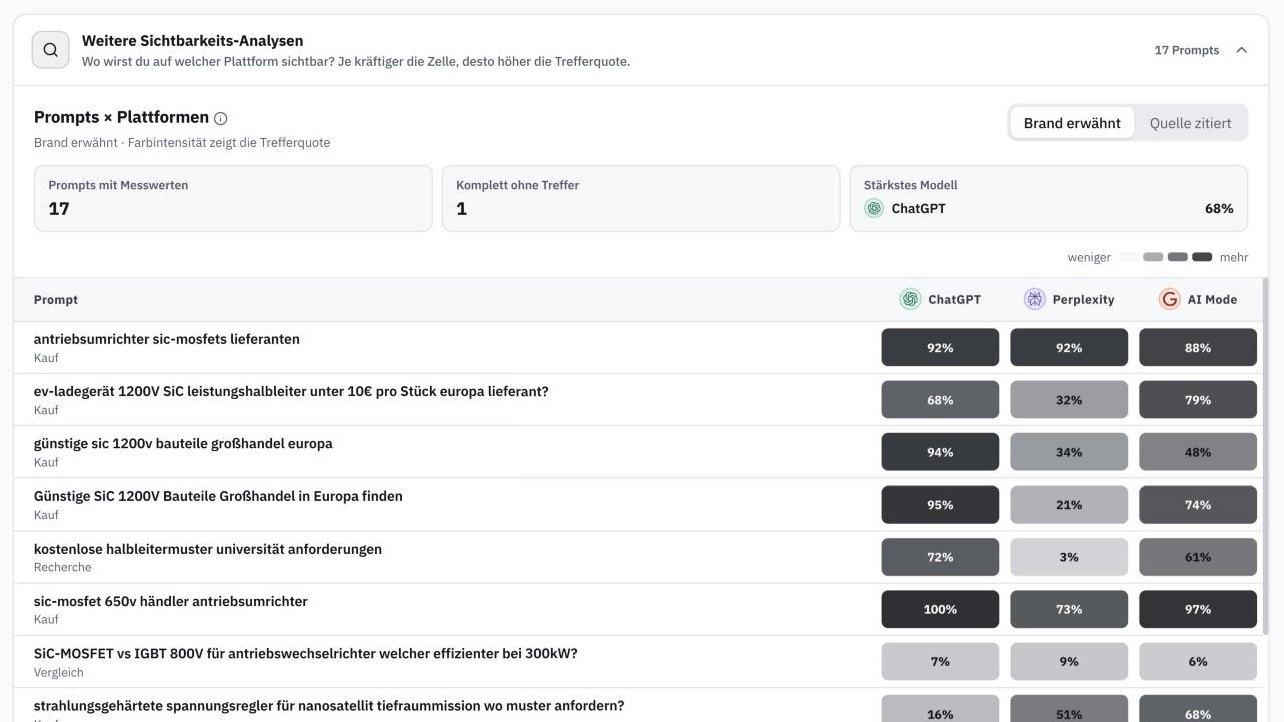
Without a tool, AEO monitoring runs on a spreadsheet: one row per question, system and day, with columns for mention, citation, position and every cited domain. The workload grows fast. Twenty questions in five systems over three days produce 300 answers to read and log. That works for a one-off baseline and hardly at all for ongoing measurement.
Which AEO tools are there?
AEO tools fall into four categories: specialist AI visibility tools such as Alexandrya.AI and Profound, SEO suites with an AI module such as the Semrush AI Visibility Toolkit and Ahrefs Brand Radar, marketing platforms with an AEO module such as HubSpot AEO, and technical checking tools such as Google Search Console. The first three analyse mentions and citations in AI answers; the fourth checks indexing and structured data. Published entry prices range from $50 to $99 a month, or €79 for Alexandrya.AI (as of 27 October 2026).
| Category | What it measures | Examples (as of 27 October 2026) | Limit |
|---|---|---|---|
| Specialist AI visibility tools | Mention, citation and position per prompt and AI system, cited sources, competitors | Alexandrya.AI, Profound | Only measure the prompts you define |
| SEO suites with an AI module | AI visibility alongside keyword and backlink data | Semrush AI Visibility Toolkit, Ahrefs Brand Radar | Separate pricing and prompt allowances on top of the SEO subscription |
| Marketing platforms with an AEO module | Visibility, citations and share of voice within content and CRM work | HubSpot AEO (beta) | Three AI systems, per the product page |
| Technical checking tools | Indexing, snippet eligibility, structured data, crawler access | Google Search Console, Rich Results Test, server logs | Show no AI answers |
No single tool covers everything: the measuring tools see no server logs, and the checking tools see no AI answers. If you already pay for Semrush or Ahrefs and only want to know whether your brand appears in AI answers, the AI module of your suite is the fastest route to first figures. If you want to turn the figures into tasks, check whether a tool gives recommendations and what they are based on.
According to vendor pages accessed on 27 October 2026: the Semrush AI Visibility Toolkit costs $99 a month, includes 25 tracked prompts in the base plan and names ChatGPT and Google AI Mode as the systems it queries. It also offers prompt research with volume and difficulty. Ahrefs Brand Radar measures mentions and citations in AI Overviews, AI Mode, ChatGPT, Perplexity, Gemini and Copilot, with custom prompts from $50 a month, and weights its estimated impressions by the search volume behind each prompt.
HubSpot AEO is labelled beta, tracks ChatGPT, Gemini and Perplexity, measures visibility, citations and share of voice, gives prioritised recommendations and costs $50 a month, or $45 billed annually, with 25 prompts. Profound uses the abbreviation AEO in its navigation and product areas, offers Answer Engine Insights, Agent Analytics for bot activity and Prompt Volumes among other features. Its pricing page shows no amounts: a free seven-day trial with 50 preset prompts and an Enterprise plan with custom pricing (as of 9 November 2026).
Alexandrya.AI is an AI visibility tool from Munich that measures brand mentions in ChatGPT, Gemini, Perplexity and Bing Copilot and turns them into content and citation tasks. On the Starter plan it runs 50 prompts daily across three selectable models for €79 (EUR) a month; Professional costs €199 for 150 prompts across five models and three countries. The measurements feed an action plan of content briefs, outreach targets and quick wins, and every recommendation becomes a task with the status Open, In Progress or Done.
What Alexandrya.AI does not offer: prompt search volume, crawler log analysis or alerts, and its API is limited to the Enterprise plan. If you want to know how often a question is asked in the first place, Semrush, Ahrefs and Profound publish estimates.
All plans are listed on the pricing page. Cost per answer is compared in AI visibility tools under €100, and the line between specialist tools and classic SEO suites is drawn in the comparison of AI monitoring tools and SEO tools.
Do you need an AEO programme on top of SEO and GEO?
Most companies do not need a separate AEO programme alongside SEO and GEO. The practices overlap almost entirely, and Google names no additional requirements for AI Overviews and AI Mode beyond the basics of search engine optimization. What should stay separate are the metrics: rankings and clicks for SEO, used passages and citations for AEO, mentions and position for GEO.
Which term will win is still open. HubSpot and Profound work with AEO, while the 2023 research paper and Alexandrya.AI itself speak of GEO. When you look for agencies or tools, search for both terms, because providers with the same offer appear under different labels.
Frequently asked questions
Does answer engine optimization replace SEO?
Answer engine optimization builds on SEO and does not replace it. Google states that a page must be indexed and eligible to be shown with a snippet in Google Search before it can appear as a source in AI Overviews or AI Mode. Fix any gaps in crawling, indexing or content quality first. AEO adds a second layer of metrics.
Do I need special schema markup or an llms.txt file for AEO?
For Google, you need neither. Its documentation on AI features says you don't need new machine-readable files, AI text files or special schema.org markup to appear in AI Overviews or AI Mode. Structured data still makes sense where it describes the visible text, such as FAQPage markup for a visible FAQ block. Other vendors have to be checked separately.
Is a mention the same as a citation in AI answers?
A mention is your brand name in the answer text; a citation is your domain linked as a source. The two occur independently. In Alexandrya.AI's own project, the brand is mentioned for 10 of 43 prompts and cited for 11 (own measurement, as of 27 October 2026). So a page can serve as a source without the brand being recommended.
Which AI platforms should AEO monitoring cover?
AEO monitoring should cover the AI platforms your audience uses for research, usually at least ChatGPT, Google AI Overviews and Perplexity. Coverage varies widely between tools: HubSpot AEO tracks ChatGPT, Gemini and Perplexity according to its product page, while Alexandrya.AI covers ChatGPT, Gemini, Google AI Mode, AI Overviews, Perplexity, Microsoft Copilot and Claude, among others.
How much does an AEO tool cost?
According to vendor pages on 27 October 2026, AEO tools start at $50 a month: HubSpot AEO (beta) costs $50 with 25 prompts, Ahrefs Brand Radar starts at $50 for custom prompts, the Semrush AI Visibility Toolkit costs $99 with 25 prompts, and Alexandrya.AI Starter costs €79 with 50 prompts. The AI platforms covered differ considerably.
Try AEO monitoring on your customers' questions free for seven days
Which answers do ChatGPT, Perplexity and Google AI Overviews give to your customers' questions today, and does your brand appear in them? During the free seven-day trial, Alexandrya.AI runs your own prompts with no credit card and reports mention, citation and source-list position separately for each AI system. Try Alexandrya.AI free for 7 days
Frequently asked questions
Does answer engine optimization replace SEO?
Answer engine optimization builds on SEO and does not replace it. Google states that a page must be indexed and eligible to be shown with a snippet in Google Search before it can appear as a source in AI Overviews or AI Mode. Fix any gaps in crawling, indexing or content quality first. AEO adds a second layer of metrics.
Do I need special schema markup or an llms.txt file for AEO?
For Google, you need neither. Its documentation on AI features says you don't need new machine-readable files, AI text files or special schema.org markup to appear in AI Overviews or AI Mode. Structured data still makes sense where it describes the visible text, such as FAQPage markup for a visible FAQ block. Other vendors have to be checked separately.
Is a mention the same as a citation in AI answers?
A mention is your brand name in the answer text; a citation is your domain linked as a source. The two occur independently. In Alexandrya.AI's own project, the brand is mentioned for 10 of 43 prompts and cited for 11 (own measurement, as of 27 October 2026). So a page can serve as a source without the brand being recommended.
Which AI platforms should AEO monitoring cover?
AEO monitoring should cover the AI platforms your audience uses for research, usually at least ChatGPT, Google AI Overviews and Perplexity. Coverage varies widely between tools: HubSpot AEO tracks ChatGPT, Gemini and Perplexity according to its product page, while Alexandrya.AI covers ChatGPT, Gemini, Google AI Mode, AI Overviews, Perplexity, Microsoft Copilot and Claude, among others.
How much does an AEO tool cost?
According to vendor pages on 27 October 2026, AEO tools start at $50 a month: HubSpot AEO (beta) costs $50 with 25 prompts, Ahrefs Brand Radar starts at $50 for custom prompts, the Semrush AI Visibility Toolkit costs $99 with 25 prompts, and Alexandrya.AI Starter costs €79 with 50 prompts. The AI platforms covered differ considerably.
How visible is your brand in AI?
Try Alexandrya.AI free for 7 days and see how ChatGPT, Gemini, Perplexity, AI Overviews and Copilot talk about your brand.
- 7 days free
- No credit card required
- All features included
- Cancel anytime
About the author
Talaal Max Habib
Managing Director at Alexandrya.AI
Talaal Max Habib has advised companies in industry, the Mittelstand and e-commerce on SEO and Generative Engine Optimization since 2015. With his team he built Alexandrya.AI, the Munich-based platform that measures how brands appear in ChatGPT, Perplexity and Gemini.
LinkedIn