Per-platform AI source analysis: how citations in ChatGPT, Perplexity and Gemini really work
Per-platform AI source analysis shows which domains ChatGPT, Perplexity, Gemini and AI Mode link to, and in which position. With our own measurements.

Managing Director at Alexandrya.AI
Per-platform AI source analysis records which domains ChatGPT, Perplexity, Gemini and Google AI Mode link to in the source lists of their answers, and in which position, with each platform counted on its own. The gaps are wide. In an Alexandrya.AI measurement on 21 October 2026, ChatGPT listed 24 entries for the prompt “ki sichtbarkeit” and linked two of them. Google AI Mode linked all 11.
How does per-platform AI source analysis work?
Per-platform AI source analysis runs in five steps. A fixed prompt goes to each platform every day, the answer is stored, its source list is broken down entry by entry, each entry is tagged with domain, position and link status, and only then are the results counted per platform. Counting per platform matters because ChatGPT, Gemini, Copilot and Google AI Mode mostly link to different domains for the same question.
- Fix the prompt. The wording, language and country stay the same so that answers can be compared from one day to the next.
- Collect the answer on every platform. The same prompt goes to ChatGPT, Gemini, Perplexity, Google AI Mode and Copilot, each with web search switched on.
- Break down the source list. Every entry is stored with URL, domain, position and whether it is linked in the answer text or only appears in the list below it.
- Normalise. Tracking parameters such as ?utm_source=chatgpt.com are stripped, duplicate URLs merged, and subdomains either kept apart or combined on purpose.
- Count per platform. Citations, average position and the share of answers that link to your domain are calculated for each platform first and only then added up.
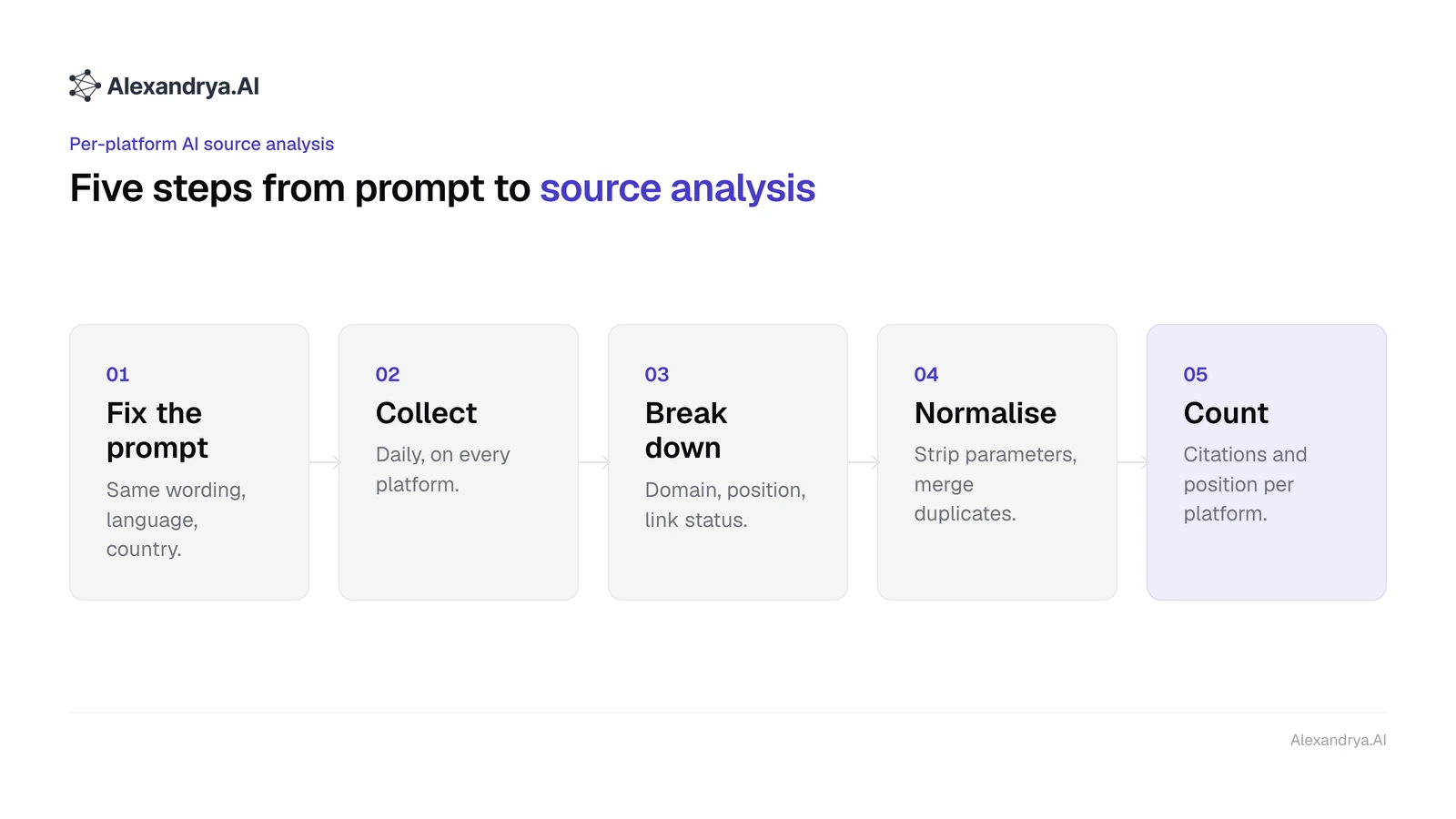
The five steps of a per-platform source analysis. Source: Alexandrya.AI, October 2026.
Step 4 looks like housekeeping, yet it moves the numbers more than any other. ChatGPT’s answer to “ai antworten tracking” on 21 October 2026 contained 27 entries. Almost every URL appeared twice, once plain and once with utm_source=chatgpt.com attached. After merging, 13 domains were left, and three of them were linked in the answer text. Count the raw list and you double the number of sources and record positions that never existed.
Where does the source list in an AI answer come from?
The source list in an AI answer is built while the platform searches. It sends several sub-queries to a search index, reads the pages it finds and refers to some of them in the answer. Google calls this “query fan-out” for AI Overviews and AI Mode, and says a page only needs to be indexed and eligible for a snippet to appear as a supporting link. Which pages get linked, and in what order, is decided by each platform.
The Google detail comes from the Search Central page AI features and your website (last updated 10 December 2025, accessed 22 October 2026). The other platforms document their selection less precisely. What you can measure is the format in which they return sources, and that format varies a lot.
| Platform | Entries per answer in the sample | Linked in the answer text | What to watch when you analyse it |
|---|---|---|---|
| ChatGPT | 24 to 27 | 2 to 8 | Most URLs appear twice, once with utm_source=chatgpt.com. The majority show up only as footnotes. |
| Google AI Mode | 2 to 13 | all | Sources are linked inline, including YouTube videos with a timestamp. |
| Gemini | 0 to 6 | all | Links use a text fragment that jumps straight to the cited passage. No source at all for “beste ki tools”. |
| Microsoft Copilot | 0 to 13 | all | For “beste ki tools”, retailer and product listings filled positions 1 to 8. No source for “ai antworten tracking”. |
| Perplexity | 10 | 1 to 2 | A fixed list of ten entries, of which only a few were recorded as linked (measured 13 October 2026). |
Sample: our own Alexandrya.AI measurement with four German-language prompts (“ki sichtbarkeit”, “ai antworten tracking”, “wie funktioniert per-platform ki-quellen analyse”, “beste ki tools”), scan of 21 October 2026. Perplexity: scan of 13 October 2026 with “ki sichtbarkeit” and “ai search monitoring”.
The table explains why a single cross-platform total misleads. A ChatGPT footnote, a Gemini inline link and a Copilot product listing would otherwise end up in the same column.
Do ChatGPT, Perplexity and Gemini cite different sources?
Yes. ChatGPT, Perplexity, Gemini, Google AI Mode and Copilot cite clearly different sources for the same prompt. For “ki sichtbarkeit” (German for AI visibility), the five platforms linked 19 distinct domains between them in an Alexandrya.AI measurement, and none of those domains appeared on all five. hubspot.de was linked by three platforms, distart.de, suchhelden.de and blog.hubspot.de by two. Every other domain was linked by a single platform only.
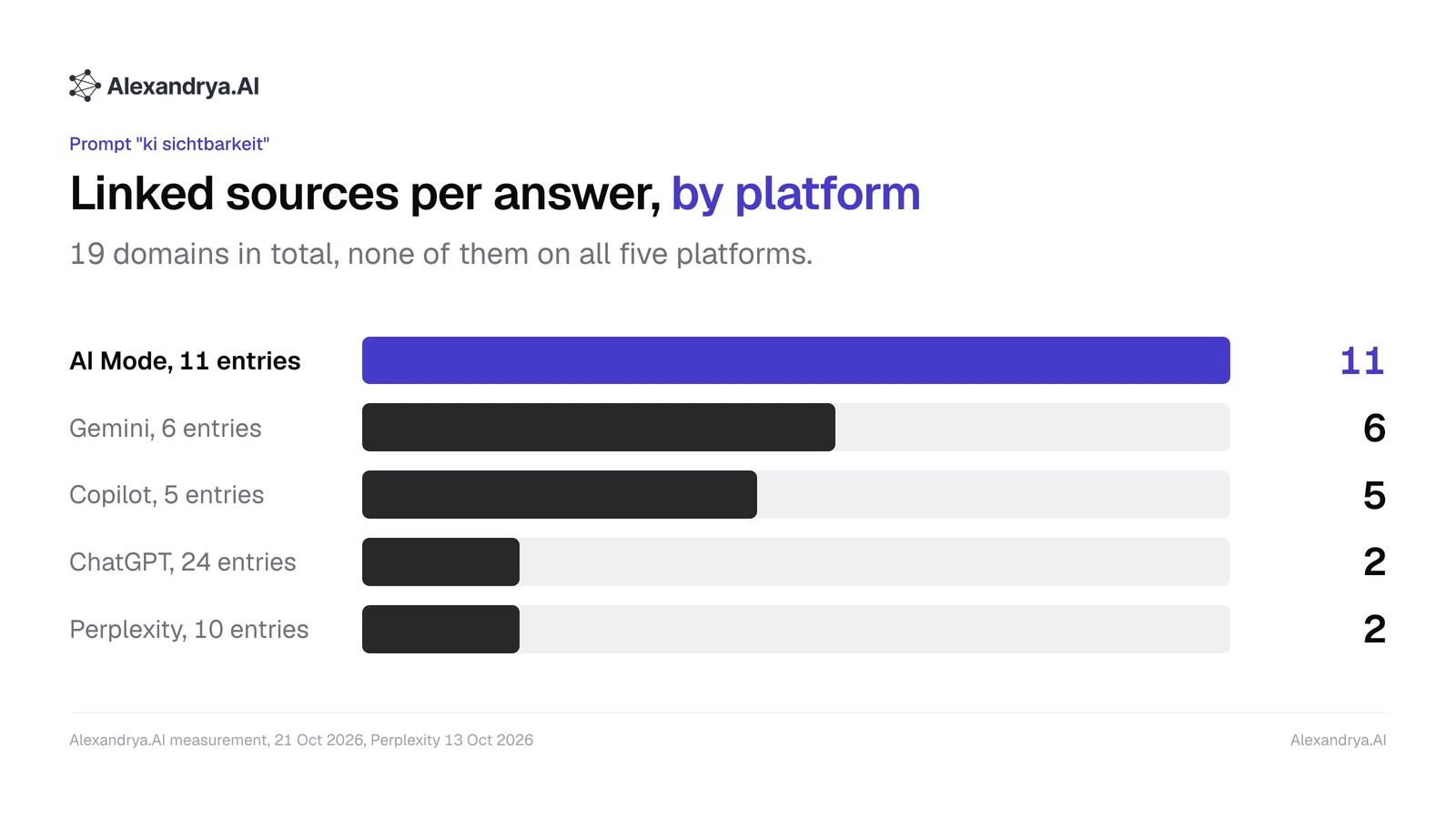
Linked sources per answer for the prompt “ki sichtbarkeit”: Google AI Mode 11, Gemini 6, Copilot 5, ChatGPT 2, Perplexity 2. Source: Alexandrya.AI measurement, 21 October 2026, Perplexity 13 October 2026.
The first linked source was a different domain on every platform: omr.com on Google AI Mode, distart.de on Gemini, blog.contentforce.ai on Copilot and shopify.com on Perplexity. On ChatGPT the only linked domain was hubspot.de, sitting at position 15. The 14 entries above it were unlinked footnotes.
A larger study points the same way. SE Ranking analysed 2,000 English-language queries between 26 February and 3 March 2025 (ChatGPT vs Perplexity vs Google vs Bing, accessed 22 October 2026). Perplexity and ChatGPT shared 25.19% of domains, Google AI Overviews and ChatGPT 21.26%, and Bing Copilot and Google AI Overviews 9.81%. List length differed as well: ChatGPT averaged 10.42 links per answer, Google AI Overviews 9.26, Perplexity 5.01 and Bing Copilot 3.13.
Source types are worth filtering by platform too. Across all 38 prompts in our own project, youtube.com is the most cited domain with 1,782 citations, followed further down by reddit.com with 470 and linkedin.com with 321 (Alexandrya.AI measurement, as of 21 October 2026). In the 21 October sample, every YouTube link came from Google AI Mode: two of 11 sources for “ki sichtbarkeit” and three of 13 for “beste ki tools”. ChatGPT, Gemini and Copilot linked no videos in those answers. In this data, a video strategy pays off on Google and barely on ChatGPT. Four prompts do not make a law, but they are reason enough to filter the domain list by platform before budget goes into a channel.
What does a source’s position in the list tell you?
The position of a source in an AI source list shows how prominently the platform uses that domain: the lower the number, the higher the link sits and the more likely the user is to see it. Across many answers this becomes the average position. From our own observation, a working rule is that domains with an average position below 3 are ones the platform prefers to draw on. Treat that threshold as a rule of thumb, not a fixed law.
Position and frequency are separate signals. In our project, seranking.com was cited 2,416 times at an average position of 4.32. technologyadvice.com was cited 872 times at an average position of 2.21 (Alexandrya.AI measurement, as of 21 October 2026). SE Ranking shows up more often, and technologyadvice.com sits higher whenever it shows up. For an outreach list the second domain is often the better target, because a mention there is more visible inside the answer.
Positions only compare within a platform. For “beste ki tools”, Copilot put eight retailer and product listings from kinguin.net, driffle.com, etsy.com and others in positions 1 to 8, with editorial guides starting at position 9. On Copilot, an article in position 9 was therefore the first editorial source. On ChatGPT, technologyadvice.com appeared in the same answer at position 1 and at position 25, once as an inline link and once as a footnote.
Calculating a domain’s average position, with a worked example
A domain’s average position is the sum of its positions across every source list in which it is linked, divided by the number of those appearances. Answers that do not include the domain are left out of the average, so the citation count always belongs next to it. If a domain appears more than once in a single answer, decide in advance whether every entry counts or only the best one.
A worked example with real values from the 21 October 2026 sample, for blog.hubspot.de:
| Platform | Prompt | Position of blog.hubspot.de |
|---|---|---|
| Google AI Mode | ai antworten tracking | 1 |
| Google AI Mode | ki sichtbarkeit | 9 |
| Gemini | ki sichtbarkeit | 8 |
| Microsoft Copilot | wie funktioniert per-platform ki-quellen analyse | 3 |
| Total and average | 4 citations | (1 + 9 + 8 + 3) / 4 = 5.25 |
Across platforms, blog.hubspot.de averages 5.25. Per platform the picture changes: 5.0 on Google AI Mode, 8 on Gemini and 3 on Copilot. If you want to know where a source genuinely ranks near the top, only the per-platform figure answers it.
A second example shows why the rule for repeat entries matters. technologyadvice.com sat at positions 1 and 25 in ChatGPT’s answer to “ai antworten tracking”. Count both entries and the average is 13. Count only the best entry per answer and it is 1. Either method is defensible. Numbers only become comparable when the same method applies across every platform and the whole period.
How do you track whether AI answers cite your domain or only mention your brand?
AI answer tracking records mentions and citations separately. A mention is your brand name in the answer text. A citation is a link to your domain in the source list. The two occur independently: a brand can be named without a link, and a domain can serve as a source without its name appearing in the answer. Alexandrya.AI counts only linked sources as citations and leaves unlinked entries out.
Our own project shows how far apart the two can be. Between 22 September and 21 October 2026, Alexandrya.AI measured 38 prompts a day for its own domain, alexandrya.ai:
| Platform | Answers analysed | Answers naming Alexandrya.AI | Answers linking to alexandrya.ai |
|---|---|---|---|
| Google AI Mode | 1,137 | 0 | 7 |
| Gemini | 1,133 | 0 | 5 |
| ChatGPT | 1,137 | 1 | 2 |
| Microsoft Copilot | 1,132 | 0 | 0 |
| Perplexity (23 days measured) | 729 | 3 | 5 |
Alexandrya.AI measurement, 22 September to 21 October 2026. Counts derived from the daily per-platform rates and rounded.
On Google AI Mode and Gemini, the domain appeared only as a source, never by name. The models used content from alexandrya.ai as evidence and still did not recommend the brand. Over the full period covered by the action plan, the brand was named in 7 of 38 prompts, cited in 7 of 38 and listed in position 1 of the source list in 3 of 38.
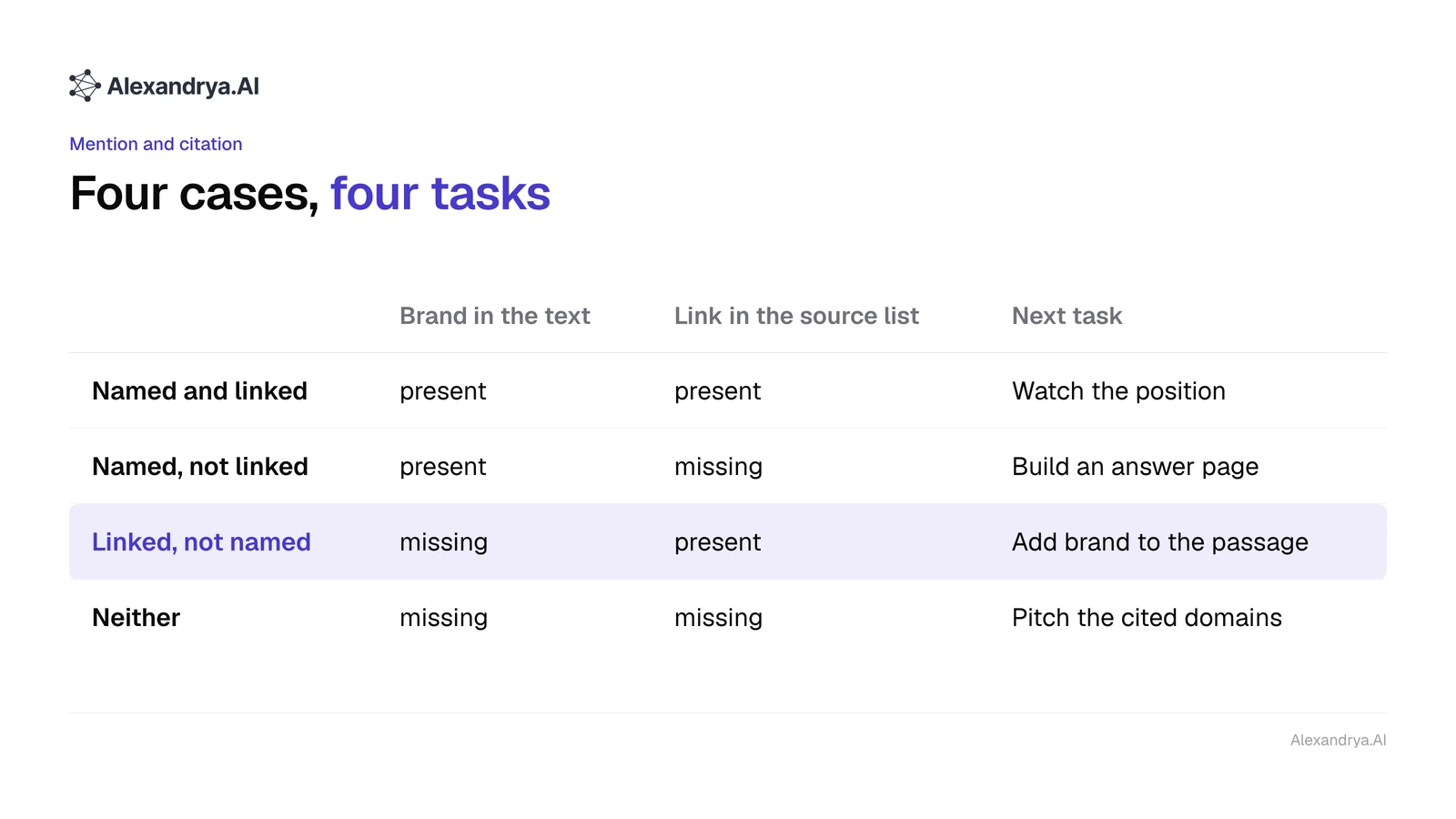
Four combinations of mention and link, and the task each one leads to. Source: Alexandrya.AI, October 2026.
The two columns produce four cases, each with a different next step:
- Named and linked: your brand is in the text and your domain backs the statement. Watch the position.
- Named but not linked: the model knows your brand from other sources. You are missing a page that answers this exact question.
- Linked but not named: your page supplies facts, yet the brand stays out of the answer. Your brand name is missing from the cited passage.
- Neither: other domains own the answer. The domains being cited go on your outreach list.
Turning source analysis into tasks
Alexandrya.AI is an AI visibility tool from Munich that measures brand mentions in ChatGPT, Gemini, Perplexity and Bing Copilot and turns them into content and citation tasks. Its Sources and Domains view shows, per platform, which domains are cited, where they sit in the source list, and how the citation mix splits across source types such as service providers, comparison sites, blogs and news.

In the action plan, the domain list becomes a pitch list of outreach targets: domains that are cited for your prompts and do not name your brand. Prompts where your domain is missing turn into content briefs. Both land as tasks with the status Open, In Progress or Done on the task board.
Four steps are enough to get started:
- Pick 20 to 50 prompts with buying or comparison intent and measure them daily on at least three platforms.
- After two to four weeks, list the ten most cited domains per platform with their citation count and average position.
- Put domains with an average position below 3 that do not name your brand on the outreach list.
- For prompts where no platform links to your domain, plan a page that answers exactly that question.
What the measurement cannot do: it shows which sources a platform returned, not the internal criteria it used to choose them. Why a page gets cited is covered in our piece on what makes a brand citable in AI responses. The strategic differences between platforms are in our comparison of ChatGPT, Perplexity and Google AI, and counting the mentions themselves is covered in the guide to tracking brand mentions in AI search.
One question stays open in any source analysis: how stable is a position over several weeks? With 38 prompts, the daily share of linked answers per platform moved between 0 and 5% in our project. Ranking domains from one measurement is not enough, so collect several weeks of data per platform before you call a domain a preferred source. Plan prices for this kind of tracking are on the Alexandrya.AI pricing page.
Frequently asked questions
Why is my brand mentioned in AI answers but not linked?
An AI platform names a brand when it knows it from training data or from other sources. It only links to pages it retrieves during the search and uses as evidence. If your site has no page that answers the exact question asked, the model links to comparison sites, blogs or competitors instead, even while naming you in the answer.
How is the average position in an AI source list calculated?
Add up every position a domain holds across the source lists in which it is linked, then divide by the number of those appearances. Positions 1, 9, 8 and 3, for example, give 5.25. Answers without the domain are left out, so always report the citation count next to the average position.
What average position counts as a preferred source?
There is no fixed cut-off. As a rule of thumb from Alexandrya.AI measurements, an average position below 3 suggests a platform prefers to draw on that domain. The threshold depends on the platform: on Copilot, product listings often take the top slots for buying queries, and on ChatGPT many entries appear only as footnotes.
Which AI platforms show sources at all?
ChatGPT with web search, Perplexity, Gemini, Google AI Mode, Google AI Overviews and Microsoft Copilot all return sources, though not for every answer. In the Alexandrya.AI sample from 21 October 2026, Gemini and Copilot each returned no source for one of four prompts. ChatGPT listed the most entries but linked only some of them.
How often should you measure AI source lists?
Daily, because source lists change from one day to the next. In Alexandrya.AI's own project, the share of linked answers per platform moved between 0 and 5% from day to day. A single check is a snapshot. An average position becomes reliable only after several weeks with the same set of prompts.
How much does per-platform source analysis with Alexandrya.AI cost?
Alexandrya.AI starts with the Starter plan at €79 a month for 50 prompts and three selectable AI models with daily tracking. Professional costs €199 for 150 prompts, five models and three countries. Annual billing saves 15%. The trial runs for seven days free of charge, with no credit card required.
Free GEO audit
Want to see which domains ChatGPT, Gemini and Google AI Mode link to for your most important prompts, and whether yours is among them? The free GEO audit shows you the source lists per platform with position and link status. Start your free source analysis
Frequently asked questions
Why is my brand mentioned in AI answers but not linked?
An AI platform names a brand when it knows it from training data or from other sources. It only links to pages it retrieves during the search and uses as evidence. If your site has no page that answers the exact question asked, the model links to comparison sites, blogs or competitors instead, even while naming you in the answer.
How is the average position in an AI source list calculated?
Add up every position a domain holds across the source lists in which it is linked, then divide by the number of those appearances. Positions 1, 9, 8 and 3, for example, give 5.25. Answers without the domain are left out, so always report the citation count next to the average position.
What average position counts as a preferred source?
There is no fixed cut-off. As a rule of thumb from Alexandrya.AI measurements, an average position below 3 suggests a platform prefers to draw on that domain. The threshold depends on the platform: on Copilot, product listings often take the top slots for buying queries, and on ChatGPT many entries appear only as footnotes.
Which AI platforms show sources at all?
ChatGPT with web search, Perplexity, Gemini, Google AI Mode, Google AI Overviews and Microsoft Copilot all return sources, though not for every answer. In the Alexandrya.AI sample from 21 October 2026, Gemini and Copilot each returned no source for one of four prompts. ChatGPT listed the most entries but linked only some of them.
How often should you measure AI source lists?
Daily, because source lists change from one day to the next. In Alexandrya.AI's own project, the share of linked answers per platform moved between 0 and 5% from day to day. A single check is a snapshot. An average position becomes reliable only after several weeks with the same set of prompts.
How much does per-platform source analysis with Alexandrya.AI cost?
Alexandrya.AI starts with the Starter plan at €79 a month for 50 prompts and three selectable AI models with daily tracking. Professional costs €199 for 150 prompts, five models and three countries. Annual billing saves 15%. The trial runs for seven days free of charge, with no credit card required.
How visible is your brand in AI?
Try Alexandrya.AI free for 7 days and see how ChatGPT, Gemini, Perplexity, AI Overviews and Copilot talk about your brand.
- 7 days free
- No credit card required
- All features included
- Cancel anytime
About the author
Talaal Max Habib
Managing Director at Alexandrya.AI
Talaal Max Habib has advised companies in industry, the Mittelstand and e-commerce on SEO and Generative Engine Optimization since 2015. With his team he built Alexandrya.AI, the Munich-based platform that measures how brands appear in ChatGPT, Perplexity and Gemini.
LinkedIn