Alexandrya.AI vs. Manual AI Tracking: Why Spreadsheets Don't Scale
Manual AI visibility tracking works for a handful of prompts, but breaks down fast across multiple models, languages, and competitors.

Managing Director at Alexandrya.AI
When Does Manual AI Tracking Work, and Where Does It Reach Its Limits?
Manual AI visibility tracking is not a bad idea. It is a good starting point that runs into hard structural limits within weeks of serious use. Understanding where those limits are (and what they cost) is the right frame for evaluating whether a dedicated platform is necessary for your organization.
For context on what AI visibility tracking involves and why it matters, see: How to Track Your Brand Mentions in AI Search Results
What Can You Do Manually for Free?
Manual tracking means opening ChatGPT, Gemini, or Perplexity, entering a relevant buyer query, and recording whether your brand appears and how it is described. Done consistently across a small set of queries, this provides genuine signal about your current AI visibility baseline.
Manual tracking is appropriate when you are:
- Running an initial diagnostic to understand the problem
- Testing fewer than 10 prompts across 1 to 2 AI platforms
- Tracking a single brand with no competitive benchmark requirement
- Operating in one language only
Where Does Manual AI Tracking Break Down?
The structural problems with manual tracking emerge as soon as scope increases beyond the above constraints. They fall into three categories: volume, consistency, and analysis depth.
What Are the Hidden Costs of Manual AI Monitoring?
The costs of manual AI monitoring are rarely visible on a single invoice. They accumulate in staff hours across three distinct problem categories: the time per prompt run, the consistency failures that invalidate trend analysis, and the analytical gaps that make the data operationally unusable. Each category compounds the others, producing a total cost that consistently exceeds the perceived savings of avoiding a dedicated platform.
How Much Time Does Each Manual Prompt Run Actually Take?
A single prompt query requires: opening the AI platform, entering the prompt, reading and interpreting the response, recording the result with sufficient detail (brand mentioned? position in response? description accurate?), and closing or resetting the session to avoid context carryover.
A careful, complete manual prompt run takes approximately 3 to 5 minutes per prompt per platform. Across 20 prompts and 3 platforms, that is 3 to 5 hours per tracking cycle. Run weekly, that is 150 to 260 hours per year, for one brand, in one language, with no competitive benchmarking.
Why Does Manual Tracking Create Inconsistency Across Team Members?
Manual tracking generates inconsistency when more than one person is involved. Different team members interpret "mentioned" differently (is a brand mentioned if it appears in a list of alternatives but is not the primary recommendation?). Different prompt phrasings produce different outputs. Without a standardized prompt set and recording protocol, week-over-week comparisons are unreliable.
AI systems also respond differently to the same prompt across sessions due to output stochasticity. A prompt that returns your brand on Monday may not return it on Wednesday, not because your AI visibility changed, but because of natural output variation. Manual single-run checks cannot distinguish signal from noise.
Why Can't Manual Tracking Deliver Reliable Trend Analysis?
A spreadsheet tracks what was observed. It does not reveal whether the observed state is improving, declining, or stable relative to prior periods, unless every prior entry is formatted consistently enough to compare. In practice, manual tracking records rarely achieve the consistency needed for reliable trend analysis. The result is a series of snapshots with no interpretable trajectory.
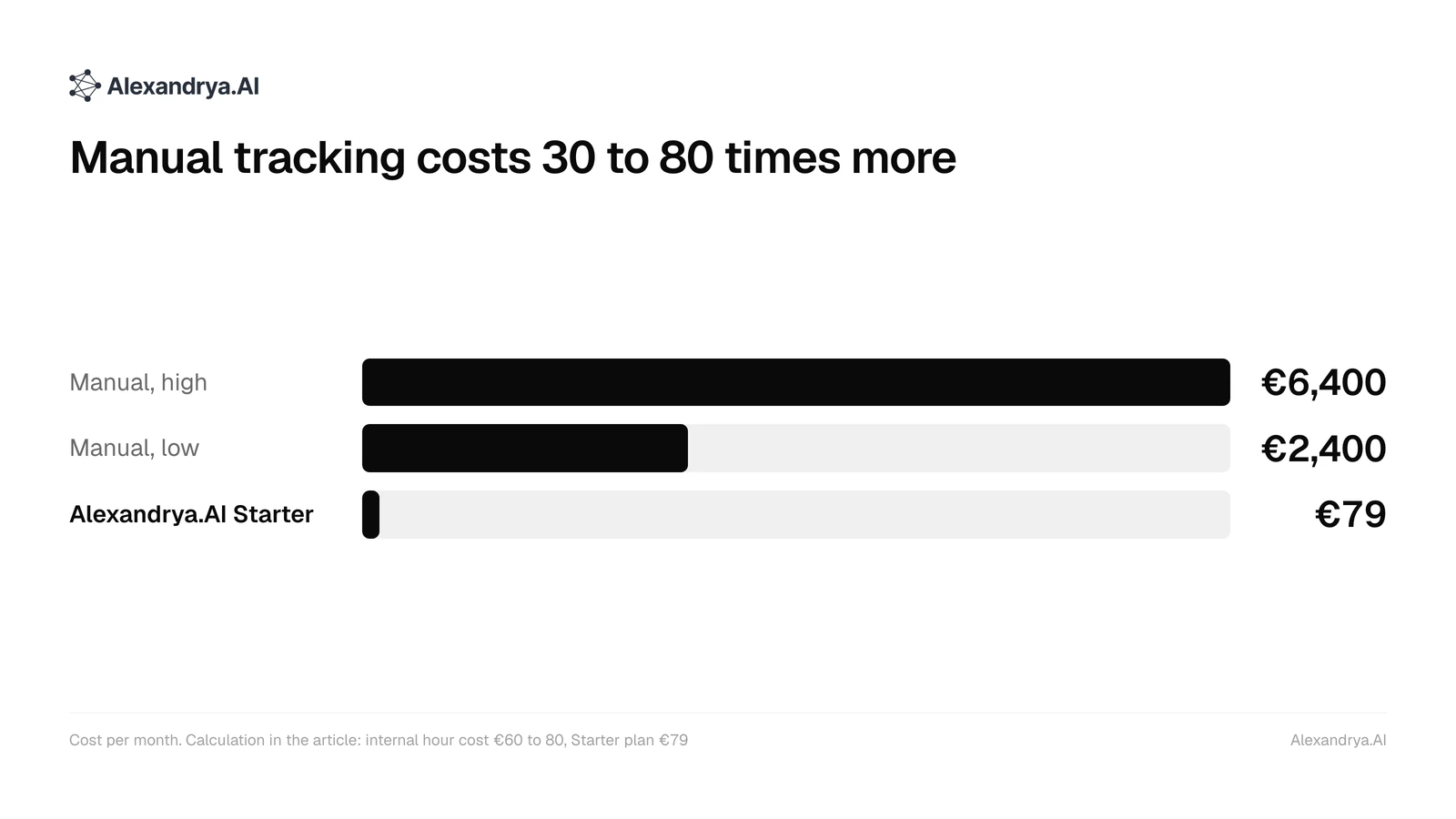
At an average internal hour cost of €60 to 80, a minimal manual AI tracking program costs €2,400 to 6,400 per month in labor, 30 to 80 times the cost of Alexandrya.AI Starter.
What Does a Dedicated AI Visibility Platform Track That Spreadsheets Cannot?
A dedicated AI visibility platform solves the three structural failures of manual tracking (volume, consistency, and analytical depth) by automating prompt execution, normalizing outputs across models, and maintaining a continuous historical record that makes trend analysis reliable. The result is not just time saved, but data that is structurally capable of supporting operational decisions about GEO investment priorities.
Why Does Multi-Model Coverage Matter for AI Visibility?
Manual AI visibility tracking (running prompts in ChatGPT, Gemini, or Perplexity and recording outputs in a spreadsheet) is a viable starting point for understanding how a brand appears in AI-generated search responses. However, it fails to scale across three dimensions: model coverage, temporal consistency, and competitive analysis. A single prompt query across five AI models and three language variants generates fifteen data points. Run weekly across ten competitors and twenty prompts, that becomes 3,000 manual data points per month, before accounting for the stochastic variability of AI outputs, which means a single prompt must be run multiple times to produce a reliable frequency signal. Dedicated AI visibility platforms solve this by automating prompt execution across models, aggregating outputs into normalized metrics, and providing historical trend data that reveals whether visibility is improving or declining in response to content changes. For any organization tracking more than one competitor, more than one AI model, or operating in more than one language, automated AI visibility tracking is the operationally correct choice.
How Does Competitor Benchmarking Work in Alexandrya.AI?
Manual competitive tracking requires running every prompt set for every competitor, on every platform, on every tracking cycle. For five competitors tracked weekly across three platforms and twenty prompts, that is 300 additional prompt runs per week. Competitive benchmarking (the most commercially valuable AI visibility metric) is practically impossible to maintain manually at meaningful scope.
Why Is Multi-Language and Multi-Country Tracking Critical?
AI visibility varies significantly by language and region. A brand may be cited as the primary recommendation for a query in English and absent from the same query in German, because AI training data distributions differ across languages and because localized sources are weighted differently by retrieval systems. Tracking this systematically requires running identical or translated prompts across language variants on a consistent schedule, which compounds the manual volume problem further.
How Do Trend Alerts Enable Weekly Change Detection?
The most actionable AI visibility signal is not the current state. It is the change. A brand that drops from 65% citation frequency to 40% within two weeks has likely experienced a content change, a competitor action, or a platform algorithm update that requires a response. Manual tracking catches this only if tracking cycles are consistent enough and if prior data is organized well enough to compare. In practice, manual tracking almost never provides reliable trend alerts.
What Features Does Alexandrya.AI Provide?
Alexandrya.AI is purpose-built to replace manual AI visibility tracking with automated, continuous measurement across all major AI platforms. Four core features address the specific operational gaps that spreadsheet-based tracking cannot fill: real-time monitoring, competitive benchmarking, prioritized GEO recommendations, and white-label reporting for agencies managing multiple client accounts.
How Does Real-Time AI Visibility Monitoring Work?
alexandrya.ai runs your defined prompt set across all major AI platforms (ChatGPT, Google Gemini, Perplexity, and Bing Copilot) on a daily schedule. Every run records citation frequency, position within the response, sentiment accuracy, and the specific language used to describe your brand. Results are normalized across platforms so that cross-model comparisons are valid.
How Does Competitor Benchmarking Work in Alexandrya.AI?
Competitive share (your brand's citation frequency relative to defined competitors) is calculated automatically for every prompt cycle. The dashboard shows which competitor leads for which query cluster, where you are closing the gap, and where you are losing ground. This is the metric that connects AI visibility to pipeline.
How Are GEO Recommendations Prioritized?
Every gap between your current AI visibility and your competitive position generates a recommendation. Recommendations are prioritized by estimated impact and sorted by effort, so your team works on the changes most likely to produce measurable citation improvement first.
What Does White-Label Agency Reporting Include?
For agencies managing AI visibility across multiple client accounts, alexandrya.ai's Business plan provides white-label reporting under agency branding, multi-project dashboard access, and automated report generation on a defined schedule. Competitive benchmarking applies across all client accounts from a single interface.
How Does Alexandrya.AI's Pricing Compare to Manual Tracking?
The simplest cost comparison is not alexandrya.ai against competitors. It is alexandrya.ai against the cost of doing it manually.
| Scenario | Manual Tracking | alexandrya.ai Starter | alexandrya.ai Professional |
|---|---|---|---|
| Platforms covered | 1 to 2 | 3 AI models | 5 AI models |
| Prompts per month | ~10 to 20 | 50 | 150 |
| Competitive benchmarking | Not practical | Included | Included (up to 5 competitors) |
| Multi-language | Not practical | 1 language | 3 countries |
| Trend analysis | Spreadsheet | Automated | Automated |
| Monthly cost | ~40 to 80 hrs staff time | €79 | €199 |
At an average internal marketing hour cost of €60 to 80, the staff time for a minimal manual tracking program costs €2,400 to 6,400 per month in labor. The alexandrya.ai Starter plan costs €79. The ROI math is straightforward.
Visit the alexandrya.ai pricing page for the full plan breakdown.
Who Should Use Alexandrya.AI?
alexandrya.ai is designed for three primary user profiles:
Brand and marketing teams at B2B companies that have recognized AI search as a commercial channel and need systematic visibility data to justify GEO investments and demonstrate ROI to leadership.
Digital agencies managing AI visibility for multiple client accounts, who need white-label reporting, multi-client dashboards, and the ability to benchmark clients against their competitive sets simultaneously.
Enterprise marketing operations teams tracking brand visibility across multiple products, multiple regions, and multiple languages, where manual tracking is categorically infeasible and where competitor intelligence in AI-generated responses is a strategic priority.
For a detailed enterprise case study, see: +340% AI Visibility in 6 Months: The ThyssenKrupp Schulte Case Study
Start Your Free 7-Day Trial
Manual tracking tells you where you are today. alexandrya.ai tells you whether you are improving, declining, and what to do about it.
Start your free 7-day trial: no credit card required →
Setup takes under 30 minutes. Your first competitive benchmark in hours.
Frequently asked questions
Can I start with manual tracking and switch to alexandrya.ai later?
Yes. Manual tracking is a reasonable way to build initial familiarity with AI visibility as a concept. The practical trigger point for switching to an automated platform is when any of the following become true: you are tracking more than two AI platforms, you need competitive benchmarking, you need week-over-week trend data, or you are spending more than 5 hours per month on manual tracking. At that point, the labor cost of manual tracking exceeds the cost of the Starter plan.
Does alexandrya.ai require technical setup?
No. alexandrya.ai is a no-code SaaS platform. Setup involves defining your tracking prompts (the questions your buyers ask AI systems), selecting the AI platforms to monitor, and adding competitors. The platform handles all API calls, response aggregation, and normalization. The typical time from account creation to first results is under 30 minutes.
What makes alexandrya.ai different from social listening tools?
Social listening tools crawl published web content and social media for brand mentions. AI-generated responses are not crawlable. They are generated dynamically and do not exist as indexable web pages. alexandrya.ai actively queries AI platforms with your defined prompts and analyzes the responses directly. These are fundamentally different data sources and require different technical approaches.
Is the free trial full-featured?
The 7-day free trial provides access to all features of the Starter plan: 50 prompts across 3 AI models, daily tracking, sentiment analysis, and the competitive benchmarking dashboard. No credit card is required. At the end of the trial, you can continue on the Starter plan at €79/month or upgrade to Professional or Business.
Does alexandrya.ai track AI Overviews in Google Search?
Yes. Google AI Overviews is included in the tracked platforms. Coverage of AI Overviews varies by query type and region, as Google AI Overviews does not appear for all queries in all markets.
How visible is your brand in AI?
Try Alexandrya.AI free for 7 days and see how ChatGPT, Gemini, Perplexity, AI Overviews and Copilot talk about your brand.
- 7 days free
- No credit card required
- All features included
- Cancel anytime
About the author
Talaal Max Habib
Managing Director at Alexandrya.AI
Talaal Max Habib has advised companies in industry, the Mittelstand and e-commerce on SEO and Generative Engine Optimization since 2015. With his team he built Alexandrya.AI, the Munich-based platform that measures how brands appear in ChatGPT, Perplexity and Gemini.
LinkedIn