GEO Metrics Explained: The 4 KPIs That Actually Matter
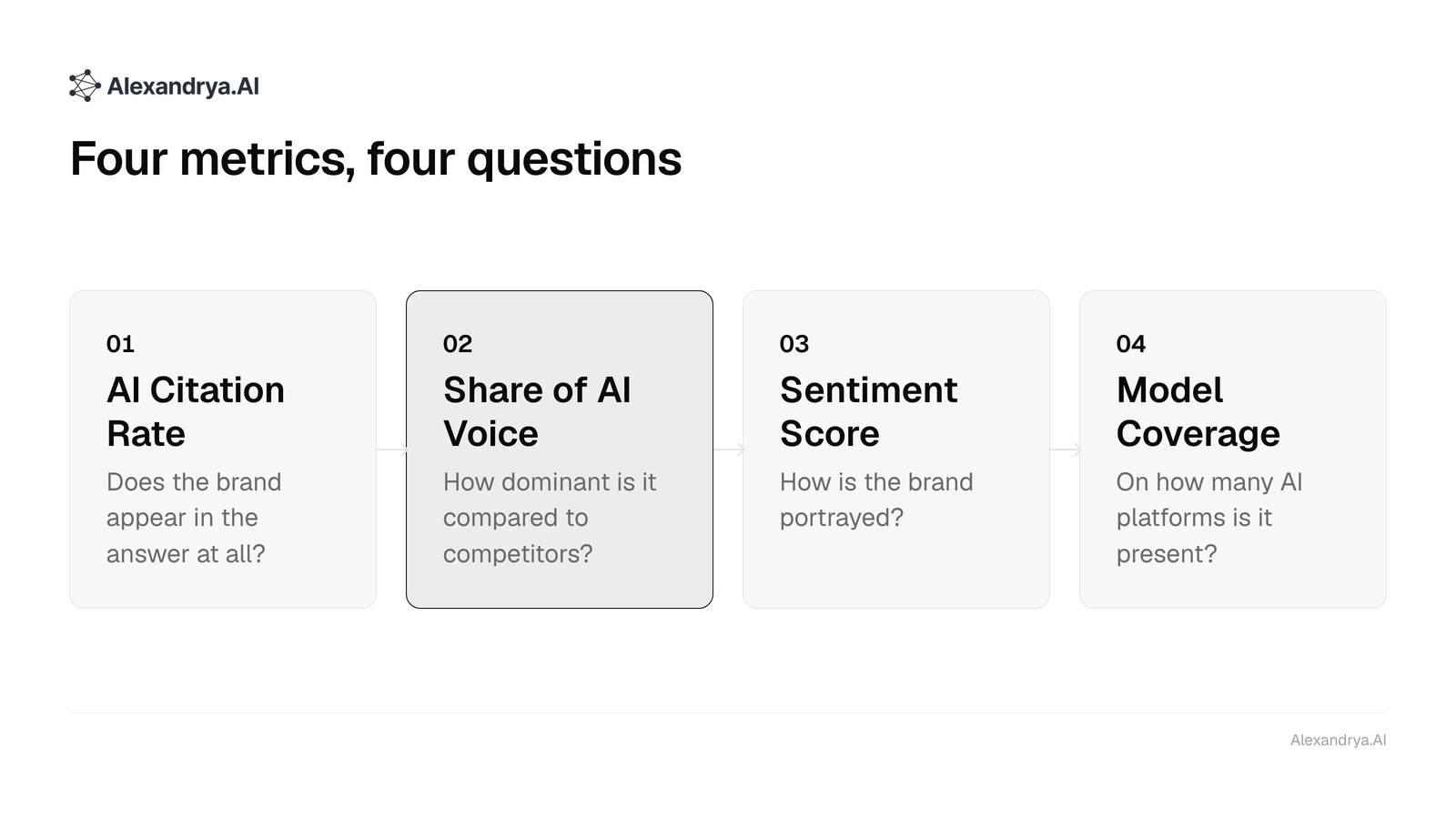
Citation Rate, Share of AI Voice, Sentiment Score, Model Coverage: the four core GEO KPIs.

Managing Director at Alexandrya.AI
Why Don't Standard SEO Metrics Work for GEO?
Rankings and traffic measure clicks. AI search delivers zero-click influence that SEO tools can't capture. When ChatGPT, Perplexity, or Google AI Overviews recommend a brand, the purchasing decision often happens before the first website visit. Position rank and organic traffic remain at zero while the brand is being actively shaped.
Traditional SEO metrics like keyword ranking, click-through rate, or Domain Authority were built for search engines that deliver result lists. Generative AI systems work differently: they synthesize information from thousands of sources and provide a direct answer. Whether your brand appears in that answer, whether it's portrayed positively, and across how many models: standard SEO tools don't measure any of that. GEO requires its own KPI framework.
Measuring the success of Generative Engine Optimization requires a completely distinct KPI framework, one that is not based on clicks or ranking positions. AI systems like ChatGPT, Perplexity, Google AI Overviews, and Gemini each independently decide whether and how they mention a brand. These decisions are driven by training data, real-time retrieval, and algorithmic relevance judgments, not by backlink count or page load speed. Brands that want to succeed in the AI era therefore need four specific metrics: AI Citation Rate (how often is the brand mentioned at all?), Share of AI Voice (how dominant is the brand compared to competitors?), Sentiment Score (how is the brand portrayed?), and Model Coverage (how many platforms include the brand?). Only these four KPIs together provide a complete picture of AI visibility and deliver actionable levers for improvement. (Source: Alexandrya.AI Benchmarks 2026)
What Are the Four Core KPIs of Generative Engine Optimization?
The four core GEO KPIs are AI Citation Rate, Share of AI Voice, Sentiment Score, and Model Coverage. Each metric measures a different dimension of AI visibility. Together they reveal how present, dominant, positive, and broadly distributed a brand is across AI responses. No single KPI is sufficient on its own; only the combination produces an actionable picture.
KPI 1: What Is AI Citation Rate?
AI Citation Rate refers to the share of relevant AI queries in which a brand is mentioned in the response. It is the most fundamental GEO metric: do I appear at all? A B2B company that tests 100 relevant queries and appears in 34 of them has a Citation Rate of 34%. According to Alexandrya.AI Benchmarks 2026, the median for B2B brands sits at 34%, while top performers (particularly in the cybersecurity segment) achieve 52% and above. Citation Rate is the starting point of every GEO audit and should be measured weekly, since AI responses can shift significantly within days.
KPI 2: What Is Share of AI Voice?
Share of AI Voice refers to the proportion of a brand's AI mentions relative to the total number of brand mentions across a defined query set. This metric is the most important competitive measure in the GEO framework. It shows not just whether a brand is mentioned, but how dominant it is compared to direct competitors. If your brand appears in 34 of 100 queries, competitor A in 52, and competitor B in 28, your Share of AI Voice is 29.8% (34 out of 114 total mentions). A rising Share of AI Voice is a reliable indicator that GEO measures are working. → What is AI Visibility
KPI 3: What Is Sentiment Score?
Sentiment Score refers to the quality of a brand's portrayal in AI responses, measured on a scale from negative through neutral to positive. A brand can be cited frequently and still underperform if AI systems describe it as expensive, difficult, or outdated. The Sentiment Score measures what AI systems say about a brand, not just whether they mention it. In practice, Alexandrya.AI distinguishes three dimensions: tonality (positive/neutral/negative), positioning (market leader vs. niche provider vs. alternative), and attribute accuracy (are the right strengths mentioned?). Particularly for complex B2B products, Sentiment Score is often more decisive than Citation Rate alone.
KPI 4: What Is Model Coverage?
Model Coverage refers to the number of AI platforms on which a brand regularly appears for relevant queries. Because ChatGPT, Perplexity, Google AI Overviews, and Gemini each use different sources, weightings, and algorithms, a brand visible on only one platform is significantly vulnerable. A shift in training data or an algorithm update can eliminate entire AI visibility overnight. Full Model Coverage means appearing on at least three of the four major platforms with a Citation Rate above the respective industry median. Alexandrya.AI tracks ChatGPT, Perplexity, Google AI Overviews, and Gemini in parallel as standard.
The 4 Core GEO KPIs at a Glance
B2B brands with full Model Coverage across four platforms achieve on average 2.3× higher Share of AI Voice values than platform-specific competitors (Alexandrya.AI Benchmarks 2026).
What Secondary GEO Metrics Complement the Four Core KPIs?
The four core KPIs provide the strategic picture. Secondary metrics pinpoint exactly where optimization is needed. Citation Position, Query Coverage, and Language Coverage are not replacement metrics but diagnostic ones that explain why a KPI has changed and where to focus next.
How Does Citation Position Affect Impact?
Citation Position refers to the rank of a brand mention within an AI response: first brand mentioned, second mention, or lower-order reference. In practice, first mention matters most: AI responses are built narratively, and the first brand named is perceived by readers as the implicit recommendation, even when the AI makes no explicit evaluation. Alexandrya.AI measures Citation Position automatically and reports it as a percentage of "First Mention" per query cluster.
What Does Query Coverage Measure?
Query Coverage refers to the proportion of all relevant industry queries for which a brand has any visibility (Citation Rate > 0). A high Citation Rate across a small query set can be misleading: a brand appearing in only three of 50 relevant queries has a Query Coverage of just 6%, despite a nominal 60% rate. Query Coverage reveals blind spots in the content portfolio and shows which topic areas generate no AI presence yet.
Why Is Language Coverage Critical for International Brands?
Language Coverage refers to a brand's presence across different language variants and market versions of AI queries. AI systems often respond to English and German queries with different source preferences and brand mentions. A brand that performs well in English-language queries may be nearly invisible in the German-speaking market. For B2B brands with international reach, Language Coverage is a critical early warning indicator.
How Do You Turn GEO KPIs Into a Dashboard?
A GEO dashboard should display the four core KPIs as weekly time series and break them down at the query-cluster level, not just as aggregated totals. Only the granular view reveals whether an improvement in Citation Rate reflects genuine growth or simply a single query type that happened to be queried more frequently.
The practical recommendation for dashboard design: four KPI cards at the top with week-over-week comparison, followed by a competitive matrix showing Share of AI Voice by platform and competitor, then a query-cluster heatmap. Alexandrya.AI provides this dashboard format automatically, including weekly tracking runs across ChatGPT, Perplexity, Google AI Overviews, and Gemini. → All Alexandrya.AI Features
What Are Typical Benchmark Values for Each Metric?
Benchmark values provide orientation but not judgment. The decisive comparison is always industry-specific, not global averages. According to Alexandrya.AI AI Visibility Benchmarks 2026, the following ranges apply for B2B brands:
AI Citation Rate: B2B median 34%, top performers (cybersecurity) 52%+, bottom quartile < 15%. Goal: reach at least the industry median, aim for top quartile over time.
Share of AI Voice: A healthy competitive position starts at 25% in a three-player market; market leadership begins at 40%+. Below 15% requires urgent action.
Sentiment Score: Above 70% positive mentions is strong; 50 to 70% is neutral-stable; below 50% positive requires targeted content corrections.
Model Coverage: Complete = 4/4 platforms with Citation Rate above industry median. 3/4 = good. 2/4 or fewer = elevated risk from platform concentration.
For direct industry comparison → AI Visibility Benchmarks.
How Often Should You Measure GEO KPIs?
GEO KPIs should be measured weekly because AI responses can shift significantly within days. Unlike traditional SEO metrics (where weekly measurement is optional and monthly tracking is adequate), AI systems react much faster to changes in source preferences, new training data, or algorithmic updates.
Weekly tracking: All four core KPIs across all platforms as the basis for operational action.
Monthly reporting: Aggregated trend analysis, competitive comparison, progress reporting to stakeholders. → GEO Audit Framework
Quarterly audit: Full GEO Audit Framework: update query sets, incorporate new competitors, strategic recalibration.
Alexandrya.AI runs automatic weekly tracking cycles and sends alerts for significant changes, without manual effort. → All Features
Track all GEO metrics automatically: start free with Alexandrya.AI →
Frequently asked questions
What is the difference between AI Citation Rate and Share of AI Voice?
AI Citation Rate measures in absolute terms how often a brand appears for relevant queries. Share of AI Voice measures in relative terms how dominant a brand is compared to competitors. Both metrics are necessary: a high Citation Rate alongside a low Share of AI Voice means competitors appear even more frequently.
Can I measure GEO KPIs without a specialized tool?
In principle yes, by manually testing queries across different AI platforms. In practice, this becomes too time-consuming for weekly tracking with more than 20 queries and multiple competitors. Specialized tools like Alexandrya.AI automate the entire process and deliver statistically reliable results.
Which GEO KPI is the most important?
Share of AI Voice is the most strategically important metric because it directly reflects competitive position. As a first entry point, however, AI Citation Rate is the right starting metric: it reveals whether there is any foundation for competitive optimization at all.
How long does it take for GEO measures to improve KPIs?
The first measurable changes typically appear after 4 to 8 weeks of intensive content optimization. Substantial improvements in Citation Rate and Share of AI Voice become visible after 3 to 6 months of consistent GEO work, as demonstrated by the ThyssenKrupp Schulte Case Study.
Is Sentiment Score truly measurable or is it subjective?
Sentiment Score is measured through structured analysis of AI response texts, using defined positive, neutral, and negative attributes per industry category. Alexandrya.AI uses a category-specific sentiment lexicon that accounts for both tonality and content positioning. The method is not fully objective, but it is reproducible and trend-stable.
How visible is your brand in AI?
Try Alexandrya.AI free for 7 days and see how ChatGPT, Gemini, Perplexity, AI Overviews and Copilot talk about your brand.
- 7 days free
- No credit card required
- All features included
- Cancel anytime
About the author
Talaal Max Habib
Managing Director at Alexandrya.AI
Talaal Max Habib has advised companies in industry, the Mittelstand and e-commerce on SEO and Generative Engine Optimization since 2015. With his team he built Alexandrya.AI, the Munich-based platform that measures how brands appear in ChatGPT, Perplexity and Gemini.
LinkedIn