Why your brand is not mentioned in AI answers and how to find the cause
If your brand is not mentioned in AI answers, the cause is usually blocked crawlers, indexing, inconsistent entity facts, missing passages or sources.
Managing Director at Alexandrya.AI
Your brand is not mentioned in AI answers when ChatGPT, Perplexity or Google are not allowed to fetch it, cannot place it clearly or cannot find it in any suitable source. The usual causes are blocked AI crawlers, missing indexing, conflicting entity facts, no citable passages and no presence on the third-party sources cited for your prompts. Check them in exactly that order.
Alexandrya.AI is our own product, and we know the problem first-hand. Every day, it runs the German prompt “marken werden in ai antworten nicht genannt warum” (“why are brands not mentioned in AI answers”) in five AI systems. In the scan on 27 October 2026, none of the five answers named Alexandrya.AI. Across all tracked prompts, the brand is named in the answer text for 10 of 43, cited as a source for 11 and listed first in the source list for 4 (Alexandrya.AI's own measurement, as of 27 October 2026, 43 tracked prompts). We apply the check order in this guide to ourselves as well.
Why are brands not mentioned in AI answers?
Brands go unmentioned in AI answers for five checkable reasons: the platform's search crawler is blocked, the page is not indexed, the facts about the brand contradict each other, the brand's own site has no paragraph that answers the question directly, or the brand is absent from the pages cited for that prompt. A sixth reason is no fault at all: the brand does not fit the question.
Rule out the sixth reason first; it saves work. A maker of industrial pumps missing from the prompt “best CRM for start-ups” has no visibility problem. You can spot a relevance problem when no direct competitor appears in the answer either. If two or three competitors show up and you do not, it is a visibility problem.
Brand not mentioned in AI answers: the order to check
Each stage depends on the one before it. A perfect passage achieves nothing while OAI-SearchBot cannot read the page, and new guest articles help little if every source describes your brand differently. Checking access takes hours, passages and cited sources take weeks or months. Starting at the top finds cheap faults first.
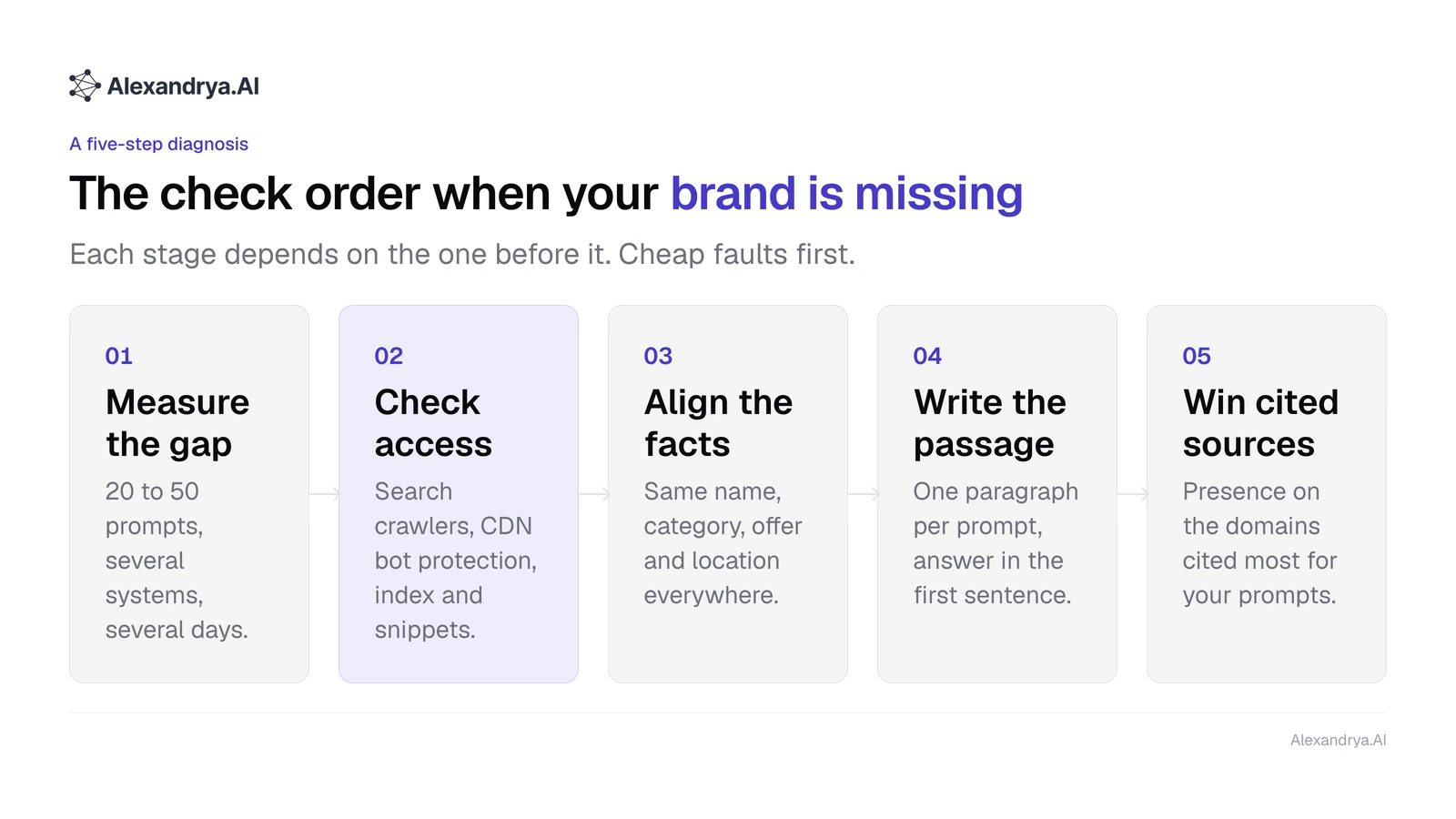
| Step | What you check | How you spot the fault | Time to fix (own estimate) |
|---|---|---|---|
| 1. Measure the gap | Mentions and citations across 20 to 50 prompts, several AI systems, several days | Competitors are named, your brand is not | 1 to 3 days |
| 2. Check access | robots.txt, CDN bot protection, Google index, snippet eligibility | Status code 403 for search crawlers in your logs, page not indexed, nosnippet set | hours |
| 3. Align the facts | Name, category, offer and location on your site, profiles and directories | Asking about your brand directly returns wrong or vague answers | a few days |
| 4. Write the passage | One paragraph per target prompt that answers the question in its first sentence | Other sites with the question in their title get cited | 1 to 4 weeks |
| 5. Win cited sources | Presence on the most-cited domains for your prompts | Your brand is absent from the domains in the source list | several months |
A complete blackout in a single system, such as no mentions at all in ChatGPT while Perplexity looks reasonable, points to step 2 first, because access blocks apply per platform. If the brand is missing evenly everywhere, the cause is more likely in steps 3 to 5.
Good Google rankings, still no mention in the AI answer
A strong Google ranking and a mention in an AI answer are two different outcomes. A ranking scores one page for one search term. An AI answer is assembled from passages across several sources and names the brands that appear in those passages. A Semrush study published on 9 June 2026 found that 61.7% of 3,981 domain appearances were citations without the brand being named in the answer.
Nightwatch sums up its approach on its AI brand monitoring page as “Fix the ranking, fix the mention” (accessed 27 October 2026). For Google AI Overviews and AI Mode the direction is right, because according to Google's documentation only pages that are indexed and eligible to show with a snippet are used there. For ChatGPT, OAI-SearchBot access matters too, and your name only appears in the answer text if the cited sources name you. Our own figures diverge in the same way: cited for 11 of 43 prompts, named for 10.
Do crawler settings block AI visibility?
Crawler settings block AI visibility as soon as a platform's search crawler is shut out. For ChatGPT search that crawler is OAI-SearchBot, for Perplexity it is PerplexityBot, and for search in Claude it is Claude-SearchBot. OpenAI and Anthropic describe GPTBot and ClaudeBot as crawlers for training data and name separate crawlers for search. OpenAI says ChatGPT search takes about 24 hours to reflect a robots.txt change.
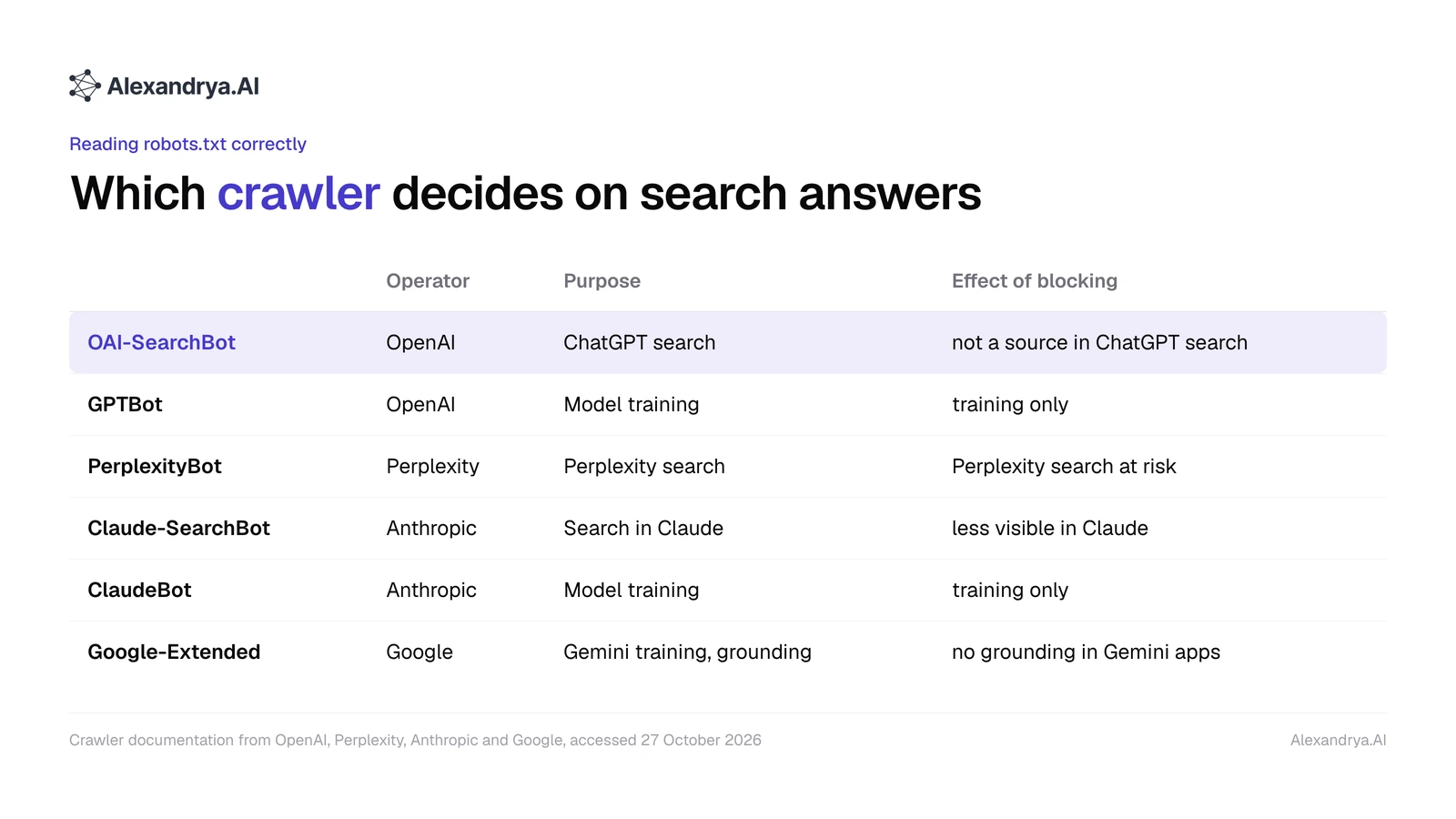
| Crawler | Operator | Purpose according to documentation | Effect of blocking |
|---|---|---|---|
| OAI-SearchBot | OpenAI | Show websites in ChatGPT search | no source links in ChatGPT search answers, navigational links only |
| GPTBot | OpenAI | Content for training foundation models | content excluded from training, search unaffected |
| PerplexityBot | Perplexity | Surface and link websites in Perplexity search results | Perplexity recommends allowing it so your site appears in results |
| Claude-SearchBot | Anthropic | Index for search results in Claude | lower visibility in Claude search results |
| ClaudeBot | Anthropic | Content for model training | future content excluded from training |
| Google-Extended | robots.txt token for Gemini training and grounding | no effect on Google Search inclusion or ranking |
Sources: OpenAI crawler overview, Perplexity crawler docs, Anthropic help article on crawlers and Google's crawler overview, all accessed 27 October 2026. The table shows an asymmetry. Blocking every OpenAI bot out of concern about training data also removes you from ChatGPT search. Blocking only GPTBot keeps you visible there.
What Google-Extended controls and what it doesn't
Google-Extended is a robots.txt token with no user agent of its own. According to Google's crawler overview, it controls whether crawled content is used to train future Gemini models and for grounding in the Gemini apps and on Vertex AI. It has no effect on inclusion in Google Search or on ranking. AI Overviews and AI Mode follow the normal Search rules: page indexed, snippet allowed, limited if needed with nosnippet, data-nosnippet, max-snippet or noindex. Blocking Google-Extended therefore does not remove you from AI Overviews, but according to Google it takes your content out of grounding in the Gemini apps.
CDN bot protection can block despite an open robots.txt
An open robots.txt does not guarantee access. Since 1 July 2025, Cloudflare has blocked AI crawlers by default and, according to its press release, asks every new domain during setup whether to allow them. Check your server or CDN logs too: if OAI-SearchBot, PerplexityBot or Claude-SearchBot receive a 403 status code or a challenge page, your infrastructure is blocking them whatever robots.txt says. Access also covers the delivered HTML: a crawler without rendering cannot read content that only loads through JavaScript.
Are your entity facts structured and consistent?
Conflicting entity facts make it harder for a language model to assign a brand to a category. Entity facts are the name and its spelling, category, offer, audience, location and founding year. If your website calls you software, LinkedIn an agency and a directory a consultancy, a model has three categories to choose from. Compare your website, legal notice, LinkedIn, Google Business Profile, review sites and any Wikipedia entry side by side.
Two prompts give you the fastest test. Ask ChatGPT and Perplexity about your brand by name, then about your category, for example “Which dosing pump suppliers operate in the UK”. If the answer about the brand is right and only the category mention is missing, the problem lies with passages and third-party sources. If the answer about the brand is already wrong, outdated or thin, the work starts with the facts. What to do when an AI states wrong facts about your brand is covered in Brand monitoring in AI answers.
Structured data helps with alignment but does not replace it. Google explicitly lists no special schema.org markup as a requirement for AI Overviews and AI Mode, and only asks that existing structured data matches the visible text.
Is there a citable passage on your site for the question?
A citable passage is a paragraph that answers a question in its first sentence, spells out the subject and contains a checkable fact; in our articles such paragraphs run to 40 to 80 words. AI answers tend to draw on pages that deal with exactly the sub-question asked. Without such a paragraph for a target prompt, the system cites another site, even if your domain is better known.
In the scan on 27 October 2026, Google AI Mode cited exactly three pages for the prompt “marken werden in ai antworten nicht genannt warum”: comdaily.ai, rankinllm.ai and a LinkedIn article. All three put the question in their title, one in German and two in English. Perplexity cited ten pages for the same prompt, including sistrix.de, t3n.de and several tool vendors' blogs (Alexandrya.AI's own measurement).
The test takes about an hour. Take your ten most important target prompts and look on your website for the paragraph that answers each one in its first sentence. Where you find none, write it: the question as a subheading, the answer in the first sentence, then condition, figure and exception. The other factors that make a brand citable are covered in What makes a brand citable in AI responses.
Are you missing from the third-party sources AI cites most?
A brand can be missing from AI answers even with a good website when it is absent from the pages cited for its prompts. In Alexandrya.AI's own measurement (as of 27 October 2026, 43 tracked prompts), seranking.com leads with 2,434 citations, ahead of youtube.com with 1,785, blog.hubspot.de with 1,027 and technologyadvice.com with 906. A brand absent from these domains depends on its own website alone for those prompts.
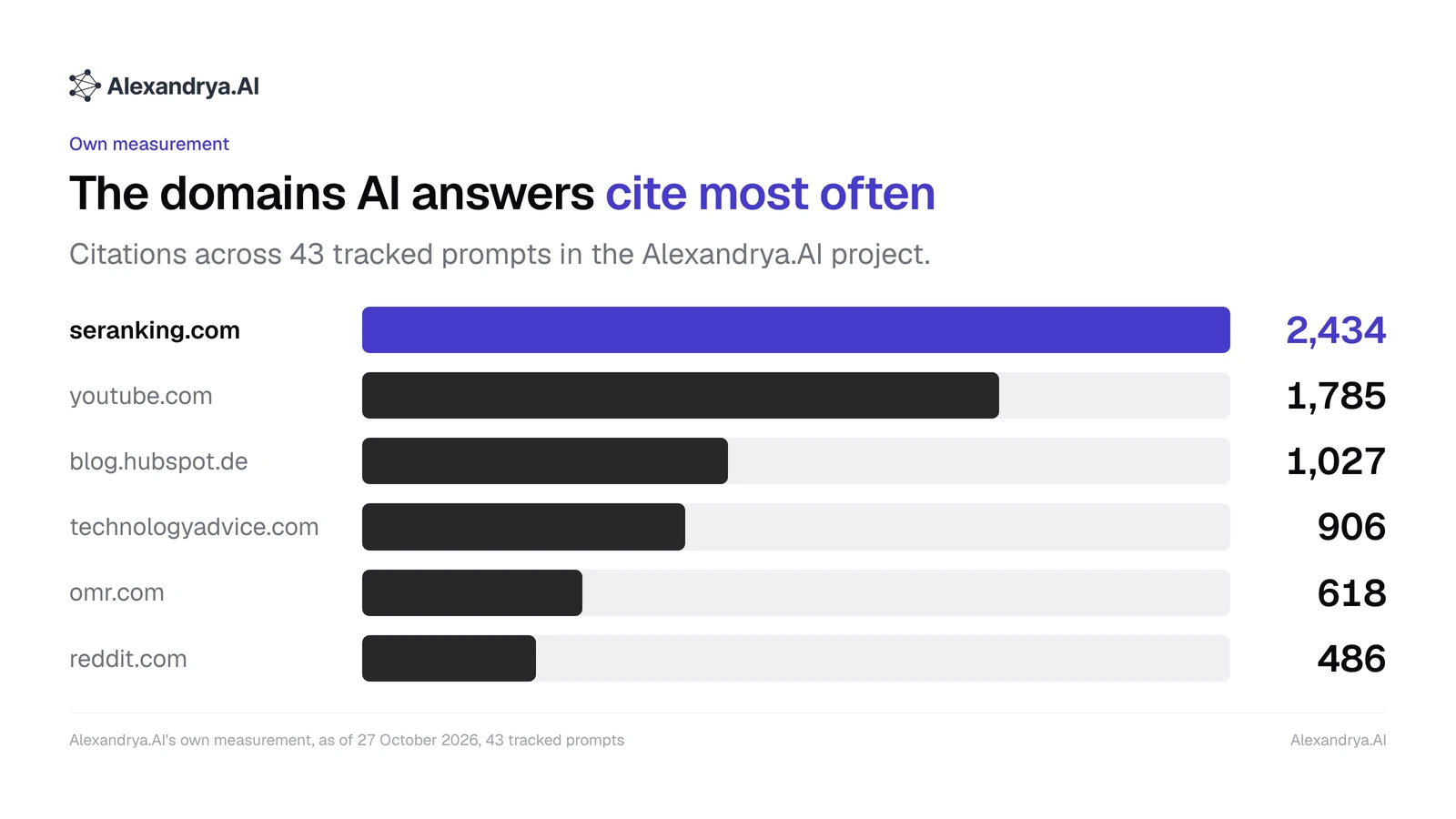
Next come omr.com with 618, reddit.com with 486 and linkedin.com with 327 citations. Position matters as well as volume: technologyadvice.com sits at an average position of 2.25 in the source list, seranking.com only at 4.37.
You cannot get onto competitor sites such as seranking.com; there, only your own material of the same kind helps: comparisons, pricing overviews and guides on your website. Trade media, forums, video platforms and comparison portals are within reach: with data for editors, answers in forums, your own videos and maintained profiles. How much the cited sources differ between ChatGPT, Perplexity and Google is shown in the per-platform AI source analysis.
How to measure brand visibility in ChatGPT answers across prompts and platforms
You measure brand visibility in ChatGPT answers with a fixed prompt set that you run on several days in several AI systems and evaluate separately for mentions and citations. A single prompt on a single day is a sample of one, because answers differ between systems and can change from day to day. For a first diagnosis, 20 to 50 prompts from real customer questions are enough, plus three to five direct questions about your brand.
Tracking AI answers without a tool
Tracking AI answers means sending fixed prompts to several AI systems at a fixed rhythm and checking every answer for mentions, position and cited sources. Without a tool, a spreadsheet with one row per prompt, system and day is enough. Each run has five steps.
- Collect prompts: questions from your sales team, Search Console queries rewritten as full questions, comparison questions with competitor names
- Run every prompt in ChatGPT, Perplexity, Gemini, Google AI Mode and Microsoft Copilot, each time in a new chat without history
- Log for each answer: brand named or not, position in the list, own domain cited or not, all cited domains
- Repeat the run on at least three days
- Calculate the mention rate: answers with a mention divided by all answers, per system and against two or three competitors
The effort grows quickly. Thirty prompts in five systems over three days produce 450 answers to read and log. That works for a one-off diagnosis, much less so for ongoing measurement.
Tools that measure brand visibility in ChatGPT answers
As of 2 November 2026, per the vendors' own pages: Alexandrya.AI runs 50 prompts a day across three selectable models on its Starter plan for €79 a month. Ahrefs Brand Radar tracks mentions and citations in ChatGPT, Perplexity, Gemini, Copilot, AI Overviews and AI Mode. Every paid Ahrefs plan includes a small custom prompt allowance (5 a day on Lite), and larger packages start at €47 a month. Semrush's AI Visibility Toolkit costs $99 a month according to the Semrush knowledge base and names ChatGPT and Google AI Mode as examples. Nightwatch tracks ChatGPT, Claude, Gemini, Perplexity and Copilot daily and lists no prices on its product page. For costs per answer, see AI visibility tools under €100.
Where Alexandrya.AI helps with the diagnosis and where it doesn't
Alexandrya.AI is an AI visibility tool from Munich that measures brand mentions in ChatGPT, Gemini, Perplexity and Bing Copilot and turns them into content and citation tasks. It covers four steps of the check order: mention, citation and source-list position per prompt (step 1), Brand Perception with categories, sentiment, strengths, gaps and supporting quotes (step 3), and the analysis of cited sources and domains with an action plan of content briefs, outreach targets and quick wins (steps 4 and 5). Every recommendation becomes a task with the status Open, In Progress or Done.
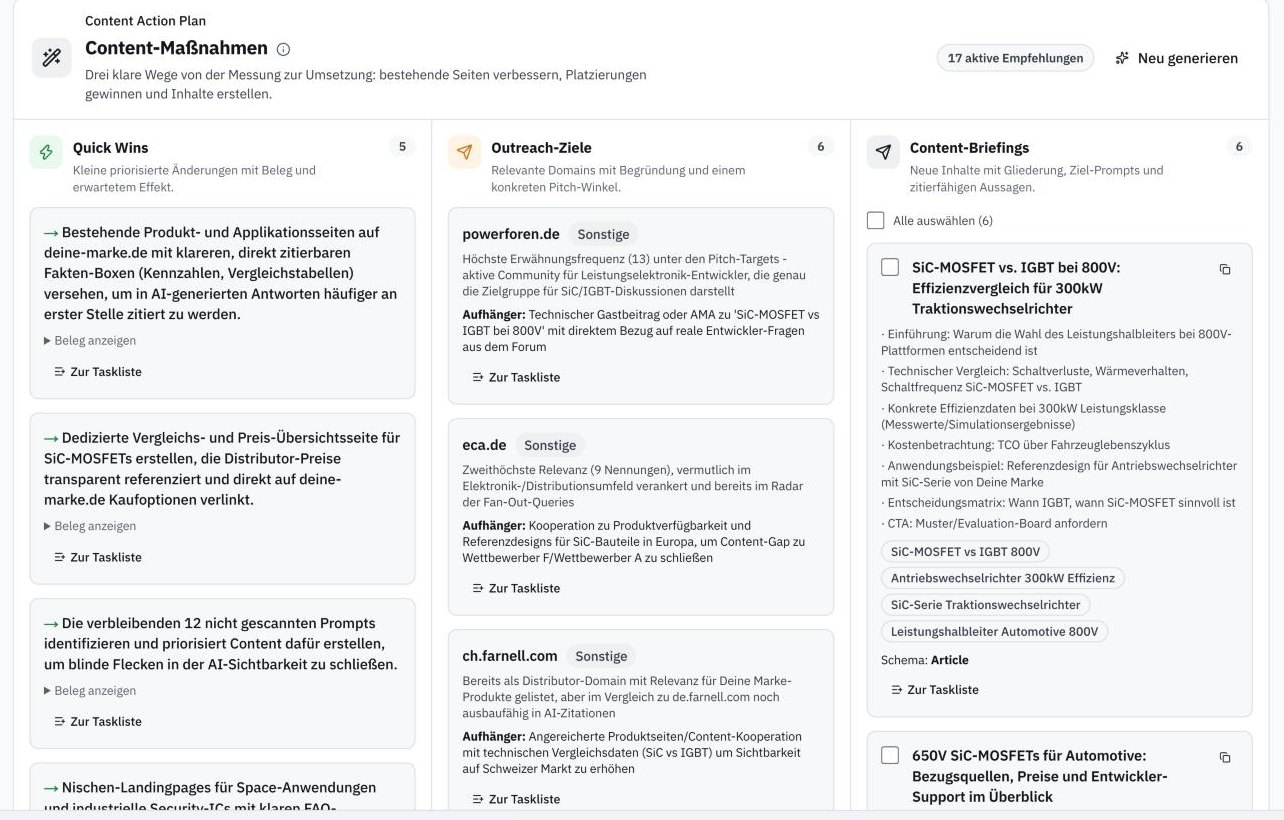
For step 2, Alexandrya.AI is the wrong tool. It does not analyse crawler logs, does not check robots.txt and does not send alerts when something changes. Check access and indexing with Google Search Console, your server or CDN logs and your host's bot settings. All plans are listed on the pricing page. A full audit process from prompt set to progress tracking is described in the GEO audit framework.
Frequently asked questions
Is my brand invisible, or just not relevant to the prompt?
Look at the competitors in the same answer to tell the two apart. If the AI names two or three direct competitors and not you, you have a visibility problem that the check order can narrow down. If it names no provider like you at all, the prompt does not fit your offer and belongs out of your prompt set.
Why does ChatGPT mention my brand but Perplexity doesn't?
ChatGPT, Perplexity and Google AI Mode build their answers from different sources. In Alexandrya.AI's scan on 27 October 2026, ChatGPT linked to semrush.com, searchengineland.com and keygrip.ai for the prompt on unmentioned brands, Perplexity to ten other pages and Google AI Mode to three more. A brand found in only one source pool appears in only one system.
Is allowing GPTBot in robots.txt enough to appear in ChatGPT?
Allowing GPTBot on its own does nothing for ChatGPT search. OpenAI describes GPTBot as the crawler for training foundation models, while OAI-SearchBot handles search, and each setting works independently. Allow OAI-SearchBot if you want to appear as a source in ChatGPT search answers, and decide on GPTBot separately, based on whether your content may be used for training.
How long until a fix shows up in AI answers?
The time depends on the stage you fix. OpenAI says ChatGPT search reflects a robots.txt change for OAI-SearchBot in about 24 hours. For changed snippet settings, Google says recrawling can take anywhere from several days to several months. New mentions on third-party sites take longer, because they have to be published and then crawled.
How much does it cost to track brand mentions in AI answers?
Tracking brand mentions by hand mainly costs time: 30 prompts in five systems over three days add up to 450 answers to read and log. Tools, according to vendor pages on 2 November 2026, cost €79 a month for Alexandrya.AI Starter, from €47 for extra custom prompts in Ahrefs Brand Radar and $99 for the Semrush AI Visibility Toolkit.
Free GEO audit for your brand
Want to see which of your prompts leave your brand out, and which domains get cited in its place? During the free seven-day trial, Alexandrya.AI runs your own prompts with no credit card and shows mention, citation and source list per AI system. Start your free GEO audit
Frequently asked questions
Is my brand invisible, or just not relevant to the prompt?
Look at the competitors in the same answer to tell the two apart. If the AI names two or three direct competitors and not you, you have a visibility problem that the check order can narrow down. If it names no provider like you at all, the prompt does not fit your offer and belongs out of your prompt set.
Why does ChatGPT mention my brand but Perplexity doesn't?
ChatGPT, Perplexity and Google AI Mode build their answers from different sources. In Alexandrya.AI's scan on 27 October 2026, ChatGPT linked to semrush.com, searchengineland.com and keygrip.ai for the prompt on unmentioned brands, Perplexity to ten other pages and Google AI Mode to three more. A brand found in only one source pool appears in only one system.
Is allowing GPTBot in robots.txt enough to appear in ChatGPT?
Allowing GPTBot on its own does nothing for ChatGPT search. OpenAI describes GPTBot as the crawler for training foundation models, while OAI-SearchBot handles search, and each setting works independently. Allow OAI-SearchBot if you want to appear as a source in ChatGPT search answers, and decide on GPTBot separately, based on whether your content may be used for training.
How long until a fix shows up in AI answers?
The time depends on the stage you fix. OpenAI says ChatGPT search reflects a robots.txt change for OAI-SearchBot in about 24 hours. For changed snippet settings, Google says recrawling can take anywhere from several days to several months. New mentions on third-party sites take longer, because they have to be published and then crawled.
How much does it cost to track brand mentions in AI answers?
Tracking brand mentions by hand mainly costs time: 30 prompts in five systems over three days add up to 450 answers to read and log. Tools, according to vendor pages on 2 November 2026, cost €79 a month for Alexandrya.AI Starter, from €47 for extra custom prompts in Ahrefs Brand Radar and $99 for the Semrush AI Visibility Toolkit.
How visible is your brand in AI?
Try Alexandrya.AI free for 7 days and see how ChatGPT, Gemini, Perplexity, AI Overviews and Copilot talk about your brand.
- 7 days free
- No credit card required
- All features included
- Cancel anytime
About the author
Talaal Max Habib
Managing Director at Alexandrya.AI
Talaal Max Habib has advised companies in industry, the Mittelstand and e-commerce on SEO and Generative Engine Optimization since 2015. With his team he built Alexandrya.AI, the Munich-based platform that measures how brands appear in ChatGPT, Perplexity and Gemini.
LinkedIn