Seven AI citation tracking tools that show which URLs ChatGPT, Perplexity and Google cite
AI citation tracking tools compared: seven options that show which URLs ChatGPT, Perplexity and Google cite, with prices from €29 and our own data.

Managing Director at Alexandrya.AI
AI citation tracking tools store the source list of every AI answer, with URL, domain and position. As of 27 October 2026, Peec AI documents this analysis in the most detail, Otterly.AI is the cheapest entry at €29, and Alexandrya.AI turns cited domains into an outreach list with tasks. Semrush and Ahrefs add citations to their SEO suites, while Profound sells enterprise contracts after a free trial week.
Our assessment rests on what each vendor publishes about pricing and features, accessed on 27 October 2026, and is not a hands-on test. Alexandrya.AI is our own product. Our agency, NX Digital, used Peec AI in client projects from autumn 2025 to spring 2026; we have not used the other tools. How each platform builds its source list is covered in our source analysis by platform. This piece is about the tools.
Citation tracking reads the source list, mention tracking reads the answer
Citation tracking records which URLs an AI answer links to as sources, where they sit in the source list and which domain they belong to. Mention tracking only checks whether a brand name appears in the answer text. The two numbers drift apart: in Alexandrya.AI's own measurement (as of 27 October 2026, 43 tracked prompts), the brand was named in 10 prompts, cited as a source in 11 and listed first in the source list in 4.
For improving your own visibility, the cited sources are the more useful half. A mention tells you a model knows your brand. A citation tells you which page it read to say so, and therefore where to act: on your own site, or on someone else's domain that could write about you. If you want the mention side as well, our guide to tracking brand mentions in AI search covers it.
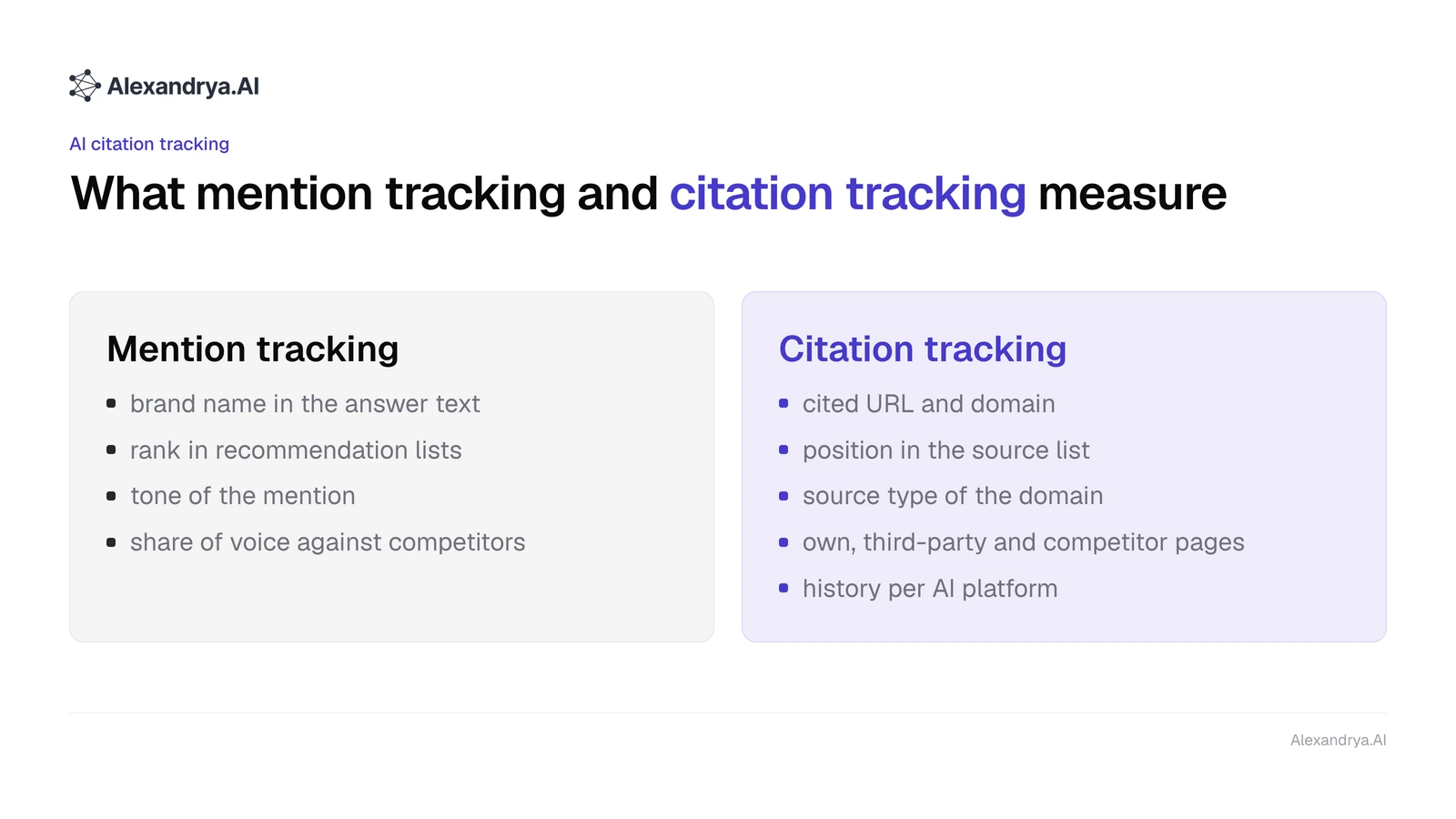
Mention tracking and citation tracking read different parts of the same AI answer. Alexandrya.AI's own classification, October 2026.
In short, mention tracking measures the brand name in the answer text, its rank in recommendation lists, the tone and the share of voice against competitors. Citation tracking measures the cited URL and domain, the position in the source list, the source type, whether the page is yours, a third party's or a competitor's, and how all of this changes per platform over time.
Six fields every citation report needs
A citation report is only useful if it records six things for every citation: the exact URL, the domain, the position in the source list, the type of domain, the AI platform and whether the page is yours, a competitor's or a third party's. Without the URL you cannot tell which article is being cited. Without the position you cannot tell whether the link sits at the top of the answer or in a footnote below it.
- URL: a domain such as hubspot.com has thousands of pages, and outreach needs the one that gets cited.
- Domain: summed across many prompts, it shows which sites a model leans on again and again.
- Position: a citation in slot 1 and one in slot 28 count the same in a total, but they are not equally visible.
- Source type: a trade publication, a comparison site, a competitor's blog and a Reddit thread each need a different response.
- Platform: ChatGPT, Perplexity, Gemini, Google AI Mode and Copilot usually cite different domains for the same question.
- Ownership: only once your own, third-party and competitor pages are tagged can you see which sources name competitors but not you.
History comes on top. Only a tool that stores answers with a date can show when someone else's page pushed yours out. We judge the tools below on these points and on price.
One prompt from our own project shows how much these fields change the picture. On 27 October 2026, "what are the best ai search monitoring tools" ran on five platforms:
| Platform | Entries in the source list | Counted as citations | Domain in position 1 |
|---|---|---|---|
| ChatGPT | 40 | 8, across 4 domains | technologyadvice.com |
| Perplexity | 10 | 10 | olostep.com |
| Google AI Mode | 6 | 6, across 5 domains | otterly.ai |
| Microsoft Copilot | 5 | 5 | aeovision.ai |
| Gemini | 4 | 4 | nightwatch.io |
Source: Alexandrya.AI's own measurement, scan of 27 October 2026. Only entries linked in the answer text count as citations.
Together, the five platforms linked 33 entries across 24 domains. No domain appeared on more than two platforms, and each platform put a different domain in position 1. The counting rule matters most on ChatGPT: 32 of its 40 entries were footnotes with no link in the text, and the four linked domains each appeared twice, once with utm_source=chatgpt.com attached. A tool that counts the raw list reports 21 domains for this single answer; counted by in-text link, there are 4.
Which tools show which URLs AI answers cite?
As of 27 October 2026, seven tools publicly document which URLs AI answers cite: Alexandrya.AI, Peec AI, Otterly.AI, Promptwatch, Profound, Ahrefs Brand Radar and Semrush's AI Visibility Toolkit. Entry prices run from €29 a month at Otterly.AI to custom enterprise contracts at Profound. The table only contains values every vendor publishes; how deep each source analysis goes is covered tool by tool further down.
| Tool | Entry price per month | Prompts on entry plan | AI platforms on entry plan | Seats | Trial | Export and integrations |
|---|---|---|---|---|---|---|
| Alexandrya.AI | €79 | 50 | 3 of your choice, such as ChatGPT, Perplexity, Google AI Mode | unlimited | 7 days, no credit card | MCP from €199, API on Enterprise |
| Peec AI | €85 | 50 | 3 of your choice; Perplexity listed as an add-on model | unlimited | free, length not stated | CSV and MCP on all plans, API from €205 |
| Otterly.AI | €29 | 15 | ChatGPT, AI Overviews, Perplexity, Copilot; more as paid add-ons | unlimited | 7 days, 50 prompts, no credit card | CSV; API and MCP from €189 |
| Promptwatch | €85 | 50, up to 6,000 responses | all supported models | 1 | 7 days | MCP and API on all plans |
| Profound | no public price | 50 during the trial | trial: ChatGPT, Gemini, AI Overviews | unlimited | 7 days free | CSV, JSON and API on Enterprise only |
| Ahrefs Brand Radar | from €47 (custom prompts), index from €179 | 2,500 checks | AI Overviews, AI Mode, ChatGPT, Perplexity, Copilot, Gemini; Claude with custom prompts only | not stated | not stated | API and MCP from Ahrefs Lite (€119) |
| Semrush AI Visibility Toolkit | $99 | 25 | ChatGPT, Google AI Mode | one licence per user | none | CSV, 10 exports a day |
The seats column is the one to watch. Promptwatch includes one seat on its entry plan, and Semrush charges $99 for every additional licence. If content, PR and SEO share one outreach list, you need a bigger Promptwatch plan or pay per head at Semrush. Alexandrya.AI, Peec AI, Otterly.AI and Profound set no seat limit.
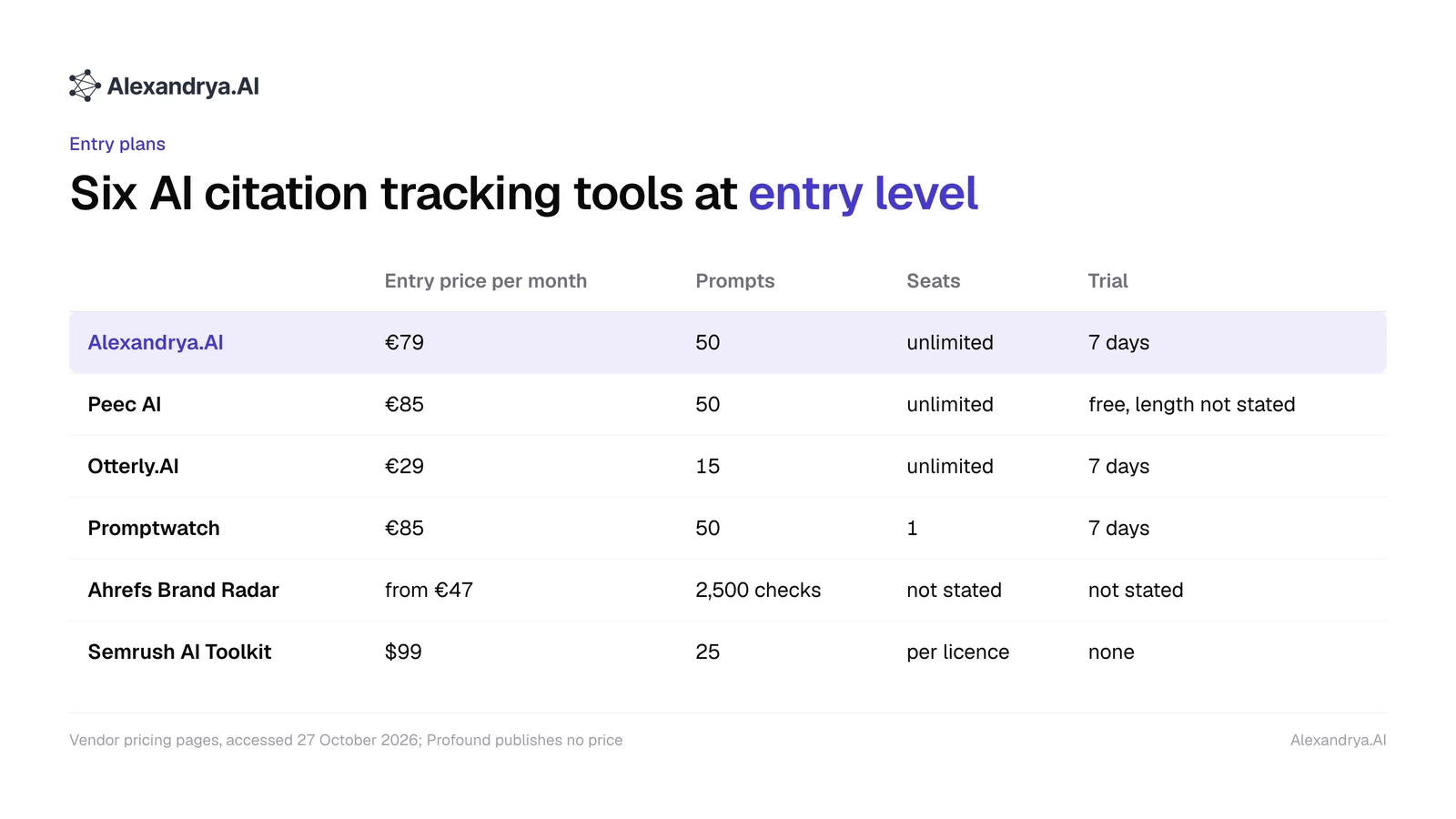
Entry plans of six AI citation tracking tools, vendor pricing pages accessed on 27 October 2026. Profound publishes no price.
How the seven AI citation tracking tools compare in detail
Peec AI shows citations down to the single URL
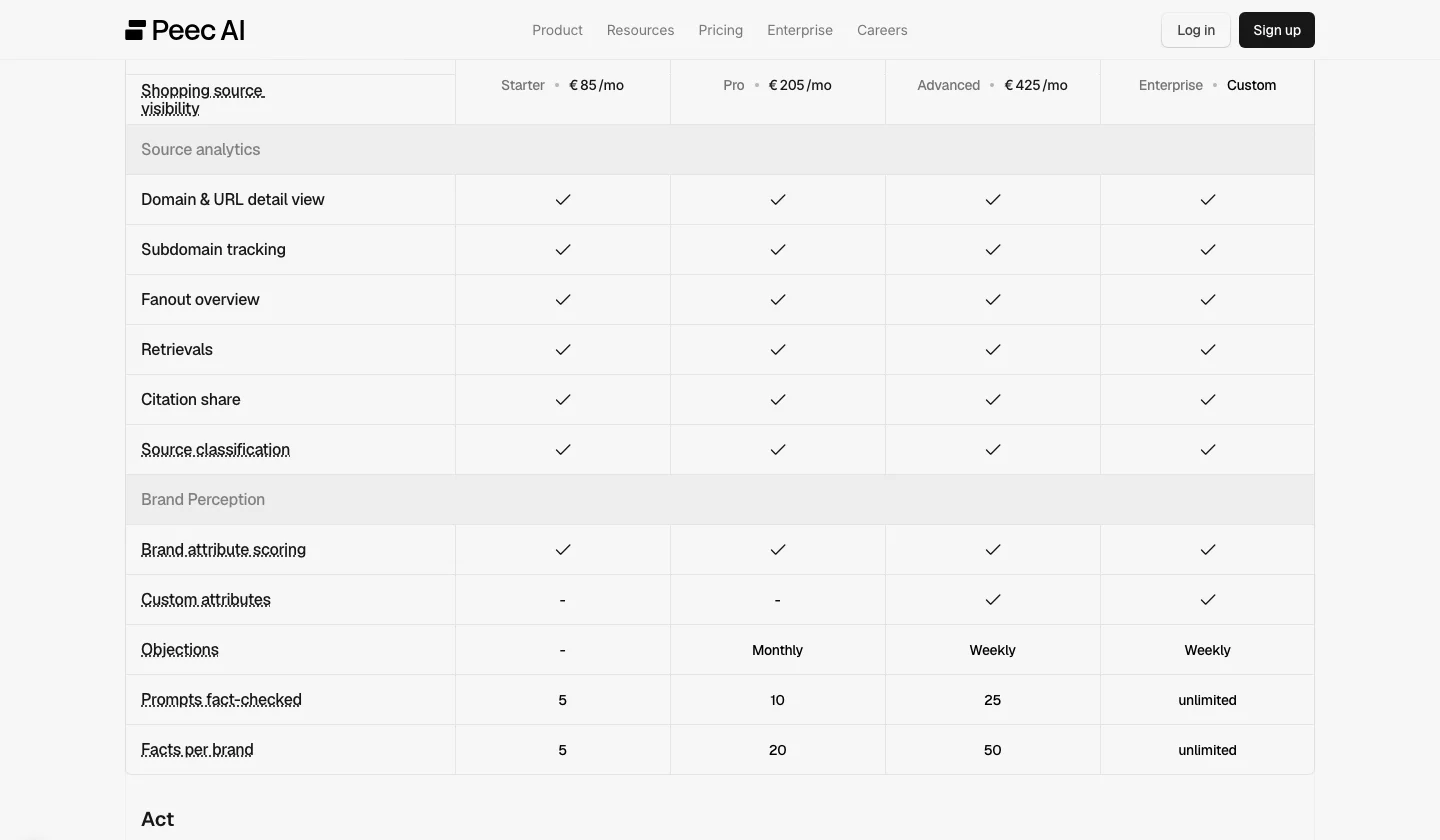
Of the seven tools, Peec AI documents its source analysis in the most detail as of 27 October 2026. On the Starter plan at €85 a month with 50 prompts, the URL table in the Peec AI documentation shows how often each page was retrieved and cited in the answer, its average citation position, its page type, such as listicle or comparison, and its domain type (accessed 27 October 2026).
A gap analysis lists sources that name competitors but not you, down to URL level, and crawl insights on AI bots are included from Starter. Perplexity only appears in the pricing table under Enterprise and as an add-on model, and the API starts at €205. When we used Peec AI between autumn 2025 and spring 2026, we missed an overview of which sources were actually missing and what to do first. Peec AI has since added a gap analysis and ranked recommended actions, so that criticism refers to that period. Peec AI suits SEO teams that want to analyse sources themselves in depth.
Otterly.AI is the cheapest way in
Otterly.AI costs €29 a month on its Lite plan for 15 prompts on ChatGPT, Google AI Overviews, Perplexity and Copilot, with citation tracking included. According to the Otterly.AI features page, the tool checks every cited domain and URL daily, follows changes in link position over time and exports prompts and citations as CSV (accessed 27 October 2026).
Fifteen prompts will tell you whether you are cited at all, but they cannot cover a whole product category. Google AI Mode and Gemini cost extra, and API and MCP access start with the Standard plan at €189. The features page does not describe a classification by source type. Prices and limits are broken down in our Otterly.AI review.
Promptwatch turns citation data into new content
Promptwatch starts at €85 a month for 50 prompts and 6,000 responses and queries all supported models on its entry plan, including ChatGPT, Perplexity, Claude, Gemini and Google AI Mode. Its citation analytics cover cited pages, including Reddit threads and YouTube videos. Crawler logs and content agents are added from the Professional plan at €205 (Promptwatch pricing page, accessed 27 October 2026).
The Essential plan includes a single seat. Promptwatch suits teams that want citation data turned straight into articles and page refreshes.
Profound keeps raw citation data for enterprise contracts
As of 27 October 2026, Profound offers a free trial week with 50 prompts on ChatGPT, Gemini and Google AI Overviews, followed by enterprise contracts and, for agencies, an Agency Growth plan, neither with a public price. The Profound API documentation describes citations queried at page level and filtered by categories such as owned, competition, social, earned media and press wire (accessed 27 October 2026).
Enterprise contracts include up to nine answer engines, CSV and JSON exports and the API; the trial week includes none of these. Profound fits large companies with a data team that feeds citations into existing reporting.
Ahrefs Brand Radar measures citations without a prompt list of your own
Ahrefs Brand Radar measures citations in two ways. Its AI Visibility Index draws, by Ahrefs' account, on more than 500 million prompts and starts at €179 a month with AI Overviews and AI Mode, or €654 with all models. Custom prompts start at €47 for 2,500 checks a month, and every paid Ahrefs plan includes a small allowance (5 prompts a day on Lite). Ahrefs counts a citation whenever an AI answer links to your pages or domains (Ahrefs Brand Radar page, accessed 29 October 2026).
The index is re-run monthly and reported over 90 days, so only custom prompts give you daily figures. Brand Radar fits teams already on Ahrefs that want to size up their market without writing a prompt list first.
Semrush lists source opportunities in its AI Visibility Toolkit
Semrush sells its AI Visibility Toolkit for $99 a month for one project with 25 prompts, with prompt tracking on ChatGPT and Google AI Mode. According to the Semrush help page on the Visibility Overview report, the report shows cited sources, your own cited pages and source opportunities, meaning sources that name competitors but not you (accessed 27 October 2026).
Each additional user licence costs another $99, according to the Semrush help page on the AI Toolkit. Perplexity is not on the platform list, and the toolkit has no free trial. For teams that already work in Semrush, it is the shortest route to a first outreach list.
Alexandrya.AI turns cited domains into an outreach list
Alexandrya.AI is an AI visibility tool from Munich that measures brand mentions in ChatGPT, Gemini, Perplexity and Bing Copilot and turns them into content and citation tasks. Its sources view shows which domains and pages the models cite, how often and at which average position, grouped by source type such as competitor, own, editorial, social or community.
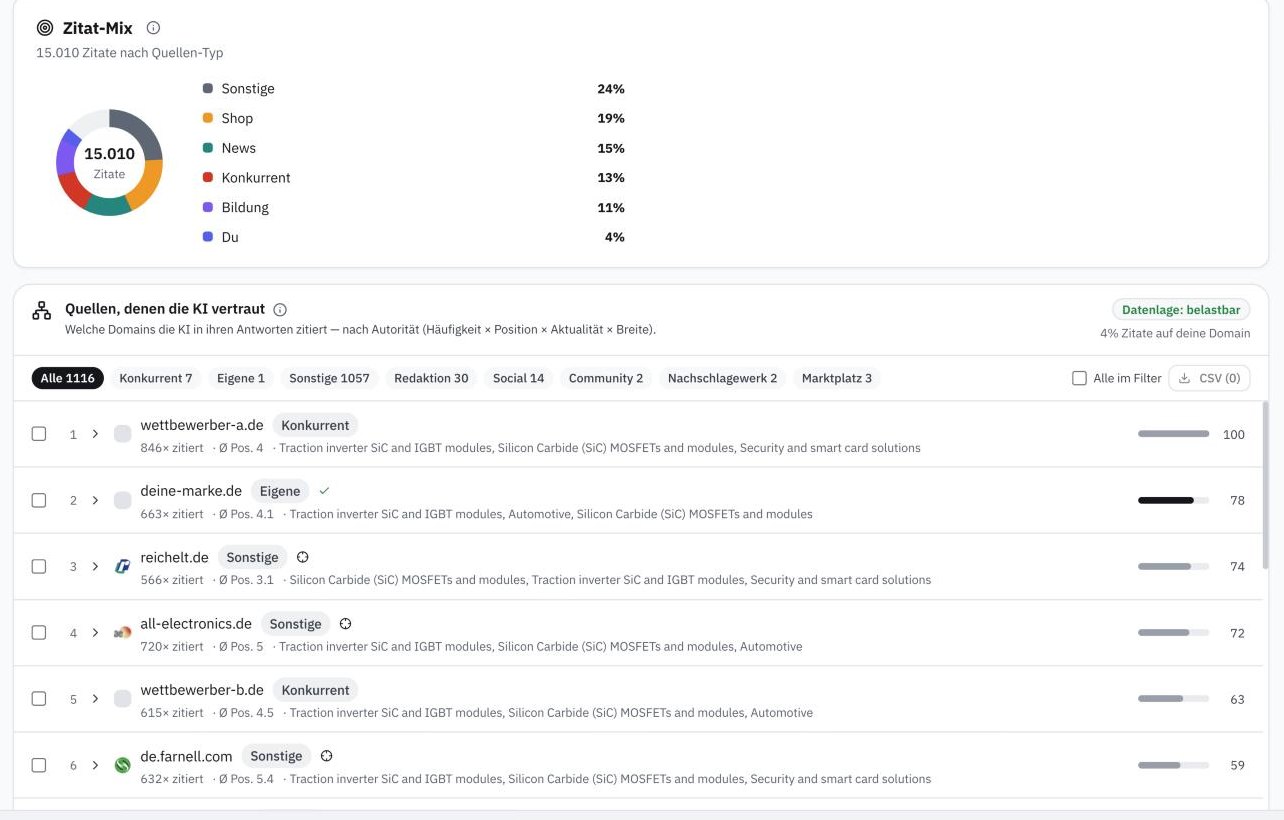
The action plan turns this data into outreach targets with a reason and a pitch angle. Each target becomes a task that moves from Open through In Progress to Done. Starter costs €79 a month with 50 prompts, three models of your choice, one country and unlimited users; MCP access to citations and sources starts at €199 (all plans on our pricing page). For crawler logs, alerts or prompt search volume, Alexandrya.AI is the wrong tool, and its API is only available on Enterprise.
How do you track which URLs ChatGPT and Perplexity cite for your site?
To track which URLs ChatGPT and Perplexity cite for your site, run a fixed set of buying-intent prompts on both platforms every day, store each source list separately and filter it for your domain. Keep the platforms apart because they return sources differently: in our example from 27 October 2026, Perplexity returned ten linked sources, while ChatGPT listed 40 entries and linked only 8 of them in the answer text.
- Pick 20 to 50 prompts phrased the way customers ask, for example "which provider of X works best for Y".
- Before you buy, check that ChatGPT and Perplexity are both on the plan you choose. Peec AI lists Perplexity only under Enterprise and as an add-on model, and Semrush's AI Visibility Toolkit does not cover it.
- Add your own domain and three to five competitor domains in the tool so it can assign every citation.
- Use the trial to find out whether the tool counts only sources linked in the answer text or the whole list below it.
- Export the URLs that are new or have dropped out every week and pass them on to content and PR.
How to break an answer's source list down entry by entry, clean it and count it per platform is covered in detail in our source analysis by platform. For choosing a tool, it is enough to know which counting rule a vendor uses.
Web analytics will not do this for you. Because ChatGPT adds utm_source=chatgpt.com to many links, clicks from ChatGPT do show up in your traffic reports, but a citation nobody clicks never does. Checking by hand works for five prompts. At 20 prompts on two platforms, you are looking at 40 source lists a day.
Turning cited domains into outreach targets and content gaps
Cited domains are easiest to act on when you sort them by source type, because each type calls for different work: trade media and comparison sites go on the outreach list, software vendors' blogs point to content gaps on your own site, and video and community sources need contributions of your own. In Alexandrya.AI's own measurement (as of 27 October 2026, 43 tracked prompts), software vendors accounted for 40.8% of the citations of the eleven most-cited domains and trade media and comparison sites for 28.6%.
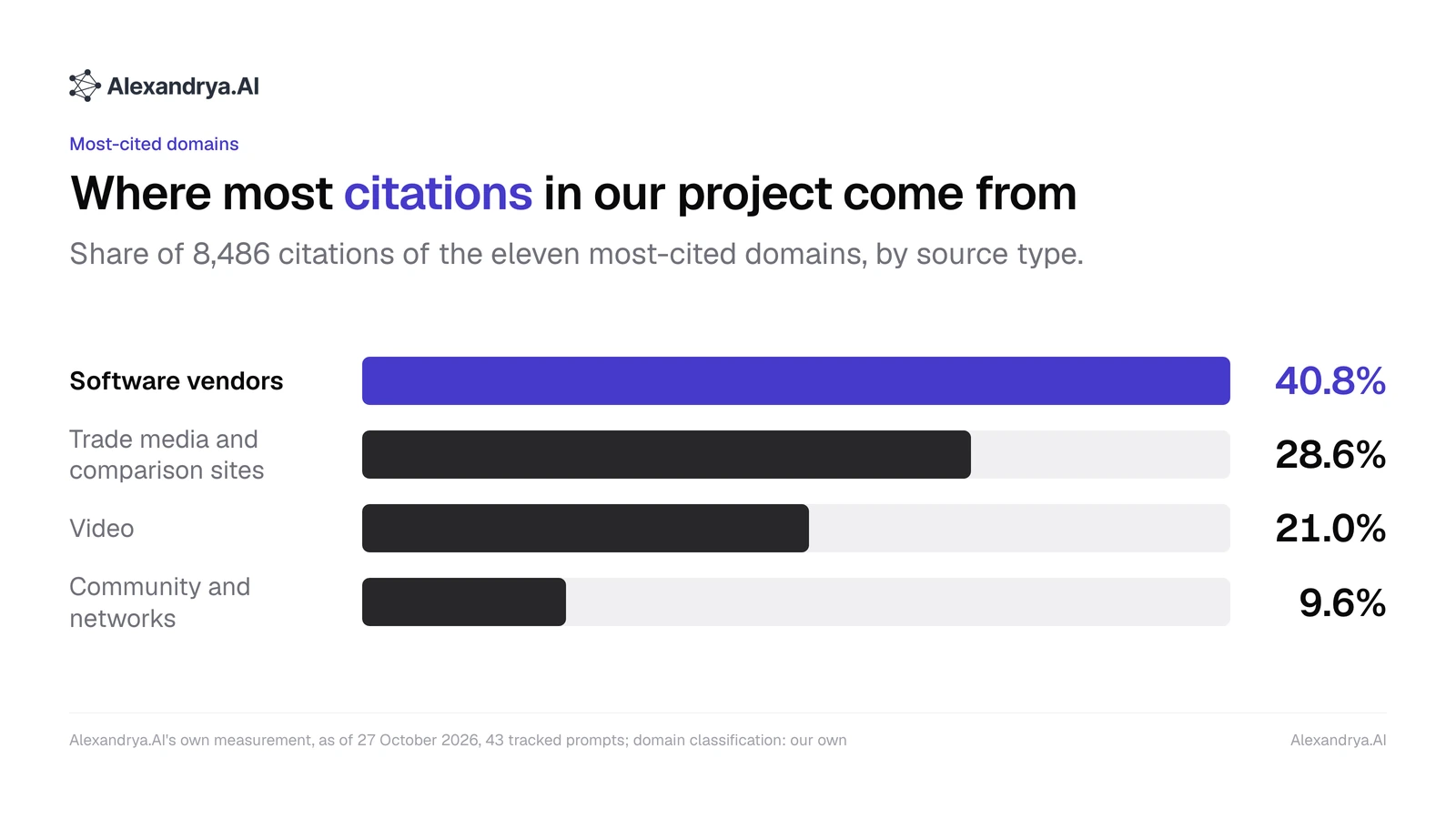
Source types of the eleven most-cited domains in our own project, Alexandrya.AI's own measurement as of 27 October 2026, 43 tracked prompts, domains classified by us.
| Source type | Domains among the eleven most cited | Share of their citations | Task |
|---|---|---|---|
| Software vendors | seranking.com, blog.hubspot.de | 40.8% | your own comparison or guide page on the same question |
| Trade media and comparison sites | technologyadvice.com, omr.com, saaswelt.de, searchengineland.com, basicthinking.de, g2.com | 28.6% | outreach: inclusion in comparisons, data, guest articles |
| Video | youtube.com | 21.0% | your own video on the buying question |
| Community and networks | reddit.com, linkedin.com | 9.6% | answers in threads, posts in the network |
The base is 8,486 citations: seranking.com 2,434 (average position 4.37), youtube.com 1,785, blog.hubspot.de 1,027, technologyadvice.com 906 (average position 2.25), omr.com 618, reddit.com 486, linkedin.com 327, saaswelt.de 289, searchengineland.com 269, basicthinking.de 258 and g2.com 87.
The example prompt above shows the same pattern on a small scale. At least 14 of the 24 domains cited there belong to vendors of SEO, monitoring or AI visibility software, among them Semrush, Ahrefs, HubSpot, Meltwater and Otterly.AI, each with its own best-of list. If you sell in this category, you need a comparison page of your own, and the few independent publishers are the most valuable outreach targets. technologyadvice.com sat in position 1 on ChatGPT and position 3 on Copilot and averages position 2.25 across all 43 prompts. Whether your own page is fit to be cited depends on structure and evidence, covered in what makes a brand citable in AI answers.
Which tool fits which team?
| Starting point | Tool that fits |
|---|---|
| SEO team that analyses sources down to URL level | Peec AI |
| budget under €50, first look at your own citations | Otterly.AI Lite |
| citation data should become articles automatically | Promptwatch from Professional |
| large company with a data team, raw data over API | Profound |
| Ahrefs or Semrush already in place | Ahrefs Brand Radar or Semrush AI Visibility Toolkit |
| outreach list and tasks for a whole team | Alexandrya.AI |
No pricing page answers one question: whether the tool finds the same URLs for your buying prompts that you see yourself in ChatGPT and Perplexity. During the trial, check three of your most important prompts by hand and compare domain and position.
Frequently asked questions
What is AI citation tracking?
AI citation tracking is the ongoing record of the sources that AI platforms such as ChatGPT, Perplexity, Gemini and Google AI Mode link to in their answers. For each answer it stores the URL, the domain and the position in the source list. Unlike mention tracking, it shows which pages a model drew on to write the answer.
Is there a free AI citation tracking tool?
None of the seven vendors compared here lists a permanently free plan for citation tracking on its pricing page. Otterly.AI and Profound offer seven-day trials with 50 prompts, Promptwatch a seven-day trial. Alexandrya.AI can be tested for seven days with all features and no credit card. Manual checks in Perplexity are free but keep no history.
Why does ChatGPT list more sources than a tool counts as citations?
ChatGPT often lists more entries below an answer than it links in the text. In Alexandrya.AI's own measurement on 27 October 2026, one answer listed 40 entries, 8 of them linked in the text, and each linked URL appeared twice, once with utm_source=chatgpt.com attached. Tools that count only in-text links therefore report fewer citations.
How much does an AI citation tracking tool cost?
As of October 2026, AI citation tracking tools start at €29 a month, which is what Otterly.AI charges for 15 prompts. For 50 prompts you pay €79 at Alexandrya.AI and €85 each at Peec AI and Promptwatch. Semrush's AI Visibility Toolkit costs $99 per user with 25 prompts, and Profound publishes no price.
Does Alexandrya.AI show which page of a domain is cited?
In its sources view, Alexandrya.AI shows which domains and pages ChatGPT, Gemini, Perplexity, Google AI Mode and Copilot cite, how often and in which position. From the Professional plan at €199 a month, the same citation data can be queried over MCP straight from Claude or ChatGPT, using the same definition as the dashboard.
Free GEO audit of your AI citations
Run your buying-intent prompts through Alexandrya.AI and the first run shows which domains ChatGPT, Perplexity and Google cite for them and where your own site sits in the list. The trial lasts seven days and needs no credit card. Check your citations for free
Frequently asked questions
What is AI citation tracking?
AI citation tracking is the ongoing record of the sources that AI platforms such as ChatGPT, Perplexity, Gemini and Google AI Mode link to in their answers. For each answer it stores the URL, the domain and the position in the source list. Unlike mention tracking, it shows which pages a model drew on to write the answer.
Is there a free AI citation tracking tool?
None of the seven vendors compared here lists a permanently free plan for citation tracking on its pricing page. Otterly.AI and Profound offer seven-day trials with 50 prompts, Promptwatch a seven-day trial. Alexandrya.AI can be tested for seven days with all features and no credit card. Manual checks in Perplexity are free but keep no history.
Why does ChatGPT list more sources than a tool counts as citations?
ChatGPT often lists more entries below an answer than it links in the text. In Alexandrya.AI's own measurement on 27 October 2026, one answer listed 40 entries, 8 of them linked in the text, and each linked URL appeared twice, once with utm_source=chatgpt.com attached. Tools that count only in-text links therefore report fewer citations.
How much does an AI citation tracking tool cost?
As of October 2026, AI citation tracking tools start at €29 a month, which is what Otterly.AI charges for 15 prompts. For 50 prompts you pay €79 at Alexandrya.AI and €85 each at Peec AI and Promptwatch. Semrush's AI Visibility Toolkit costs $99 per user with 25 prompts, and Profound publishes no price.
Does Alexandrya.AI show which page of a domain is cited?
In its sources view, Alexandrya.AI shows which domains and pages ChatGPT, Gemini, Perplexity, Google AI Mode and Copilot cite, how often and in which position. From the Professional plan at €199 a month, the same citation data can be queried over MCP straight from Claude or ChatGPT, using the same definition as the dashboard.
How visible is your brand in AI?
Try Alexandrya.AI free for 7 days and see how ChatGPT, Gemini, Perplexity, AI Overviews and Copilot talk about your brand.
- 7 days free
- No credit card required
- All features included
- Cancel anytime
About the author
Talaal Max Habib
Managing Director at Alexandrya.AI
Talaal Max Habib has advised companies in industry, the Mittelstand and e-commerce on SEO and Generative Engine Optimization since 2015. With his team he built Alexandrya.AI, the Munich-based platform that measures how brands appear in ChatGPT, Perplexity and Gemini.
LinkedIn