What Makes a Brand Citable in AI Responses? The 5 Decisive Factors
Five measurable factors determine whether a brand gets cited in AI responses. How to make your brand more citable across ChatGPT, Perplexity and Gemini.

Managing Director at Alexandrya.AI
Why Are Some Brands Cited 6× More Often in AI Responses?
The top decile of B2B brands achieves a 68.3% citation rate in AI responses while the average sits at 11.4%, a gap driven by five measurable factors, not luck or brand size. These factors are systematically identifiable and actionable, which means citability is an engineering problem, not a reputation lottery.
The 6× citation differential between top performers and the average is one of the most striking findings from Alexandrya.AI's Q1 2026 research across 500 B2B brand queries. It reveals that AI citation is highly concentrated: a small number of brands dominate AI responses in every category, while the majority remain largely invisible. The decisive insight is that dominant brands are not simply the most famous or the largest; they are the ones that most closely match the five structural signals that AI retrieval and generation systems use to select and cite sources. Understanding those five signals is the starting point for any citability improvement program.
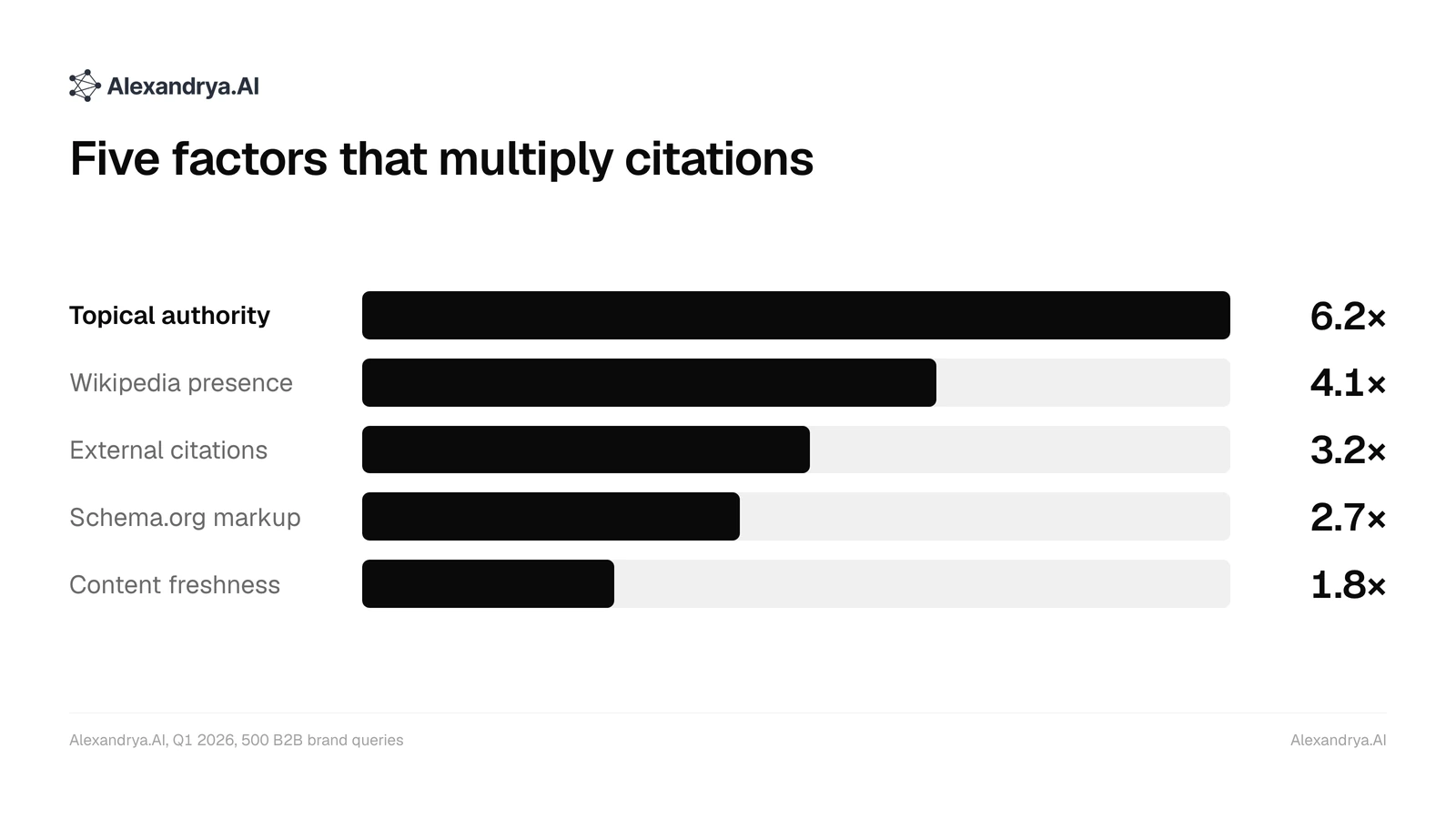
Alexandrya.AI research across 500 B2B brand queries in Q1 2026 identified five measurable factors that predict whether a brand will be cited in AI responses, and quantified the citation lift associated with each. Factor 1: Wikipedia presence. Brands with a Wikipedia entry are cited 4.1× more often than brands without one, because Wikipedia functions as a pre-indexed trust anchor in AI training pipelines. Factor 2: Structured data markup. Brands with comprehensive Schema.org implementation achieve a 2.7× higher citation rate, as markup reduces the semantic ambiguity AI retrieval systems must resolve. Factor 3: Topical authority depth. Brands covering 80% or more of their category's core queries achieve a 68% citation rate versus 11% for brands covering less than 40%, a 6.2× differential. Factor 4: External citation density. Brands mentioned by 15 or more authoritative external domains in their topic category achieve a 3.2× higher citation rate. Factor 5: Content freshness. Pages updated within the past 90 days are selected at 1.8× the rate of older content in RAG-based retrieval systems that favor recency as a relevance signal. All five factors are independently actionable and their effects appear to compound when implemented together. (Source: Alexandrya.AI Q1 2026 research, 500 B2B brand queries)
Factor 1: Does Wikipedia Presence Predict AI Citations?
Wikipedia presence is the single strongest predictor of AI citation rate, generating a 4.1× lift for brands that have an entry compared to those that don't. The mechanism is structural: Wikipedia is among the highest-weighted training data sources for virtually every major AI model, and its content functions as a pre-validated reference that AI systems use to verify brand descriptions and extract factual attributes.
A brand without a Wikipedia page can still be cited in AI responses, but its citation profile will typically be generic ("Brand X is a company in [category]") rather than attribute-rich ("Brand X is known for [specific differentiator], serving [market segment], with [key characteristic]"). The attribute richness of citations matters because it determines whether the citation creates purchase intent. A generic mention confirms existence; an attribute-rich citation communicates relevance and advantage.
The practical implication: establishing and maintaining a Wikipedia page with accurate, well-sourced descriptions of market position, product categories, and differentiation is the highest-ROI single action for AI citability improvement. → Brand Visibility Research 2026
Factor 2: How Does Structured Data Markup Drive Citation?
Structured data markup via Schema.org generates a 2.7× citation rate lift by reducing the semantic ambiguity that AI retrieval systems must resolve when deciding whether and how to cite a source. When a page explicitly marks up its entity type (Organization, Product, Article), its key attributes, and its relationships, AI parsing becomes deterministic rather than probabilistic.
The most impactful Schema types for B2B brand citability are: Organization (with name, description, url, industry, and founding date), FAQPage (with question-and-answer pairs that mirror AI user query phrasing), Article (with headline, author, datePublished, and about), and Product (for product-focused pages, with name, description, and category). FAQPage schema shows the highest individual citation lift because FAQ content directly matches the question-based retrieval logic used by most AI systems.
Implementation note: Schema markup must be syntactically valid (test with Google's Rich Results tool) and semantically consistent with the page's primary content. Markup that contradicts page content creates ambiguity rather than reducing it. → GEO Content Framework
The 5 Brand Citability Factors and Their Citation Rate Multipliers
Brands implementing all five citability factors simultaneously achieve citation rates above 60% (more than 5× the 11.4% average), according to Alexandrya.AI Q1 2026 research across 500 B2B brand queries.
Factor 3: What Does Topical Authority Depth Mean for AI Systems?
Topical authority depth refers to the breadth of query coverage within a category, specifically, how many of the relevant queries in a topic category a brand's content directly addresses. Brands that cover 80% or more of their category's core queries achieve a 68% citation rate; brands covering less than 40% achieve only 11%, a 6.2× differential that is the largest among the five citability factors.
AI systems build implicit topic maps during retrieval: a brand that appears as a relevant source for many related queries within a category is treated as a category authority and cited with higher probability even on queries where its content is not the strongest individual match. This authority halo effect rewards breadth of coverage, not just depth on individual topics.
The practical implication: conduct a query coverage audit before optimizing individual pages. If your brand addresses only 30% of the queries your target audience asks in AI systems, the highest-impact action is expanding query coverage, not deepening content on already-covered topics. The GEO Audit Framework provides a systematic approach to query coverage auditing.
Factor 4: How Does External Citation Density Affect AI Visibility?
External citation density (the number of distinct authoritative external domains that mention or link to a brand in a topic-relevant context) is the fourth citability factor, generating a 3.2× citation rate lift for brands with 15 or more authoritative external citations compared to those with fewer than five.
The mechanism operates differently across platforms. For ChatGPT, external citations in training data provide the co-occurrence signals that strengthen a brand's association with category attributes. For Perplexity, external authoritative sources increase the probability that retrieval pulls in brand mentions alongside query-relevant content. For Google AI, external links contribute to the organic authority signals that correlate with AI Overview selection.
Not all external citations are equal. The highest-impact citations come from: established trade publications in the brand's category, independent review and comparison platforms (G2, Capterra, industry directories), partner and customer success mentions on authoritative domains, and press coverage in business publications with high domain authority. The threshold of 15 domains should be treated as a minimum, not a target. Brands in the top decile typically show 30+ authoritative external domain citations. → AI Visibility Benchmarks
Factor 5: Why Does Content Freshness Matter More Than Expected?
Content freshness (whether a page has been updated within the past 90 days) generates a 1.8× citation rate lift in RAG (Retrieval-Augmented Generation) based AI systems, which use recency as an explicit relevance signal. This finding is counterintuitive for marketers accustomed to treating evergreen content as a set-and-forget asset.
The mechanism in RAG systems: when retrieving candidate sources to synthesize a response, retrieval systems weight recency as a proxy for accuracy. For information that may have changed (pricing, product features, market positioning, regulatory context), a recently updated page signals that the information is trustworthy, reducing the risk that the AI synthesizes outdated claims. Pages with explicit date metadata (Schema.org Article dateModified) benefit disproportionately from this signal.
The practical approach: establish a content refresh calendar that prioritizes pages covering rapidly-evolving topics (pricing, product comparisons, regulatory requirements, competitive landscape) for 90-day update cycles. Add meaningful updates (new data, updated examples, revised competitive analysis) rather than superficial changes that don't alter content substance. AI retrieval systems appear to detect semantic change, not just metadata date updates.
How Do You Improve All 5 Citability Factors Simultaneously?
Improving all five citability factors simultaneously requires a structured program rather than isolated tactical fixes. The recommended sequence: start with the Wikipedia gap (highest single-factor lift, often addressable in 2 to 4 weeks if brand qualifies for notability), then implement Schema.org markup across all major pages (technical effort, typically 2 to 4 weeks), then conduct the query coverage audit and expand content to reach 80%+ topic coverage (ongoing, 3 to 6 months), then build external citation density through trade publication outreach (ongoing, 6 to 12 months), and establish a content freshness program with quarterly update cycles (ongoing).
Tracking all five factors requires monitoring infrastructure. Alexandrya.AI measures Citation Rate, Share of AI Voice, Sentiment Score, and Model Coverage weekly, and its GEO Audit capability identifies which of the five citability factors is the current binding constraint for a given brand. The audit output provides a prioritized action list specific to the brand's current position, rather than a generic checklist. → GEO Audit Framework
The compounding effect is the most important finding from the research: brands implementing three or more of the five factors simultaneously show citation rate improvement significantly above what additive multipliers would predict. The factors appear to reinforce each other: Wikipedia presence makes external citations more credible, Schema markup makes fresh content more parseable, topical authority makes both Wikipedia and external citations more relevant.
Measure your brand's citability score: 7-day free trial with Alexandrya.AI →
Frequently asked questions
Which of the five citability factors should I address first?
Start with Wikipedia if your brand doesn't have an entry and qualifies for notability: the 4.1× lift is the largest single-factor impact and Wikipedia presence also amplifies the effect of the other four factors. If Wikipedia is already in place, move to Schema.org markup implementation, which is purely technical and can be completed in weeks.
What qualifies a brand for a Wikipedia entry?
Wikipedia's notability guidelines require "significant coverage in reliable sources that are independent of the subject." For B2B brands, this means press coverage in established business publications, mentions in academic or industry research, or a track record that Wikipedia's editors consider independently verifiable. Brands without existing press coverage should build external citation density first, then pursue Wikipedia.
How do I audit my current query coverage?
Query coverage audit starts with defining your category's core query set, typically 100 to 200 queries that represent how your target audience researches AI solutions in your space. Then test each query across ChatGPT, Perplexity, and Google AI to determine where your brand appears and where it doesn't. Queries with zero brand appearance are coverage gaps. Alexandrya.AI automates this process.
Does Schema.org markup directly communicate with AI systems?
Schema.org markup is not directly parsed by AI generation systems at inference time; rather, it influences which pages retrieval systems surface as candidates. The mechanism is indirect: markup improves machine readability for retrieval indexing, which increases the probability that the page is retrieved as a candidate, which increases citation probability. The net effect is real and measurable, even if the pathway is indirect.
How quickly does content freshness impact citation rates?
Content freshness impact is fastest on Perplexity, which indexes refreshed content within days. Google AI Overviews reflect freshness signals on the timescale of organic indexing (days to weeks). ChatGPT freshness impact is minimal in the short term: training data updates occur on multi-month cycles. Freshness optimization has the most impact for brands targeting Perplexity specifically.
How visible is your brand in AI?
Try Alexandrya.AI free for 7 days and see how ChatGPT, Gemini, Perplexity, AI Overviews and Copilot talk about your brand.
- 7 days free
- No credit card required
- All features included
- Cancel anytime
About the author
Talaal Max Habib
Managing Director at Alexandrya.AI
Talaal Max Habib has advised companies in industry, the Mittelstand and e-commerce on SEO and Generative Engine Optimization since 2015. With his team he built Alexandrya.AI, the Munich-based platform that measures how brands appear in ChatGPT, Perplexity and Gemini.
LinkedIn