Calculating AI share of voice and comparing competitors fairly
AI share of voice is your share of all brand mentions across a fixed prompt set, counted separately for mentions and citations, with a real example.

Managing Director at Alexandrya.AI
AI share of voice is your brand's share of all brand mentions that ChatGPT, Gemini, Perplexity and other AI assistants give across a fixed set of prompts. The formula: answers that mention your brand, divided by the sum of that figure across all tracked brands, times 100. Each brand counts once per answer. Citations in the source list get the same calculation, kept separate.
What is competitor AI share of voice?
Competitor AI share of voice is the portion of AI-answer mentions a brand holds relative to the competitors you track. It is measured over a fixed prompt set, a fixed competitor list and fixed platforms. If your brand holds 30 of 120 mentions, its share of voice is 25%. Change the prompt set or the competitor list and the figure stops being comparable with last month.
Visibility rate only tells you in how many prompts or answers your brand appears. In Alexandrya.AI's own measurement (as of 27 October 2026, 43 tracked prompts), our brand was named in the answer text for 10 prompts, cited as a source for 11 and listed first in the source list for 4. Whether 10 out of 43 is good only becomes clear once you run the same count for your competitors.
Our overview of GEO metrics and the four KPIs that matter uses the same base formula: your mentions over all brand mentions in a query group. Whether those answers describe your brand correctly is a separate question, covered by brand monitoring in AI answers.
How do you calculate AI share of voice?
AI share of voice comes in two versions, and both belong in every report on separate lines. Mention share divides the number of answers that name your brand in the text by the sum of the same figure across all tracked brands. Citation share does the same with citations of your domain in the source lists. A model can recommend a brand without linking to its site, or cite a site without naming the brand.
Each brand counts once per answer, even if it appears three times, otherwise a long answer full of repetition would outweigh a tight shortlist. Each counted citation counts on its own, because two pages from one domain take two slots in the source list.
A made-up example: 20 prompts run daily on three platforms, giving 60 answers. Your brand appears in 15, competitor A in 30, B in 18 and C in 12, so 75 mentions in total. Your mention share is 20% (15 of 75), your visibility rate 25% (15 of 60). Of 20 citations from tracked brands' domains, 6 are yours: a 30% citation share. Relative to your competitors, models use you as evidence more often than they recommend you, which calls for different work than the reverse.
| Metric | Formula | Value in the made-up example | Question it answers |
|---|---|---|---|
| Visibility rate | answers with a mention ÷ all answers | 25% (15 of 60) | Does the brand show up at all? |
| Mention share | your answers with a mention ÷ answers with a mention across all tracked brands | 20% (15 of 75) | How big is my share of the recommendations? |
| Citation share | citations of your domain ÷ citations of all tracked brands' domains | 30% (6 of 20) | How often does my site serve as evidence? |
Note the gap between visibility rate and mention share. It grows with every competitor that gets named often, even when your own mentions stay the same.
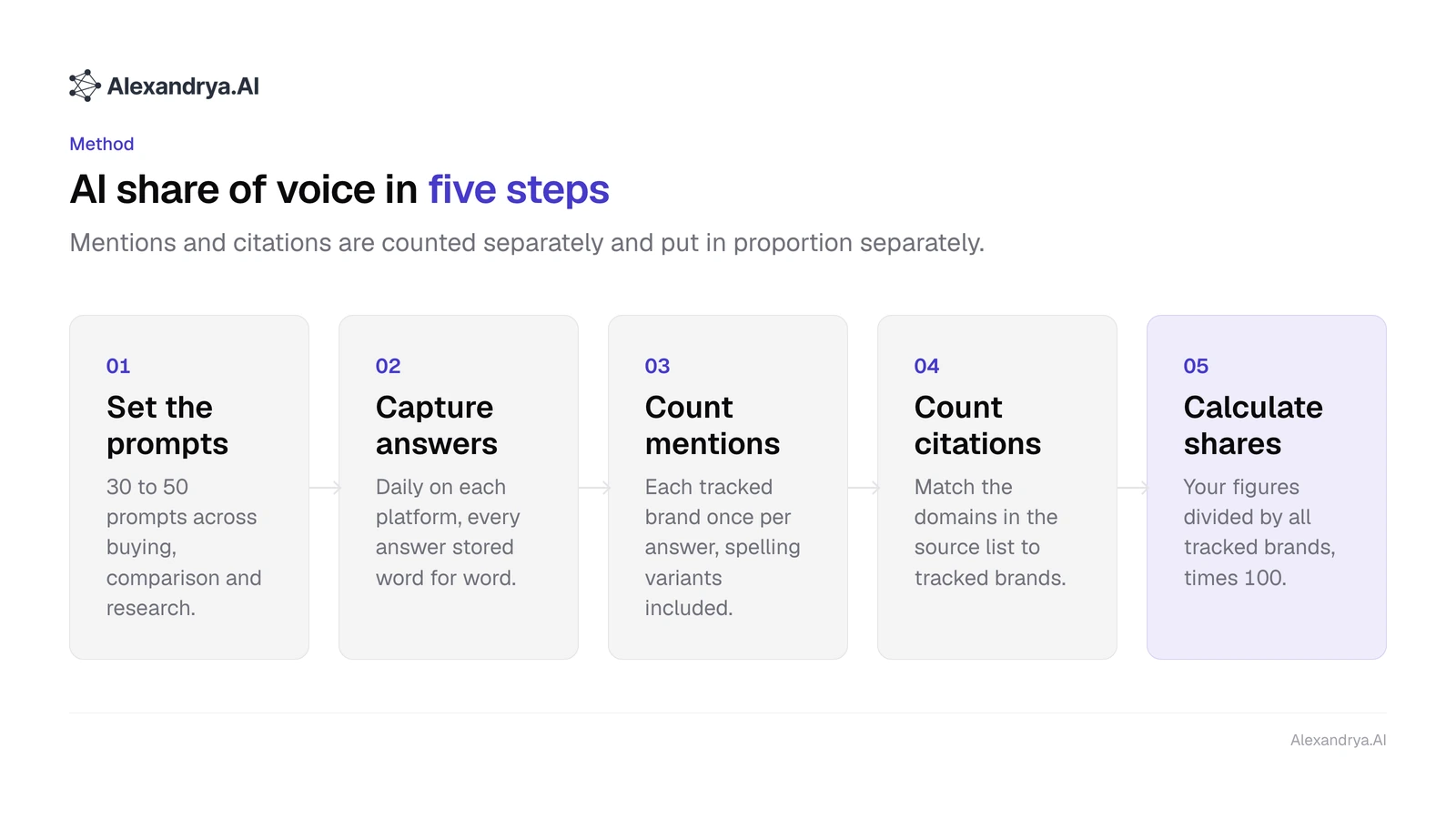
AI share of voice in five steps, with mentions and citations counted separately. Alexandrya.AI, October 2026.
- Set the prompts: 30 to 50 across buying, comparison and research.
- Capture answers: daily per platform, stored word for word.
- Count mentions: each brand once per answer, with spelling variants.
- Count citations: match source-list domains to brands.
- Calculate shares: your figures over the total for all tracked brands, times 100.
How do tools measure brand visibility in ChatGPT answers?
AI visibility tools measure brand visibility in ChatGPT answers by sending a fixed prompt set to ChatGPT automatically and repeatedly, storing every answer and detecting brand names, spelling variants and linked sources in it. From that they calculate visibility rate, share of voice and position in the source list. The formula behind share of voice differs by vendor, and for the same answers it can move the result from 25% to 80%.
You will meet three formulas in guides and tools. Ahrefs' methodology from 22 October 2026 divides the answers that mention your brand by the answers that mention any tracked brand. Brand Radar then weights each prompt by estimated demand, applying a factor of 0.115 to Google search volume for ChatGPT. Alex Birkett's guide (updated 5 August 2026) divides by all answers in the prompt set. Both were accessed on 27 October 2026. The third formula, share of all brand mentions, is the only one where all brands add up to 100%.
On 3 August 2026 the US trade body IAB published its guideline Measuring Visibility in the AI Era. Its project page lists a shared vocabulary, disclosure requirements for providers and a split between decision-grade and directional data (accessed 27 October 2026). Until vendors adopt it, compare share of voice only within one tool.
One buying prompt, five platforms, three different results
For the prompt "Tool für KI-Suchmaschinen-Monitoring kaufen", a German query meaning "buy a tool for AI search monitoring", ChatGPT, Microsoft Copilot, Gemini, Google AI Mode and Perplexity named one of nine tracked brands 16 times. Peec AI, Otterly.AI and Profound each appeared in four of five answers, a 25% mention share each. All three counted citations from tracked brands' domains went to seranking.com. Source: Alexandrya.AI's own measurement, as of 27 October 2026, 43 tracked prompts.
| Platform | Tracked brands named | Untracked brands named | Citations from tracked domains |
|---|---|---|---|
| ChatGPT | Otterly.AI, Peec AI, Profound | Geneo, Ahrefs | none of 8 counted |
| Microsoft Copilot | Peec AI, Otterly.AI, Profound, Semrush | Rankscale, Scrunch AI, AthenaHQ | none of 5 counted |
| Gemini | Otterly.AI, Peec AI, SE Ranking | Rankscale, Goodie AI | seranking.com in position 4, of 3 counted |
| Google AI Mode | SE Ranking, Profound | HubSpot, Writesonic | seranking.com in positions 1 and 3, of 4 counted |
| Perplexity | Semrush, Peec AI, Otterly.AI, Profound | GEOly AI | none of 10 counted |
Alexandrya.AI appeared in none of the five answers, nor did three other tracked competitors.
The same five answers give Peec AI three figures. As a share of tracked-brand mentions it holds 25% (4 of 16). Add the ten mentions of untracked brands and the figure drops to 15.4% (4 of 26). Under Ahrefs' answer formula it reaches 80%, because Peec AI appears in four of the five answers that name any tracked brand. None of these numbers is wrong. They answer different questions, and a report that mixes them shows movement that never happened.
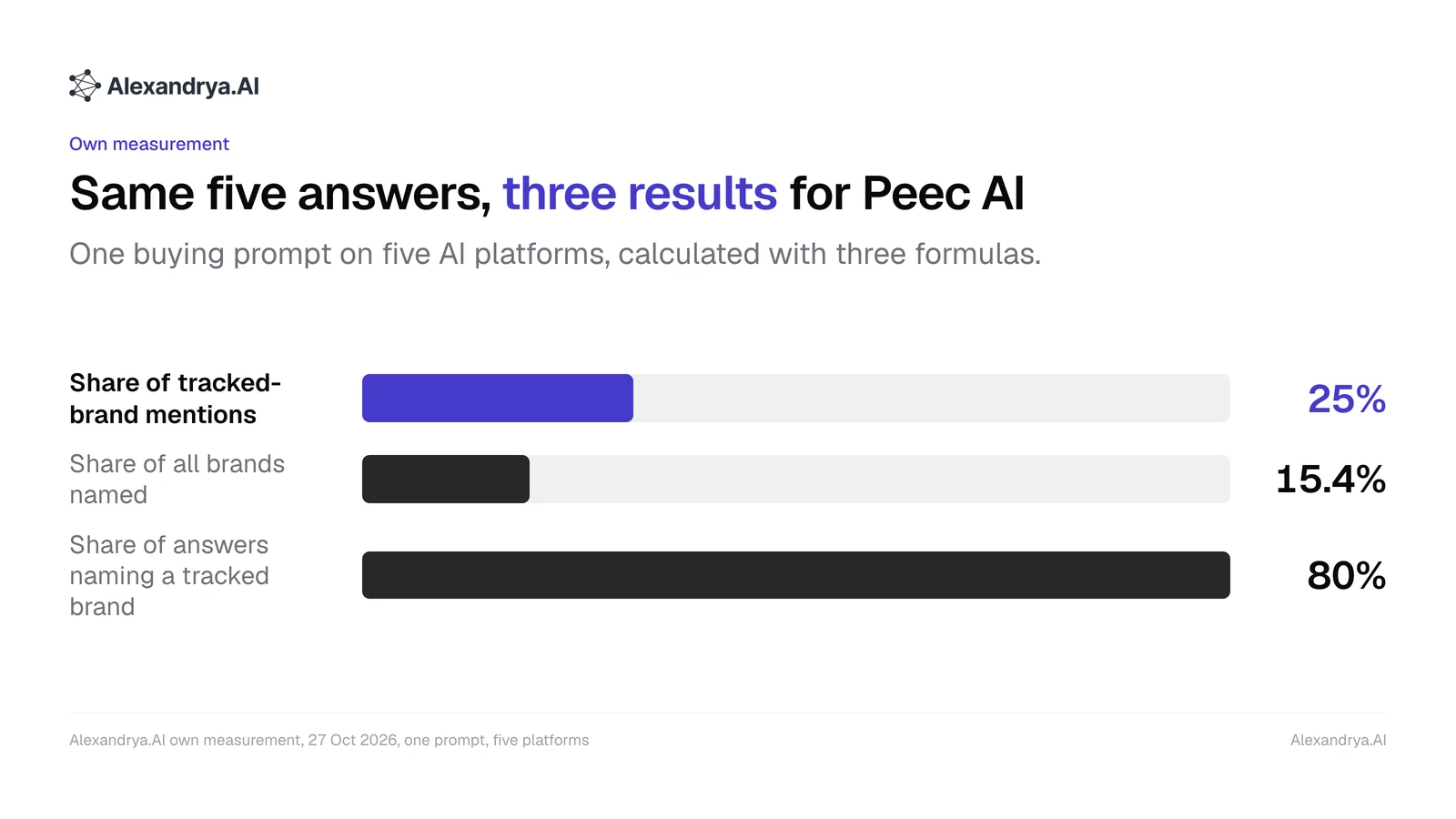
Same five answers, three formulas: Peec AI scores 25%, 15.4% or 80%. Own measurement by Alexandrya.AI, 27 October 2026.
Mentions and citations drift further apart still. Peec AI, Otterly.AI and Profound hold 75% of tracked-brand mentions, yet none of their domains appears in the counted source lists. SE Ranking is named in only two answers and still holds all three citations from tracked brands' domains, each one a best-of list on its own blog. The other 27 of the 30 counted sources belong to no tracked brand, and 22 of those are best-of lists and comparison articles.
| Brand | Answers with a mention | Mention share among tracked brands | Citation share among tracked domains |
|---|---|---|---|
| Peec AI | 4 of 5 | 25% | 0% |
| Otterly.AI | 4 of 5 | 25% | 0% |
| Profound | 4 of 5 | 25% | 0% |
| Semrush | 2 of 5 | 12.5% | 0% |
| SE Ranking | 2 of 5 | 12.5% | 100% (3 of 3) |
| Alexandrya.AI | 0 of 5 | 0% | 0% |
A report that only shows mention share puts SE Ranking near the bottom. Ask whose content the models use as evidence and SE Ranking comes first.
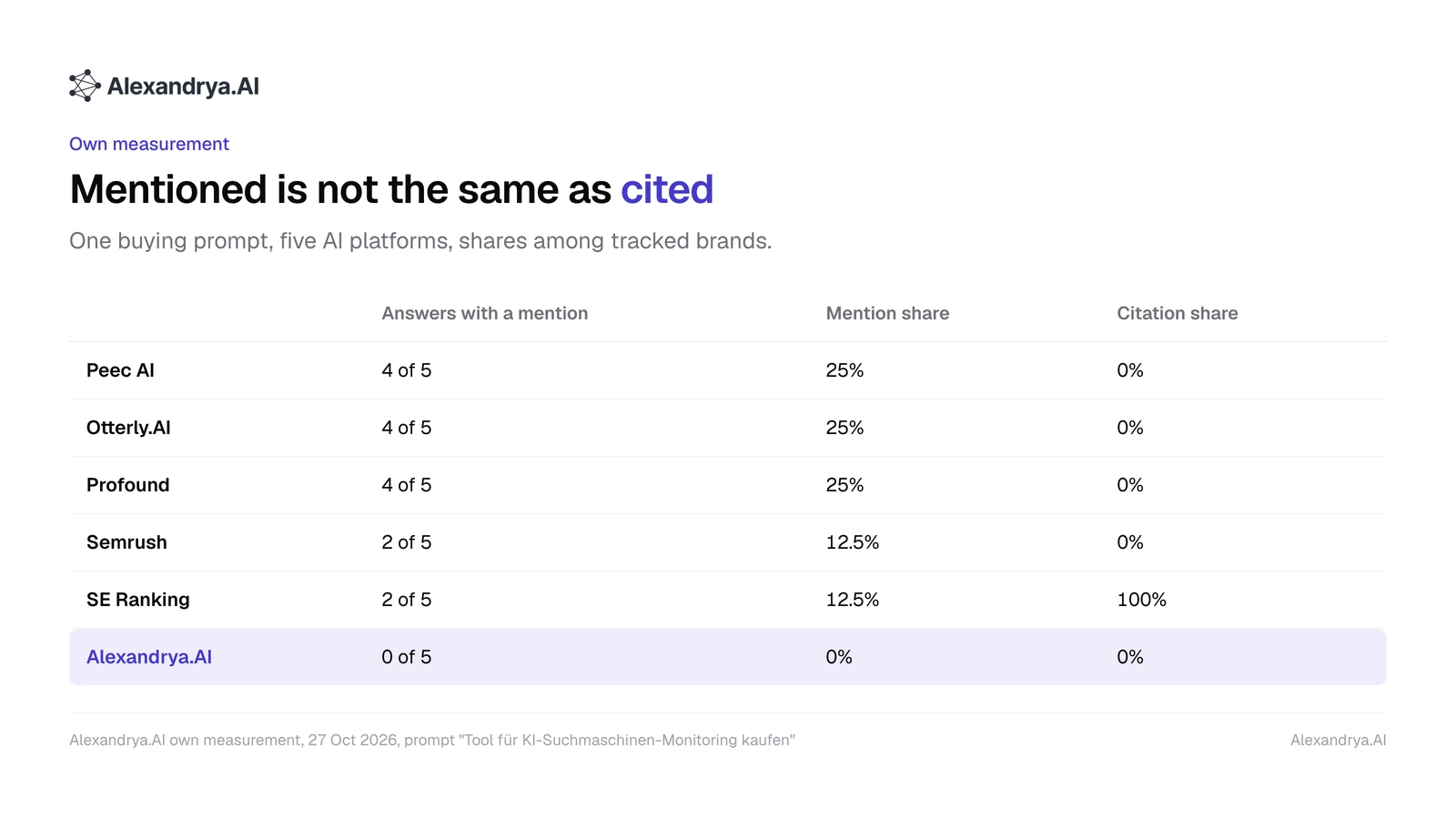
Three brands with 25% of mentions each, none of them cited. Own measurement by Alexandrya.AI, 27 October 2026.
One prompt on one day is a sample. It says nothing about the vendors' strength and only shows how the calculations work. A reliable comparison needs 30 to 50 prompts over several weeks.
Which prompts make a fair competitor comparison?
A fair competitor comparison in AI answers uses prompts from at least three intent categories, buying, comparison and research, with no brand name in them. A prompt that contains a brand name measures whether the model knows that brand and inflates its share. Between 30 and 50 generic prompts, weighted roughly evenly across intents, are enough for a first month-on-month comparison on three platforms.
Alexandrya.AI's own project tracks 43 prompts: 15 research, 11 buying, 11 comparison, 2 problem, 1 local and 3 custom (as of 27 October 2026). The set includes alternatives prompts such as "Alternativen Peec AI", which push the named competitor up by default and therefore get their own reporting block. Alex Birkett suggests starting with 100 to 200 prompts, worth it once you split results by persona or product line.
A made-up scenario shows how far the mix moves the result: two brands, 30 prompts, three platforms, 90 answers. Brand A is strong in best-of lists and comparison sites, brand B in guides to basic questions.
| Intent | Answers | Brand A mentions | Brand B mentions | Mentions of all tracked brands | Brand A mention share | Brand B mention share |
|---|---|---|---|---|---|---|
| Buying | 30 | 18 | 6 | 60 | 30% | 10% |
| Comparison | 30 | 12 | 9 | 50 | 24% | 18% |
| Research | 30 | 4 | 14 | 40 | 10% | 35% |
| All three intents | 90 | 34 | 29 | 150 | 22.7% | 19.3% |
With buying prompts alone, brand A looks three times as strong as brand B. Across all three intents the gap is 3.4 points. Both figures are correct, so the report must say which question it answers: who makes the shortlist, or who shapes the category from the first question.
Capturing competing brands in the same answer
You capture competing brands in the same AI answer by checking every answer against all names and spelling variants of the tracked brands and counting each brand found once per answer. The hits form a co-mention list: which brands appear together and which comes first. In Alexandrya.AI's measurement of the prompt "Tool für KI-Suchmaschinen-Monitoring kaufen" on 27 October 2026, Peec AI and Otterly.AI sat side by side in four of five answers.
Spelling variants decide the count. In the same example SE Ranking appears as "SE Visible (by SE Ranking)", Semrush as "Semrush AI Toolkit" and Otterly.AI as "Otterly AI". Without an alias list those hits go missing.
First mention is a second signal. Otterly.AI was the first tracked brand in two of the five answers, Peec AI, SE Ranking and Semrush in one each, Profound in none.
Average citation position shows who gets cited first
Average citation position shows how high a domain sits in the source lists of AI answers. In Alexandrya.AI's own measurement (as of 27 October 2026, 43 tracked prompts), seranking.com collected 2,434 citations at an average position of 4.37 and technologyadvice.com 906 citations at an average position of 2.25. Many citations lower down and fewer citations higher up are two different kinds of competitive strength.
A citation share without position overrates domains cited often but far down the list. To include position, weight the citations, say position 1 at 1, position 2 at 0.5 and position 3 at 0.33, and state that choice in the report. How much the sources differ between platforms is covered in our AI source analysis by platform.
Measure daily, review weekly, report monthly
AI share of voice is best measured daily, reviewed weekly and reported monthly. With 90 answers a day, a 25% share swings by about ±9 percentage points through chance alone, by about ±3.4 points over a week of 630 answers and by about ±1.6 points over a month of 2,700 answers (95% interval, binomial approximation). Check the prompt set and the competitor list once a quarter.
Treat that as a floor, because answers to the same prompt are not independent. A five-point jump in a day is not a finding; a three-week trend in one direction starts to be one.
Setup changes move the number more than chance. Ahrefs' methodology shows share of voice rising from 18% to 26% purely because a competitor was removed, favourable prompts added and a weak platform dropped. Mark such changes in the timeline and only compare periods with an identical setup.
What to check before buying an AI search competitor analysis tool
Before you buy an AI search competitor analysis tool, check the metric first and the dashboard second. The tool should disclose what sits in the numerator and denominator of its share of voice, report mentions and citations separately, let you edit the competitor list freely and trace every figure back to the stored answer, word for word. If any of these is missing, you cannot explain a jump in share of voice.
- Counting per answer or per mention, with or without untracked brands in the denominator.
- Separate mention share, citation share and source-list position.
- Filters by platform, intent and time range.
- Answers you can read and export word for word.
- Competitor aliases, so "Otterly AI" and "Otterly.AI" are one brand.
Alexandrya.AI is an AI visibility tool from Munich that measures brand mentions in ChatGPT, Gemini, Perplexity and Bing Copilot and turns them into content and citation tasks. The competitor module in Alexandrya.AI shows brand mention and link visibility per competitor side by side, by topic, market and platform, and the dashboard filters by model, intent and time range. From the Professional plan, your AI assistant can read the stored answers word for word through the MCP server. Alexandrya.AI does not show prompt search volume, so a demand weighting like the one in Ahrefs Brand Radar is not possible.
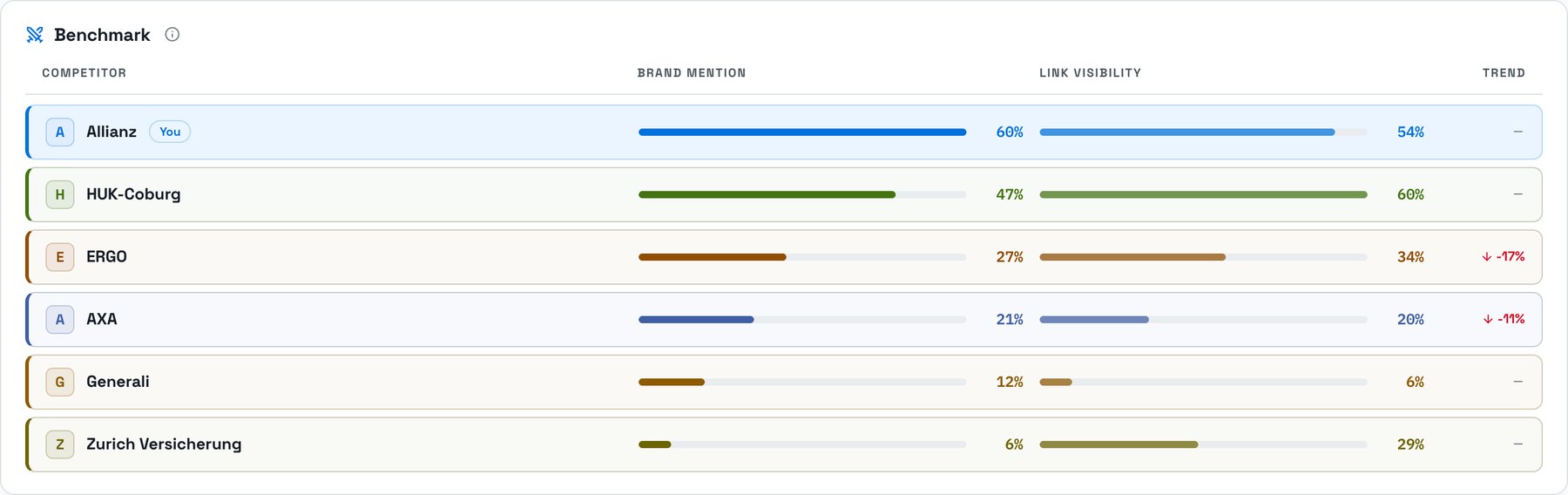
For the gaps against competitors, Alexandrya.AI's action plan produces content briefs, outreach targets and quick wins, which your team works through as tasks marked Open, In Progress or Done. Starter costs €79 a month for 50 prompts on three selectable models with daily tracking; all tiers are on the Alexandrya.AI pricing page (as of 27 October 2026).
What remains open is whether vendors will adopt the IAB vocabulary. Until they do, every share of voice figure in a report needs its formula, prompt count, platforms and competitor list next to it.
Frequently asked questions
How is AI share of voice different from SEO share of voice?
SEO share of voice usually measures the share of estimated clicks or visibility a domain earns across a keyword set, from rankings and search volume. AI share of voice counts brand mentions and citations in AI answers. A brand can rank well on Google and still be missing from ChatGPT, because the answer draws on a handful of cited sources.
What is a good AI share of voice?
There is no universal target, because the figure depends on how many competitors you track. With five brands an even split is 20% each, with ten brands 10%. The gap to your strongest competitor and the trend against last month tell you more. Thresholds such as 25% only hold for the formula and brand count behind them.
Does a brand count twice if it appears several times in one answer?
In Ahrefs Brand Radar a brand counts once per answer, however often it appears, according to the methodology published on 22 October 2026. That rule makes sense for AI share of voice, because otherwise long, repetitive answers would outweigh short ones. If you count raw mentions instead, your figures will differ, so say so in the report.
Are 20 prompts enough to compare competitors?
Twenty prompts are enough for a first impression but thin for month-on-month comparisons. On three platforms they give 60 answers a day, and a 25% share then swings by about ±11 percentage points daily. With 30 to 50 prompts across buying, comparison and research, reviewed weekly, shifts of three to four points become visible.
Can you measure ChatGPT share of voice manually?
You can measure ChatGPT share of voice manually for a sample: run 20 prompts in fresh chats, note the brands named and sources linked in each answer, then work out the shares in a spreadsheet. Across weeks and several platforms that becomes too much manual work. Alexandrya.AI queries the platforms daily and stores every answer.
Which tools measure brand visibility in ChatGPT answers?
Specialist tools such as Alexandrya.AI and Peec AI measure brand visibility in ChatGPT answers, as do SEO-suite add-ons like the Semrush AI Visibility Toolkit and Ahrefs Brand Radar (as of October 2026). All send fixed prompts to ChatGPT and analyse the answers. Ask whether mentions and citations are reported separately and which formula sits behind the figure.
Free GEO audit of your share of voice
Add your brand, three to five competitors and 30 prompts across buying, comparison and research intent, and after the first scan you will see how mentions and citations split between you. Alexandrya.AI is free for seven days, no credit card needed. Measure your share of voice
Frequently asked questions
How is AI share of voice different from SEO share of voice?
SEO share of voice usually measures the share of estimated clicks or visibility a domain earns across a keyword set, from rankings and search volume. AI share of voice counts brand mentions and citations in AI answers. A brand can rank well on Google and still be missing from ChatGPT, because the answer draws on a handful of cited sources.
What is a good AI share of voice?
There is no universal target, because the figure depends on how many competitors you track. With five brands an even split is 20% each, with ten brands 10%. The gap to your strongest competitor and the trend against last month tell you more. Thresholds such as 25% only hold for the formula and brand count behind them.
Does a brand count twice if it appears several times in one answer?
In Ahrefs Brand Radar a brand counts once per answer, however often it appears, according to the methodology published on 22 October 2026. That rule makes sense for AI share of voice, because otherwise long, repetitive answers would outweigh short ones. If you count raw mentions instead, your figures will differ, so say so in the report.
Are 20 prompts enough to compare competitors?
Twenty prompts are enough for a first impression but thin for month-on-month comparisons. On three platforms they give 60 answers a day, and a 25% share then swings by about ±11 percentage points daily. With 30 to 50 prompts across buying, comparison and research, reviewed weekly, shifts of three to four points become visible.
Can you measure ChatGPT share of voice manually?
You can measure ChatGPT share of voice manually for a sample: run 20 prompts in fresh chats, note the brands named and sources linked in each answer, then work out the shares in a spreadsheet. Across weeks and several platforms that becomes too much manual work. Alexandrya.AI queries the platforms daily and stores every answer.
Which tools measure brand visibility in ChatGPT answers?
Specialist tools such as Alexandrya.AI and Peec AI measure brand visibility in ChatGPT answers, as do SEO-suite add-ons like the Semrush AI Visibility Toolkit and Ahrefs Brand Radar (as of October 2026). All send fixed prompts to ChatGPT and analyse the answers. Ask whether mentions and citations are reported separately and which formula sits behind the figure.
How visible is your brand in AI?
Try Alexandrya.AI free for 7 days and see how ChatGPT, Gemini, Perplexity, AI Overviews and Copilot talk about your brand.
- 7 days free
- No credit card required
- All features included
- Cancel anytime
About the author
Talaal Max Habib
Managing Director at Alexandrya.AI
Talaal Max Habib has advised companies in industry, the Mittelstand and e-commerce on SEO and Generative Engine Optimization since 2015. With his team he built Alexandrya.AI, the Munich-based platform that measures how brands appear in ChatGPT, Perplexity and Gemini.
LinkedIn