Brand monitoring in AI answers: what it means and how to start
Brand monitoring in AI answers checks whether ChatGPT, Perplexity and Gemini describe your brand correctly: sentiment, wrong facts and how to fix them.

Managing Director at Alexandrya.AI
Brand monitoring in AI answers systematically records how ChatGPT, Perplexity, Gemini and other AI assistants describe your brand in generated text: whether it is named, in what context, with what sentiment and on which sources the answer relies. Its value is accuracy. You spot wrong prices, outdated facts and negative framing before prospects take them at face value, and you correct them where they originate.
What does brand monitoring mean for AI search?
Brand monitoring for AI search means that a company regularly asks ChatGPT, Perplexity, Gemini or Google AI Overviews the same set of questions and analyses what the answers say about its brand. The analysis covers mention, context, sentiment and cited sources. Social listening and media monitoring find posts that already exist. In an AI assistant, the statement about your brand only comes into being when a user asks.
The term causes confusion in search results because it overlaps with trademark watch. Trademark watch is a legal service: registers and marketplaces are checked for new filings that conflict with a registered mark, so that the owner can object in time. Marketing teams use brand monitoring for mentions and reputation. Neither of the two classic disciplines looks at what an AI assistant generates.
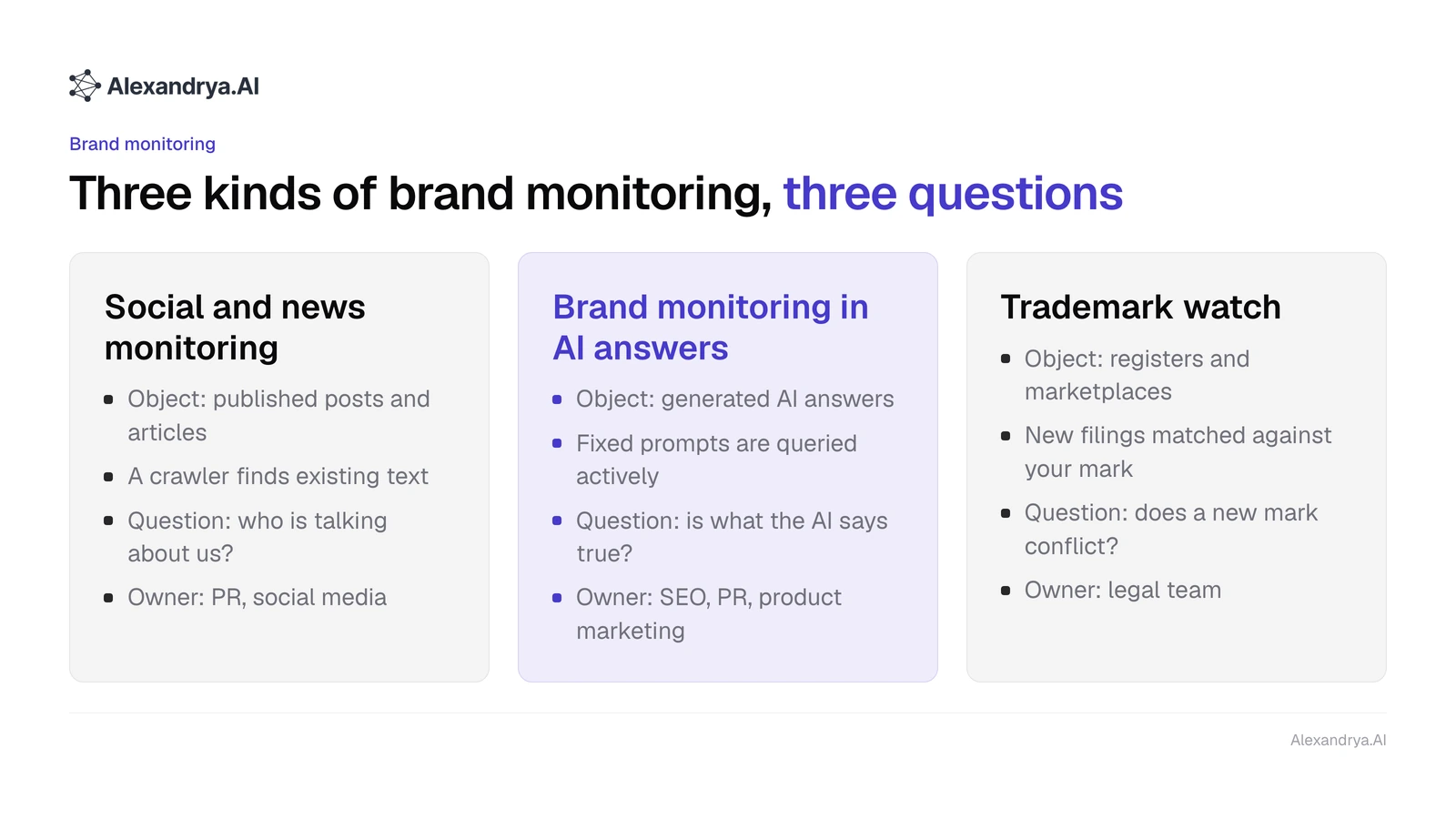
Three kinds of brand monitoring with different objects. Alexandrya.AI's own classification, October 2026.
| Feature | Social and news monitoring | Brand monitoring in AI answers | Trademark watch |
|---|---|---|---|
| Object | published posts, articles, comments | generated answers from AI assistants | trademark registers, marketplaces, domains |
| How data is created | a crawler finds existing text | fixed prompts are queried actively | new filings are matched against your mark |
| Typical question | Who is talking about us? | Is what the AI says about us true? | Does a new mark conflict with ours? |
| Owner | PR, social media | SEO, PR, product marketing | legal team, trademark attorney |
| Response | reply, moderate | fix the source, measure again | opposition, cease-and-desist letter |
Only the middle column asks whether a statement is correct. How often your brand is mentioned at all, and how to set up that count, is covered in our guide to tracking brand mentions in AI search. This article picks up one step later: is the mention accurate, and what do you do when it is not?
Why is classic brand monitoring no longer enough?
Classic brand monitoring falls short for AI answers because it only finds published text, while ChatGPT, Perplexity and Gemini assemble their statements about a brand afresh for every query. A wrong price in an AI answer has no URL, no author and no timestamp. No social listening tool will flag it, even though a buyer reads it and uses it to build a shortlist.
Two more traits sit outside what classic tools capture. Answers vary: the same question can return different vendors and different wording on two consecutive days, so a single spot check tells you little. And platforms differ. Perplexity shows its sources openly, ChatGPT shows them in search mode, and Google AI Overviews draws on the Google index. Checking one platform shows you one slice.
How do you spot negative or wrong brand descriptions in AI answers?
You spot negative or wrong brand descriptions in AI answers by grouping every statement about your brand into topics and rating each topic for sentiment, backed by a quote from the answer. A single sentiment score for the whole brand hides the problem. A brand can look positive on price and thin on agency features at the same time, and only the split shows where a correction is needed.
In practice you will meet four kinds of misrepresentation. Each calls for a different response, so keep them apart.
| Type of misrepresentation | Example | Common cause | First action |
|---|---|---|---|
| Wrong fact | wrong headquarters, wrong founding year | conflicting details in directories | check entity consistency |
| Outdated fact | old price, discontinued product | old comparison articles, neglected profiles | get the source updated |
| Gap | a feature is never mentioned | the feature is not described publicly anywhere | publish a page with a clear statement |
| Negative framing | "expensive", "not suitable for small teams" | review sites, forums, comparison pages | separate fair criticism from wrong claims |
The last row is the hardest. Negative framing may simply be accurate. In that case a correction request changes nothing, and the work lies with the product or the positioning.
Alexandrya.AI's own measurement shows what this looks like in practice. The brand perception snapshot of 20 October 2026 covers answers from 20 September to 20 October 2026 in our own project with 38 tracked prompts. It sorts the statements about Alexandrya.AI into five categories. The entry price of €79 a month appears in 2 of the 4 answers that mention Alexandrya.AI, and it is correct. The task board appears in 1 of 4, with Perplexity describing it as "Tracking plus priorisiertes Task-Board statt reiner Beobachtung" (tracking plus a prioritised task board instead of pure observation). The most telling category is rated neutral and is still a problem. All 4 answers lack any detail on agency features such as multi-client management, exports or agency reporting. Alexandrya.AI has dedicated agency plans and CSV export, but the models do not know it. In comparison answers aimed at agencies, the competitor that describes its agency packages publicly wins. No sentiment score catches a gap like this, because no negative word is ever used.
The same snapshot shows contradictions about competitors. For one vendor, most answers gave an entry price of US$29 a month, while one German-language comparison put it at €200 to €600. If you find a spread like that about your own brand, there is usually an old or faulty third-party source that some of the models pull from.
For your own review, four questions per answer are enough. Is the brand named? Does every stated fact match your own fact sheet? Which attribute is missing that matters for this prompt? Which source backs the statement?
What should you do when an AI states wrong facts about your brand?
When an AI states wrong facts about your brand, check entity consistency first: do founding year, headquarters, product description and prices on your website match Wikipedia, Wikidata, business directories and review sites? In our project work, a contradiction between these sources is the cause we find most often. Usually the model has picked up the error from a source that says something different from you.
The playbook has five steps, and the order matters. Start at step four and you may end up correcting the wrong source.
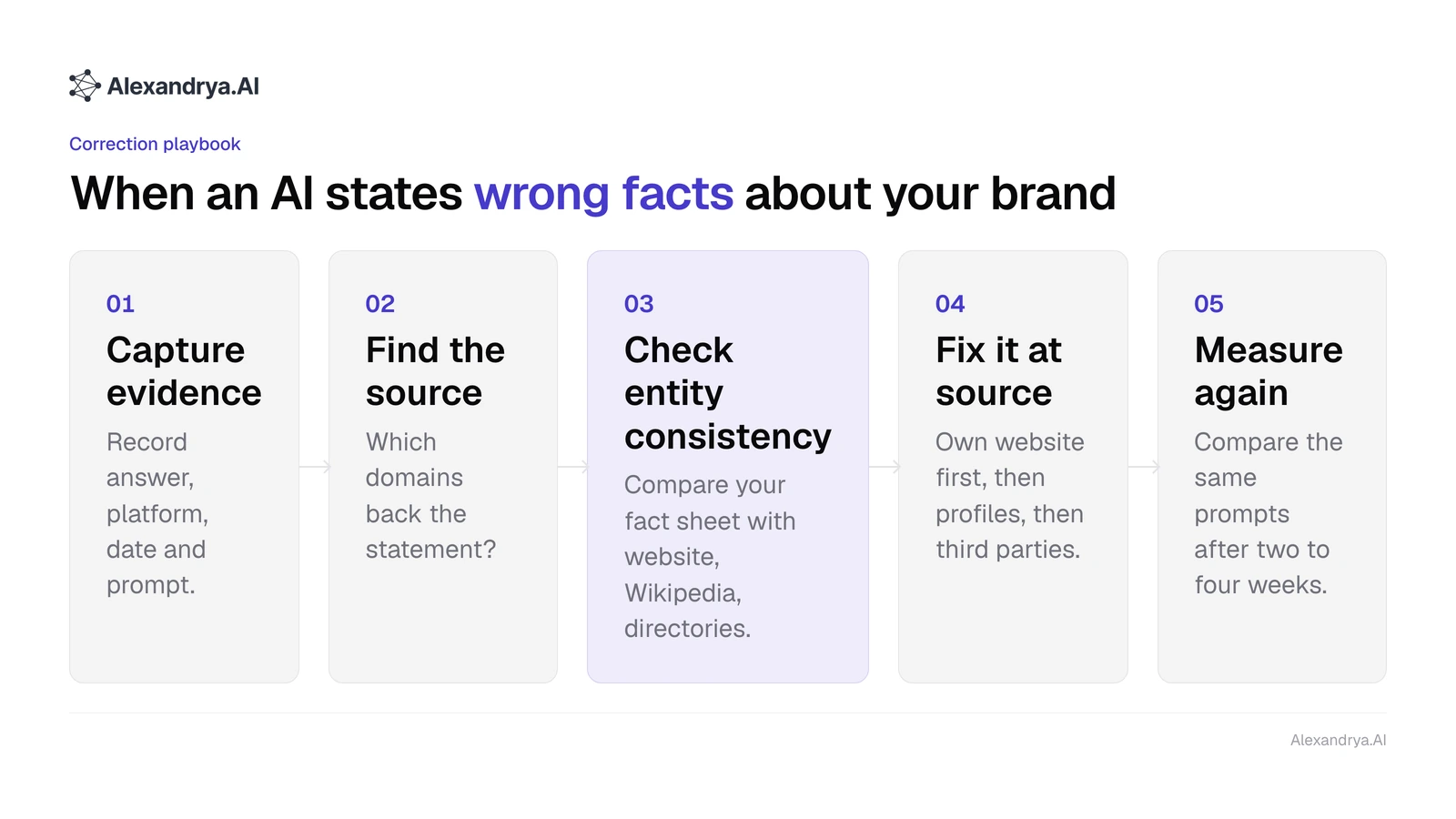
Correction playbook for wrong facts in AI answers. Alexandrya.AI's own classification, October 2026.
- Capture evidence. Record the answer word for word, with platform, date and prompt. Without it, you cannot show later whether the correction worked.
- Find the source. Perplexity and ChatGPT search list sources under the answer. Where no source is shown, source analysis across many answers helps: which domains keep appearing for this prompt?
- Check entity consistency. Build a fact sheet with the exact company name, headquarters, founding year, management, product category, prices with a date and your three main features. Compare it with every source found in step 2.
- Fix it at source. Start with your own website, because you can change it today: about page, pricing page, Organization schema. Then the profiles you control, such as your Google Business Profile, LinkedIn and directory listings. For third-party sources, contact the editor and supply the correct value with evidence.
- Measure again. Keep the same prompts running and compare against the evidence from step 1 after two to four weeks. In our experience, platforms with live search such as Perplexity react faster than answers that rely more on training data.
Two sources have rules of their own. Wikipedia's conflict of interest guideline (accessed 22 October 2026) strongly discourages editing articles about your own company. You propose changes on the article's talk page, and paid editors must disclose who pays them. For the Google Knowledge Panel, Google's help page on verifying your panel (accessed 22 October 2026) explains how to claim it, confirm your identity through an official profile such as Search Console or YouTube and then suggest changes with supporting links through the feedback option.
ChatGPT, Perplexity and Gemini offer brands no direct correction feature. A thumbs-down under an answer is user feedback, with no visible short-term effect on what other users see. The route that works runs through the sources.
What can you do about negative reviews of your brand on AI platforms?
What you can do about negative reviews of your brand on AI platforms depends first on whether the criticism is fair. When ChatGPT or Perplexity summarises genuine customer reviews, the answer only changes once the reviews change: through replies to reviews, problems that get solved and new reviews from satisfied customers. When the negative framing comes from an outdated comparison article, the correction playbook applies.
Bought or self-written reviews do more harm than good. Review sites remove them, and a brand caught faking reviews hands the models its next negative source. Asking customers for a review after a problem has been solved works better, as does replying to criticism publicly and specifically, because those replies get crawled too.
Who owns brand monitoring in AI answers inside a company?
Brand monitoring in AI answers needs one accountable owner and three contributing roles, because the causes sit in different departments. The measurement itself usually lives in the SEO or content team, which also maintains the prompts. Corrections to third-party sources and review sites belong to PR, and signing off the correct facts belongs to product marketing.
| Role | Responsible for | Typical task from monitoring |
|---|---|---|
| SEO and content | prompts, measurement, own website, structured data | align pricing page and Organization schema, write a page for a missing feature |
| PR and communications | press, Wikipedia talk pages, review sites, directories | ask the editor of a comparison article for a correction, reply to reviews |
| Product marketing | fact sheet, prices, positioning | update the fact sheet after every price or feature change |
| Legal | trademark law only | review cases of infringement or confusion with another mark |
Without clear ownership, findings stay in the dashboard. A finding turns into a correction only once it lands as a task with a name and a status in one of these roles.
What should you look for when you buy AI brand monitoring software?
When you buy AI brand monitoring software, test it against five questions. Which AI platforms does it query? Does it report sentiment per topic with a supporting quote, or only as one overall score? Does it show the sources behind a statement? How often does it measure? Does a finding become a task with an owner? A tool that only counts mentions cannot tell you whether those mentions are accurate.
| Buying criterion | Why it matters | Alexandrya.AI, October 2026 |
|---|---|---|
| Platform coverage | answers differ by platform | ChatGPT, Gemini, Google AI Mode, Google AI Overviews, Perplexity, Microsoft Copilot, Claude, Meta AI, Grok; 3 or 5 selectable per plan |
| Sentiment per topic with evidence | one overall score hides gaps | brand perception with categories, sentiment, strengths, gaps and supporting quotes |
| Sources behind the statement | corrections start at the source | sources and domains with citation mix by source type and position in the source list |
| Measurement frequency | answers vary from day to day | daily tracking on every plan, perception snapshots over time |
| From finding to task | otherwise findings go nowhere | action plan with content briefs, outreach targets and quick wins; tasks as Open, In Progress, Done |
| Price | budget for getting started | €79, €199 or €399 a month for 50, 150 or 350 prompts; Enterprise on request |
Alexandrya.AI is an AI visibility tool from Munich that measures brand mentions in ChatGPT, Gemini, Perplexity and Bing Copilot and turns them into content and citation tasks. One limit belongs in an honest buying decision: Alexandrya.AI currently has no alerts and no Slack connection. You see a new misrepresentation in the dashboard and in the monthly email report, not as an instant notification. If you need crisis communications that react within minutes, add a social listening tool for that. The full feature set is on the product page, and plans are on the pricing page. Every plan can be tested for seven days without a credit card.
Before you buy, run a test with your ten most important prompts. The question is simple: within a week, does the tool find at least one wrong or missing statement about your brand and tell you which source is behind it? For the basic terms around mentions, citations and share of voice, see what AI visibility is.
Frequently asked questions
How often should you monitor your brand in AI answers?
Run the queries daily, because AI answers vary from day to day and a single measurement says little. Review on a slower rhythm: check sentiment and facts weekly and compare snapshots monthly. Alexandrya.AI queries daily on every plan. After price changes, product launches or critical press coverage, recheck your most important prompts within a few days.
How much does AI brand monitoring software cost?
At Alexandrya.AI, brand monitoring in AI answers costs €79 a month for 50 prompts and three models, €199 for 150 prompts and five models, and €399 for 350 prompts, as of October 2026. Enterprise pricing is on request. Annual billing saves 15 per cent, and the seven-day trial needs no credit card.
Can I ask ChatGPT to correct false statements about my brand?
No. ChatGPT, Perplexity and Gemini give brands no way to correct statements directly. A thumbs-down under an answer is user feedback without a reliable effect on what other users see. What works is fixing the sources the models draw on: your own website, directories, Wikipedia via the talk page, review sites and comparison articles.
What is the difference between brand monitoring and trademark watch?
Trademark watch is a legal service that checks registers and marketplaces for new marks that conflict with yours. Brand monitoring, in marketing, observes how people talk about a brand. Brand monitoring in AI answers adds a further check: whether AI assistants such as ChatGPT or Gemini describe the brand correctly and which sources they rely on.
What does sentiment mean in AI answers?
Sentiment in AI answers describes whether an AI assistant frames a brand positively, neutrally or negatively. It becomes useful only per topic, such as price, features or support, and with the quote from the answer as evidence. A neutral rating can still signal a problem when important attributes of the brand never appear in the answers.
Can I monitor my brand in AI answers manually?
For a first impression, ask ten prompts by hand in ChatGPT, Perplexity and Gemini and collect the answers in a spreadsheet. For a reliable picture, that is not enough, because answers vary and are generated afresh every day. Checking three platforms and 30 prompts by hand means around 90 answers a day that someone has to read and rate.
Free GEO audit
Find out what ChatGPT, Perplexity and Gemini say about your brand today, and which of those statements are wrong. Alexandrya.AI shows you sentiment per topic, the supporting quotes and the sources behind them, free for seven days and without a credit card. Check your brand in AI answers for free
Frequently asked questions
How often should you monitor your brand in AI answers?
Run the queries daily, because AI answers vary from day to day and a single measurement says little. Review on a slower rhythm: check sentiment and facts weekly and compare snapshots monthly. Alexandrya.AI queries daily on every plan. After price changes, product launches or critical press coverage, recheck your most important prompts within a few days.
How much does AI brand monitoring software cost?
At Alexandrya.AI, brand monitoring in AI answers costs €79 a month for 50 prompts and three models, €199 for 150 prompts and five models, and €399 for 350 prompts, as of October 2026. Enterprise pricing is on request. Annual billing saves 15 per cent, and the seven-day trial needs no credit card.
Can I ask ChatGPT to correct false statements about my brand?
No. ChatGPT, Perplexity and Gemini give brands no way to correct statements directly. A thumbs-down under an answer is user feedback without a reliable effect on what other users see. What works is fixing the sources the models draw on: your own website, directories, Wikipedia via the talk page, review sites and comparison articles.
What is the difference between brand monitoring and trademark watch?
Trademark watch is a legal service that checks registers and marketplaces for new marks that conflict with yours. Brand monitoring, in marketing, observes how people talk about a brand. Brand monitoring in AI answers adds a further check: whether AI assistants such as ChatGPT or Gemini describe the brand correctly and which sources they rely on.
What does sentiment mean in AI answers?
Sentiment in AI answers describes whether an AI assistant frames a brand positively, neutrally or negatively. It becomes useful only per topic, such as price, features or support, and with the quote from the answer as evidence. A neutral rating can still signal a problem when important attributes of the brand never appear in the answers.
Can I monitor my brand in AI answers manually?
For a first impression, ask ten prompts by hand in ChatGPT, Perplexity and Gemini and collect the answers in a spreadsheet. For a reliable picture, that is not enough, because answers vary and are generated afresh every day. Checking three platforms and 30 prompts by hand means around 90 answers a day that someone has to read and rate.
How visible is your brand in AI?
Try Alexandrya.AI free for 7 days and see how ChatGPT, Gemini, Perplexity, AI Overviews and Copilot talk about your brand.
- 7 days free
- No credit card required
- All features included
- Cancel anytime
About the author
Talaal Max Habib
Managing Director at Alexandrya.AI
Talaal Max Habib has advised companies in industry, the Mittelstand and e-commerce on SEO and Generative Engine Optimization since 2015. With his team he built Alexandrya.AI, the Munich-based platform that measures how brands appear in ChatGPT, Perplexity and Gemini.
LinkedIn