The GEO Content Framework: How to Write for ChatGPT, Perplexity, and AI Overviews
A step-by-step GEO content framework for writing content that AI systems cite. Five structural rules, with before/after examples.

Managing Director at Alexandrya.AI
What Is the GEO Content Framework?
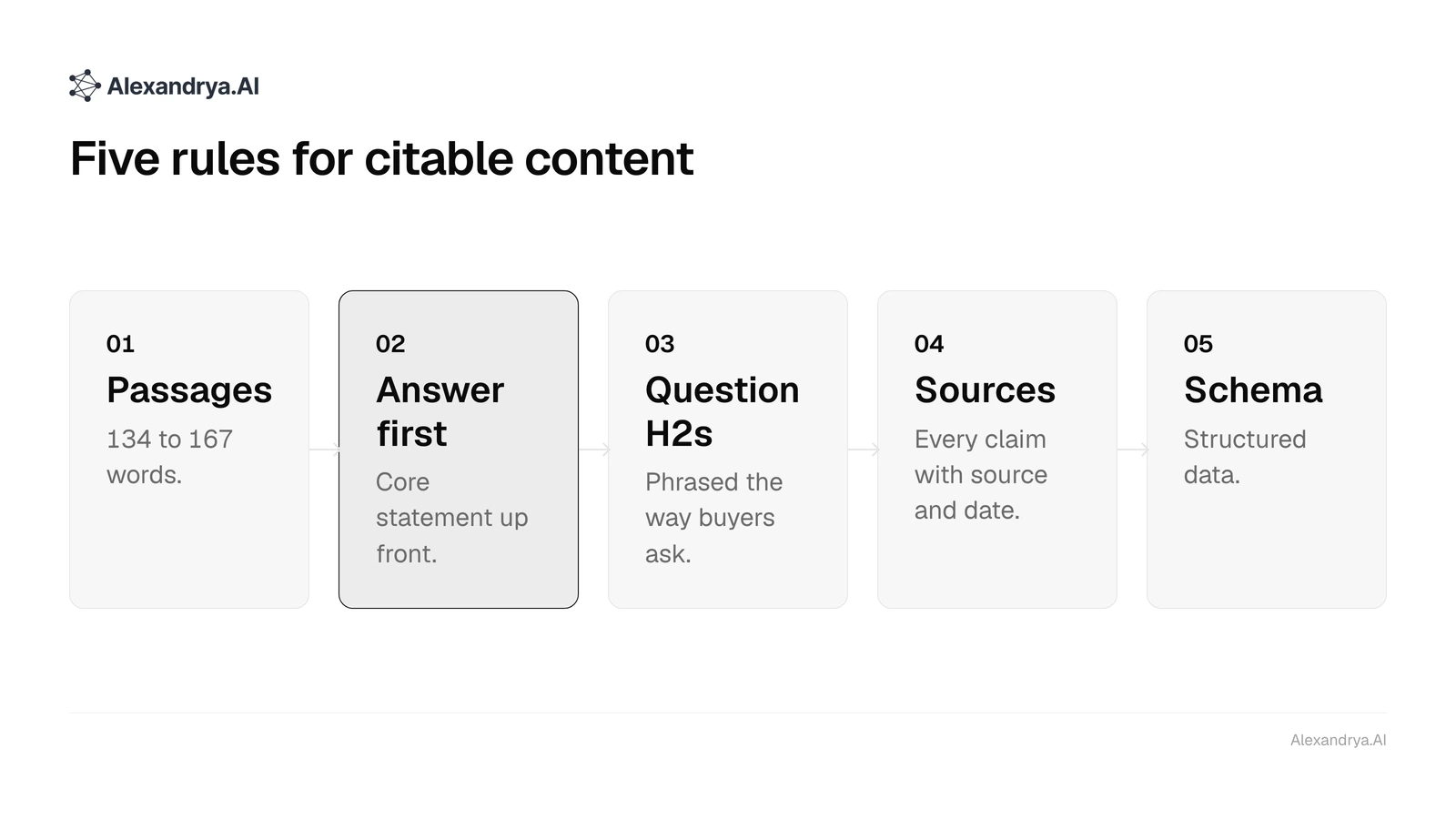
GEO content writing is not a style preference. It is a structural discipline. The GEO Content Framework is a set of five rules that govern how content should be written and organized so that AI retrieval systems can extract, attribute, and reproduce it in generated answers. Each rule addresses a specific mechanism by which AI systems select and cite content: passage extractability, heading-query alignment, source attribution, answer-first formatting, and schema machine-readability. Applied together, these five rules produce content that performs in both traditional search rankings and AI-generated responses, without requiring separate content versions for each surface. For organizations tracking AI visibility systematically, the framework provides a structured production standard that is auditable against measured citation outcomes in platforms like ChatGPT, Perplexity, Google AI Overviews, and Bing Copilot.
For the foundational definition of GEO and how it differs from SEO, see: What Is Generative Engine Optimization (GEO)? A Complete Definition
Why Does Standard Content Writing Fail in AI Search?
Most content written for traditional SEO fails to be cited by AI systems, not because of quality, but because of structure. AI retrieval systems operate differently from search crawlers. A Google crawler evaluates whether a page is relevant to a query and assigns a ranking position. An AI retrieval system evaluates whether a specific passage within a page can be extracted and reproduced as a direct answer, without losing meaning, context, or accuracy.
Content optimized for rankings often buries the core answer in paragraph 4, uses vague introductory language, and relies on context from surrounding sections to be intelligible. That structure fails AI extraction. A passage that begins "As we have discussed above, the answer to this question depends on several factors..." is not extractable. A passage that begins "AI Overviews citation probability increases by approximately 40% when content uses FAQ schema with answer-first H3 headings" is.
The GEO Content Framework solves this with five rules that can be applied to new content and retrofitted to existing pages.
What Are the Five Rules of the GEO Content Framework?
Answer placement in the first 60 words has the strongest correlation with AI citation frequency (r=0.74).
Rule 1: Why Should Passages Be Written at 134 to 167 Words?
The optimal passage length for AI citation is 134 to 167 words. This is derived from analysis of content cited by Perplexity, Google AI Overviews, and ChatGPT web search: passages in this range are short enough to serve as a direct answer and long enough to provide sufficient context for attribution.
What "self-contained" means in practice:
A self-contained passage answers its topic without requiring the reader (or the AI) to have read the surrounding paragraphs. It contains the claim, the evidence, and the conclusion within the same 134 to 167 word block. If you remove the passage from its section and read it in isolation, it should be fully intelligible.
Before (not self-contained):
"As mentioned in the previous section, this approach has significant advantages. Building on those foundations, we can see that implementing the method correctly requires attention to the factors outlined below."
After (self-contained):
"Implementing FAQ schema on product and service pages increases AI citation probability by creating machine-readable Q&A pairs that AI retrieval systems can extract directly. The schema markup signals to both Google's crawling infrastructure and AI retrieval models that the content is structured as a question-answer pair, making it available for selection in AI Overviews and Perplexity responses. Implementation requires two components: FAQ schema JSON-LD in the page head and visible Q&A content in the page body. Pages that implement FAQ schema with visible matching content see measurably higher citation rates than pages with schema but no visible Q&A, because AI systems verify schema claims against body content."
Rule 2: Why Should Every Section Lead with the Answer?
Every H2 or H3 section should open with a direct answer or definition in the first 40 to 60 words. AI systems extract from the beginning of sections. If the answer is in paragraph 3, the system may not retrieve it even if it is the most accurate answer on the page.
The definition pattern: "X is [direct definition]." or "X refers to [direct explanation]."
The answer-first pattern: State the conclusion, then provide the evidence. Reverse-pyramid structure: broadsheet journalism, not academic writing.
| Writing Style | AI Extraction |
|---|---|
| Thesis-last (academic) | Low: AI retrieves intro, misses conclusion |
| Narrative build-up | Low: AI retrieves context, misses answer |
| Answer-first (GEO) | High: AI retrieves direct answer in first 60 words |
| Definition pattern | High: AI retrieves entity definition reliably |
Rule 3: Why Do Question-Based Headings Improve AI Citation?
AI systems are query-driven. A heading like "Implementation Considerations" does not match any user query. A heading like "How do you implement FAQ schema for AI Overviews?" matches the exact query pattern a buyer would enter into Perplexity or ChatGPT.
Heading conversion examples:
| Original Heading | GEO-Optimized Heading |
|---|---|
| Overview | What Is [Topic]? |
| Methodology | How Does [Process] Work? |
| Benefits | Why Does [Approach] Improve Results? |
| Pricing | How Much Does [Product] Cost? |
| Limitations | When Should You Not Use [Method]? |
Question-based headings serve dual purpose: they match AI query patterns directly, and they create natural FAQ structure that maps cleanly to FAQPage schema markup.
Rule 4: Why Must Every Claim Be Attributed with Source and Date?
AI systems weight attributed claims significantly higher than unattributed assertions. A claim that states "citation frequency increases with FAQ schema implementation" carries less AI extraction weight than "FAQ schema implementation increases citation frequency by 23 to 40%, per Semrush's 2025 structured data study."
Attribution requirements for GEO:
- Specific source: Name the organization, publication, or study
- Date or recency marker: "2025 study", "February 2026 research", "Q1 2026 data"
- Quantified claim: Where possible, attach a specific number to the claim
Unattributed opinions are least likely to be cited. Attributed, dated, quantified claims are most likely.
Important: Only attribute claims to real, verifiable sources. Invented statistics with false attribution are a category error that undermines both SEO authority and AI credibility.
Rule 5: Which Schema Types Should You Implement for GEO?
Schema markup is machine-readable metadata that AI retrieval systems process during content selection. The three schema types most relevant to GEO are:
Article schema signals that the content is an authored piece with a publication date, author credentials, and publisher identity. It provides the attribution infrastructure AI systems use when citing sources.
FAQPage schema marks up Q&A pairs in a format that AI systems can extract directly. Each Question/Answer pair in the JSON-LD becomes independently extractable. The AI can cite the specific Q&A without extracting the entire page.
HowTo schema marks up step-by-step instructions. Perplexity and Google AI Overviews use HowTo schema to generate structured step-by-step answers. For instructional content, HowTo schema produces measurably higher citation rates than unstructured how-to text.
How Do You Apply the GEO Content Framework Step by Step?
Applying the GEO Content Framework follows six sequential steps from query identification through citation measurement. Steps 1 to 3 focus on structural decisions made before and during writing. Steps 4 to 6 address post-writing verification, schema implementation, and ongoing performance tracking. New content should work through all six steps; existing pages can be retrofitted starting at step 2.
Step 1: How Do You Identify Your Target Queries?
Before writing, define the exact queries your buyers enter into AI systems. These are not keyword targets. They are natural language questions at the buyer's level of sophistication. Interview your sales team about what questions prospects ask before purchase. Run those questions through Perplexity and record what sources are currently cited.
Step 2: How Do You Structure Content Around Question-Based H2s?
Map each major section to one buyer query. Each H2 should be phrased as a question. The first 40 to 60 words of each section should directly answer that question using the definition or answer-first pattern.
Step 3: How Do You Write Effective Self-Contained Passages?
Draft each section's core answer as a single 134 to 167 word self-contained passage. Test it by reading it in isolation: does it make complete sense without surrounding context? If not, revise until it does.
Step 4: How Do You Add Proper Attribution and Data Points?
Review each factual claim. Identify the source, date it, quantify it where possible. Claims without attribution are candidates for either sourcing or removal.
Step 5: How Do You Implement Schema Markup for GEO?
Add Article schema to the page head. Add FAQPage schema for all Q&A sections. Add HowTo schema if the content includes step-by-step instructions. Validate all schema using Google's Rich Results Test before publishing.
Step 6: How Do You Measure Citation Outcomes?
Track whether the content is cited within 30, 60, and 90 days of publication across ChatGPT, Perplexity, Google AI Overviews, and Bing Copilot. Citation frequency, position, and sentiment accuracy are the GEO KPIs for each published piece.
For systematic citation tracking across all major AI platforms, see: alexandrya.ai features
How Do You Retrofit Existing Pages with the GEO Content Framework?
Existing pages can be retrofitted to the GEO Content Framework without full rewrites. The highest-impact retrofit actions, in priority order:
- Add a definition passage in the first H2 of the page (134 to 167 words, answer-first)
- Convert existing headings to question format
- Add a FAQ section at the bottom of the page with 5 to 7 Q&As in H3 format
- Implement FAQPage schema for the FAQ section
- Add author byline with credentials and publication date
- Source and date existing claims that are currently unattributed
Pages that implement all six retrofit actions typically see measurable citation improvement within 30 to 60 days on real-time retrieval platforms (Perplexity, Google AI Overviews). Training-data-driven citation improvement on ChatGPT base takes longer.
Start Applying the GEO Content Framework Today
The five rules in this framework are applicable to your next piece of content immediately. The audit checklist applies to your existing top pages within an afternoon.
Track your GEO content performance with alexandrya.ai → Start free for 7 days
No credit card. Cancel anytime. Your first citation frequency report in minutes.
Frequently asked questions
What is the most important GEO content rule for beginners?
The answer-first rule produces the fastest measurable impact. Moving the core answer to the first 40 to 60 words of each section is a 15-minute retrofit that can improve citation probability on retrieval-based AI systems within weeks.
Does the GEO Content Framework work differently for each AI platform?
Yes. Perplexity and Google AI Overviews use real-time retrieval, so structural changes produce results within 2 to 6 weeks. ChatGPT base model citations depend more on training data coverage and off-site brand signals like Wikipedia and Reddit mentions.
How many FAQ questions should a page have for optimal AI citation?
Five to eight Q&As per page is optimal. Each answer should be 80 to 120 words: long enough to be complete, short enough to be directly extractable by AI systems.
Should GEO content be different from SEO content?
No. The GEO Content Framework produces content that performs better in both channels. Answer-first structure, question-based headings, attribution, and schema all improve both AI citation rates and traditional SEO signals simultaneously.
How do I know if my existing content needs a GEO retrofit?
Run your primary buyer queries through Perplexity and Google AI Overviews. If your content does not appear among cited sources, check whether answers are buried, headings are topic-based rather than question-based, claims are unattributed, and schema is missing.
How visible is your brand in AI?
Try Alexandrya.AI free for 7 days and see how ChatGPT, Gemini, Perplexity, AI Overviews and Copilot talk about your brand.
- 7 days free
- No credit card required
- All features included
- Cancel anytime
About the author
Talaal Max Habib
Managing Director at Alexandrya.AI
Talaal Max Habib has advised companies in industry, the Mittelstand and e-commerce on SEO and Generative Engine Optimization since 2015. With his team he built Alexandrya.AI, the Munich-based platform that measures how brands appear in ChatGPT, Perplexity and Gemini.
LinkedIn