What Is Generative Engine Optimization (GEO)? A Complete Definition
GEO structures content so AI systems like ChatGPT, Gemini & Perplexity cite it. Learn the definition, the 5 pillars, and how it differs from classic SEO.

Managing Director at Alexandrya.AI
How Is Generative Engine Optimization Defined?
Generative Engine Optimization (GEO) is the practice of structuring and positioning content so that large language models (including ChatGPT, Google Gemini, and Perplexity) cite it within AI-generated search responses. Unlike traditional search engine optimization, which targets crawlers and ranking algorithms to secure click-through traffic, GEO targets the selection mechanisms of generative AI systems, which synthesize answers from trusted sources rather than returning a ranked list of links. GEO encompasses five core disciplines: citability (structuring content so individual facts are extractable), authority signals (building the cross-web reputation that AI systems use as a trust proxy), topical coverage (owning definitional and methodological content within a subject area), structured clarity (using schema markup, headers, and explicit definitions to aid AI parsing), and freshness (ensuring content is referenced across external sources recently enough to remain within an AI model's active knowledge base). GEO does not replace SEO. It operates in parallel, targeting the growing share of search journeys that begin and end within AI-generated responses, without a click to any website.
For context on why this matters commercially, see: What Is AI Visibility? The Metric Every CMO Needs in 2026
How Does GEO Differ from Traditional SEO?
GEO and SEO are not the same discipline. They share some foundational content quality requirements, but they optimize for entirely different endpoints. Understanding the distinction is the starting point for building a dual strategy.
What Does Traditional SEO Optimize For?
Traditional search engine optimization is designed to help a web page rank in Google's or Bing's search results index. The primary mechanism is earning backlinks, building topical authority in the eyes of a ranking algorithm, and matching keyword intent. The desired outcome is a user clicking through from a search results page to a website. Every SEO metric (organic traffic, ranking position, click-through rate, impressions) is built around that click.
What Does GEO Optimize For?
Generative Engine Optimization is designed to make a brand, product, or fact appear within an AI-synthesized answer. The primary mechanism is providing content that AI retrieval systems can extract, attribute, and reproduce with confidence. The desired outcome is citation: the AI model names your brand or references your content as a source when answering a user's question. The user may never click to your website, but they encounter your brand as a trusted authority in the AI's answer.
Why Do You Need Both SEO and GEO in 2026?
SEO and GEO are not competing strategies; they address two different discovery surfaces. Google processes approximately 8.5 billion searches per day. AI systems now handle hundreds of millions of queries daily and are growing rapidly. Bain & Company (February 2025) found that 60% of searches already end without a click, a figure that will increase as AI-generated answers improve. A brand that invests only in SEO is optimizing exclusively for a declining share of discovery. A brand that invests in both addresses where buyers are today and where they are going.
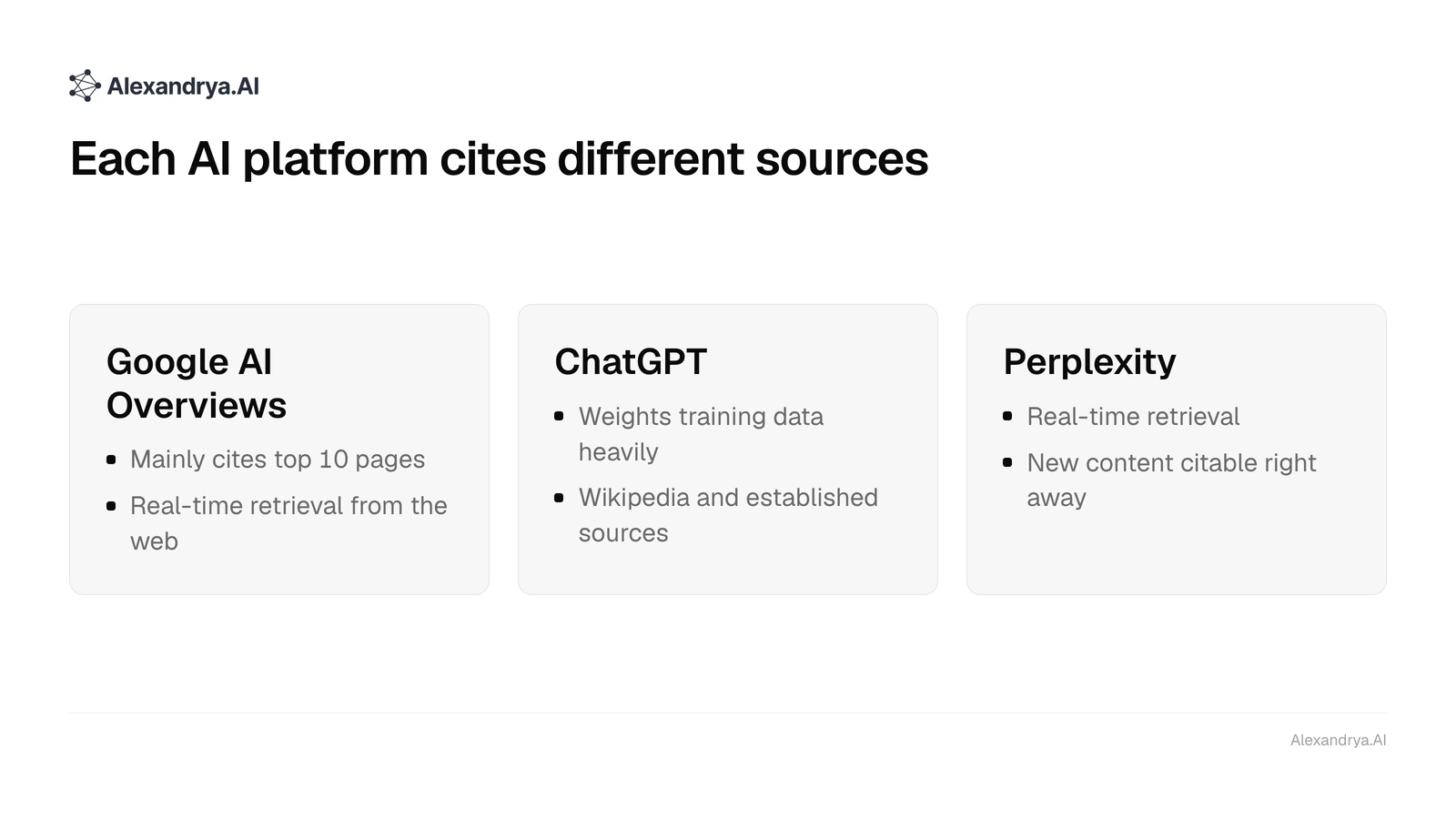
Only 11% of domains are cited by both ChatGPT and Google AI Overviews for the same buyer query, making platform-specific GEO optimization essential, not optional.
How Do Generative AI Systems Select Which Sources to Cite?
Understanding how AI systems decide which sources to cite is the foundation of effective GEO. The selection mechanism differs meaningfully between AI platforms.
What Is Retrieval-Augmented Generation (RAG)?
Most modern AI search systems (including Perplexity, Google AI Overviews, and Bing Copilot) use a technique called Retrieval-Augmented Generation (RAG). Rather than generating answers purely from training data, these systems first retrieve relevant documents from the live web, then use those documents as source material for their generated answer.
For GEO, this means: content that is well-indexed, well-structured, and answers the specific query directly has a real-time opportunity to be cited, regardless of when the AI model was trained.
What Is the Difference Between Training Data and Real-Time Retrieval?
ChatGPT's base responses (without web search enabled) draw on training data with a knowledge cutoff. Brands with strong pre-cutoff authority (Wikipedia presence, academic citations, widespread press coverage) carry higher base citation probability in training-data-driven responses.
By contrast, platforms using real-time retrieval (Perplexity, Google AI Overviews, Bing Copilot) cite content published today if it is relevant, well-structured, and accessible. This is where GEO content investments yield the fastest measurable results.
What Are the Five Pillars of Generative Engine Optimization?
GEO is built on five interdependent disciplines that collectively determine whether AI systems select your content as a citation source. Addressing only one pillar rarely produces consistent citation results. Effective GEO programs audit all five and prioritize improvements based on which gap has the greatest measurable impact on citation frequency for their specific content and competitive context.
1. Citability: Are Your Facts Extractable?
Citable content contains self-contained factual passages that AI systems can extract and reproduce without losing meaning. The structural markers of high-citability content are:
- Explicit definitions following the pattern "X is..." or "X refers to..."
- Claims accompanied by source attribution and publication dates
- Paragraphs that are 134 to 167 words long: short enough to be a direct answer, long enough to provide context
- Answer-first structure: the core fact appears in the first 40 to 60 words of a section
For a practical guide to structuring citable content, see: The GEO Content Framework: How to Write for ChatGPT, Perplexity, and AI Overviews
2. Authority Signals: Does the AI Trust Your Source?
AI systems evaluate source trustworthiness through proxy signals that mirror, but are not identical to, traditional SEO authority metrics. High-weight GEO authority signals include:
- Presence on Wikipedia or Wikidata as a recognized entity
- YouTube channel mentions (the single highest-correlation brand signal, per Ahrefs December 2025 research on 75,000 brands)
- Reddit discussions referencing the brand or its content
- Named author attribution with verifiable credentials
- Citations from academic or tier-1 journalistic sources
Domain Rating (backlinks) correlates weakly with AI citation frequency (~0.266) compared to brand mention frequency on YouTube (~0.737). Building off-site brand presence is therefore a higher-leverage GEO investment than link building alone.
3. Topical Coverage: Do You Own Your Category?
AI systems preferentially cite sources that demonstrate comprehensive expertise within a subject area. A single well-written article rarely achieves consistent citation. A content cluster (definitional article, how-to guides, case studies, benchmarks, and comparison pieces) signals topical ownership that AI systems recognize and reward with higher citation rates.
This is why the 30-day blog strategy for alexandrya.ai is structured as three interconnected clusters rather than 15 standalone posts.
4. Structured Clarity: Can the AI Parse Your Content?
Generative AI systems process HTML and structured data during retrieval. Content that uses explicit heading hierarchies (H1 → H2 → H3), FAQ schema markup, HowTo schema, and Article schema provides machine-parseable signals about content organization that improve citation probability. Key structural requirements:
- Clean H1 → H2 → H3 heading hierarchy with no skipped levels
- FAQ sections with clearly marked Q&A pairs and FAQPage JSON-LD schema
- Tables for comparative data (AI systems extract table data reliably)
- Bullet and numbered lists for multi-item content
5. Freshness: Are You Referenced Across the Web?
AI systems that use real-time retrieval weight recency. Content published or updated within the past 90 days is significantly more likely to be retrieved by RAG-based systems than content that is years old and has not been referenced recently. Freshness in GEO is not just about publishing date. It is also about being cited, discussed, or linked from external sources recently enough to appear in AI retrieval windows.
How Do You Measure the Impact of Generative Engine Optimization?
GEO cannot be measured with Google Search Console or traditional SEO rank trackers. The correct metrics are:
| Metric | What It Measures | Tool |
|---|---|---|
| Citation Frequency | % of relevant queries in which your brand appears | alexandrya.ai |
| Citation Position | Whether your brand leads or trails in AI recommendations | alexandrya.ai |
| Sentiment Accuracy | Whether AI descriptions match your actual positioning | alexandrya.ai |
| Competitive Share | Your brand's citation % vs. top 3 competitors | alexandrya.ai |
For a full measurement framework, see: How to Run a GEO Audit: Step-by-Step Framework for 2026
How Are B2B Brands Implementing GEO Right Now?
Early-adopter B2B brands implementing structured GEO programs are reporting measurable improvements in AI citation frequency within 60 to 90 days of implementation. ThyssenKrupp Schulte achieved a +340% increase in AI visibility within 6 months using alexandrya.ai's measurement and optimization platform, the first publicly documented enterprise GEO result in the German industrial sector.
The most common implementation sequence for B2B brands beginning GEO:
- Establish a baseline AI visibility measurement across ChatGPT, Gemini, and Perplexity
- Identify which competitor currently leads in AI citation for primary buyer queries
- Implement FAQ schema and Article schema on all product and service pages
- Create or expand definitional content for core category terms
- Build external brand presence through LinkedIn, industry publications, and YouTube
Start Measuring Your GEO Performance Today
Understanding GEO is step one. Knowing where your brand currently stands and what is preventing AI systems from citing you requires measurement.
See how alexandrya.ai measures your GEO performance → Start free for 7 days
No credit card. Cancel anytime. Your first AI visibility baseline in minutes.
Frequently asked questions
What does 'generative engine' mean in GEO?
A generative engine is an AI system that generates answers rather than returning links. ChatGPT, Google Gemini, Perplexity, and Bing Copilot are all generative engines. Generative Engine Optimization (GEO) is the practice of making your content the source that generative engines synthesize from.
Is GEO the same as AEO (Answer Engine Optimization)?
GEO and AEO describe the same challenge: optimizing content for AI-generated answers. AEO focused earlier on voice search and featured snippets. GEO is the more current term, specifically addressing large language model citation in systems like ChatGPT and Perplexity.
Does GEO work differently across AI platforms?
Yes. Google AI Overviews primarily cites top-10 organic ranking pages. ChatGPT draws on training data, weighting Wikipedia and authoritative pre-cutoff sources. Perplexity uses real-time retrieval with strong Reddit and Wikipedia weighting. Only 11% of domains are cited by both ChatGPT and Google AI Overviews for the same query.
How long does it take for GEO improvements to show results?
Structural changes like FAQ schema and Article schema can produce measurable citation improvements within 2 to 6 weeks on real-time retrieval platforms (Perplexity, AI Overviews). Training-data-driven improvements for ChatGPT base model citations take longer, depending on model retraining cycles.
Does GEO replace traditional SEO?
No. GEO and SEO operate in parallel. Google AI Overviews, with 1.5 billion monthly users, predominantly cites pages already ranking in organic search. The correct strategy is dual optimization: SEO for click-based discovery, GEO for AI-cited discovery.
How do I know if my content is already GEO-optimized?
Run your primary buyer queries through ChatGPT, Gemini, and Perplexity and check whether your brand is cited. If not, your content likely lacks citability, authority signals, topical coverage, structured clarity, or freshness: the five GEO pillars.
How visible is your brand in AI?
Try Alexandrya.AI free for 7 days and see how ChatGPT, Gemini, Perplexity, AI Overviews and Copilot talk about your brand.
- 7 days free
- No credit card required
- All features included
- Cancel anytime
About the author
Talaal Max Habib
Managing Director at Alexandrya.AI
Talaal Max Habib has advised companies in industry, the Mittelstand and e-commerce on SEO and Generative Engine Optimization since 2015. With his team he built Alexandrya.AI, the Munich-based platform that measures how brands appear in ChatGPT, Perplexity and Gemini.
LinkedIn