What an AI search tracker is and how it measures AI answers
An AI search tracker sends fixed prompts to ChatGPT, Gemini and Perplexity, stores every answer and turns mentions and cited sources into metrics.

Managing Director at Alexandrya.AI
An AI search tracker sends a fixed list of prompts, on a fixed schedule, to ChatGPT, Gemini, Perplexity, Google AI Mode, Google AI Overviews and Microsoft Copilot. It stores every answer with its source list and checks whether your brand is named and your domain is cited. From many of these samples it calculates mention rate, citation rate, share of voice and position.
Alexandrya.AI is our own product, and the examples come from the project in which we track our own brand. ChatGPT-specific features are covered in our piece on the ChatGPT tracking tool, pre-purchase testing in the AI monitoring tool checklist. Here the subject is the measurement itself, across platforms, from prompt to dashboard.
What is an AI search tracker?
An AI search tracker is software that sends a fixed set of prompts, on a schedule, to ChatGPT, Gemini, Perplexity, Google AI Mode, Google AI Overviews and Microsoft Copilot and stores every answer together with its source list. It then checks whether your brand name appears in the text and whether your domain is cited as a source. Vendors also call it an AI visibility tool or LLM tracker.
Google returns a ranked list of links, an AI assistant running text with a source list, and whether your brand makes it into that text is decided again every time someone asks.
Is a search visibility tool about web search or AI answers?
A search visibility tool measures how visible a site is in search, and the label is used for two different kinds of software. In classic SEO, a visibility index shows how well a domain ranks across many keywords in Google's web results. AI monitoring tools now use the same name. Before you buy, check whether a tool collects web rankings or mentions and citations in AI answers.
| Tool | Raw data | Core metric | Typical question |
|---|---|---|---|
| Rank tracker or web visibility index | Google results page per keyword | ranking position, visibility score | Where does my URL rank? |
| AI search tracker | generated answer text plus source list per prompt and platform | mention rate, citation rate, share of voice | Does the AI name my brand, and which sources does it use? |
| Social listening | published posts on social media, in the press and in forums | mention volume, reach | Who is talking about us, and where? |
Each of the three collects different raw data, so their figures cannot be added up. The AI models blur the line too: for the prompt "search visibility tool", Alexandrya.AI's Action Plan of 20 November 2026 shows answers naming mainly Nightwatch, Profound and SE Ranking, vendors from both camps. Our comparison of AI monitoring and SEO tools puts rank trackers and specialist tools side by side.
How an AI search tracker collects an answer
An AI search tracker measures in five steps: it sends a fixed prompt set to each platform, stores the answer text and source list, detects brand mentions and domain citations in them and turns the hits into metrics. Four choices come before the first query: which prompts, which access method, which country and language, and how often.
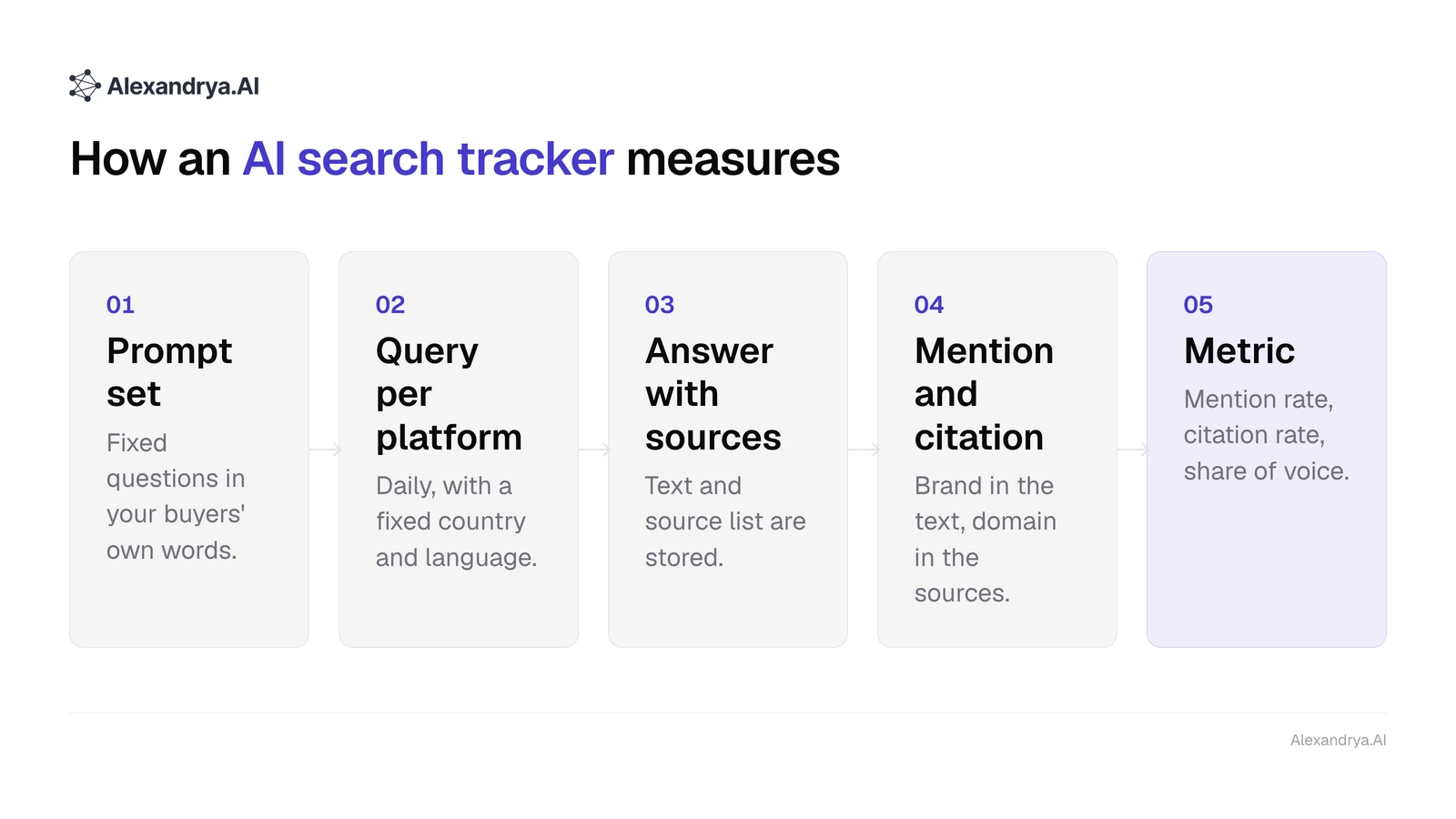
How an AI search tracker measures: from a fixed prompt set, through one query per platform, to the metric on the dashboard. Alexandrya.AI, November 2026.
The prompt set is the sample
The prompt set holds the questions your buyers actually ask, a mix of category, comparison, purchase and brand questions. It stays the same for weeks so that figures remain comparable. The IAB guideline Measuring Visibility in the AI Era (August 2026, accessed 21 November 2026) treats programmes with fewer than 50 prompts as exploratory. Some vendors bring their own prompt databases: according to its methodology page (updated 26 February 2026), Ahrefs derives the questions for Brand Radar from its keyword database. That measures the category, which is not necessarily the same as your own buying questions.
Interface or API
An AI search tracker collects answers either through the web interface people use or through the AI provider's API, and the two routes can return different answers. The IAB guideline from August 2026 therefore asks vendors to disclose the access method, whether live web retrieval was switched on, and whether the method complies with the platform's terms of service.
So far the gap has mostly been measured by vendors with a stake in the answer. Surfer, which collects through the interface, compared 1,000 prompts and 13,779 answers in October 2026 and found an overlap of 30% at best. Ahrefs says Brand Radar runs all prompts through the public web interfaces of ChatGPT, Gemini, Perplexity and Copilot. Conductor works with APIs and, in an article accessed on 21 November 2026, argues that most AI platforms prohibit automated scraping in their terms of service.
OpenAI's Responses API offers a web search tool with a configurable approximate location (accessed 21 November 2026), but OpenAI does not say its answers match chatgpt.com. Ask every vendor which route it uses per platform and whether web search is on.
Country, language and account
ChatGPT rewrites your question into its own queries for search partners, using an approximate location from your IP address and, if memory is on, saved memories. That is how OpenAI describes it in Searching the web with ChatGPT (accessed 21 November 2026). According to Google Search Central (last updated 10 December 2025), AI Overviews and AI Mode can also fan a question out into several queries on subtopics. A tracker should therefore fix country and language per project and query without a personal chat history.
Repetition turns answers into a sample
An AI search tracker queries each prompt again and again, because any single answer is just one of many possible ones. In Alexandrya.AI's own project the daily scan returns one answer per prompt and platform. On 21 November 2026 that meant 269 answers for 45 prompts across six platforms, with one query returning nothing.
What one buying prompt returns on six platforms
We added the German buying prompt "ki-suchmaschinen-monitoring tools kaufen" (buy AI search monitoring tools) to our project on 21 November 2026 and ran it for the first time at around 2 pm CET. The table shows what came back from each platform.
| Platform | Tools named in the answer | Entries in the source list | Counted as citations | alexandrya.ai |
|---|---|---|---|---|
| ChatGPT | 6: Rankscale, Otterly.AI, Peec AI, SE Visible, SISTRIX, Profound | 40 (20 URLs, each listed twice) | 6 | neither named nor cited |
| Google AI Mode | 4: Peec AI, OtterlyAI, SE Visible, Ahrefs Brand Radar | 9 | 9 | neither named nor cited |
| Gemini | 6: Otterly.AI, Peec AI, Profound, Semrush, Ahrefs Brand Radar, Rankscale | 0 | 0 | neither named nor cited |
| Perplexity | 4: Otterly.AI, Peec AI, Semrush AI Visibility Toolkit, Profound | 10 | 10 | cited at positions 3 and 4, not named |
| Microsoft Copilot | 6: Profound, Peec AI, Otterly AI, AthenaHQ, Semrush, Ahrefs Brand Radar | 35 | 4 | neither named nor cited |
| Google AI Overviews | no answer stored | 0 | 0 | no answer |
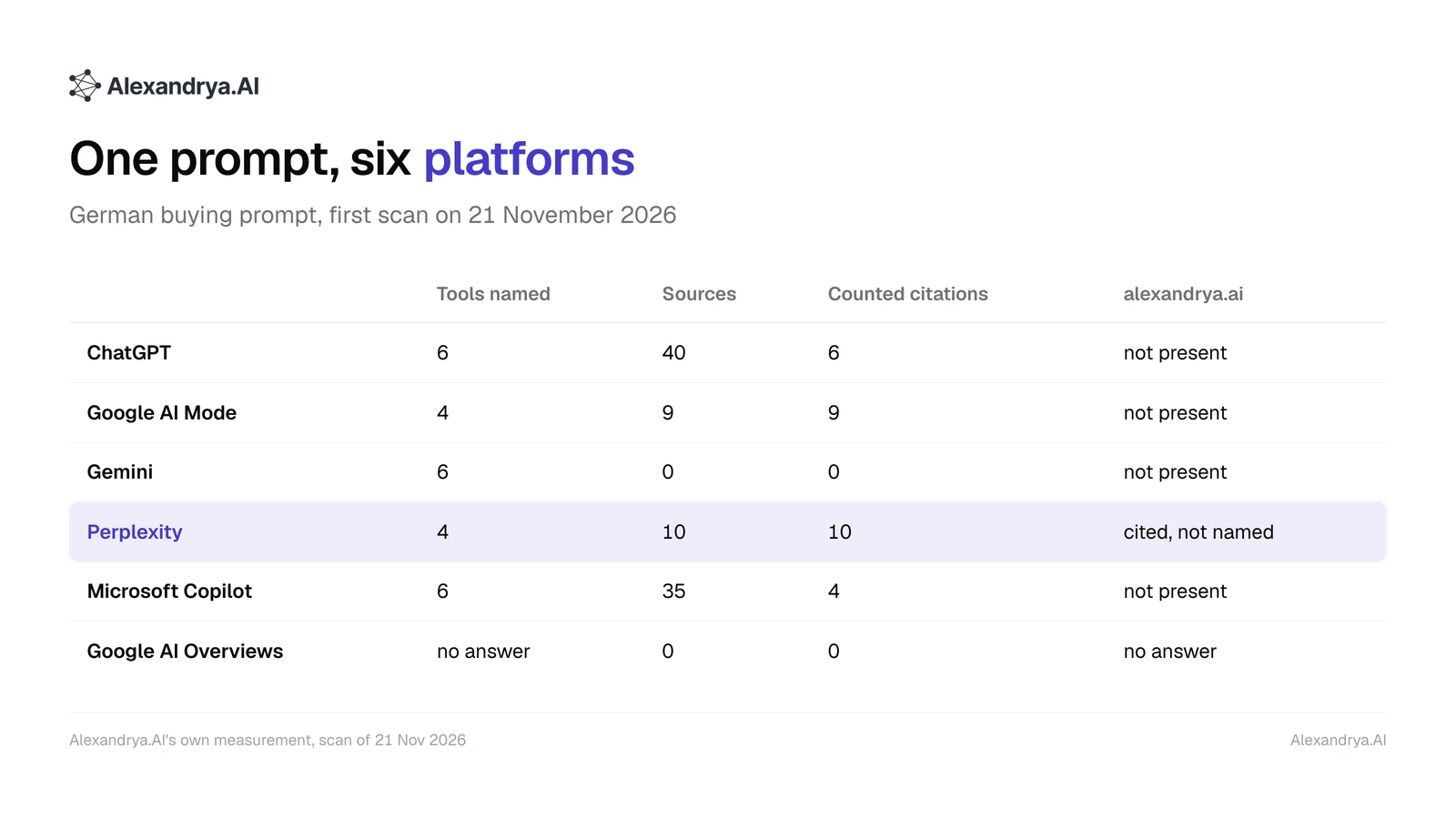
One prompt, six platforms: tools named, sources and counted citations for a German buying prompt. Alexandrya.AI's own measurement, first scan on 21 November 2026.
Peec AI and Otterly appear in all five answers and Profound in four; across platforms, nine different tools are named. The source lists, by contrast, share only a handful of domains. ChatGPT lists 40 entries, each of its 20 URLs once with and once without the parameter utm_source=chatgpt.com, while Gemini gives no source at all. Perplexity cites two alexandrya.ai articles at positions 3 and 4 and still does not name the brand in its answer. For Google AI Overviews there is no answer from this run.
The table describes a single run. What it shows is how much a tool has to read out of each answer before any number exists.
Detecting mentions and citations in an answer
An AI search tracker detects a mention by searching the answer text for the brand name and its variants. In the example, three platforms spell the same vendor as "Otterly.AI", "OtterlyAI" and "Otterly AI". A tool without maintained variants counts three brands or misses two. Short or generic brand names cause the opposite problem and produce false hits when they appear inside other words.
In a study (preprint, April 2026), Schulte, Bleeker and Kaufmann list both errors as a limitation of their word-list brand detection. Citations come from the source list: the tool splits it into entries with URL, domain, position and a flag for whether the link sits in the answer text or only below it. Then the list is cleaned. Tracking parameters such as utm_source are dropped, duplicate URLs merged and irrelevant entries removed, such as the three retail links Copilot appended at positions 33 to 35 in the example.
Alexandrya.AI's dashboard counts only linked sources as citations, which for ChatGPT meant 6 of the 40 entries. Position is a domain's rank in the cleaned list. How to turn that into an average position per domain and platform is shown in our source analysis by platform.
Calculating mention rate, citation rate and share of voice
Mention rate is the number of answers that name the brand divided by all answers, as defined in the IAB guideline of August 2026. Many reports count prompts instead, and the two figures can sit far apart. On 20 November 2026 AI answers named Alexandrya.AI for 14 of 45 prompts on at least one platform, yet in only 18 of 270 answers (7%, own measurement, six platforms).
| Metric | Calculation | What it shows | Common trap |
|---|---|---|---|
| Mention rate | answers naming the brand divided by all answers | whether the AI recommends you | counting prompts instead of answers |
| Citation rate | answers citing your domain as a source divided by all answers | whether the AI uses your pages as evidence | not stating whether only linked or also named sources count (the IAB counts both) |
| Share of voice | your mentions divided by mentions of all brands in the comparison set | your share against competitors | the result depends on which brands are in the set |
| Position | your domain's rank in the source list | how far up you are cited | treating lists of 9 and of 40 entries alike |
| Sentiment | the passage naming you rated positive, neutral or negative | how the AI talks about you | few mentions mean few ratings |
Both figures are correct and answer different questions. Counting prompts tells you on how many topics you show up at all; the answer rate tells you how likely a buyer is to read your name in a single answer. For share of voice the IAB also asks vendors to disclose the comparison set, because a different set gives a different figure for the same answers. Worked examples are in our guide to AI share of voice.
An average across platforms hides a lot as well. On 20 November 2026 Perplexity cited alexandrya.ai in 49% of its answers, Google AI Overviews in 42%, Google AI Mode in 29%, ChatGPT in 7%, Gemini in 4% and Microsoft Copilot in 2%, while the daily figure across all six was 22%. Only the per-platform figure tells you where to start.
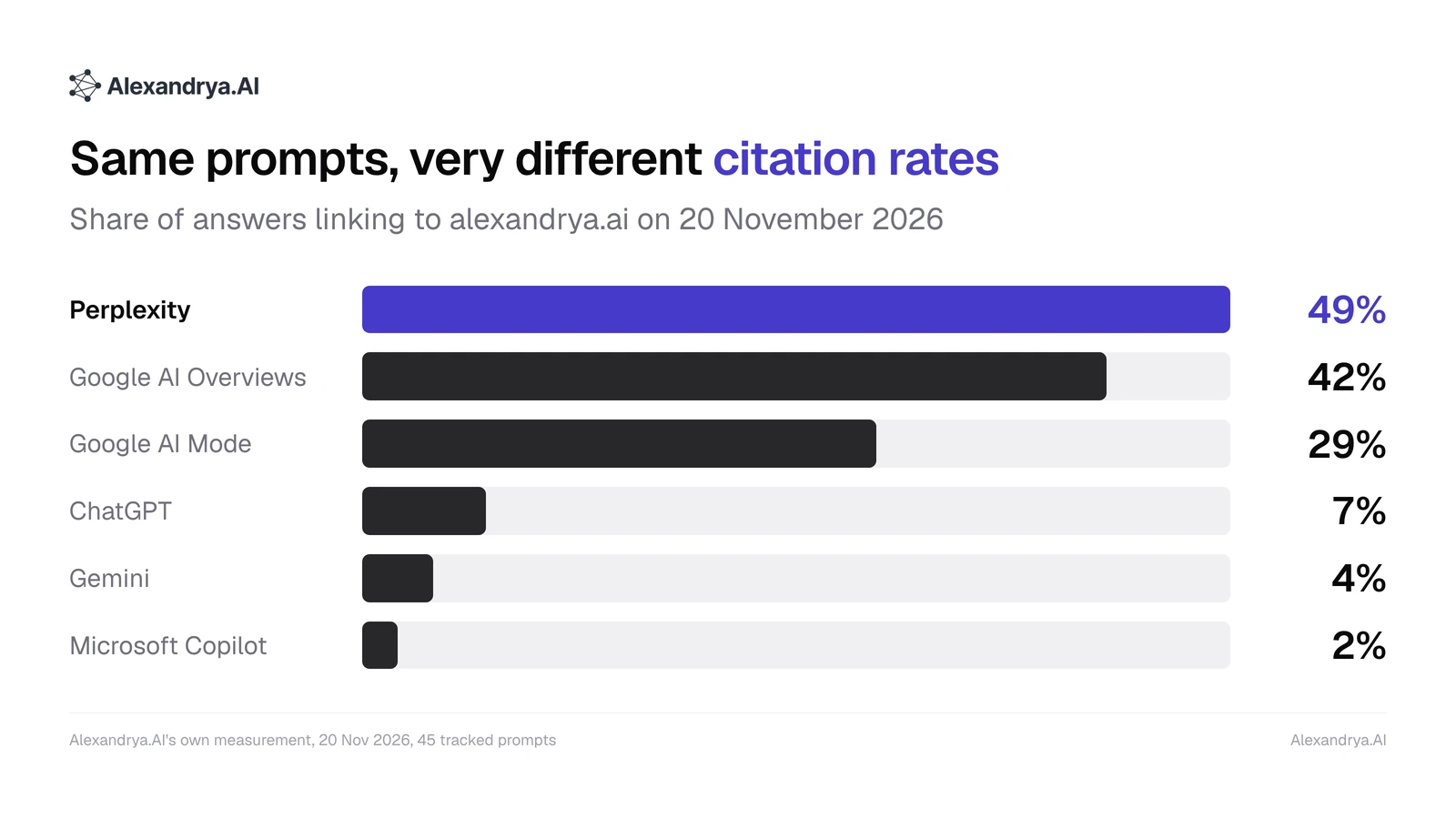
Citation rate per platform for the same prompts on the same day. Alexandrya.AI's own measurement, as of 20 November 2026, 45 tracked prompts, daily dashboard figures.
Where measuring AI answers hits its limits
A single measurement of an AI answer is a snapshot. In a study by Schulte, Bleeker and Kaufmann (preprint, April 2026, accessed 21 November 2026), the sources cited by ChatGPT, Gemini, Google AI Mode and Perplexity overlapped by only 34 to 42% from one day to the next. The authors recommend at least seven runs per prompt per day for brand figures, eight for sources, and reporting windows of two to four weeks.
The study covered four Swiss industries with eight prompts each between January and March 2026. Our own project shows the same restlessness: Gemini cited alexandrya.ai in 26% of its answers on 13 November 2026 and in 7% on 18 November, with the same 43 prompts.
Then there is platform access. In our project Google AI Overviews returned a result for only 23 of 43 prompts on 15 November 2026; in the study Gemini delivered data on only 22 to 26 of roughly 45 days. The figure alone does not say whether an overview was missing or collection failed. Personalisation stays out of scope, because a tracker queries from a fixed country without a chat history.
Daily figures therefore show swings, and trends only become visible over three to four weeks. Alexandrya.AI queries each prompt once a day per platform in our own project, which is why we compare averages over several weeks.
What to check before you buy an AI search tracker
When you buy an AI search tracker, what matters is whether you can trace every metric back to a single answer. That requires the tool to query the platforms your buyers use, count mentions and citations separately and disclose its method. Five checks are enough for a shortlist:
- It queries at least ChatGPT, Gemini, Perplexity, Google AI Mode and Google AI Overviews.
- It shows every answer in full with its source list and counts mentions and citations separately.
- The vendor names its access method, country, language and schedule for each platform.
- The vendor says whether its rates count prompts or answers, and who is in the comparison set.
- You work out the price per prompt and platform before comparing plans.
How to test these points during a trial is covered in our pre-purchase test protocol. For an overview of individual vendors, see our comparison of the best AI visibility tools.
Where Alexandrya.AI fits in this process
Alexandrya.AI is an AI visibility tool from Munich that measures brand mentions in ChatGPT, Gemini, Perplexity, Google AI Overviews, Google AI Mode and Microsoft Copilot and turns them into content and citation tasks. Mentions and citations appear separately as GEO Brand Score and GEO Link Score, and the Sources & Domains view shows the citation mix by source type and position in the source list.
Every answer is stored; from Professional upwards your AI assistant reads it in full through MCP. The Action Plan turns cited sources into content briefs, a pitch list of outreach targets and quick wins that your team works through as tasks.
Three or five of nine platforms are active depending on the plan, all of them on Enterprise, with plans starting at €79 a month for 50 prompts (pricing page, as of 21 November 2026). Limits: each prompt is queried once a day per platform, there is no social listening, no alerts or Slack integration, no prompt search volume, and the API is Enterprise only. According to the pricing page, the team explains platforms and analyses on request, so ask about the access method there too.
What remains open is how quickly vendors agree on common counting rules. The IAB guideline asks for disclosure but does not rate vendors. As long as dashboards count prompts, answers and citations differently, compare figures only within one tool.
Frequently asked questions
How much does an AI search tracker cost?
At Alexandrya.AI the price depends on prompt volume, tracked brands or products and chosen AI platforms. Starter costs €79 a month for 50 prompts on three selectable models, Professional €199 for 150 prompts, five models and three countries, and Business €399 for 350 prompts (pricing page, 21 November 2026). Compare any vendor by price per prompt and platform.
How many prompts do I need to track?
The IAB guideline from August 2026 treats measurement programmes with fewer than 50 prompts as exploratory, because they cannot fully describe a category. Alexandrya.AI tracked 45 prompts for its own brand on 20 November 2026 and extended the set to 63 the following day. Every additional country needs its own prompts in the local language.
Does an AI search tracker see the same answer I see?
Not necessarily. According to OpenAI, ChatGPT uses an approximate location from your IP address and, if memory is on, saved memories when it writes search queries. A tracker queries from a fixed country without your chat history. It therefore measures a neutral sample, and the personal answer a single user sees can differ from it.
Does Google Search Console show my AI Overviews visibility?
Google Search Console does not report AI Overviews or AI Mode separately. According to Google Search Central (last updated 10 December 2025), pages shown in these AI features are counted in the Performance report under the "Web" search type. To see which questions cite your domain in an AI Overview, you need separate monitoring.
Can I not just check AI answers by hand?
You can spot-check a few prompts yourself, but that is not monitoring. Forty-five prompts on six platforms produce 270 answers a day; Alexandrya.AI's own scan on 21 November 2026 returned 269. Then come the source lists, 40 entries from ChatGPT alone for one prompt that day, to be counted, cleaned and compared over weeks.
See what sits behind your percentages
Add 20 to 50 prompts in your buyers' own words to Alexandrya.AI and let them run for seven days on the platforms you choose. Afterwards you can see, for each prompt and platform, whether you are named or cited and which sources the AI uses instead of your pages. No credit card needed. Try Alexandrya.AI free for 7 days
Frequently asked questions
How much does an AI search tracker cost?
At Alexandrya.AI the price depends on prompt volume, tracked brands or products and chosen AI platforms. Starter costs €79 a month for 50 prompts on three selectable models, Professional €199 for 150 prompts, five models and three countries, and Business €399 for 350 prompts (pricing page, 21 November 2026). Compare any vendor by price per prompt and platform.
How many prompts do I need to track?
The IAB guideline from August 2026 treats measurement programmes with fewer than 50 prompts as exploratory, because they cannot fully describe a category. Alexandrya.AI tracked 45 prompts for its own brand on 20 November 2026 and extended the set to 63 the following day. Every additional country needs its own prompts in the local language.
Does an AI search tracker see the same answer I see?
Not necessarily. According to OpenAI, ChatGPT uses an approximate location from your IP address and, if memory is on, saved memories when it writes search queries. A tracker queries from a fixed country without your chat history. It therefore measures a neutral sample, and the personal answer a single user sees can differ from it.
Does Google Search Console show my AI Overviews visibility?
Google Search Console does not report AI Overviews or AI Mode separately. According to Google Search Central (last updated 10 December 2025), pages shown in these AI features are counted in the Performance report under the "Web" search type. To see which questions cite your domain in an AI Overview, you need separate monitoring.
Can I not just check AI answers by hand?
You can spot-check a few prompts yourself, but that is not monitoring. Forty-five prompts on six platforms produce 270 answers a day; Alexandrya.AI's own scan on 21 November 2026 returned 269. Then come the source lists, 40 entries from ChatGPT alone for one prompt that day, to be counted, cleaned and compared over weeks.
How visible is your brand in AI?
Try Alexandrya.AI free for 7 days and see how ChatGPT, Gemini, Perplexity, AI Overviews and Copilot talk about your brand.
- 7 days free
- No credit card required
- All features included
- Cancel anytime
About the author
Talaal Max Habib
Managing Director at Alexandrya.AI
Talaal Max Habib has advised companies in industry, the Mittelstand and e-commerce on SEO and Generative Engine Optimization since 2015. With his team he built Alexandrya.AI, the Munich-based platform that measures how brands appear in ChatGPT, Perplexity and Gemini.
LinkedInKeep reading
All Brands articles
November 21, 2026
AI monitoring vs brand monitoring: what Brandwatch, Meltwater and co. now track in AI answers
November 18, 2026
ChatGPT Business Hub: how to claim your profile and read the numbers
November 18, 2026