What Is AI Visibility? The Metric Every CMO Needs in 2026
AI visibility measures how your brand appears in ChatGPT, Gemini & Perplexity. Learn the 4 components, the 2026 benchmarks, and how to start tracking today.

Managing Director at Alexandrya.AI
What Is AI Visibility? (A Working Definition)
AI visibility refers to how frequently, prominently, and accurately a brand appears within AI-generated search responses across platforms such as ChatGPT, Google Gemini, and Perplexity. Unlike traditional search visibility, which measures organic rankings and click-through rates, AI visibility captures whether a brand is cited as a trusted source within synthesized answers, where no click may ever occur. Research from Bain & Company (February 2025) shows that 60% of searches now end without a click, and AI Overview results achieve a CTR of approximately 1%, compared to 15% for conventional results. For B2B companies, where McKinsey data (October 2025) indicates 67% of purchase decisions now begin in AI search engines, unmeasured AI visibility represents a direct revenue risk. AI visibility is measured across four dimensions: citation frequency, citation position, sentiment accuracy, and competitive share of AI-generated responses. Brands with high AI visibility are more likely to be shortlisted in AI-influenced buying decisions, making it the central unmeasured KPI of modern B2B marketing.
How Does AI Visibility Differ from Traditional Search Visibility?
Traditional search visibility answers the question: Where does my website appear when someone searches on Google? It is measured in keyword rankings, organic impressions, and click-through rates, all of which assume a user sees a list of links and chooses one.
AI visibility answers a fundamentally different question: What does ChatGPT say about my brand when a buyer asks which solution to choose?
The distinction matters because the mechanics are entirely different:
| Dimension | Traditional Search Visibility | AI Visibility |
|---|---|---|
| How it's measured | Keyword rankings, GSC impressions | Citation frequency, sentiment, position in AI answers |
| Who controls it | Google's ranking algorithm | LLM training data + retrieval logic |
| User behavior | Click to website | Read AI answer, no click needed |
| Click-through rate | 15% (conventional results) | ~1% (AI Overview source links) |
| Content format needed | SEO-optimized pages | Citable, structured, authority-signaling content |
Why Isn't Share of Voice a Proxy for AI Visibility?
Share of Voice (SOV) traditionally measures the percentage of advertising impressions or organic mentions your brand holds relative to competitors. AI visibility is not about impressions. It is about citation within synthesized answers.
A brand with a 40% SOV in paid search can have 0% AI visibility if AI systems never cite it when answering relevant buyer questions. These are orthogonal metrics, and treating one as a proxy for the other is the most common mistake marketing teams make entering 2026.
Why Does AI Visibility Matter for B2B Brands in 2026?
AI visibility matters because the discovery channel where B2B buyers begin purchase decisions has fundamentally shifted. Two data points define the stakes: 67% of B2B purchases now start in AI search (McKinsey, October 2025), and AI Overview links achieve only 1% CTR versus 15% for conventional results. Brands absent from AI-generated answers are invisible at the most commercially critical moment.
Why Do 67% of B2B Purchase Decisions Now Begin in AI Search?
The shift is not on the horizon. It has already happened. According to McKinsey (October 2025), 67% of B2B purchase decisions now begin in AI search engines, not in Google Search or on a vendor's website. Buyers ask ChatGPT "Which AI visibility tool should my team use?" before they ever search a keyword.
If your brand is not in that answer, you are not in consideration.
This is not a problem that a higher Google ranking solves. A company ranking #1 for "AI visibility tracking tool" in traditional search results may still be completely absent from the AI-generated answer to that exact question, because AI systems select citations based on different signals than Google's ranking algorithm.
Why Does AI Overview Source Traffic Drop to Just 1% CTR?
Bain & Company (February 2025) measured the click-through rate on links cited within AI Overview results: approximately 1%. The equivalent for a conventional position-one organic result: approximately 15%.
The implication is stark. Even when your brand is cited in an AI-generated answer, the link back to your website drives 93% less traffic than a traditional search ranking. The primary commercial benefit of AI visibility is not traffic. It is brand consideration. Being cited means being in the shortlist. Not being cited means not existing for that buyer's decision.
For B2B companies with long sales cycles and high deal values, being omitted from AI-generated shortlists is a revenue problem that compounds silently: invisible in your analytics until the pipeline starts to thin.
What Are the Four Components of AI Visibility?
AI visibility is measured across four distinct dimensions that together form a complete picture of brand presence in AI-generated responses. Each component captures a different aspect of how AI systems encounter, represent, and prioritize your brand, and each requires separate tracking because poor performance on any single dimension constitutes a different type of AI visibility problem with a different solution.
1. How Often Is Your Brand Mentioned? (Citation Frequency)
Citation frequency measures how many times your brand appears in AI-generated responses across a defined set of relevant queries. A brand tracking AI visibility would send queries such as "What is the best AI visibility tracking platform?" or "Which tools help brands monitor their presence in ChatGPT?" to each AI platform and measure how often their brand is included in the response.
High citation frequency is a prerequisite for all other AI visibility dimensions. A brand that is never cited cannot be well-positioned or positively framed.
2. Are You First or Buried? (Citation Position)
Position matters. AI systems typically structure recommendations with primary suggestions followed by alternatives. Appearing as the first recommendation in a ChatGPT answer carries significantly more buyer attention than appearing as the fifth entry in a list.
Citation position tracking measures whether your brand leads the AI's recommendation or trails it, and how this changes over time and across different AI platforms.
3. Is the AI Saying the Right Things About Your Brand? (Sentiment Accuracy)
AI systems frequently describe brands inaccurately, citing outdated features, incorrect pricing, or misattributed capabilities. Sentiment accuracy measures whether the AI's description of your brand matches your current positioning, and whether that description is favorable.
A brand that is cited frequently but described incorrectly has a different problem than a brand that is rarely cited. Both are AI visibility problems. Only systematic monitoring reveals which problem you have.
4. How Do You Compare to Rivals in AI Answers? (Competitive Share)
Competitive share of AI-generated responses (analogous to Share of Voice) measures what percentage of relevant AI citations go to your brand versus competitors. A brand with 60% competitive AI citation share in its category is strongly positioned; a brand with 5% share is nearly invisible relative to its competitors.
Competitive share is the AI visibility metric with the most direct link to pipeline impact: buyers asking AI systems for recommendations encounter your brand at a rate proportional to your citation share.
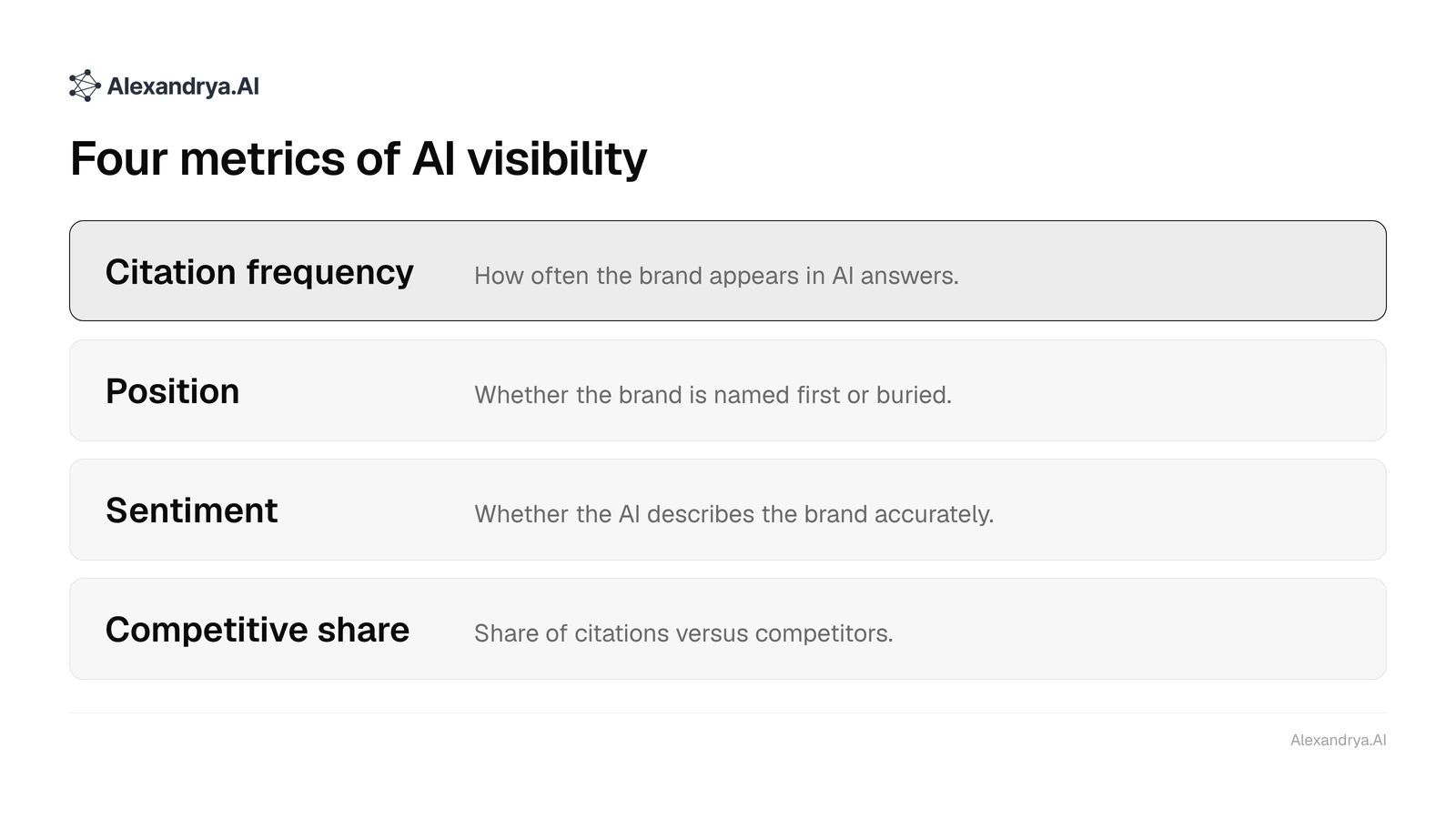
AI visibility requires four dedicated metrics (citation frequency, position, sentiment accuracy, and competitive share) that no traditional SEO platform currently tracks.
How Is AI Visibility Currently Being Measured?
There are currently three approaches to measuring AI visibility, each with significant tradeoffs:
Manual testing: Marketing teams manually submit relevant queries to ChatGPT, Perplexity, and Gemini and record the results. This provides direct insight but does not scale. Testing three AI models across ten query variations in three languages generates 90 data points per run: a manageable task monthly, an impossible one weekly.
Social listening tools: Some teams attempt to capture AI visibility through social media and web mention tracking. This does not work: AI-generated responses are not crawlable in real time and are not indexed as web pages. Social listening tools capture mentions about AI answers, not the answers themselves.
Automated AI visibility platforms: Dedicated platforms like alexandrya.ai systematically send relevant queries to AI platforms, aggregate the results, and track citation frequency, position, sentiment, and competitive share over time across all major AI systems. This is the only approach that provides continuous, comparable, cross-platform data at scale.
For how GEO optimization connects to AI visibility measurement, see our guide: What Is Generative Engine Optimization (GEO)?
What Does Good AI Visibility Look Like in 2026?
Based on data from the alexandrya.ai platform across tracked brands, the following benchmark ranges apply across B2B categories in 2026:
| AI Visibility Level | Citation Frequency | Competitive Share | Sentiment Accuracy |
|---|---|---|---|
| Low | < 20% of queries | < 15% | < 60% accurate |
| Developing | 20 to 50% of queries | 15 to 35% | 60 to 80% accurate |
| Strong | 50 to 75% of queries | 35 to 60% | 80 to 90% accurate |
| Market-leading | > 75% of queries | > 60% | > 90% accurate |
ThyssenKrupp Schulte moved from Low to Strong across all dimensions within six months of implementing a structured GEO program tracked through alexandrya.ai, achieving a +340% increase in AI visibility as a measurable outcome. See the full case study: +340% AI Visibility in 6 Months: The ThyssenKrupp Schulte Case Study.
For a deeper benchmark analysis across industries, see: AI Visibility Benchmarks 2026: How Brands Perform in ChatGPT, Gemini & Perplexity.
How Do You Start Tracking AI Visibility Today?
Starting an AI visibility tracking practice requires four steps:
Step 1: Define your tracking queries. Identify the 10 to 20 questions a buyer in your category is most likely to ask an AI system when evaluating solutions. These are not your SEO keywords. They are conversational buyer questions. Example: "Which AI visibility tracking platforms should a B2B SaaS company consider in 2026?"
Step 2: Select the AI platforms to monitor. At minimum: ChatGPT, Google Gemini, and Perplexity. These three platforms collectively reach the majority of B2B buyers using AI for purchase research. Add Bing Copilot if your buyer base uses Microsoft tools.
Step 3: Establish a baseline. Run your queries across all selected platforms and record your citation frequency, position, sentiment, and competitive share. This baseline is the starting point for all future measurement.
Step 4: Set up automated monitoring. Manual baseline measurement is a one-time exercise. Understanding how your AI visibility changes week-over-week requires automation. alexandrya.ai handles this automatically: daily tracking across all major AI platforms, competitive benchmarking, and prioritized recommendations for improvement.
Start Measuring Your AI Visibility Today
Your competitors are being recommended by AI systems right now. The only question is whether you know about it and whether you're doing anything about it.
Track your AI visibility for free: start your 7-day trial →
No credit card required. Cancel anytime. See exactly how ChatGPT, Gemini, and Perplexity describe your brand today.
Frequently asked questions
What is the difference between AI visibility and SEO visibility?
SEO visibility measures how your website ranks in traditional search engine results pages based on keyword targeting and link authority. AI visibility measures whether and how your brand is cited within AI-generated answers on platforms like ChatGPT, Perplexity, and Google Gemini. These systems do not rank pages. They synthesize answers. A high organic ranking does not guarantee AI citation, and a brand with poor organic rankings may still have strong AI visibility if its content is well-structured for AI extraction.
How is AI visibility measured?
AI visibility is measured by systematically sending relevant buyer queries to AI platforms and recording: (1) citation frequency: how often your brand appears in responses; (2) citation position: whether your brand leads or trails within recommendations; (3) sentiment accuracy: whether AI descriptions of your brand are correct and favorable; and (4) competitive share: your brand's citation frequency relative to competitors. Automated platforms like alexandrya.ai run these measurements continuously across all major AI systems.
Why does AI visibility matter for B2B companies specifically?
B2B purchase decisions increasingly begin in AI search environments. McKinsey (October 2025) found that 67% of B2B purchase decisions now start in AI search engines. In high-consideration purchases (software, services, industrial products), buyers ask AI systems for initial shortlists before conducting any other research. Brands absent from those shortlists are effectively invisible at the most critical stage of the buying journey.
Can traditional marketing tools measure AI visibility?
No. Traditional tools (Google Search Console, social listening platforms, SEO rank trackers) do not capture AI-generated responses. AI systems generate dynamic answers on demand; they do not publish crawlable pages or rank URLs in a trackable index. AI visibility requires purpose-built tools that actively query AI platforms and analyze the responses.
How quickly can AI visibility change?
AI visibility can change within weeks following content changes, structured data updates, or shifts in the AI platform's retrieval logic. Unlike traditional SEO, where ranking changes take months, some GEO improvements (particularly FAQ schema additions and citable content blocks) can produce measurable AI citation changes within 2 to 6 weeks of publication.
How visible is your brand in AI?
Try Alexandrya.AI free for 7 days and see how ChatGPT, Gemini, Perplexity, AI Overviews and Copilot talk about your brand.
- 7 days free
- No credit card required
- All features included
- Cancel anytime
About the author
Talaal Max Habib
Managing Director at Alexandrya.AI
Talaal Max Habib has advised companies in industry, the Mittelstand and e-commerce on SEO and Generative Engine Optimization since 2015. With his team he built Alexandrya.AI, the Munich-based platform that measures how brands appear in ChatGPT, Perplexity and Gemini.
LinkedIn