How to measure brand sentiment in ChatGPT and other AI answers
Brand sentiment analysis in AI answers works when you score each statement by aspect, keep the quote as evidence and collect enough answers per platform.

Managing Director at Alexandrya.AI
Brand sentiment analysis in AI answers measures whether ChatGPT, Perplexity, Gemini and other AI assistants present your brand positively, neutrally or negatively. It becomes reliable when you score each statement about the brand on its own, assign it to an aspect such as price, quality or service, keep the quote from the answer as evidence, and collect enough answers per platform that a single one cannot tip the result.
Figures from our own project are Alexandrya.AI's own measurement, as of 27 October 2026, 43 tracked prompts, plus three Brand Perception snapshots from October 2026. Alexandrya.AI is our own product. Correcting wrong facts is covered in our guide to brand monitoring in AI answers.
What brand sentiment analysis in AI answers captures
Brand sentiment analysis in AI answers records whether ChatGPT, Perplexity, Gemini or Google AI Overviews present a brand positively, neutrally or negatively in the text they generate. Review monitoring counts the stars and comments customers leave on review sites. An AI answer is a fresh summary of many sources, written at the moment someone asks. A brand with strong reviews can still come across badly if the model draws on an old test report or a critical forum thread.
| Feature | Review monitoring | Sentiment analysis in AI answers |
|---|---|---|
| What is analysed | reviews on Google, Trustpilot or G2 | answers from ChatGPT, Perplexity, Gemini, Google AI Overviews or Copilot |
| How the data comes about | customers write, reviews are counted | fixed prompts are run at regular intervals |
| Unit of analysis | one review with a star rating | one statement about the brand within an answer |
| Stability | a review stays as written | the same question returns a different answer each time |
| Lever when the result is negative | reply to the review, fix the problem | find and check the source behind the statement |
The fourth row is where the two part ways. Because an AI answer is regenerated for every query, measuring its sentiment needs repetition and a large enough sample. As a metric, Sentiment Score sits alongside AI Citation Rate, Share of AI Voice and Model Coverage among the four GEO metrics.
Using ChatGPT for brand sentiment analysis: two different jobs
You can use ChatGPT for brand sentiment analysis in two different ways. As a tool, ChatGPT classifies your own text, such as customer reviews, support tickets or social comments, as positive, neutral or negative, which tells you how customers feel. As the object of measurement, ChatGPT is the thing you query, and you analyse how the model describes your brand. The first job needs ChatGPT and a fixed rubric; the second needs repeated queries across several platforms.
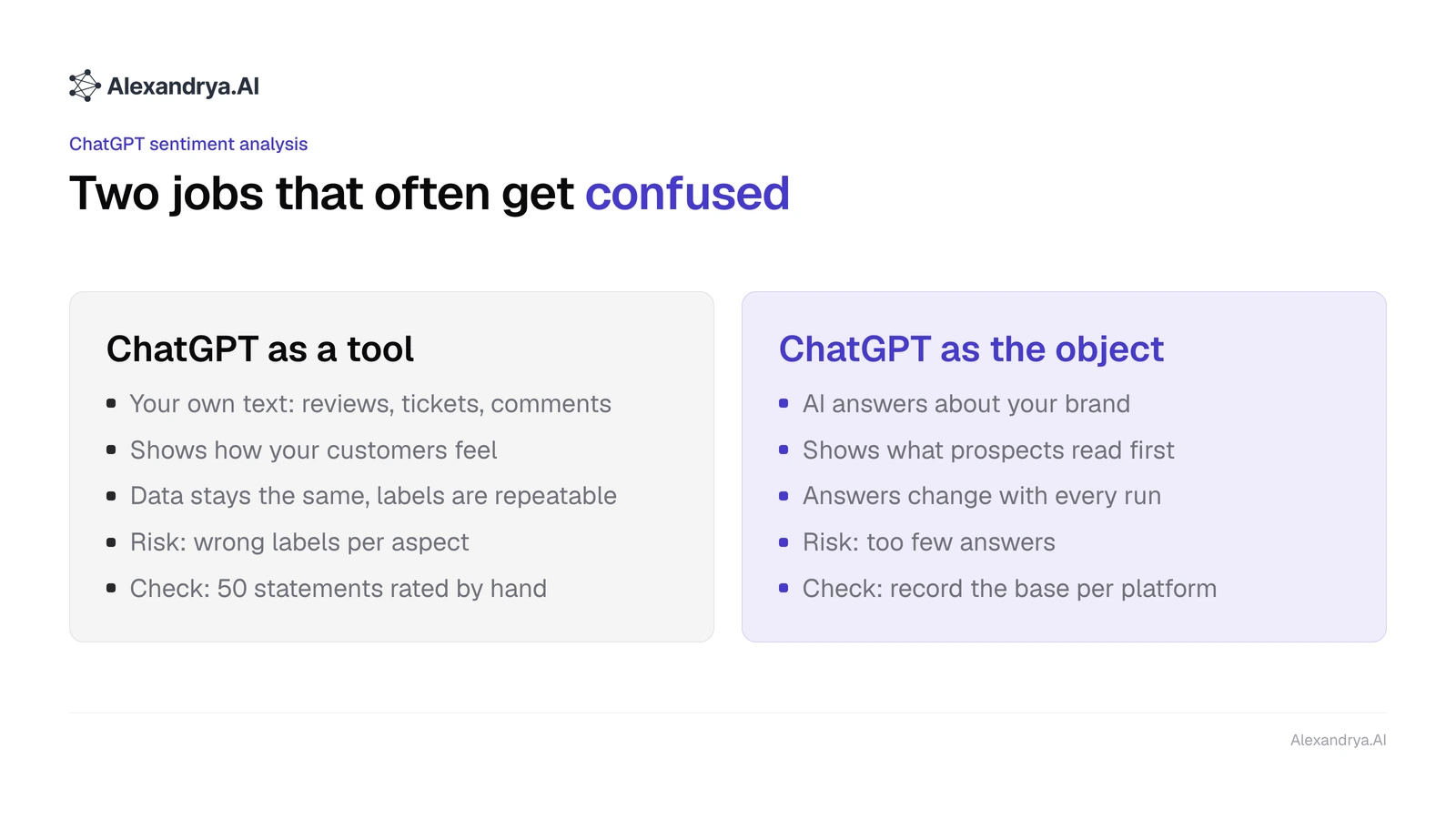
Two meanings of ChatGPT sentiment analysis, with different data and different risks. Alexandrya.AI's own classification, October 2026.
A Microsoft Copilot answer from 27 October 2026 shows how easily the two get mixed up. For the German prompt “chatgpt sentiment analyse für marken nutzen”, which Alexandrya.AI tracks daily, Copilot cited a guide to classifying social posts with language models first and a guide to monitoring ChatGPT answers second, then merged both into one answer.
There are published figures for ChatGPT as a classifier. A team led by Zengzhi Wang compared it with trained models on 17 datasets (arXiv, version of 17 February 2024, accessed 27 October 2026). Without training, ChatGPT labelled film reviews as positive or negative with 93.12% accuracy, against 95.47% for a fine-tuned BERT model. Extracting aspects with their sentiment from restaurant reviews, it scored an F1 of 69.14 against 77.75 for BERT. The figures apply to the 2023 model, and the gap on aspects argues for a manual check.
If you let ChatGPT classify your own text, give it a fixed rubric. Here is our own example for reviews of a maker of bean-to-cup coffee machines:
| Part of the rubric | Wording in the example | Prevents |
|---|---|---|
| Task | “Split each review into individual statements.” | one verdict for a mixed text |
| Aspects | “Assign each statement to exactly one aspect: price, quality, service, ease of use, delivery.” | aspects that drift between runs |
| Scale | “Label each statement positive, neutral or negative. Neutral means a fact without judgement.” | a blurred line between neutral and negative |
| Evidence | “Quote the exact passage for each statement.” | labels nobody can check |
| Uncertainty | “If the label is unclear, write unclear.” | guessed values |
| Output | “Reply as a table: statement, aspect, polarity, quote.” | prose you cannot count |
Before the first real run, have two people rate 50 statements by hand and compare their labels with ChatGPT's. Where one aspect diverges noticeably, tighten its definition and test again. Remove names, email addresses and order numbers before you upload anything.
How to analyse brand sentiment in ChatGPT answers, step by step
To analyse brand sentiment in ChatGPT answers, work in five steps: freeze a prompt set, collect answers per platform repeatedly, split each answer into individual statements about the brand, give each statement an aspect and a polarity with the quote as evidence, and compare dated snapshots. The unit of analysis is the statement, because one answer can praise the price and criticise customer support in the same paragraph.
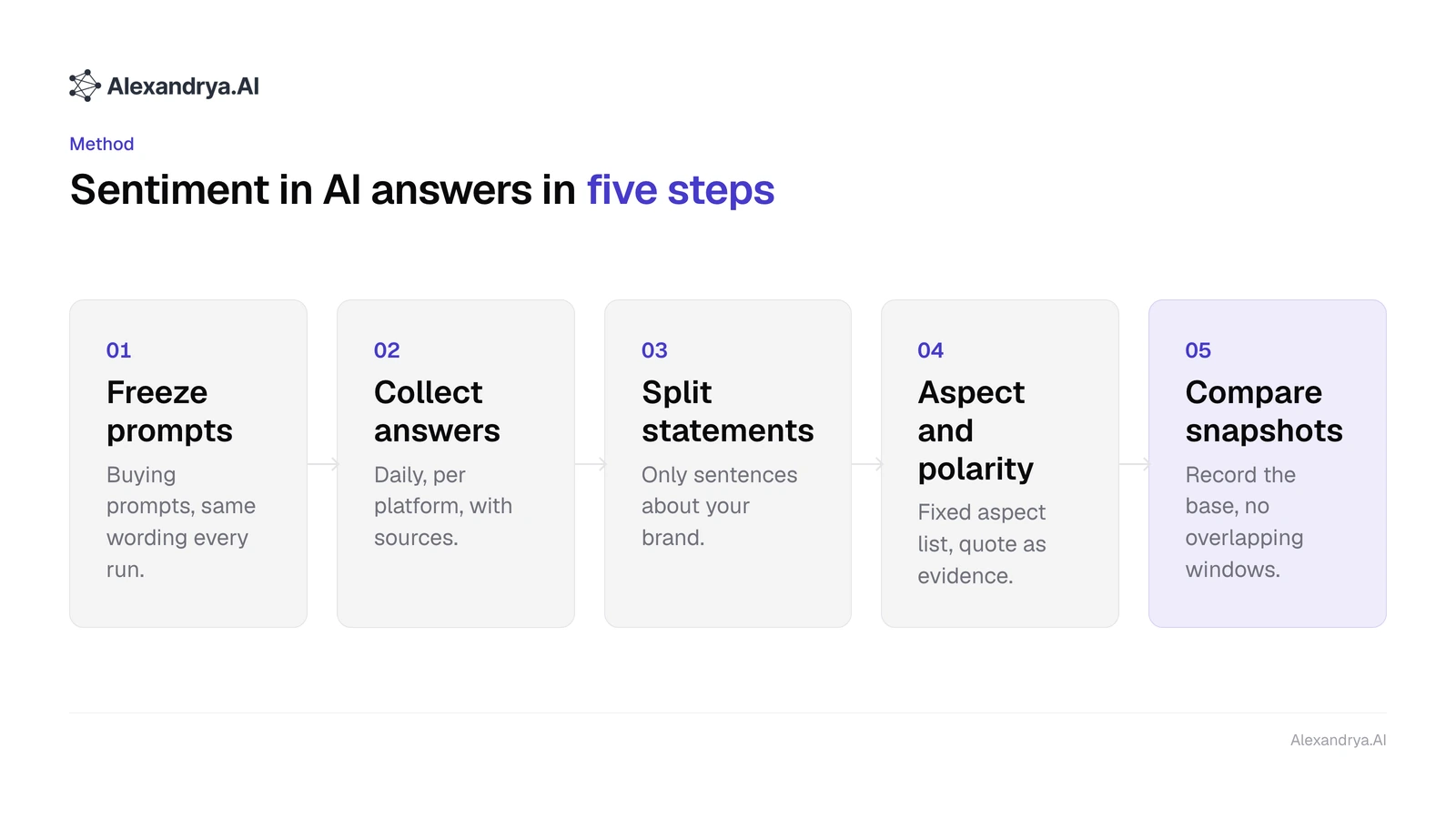
Five steps of measuring sentiment in AI answers. Alexandrya.AI's own classification, October 2026.
- Freeze the prompt set. Use the questions buyers ask before deciding, such as “Which bean-to-cup coffee machine under €800 is worth buying?”. Keep the wording identical across measurements and put prompts about drawbacks in a group of their own.
- Collect answers per platform, repeatedly. Run each prompt daily on ChatGPT, Perplexity, Gemini, Google AI Overviews or Copilot, and store the answer, date, platform and cited sources.
- Pull out statements about the brand. Only sentences about your brand count. A comparison such as “cheaper than brand B” counts for both brands, once as positive and once as negative.
- Assign aspect, polarity and evidence. Each statement gets one aspect from a fixed list, a polarity and the exact quote. An aspect missing from the answer is recorded as “not mentioned”, not as neutral.
- Aggregate and save a snapshot. Count positive, neutral and negative statements per platform and aspect, record the base size and save the result with its time window.
Step four separates two findings that an overall score would merge. A neutral statement names a property without judging it, while a missing aspect means the AI says nothing about it. In our German-language snapshot of 27 October 2026, a neutral category on presence in comparison lists covers 2 of 11 answers that list Alexandrya.AI among alternatives without comparing features. Missing information appears as gaps, even inside positive categories: under multi-platform monitoring, the snapshot notes that the answers do not explain which platforms each plan includes.
A product review in an AI answer, broken down statement by statement
The AI answer in this example is constructed: brand A and brand B are not real brands, and the text comes from no measurement. Suppose an AI assistant answers the prompt “Which bean-to-cup coffee machine under €800 is worth buying?” with this paragraph: “Brand A is rated as durable in several tests and produces consistent milk foam. At around €750, it sits at the top end of the price range. Some users report long waiting times for customer service. If easy cleaning matters most to you, brand B is the better choice.”
| Statement about brand A | Aspect | Polarity | Evidence quote | Source behind it (in the example) |
|---|---|---|---|---|
| is durable | quality | positive | “rated as durable in several tests” | two test reports from 2026 |
| produces consistent milk foam | quality | positive | “produces consistent milk foam” | one test report from 2026 |
| costs around €750 | price | neutral | “sits at the top end of the price range” | retailer page |
| long waits for customer service | service | negative | “Some users report long waiting times” | one forum post from 2023 |
| cleaning is easier with brand B | ease of use | negative, indirect | “brand B is the better choice” | a comparison article |
At answer level, this text would be labelled “mixed”, which nobody can act on. By aspect, the picture is clear: quality positive twice, price neutral, service and ease of use negative once each. Whether “the top end of the price range” counts as neutral or negative is set by the rubric, and the decision has to be the same for every answer.
Negative sentiment in an AI answer can only be judged once you know the source behind the statement. If the criticism rests on an outdated test report, a single forum post or a comparison with old prices, the problem is the source and not the product. Perplexity and ChatGPT search show the sources they used for an answer. For answers without visible sources, the only route is comparing many runs.
In the example, the service criticism rests on a forum post from 2023. If customer service has improved since then, what is missing is a current source that says so. If the criticism still holds, the work lies with the service team.
Our own measurement shows how little a negative label can rest on. In the snapshot of 27 October 2026, one of the competitors we track has a negative category on price level. Prices come up in 6 of 15 answers about that brand, the entry prices quoted contradict each other, and the verdict “particularly expensive”, translated from the German original, comes from a single Copilot answer. We are not naming the vendor, because the point is the method.
Three snapshots from Alexandrya.AI's own measurement
Alexandrya.AI's own measurement shows how small the base for a sentiment finding about one brand can be. Of 43 prompts tracked daily, AI answers mention Alexandrya.AI in the answer text for 10, as of 27 October 2026. The weekly Brand Perception snapshots therefore rest on 4 to 11 answers that mention the brand. Sentiment can only be measured where a brand appears at all.
| Snapshot date | Time window | Answers mentioning the brand | Positive categories | Neutral categories | Negative categories | Weight of one answer |
|---|---|---|---|---|---|---|
| 13 October 2026 | 13 September to 13 October 2026 | 7 | 4 | 1 | 0 | 14.3 percentage points |
| 20 October 2026 | 20 September to 20 October 2026 | 4 | 4 | 1 | 0 | 25.0 percentage points |
| 27 October 2026 | 27 September to 27 October 2026 | 11 | 3 | 2 | 0 | 9.1 percentage points |
Source: Alexandrya.AI's own measurement, Brand Perception snapshots for alexandrya.ai, accessed 27 October 2026.
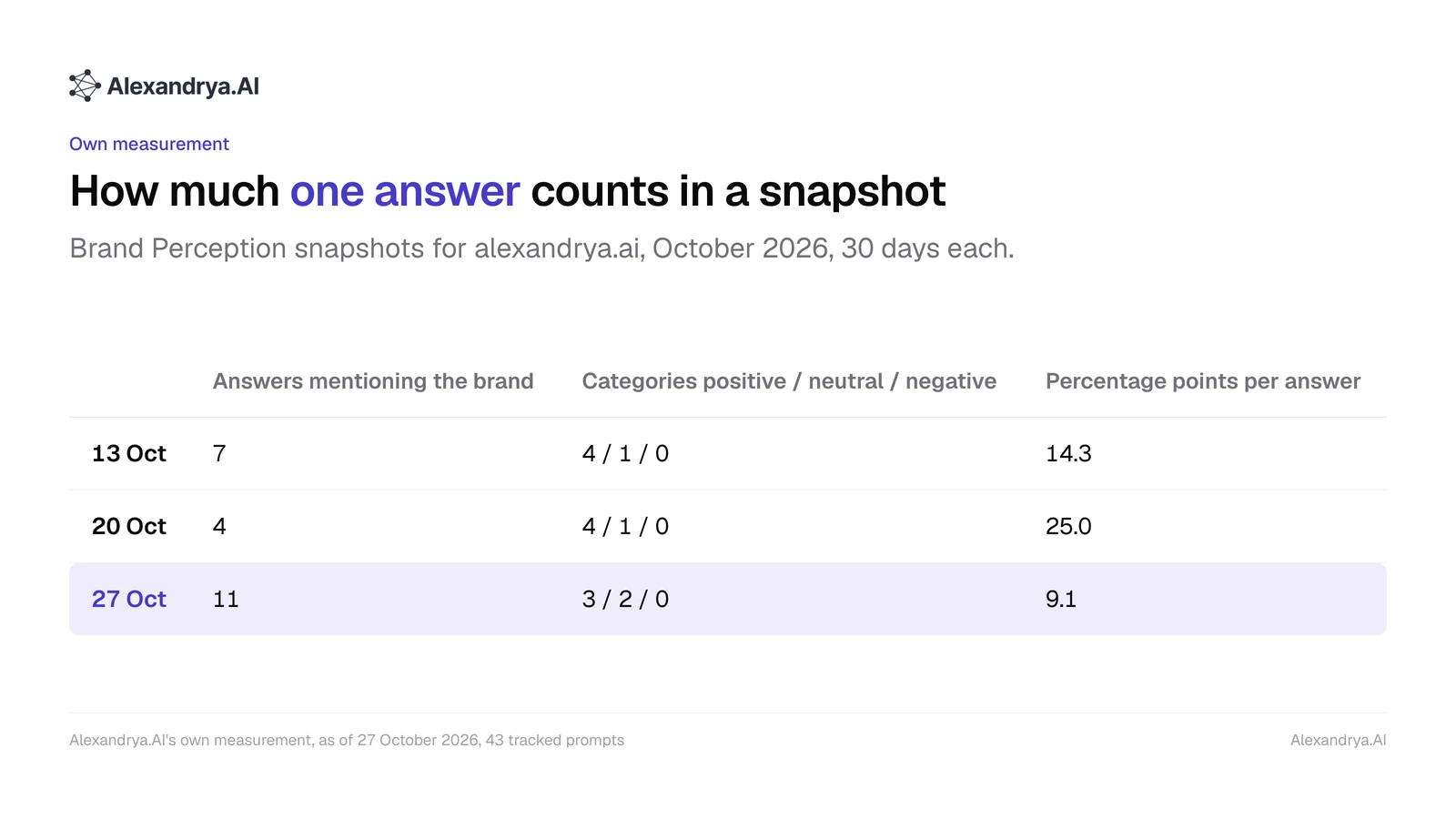
Three weekly snapshots with 4 to 11 answers each: a single answer is worth between 9.1 and 25 percentage points. Alexandrya.AI's own measurement, as of 27 October 2026.
The categories change from one snapshot to the next. None of the five category names from 20 October reappears on 27 October. The entry price category becomes part of one called agency package and price, which despite its name describes the €79 entry price and the task board, not agency features. For a trend over months, map the categories to fixed aspects yourself and read the description and quotes, not just the label.
Each snapshot in our project covers 30 days and is created weekly, so two consecutive snapshots share just over three weeks of data. The same ChatGPT quote, saying that Alexandrya.AI starts at €79 a month and offers daily tracking, appears in all three. Comparing 20 October with 27 October largely means comparing the same answers.
None of the three snapshots contains a negative category for Alexandrya.AI, yet the picture is not free of weaknesses. In the positive category on source analysis by platform, covering 5 of 11 answers, the snapshot of 27 October notes that the answers show no real customer results and no independently verified accuracy figures. That sentence tells you which evidence is missing from the sources, which makes it more useful than the label.
Answer variance, sample size and prompt wording limit what you can conclude
AI answers vary so much between runs that a single answer cannot carry a sentiment finding. In a SparkToro and Gumshoe.ai study of 2,961 answers from ChatGPT, Claude and Google's AI, the tools returned the same list of brands for the same question in fewer than one in 100 cases (SparkToro, 28 January 2026, accessed 27 October 2026). For sentiment, the measure is the share across many runs, never the individual answer.
The study was run with Gumshoe.ai, which sells tracking tools, and has not been peer reviewed. SparkToro considers visibility share across dozens to hundreds of repeatedly run prompts a reasonable metric, and ranking position not. The same logic applies to sentiment.
Sample size decides how much a single answer counts. With 4 answers, one unusual answer moves a share by 25 percentage points, with 11 answers by 9.1 and with 100 answers by one point. If an aspect appears in 5 of 11 answers, the 95% Wilson confidence interval runs from 21% to 72%, and for 45 of 100 answers from 36% to 55% (our own calculation). Below roughly 30 answers per aspect and platform, where one answer still weighs 3.3 points, a count is more honest than a percentage. Alexandrya.AI's snapshots report frequencies as counts, for example 5 of 11 answers.
Prompt wording shapes sentiment too. “What are the drawbacks of brand A?” produces drawbacks, while “Which coffee machine is worth buying?” produces recommendations. Mix the two groups and you mostly measure the make-up of your prompt set. Keep German and English prompts apart as well, because they can draw on different sources. The classifier also varies between runs, so a fixed model, a fixed rubric and a repeated sample keep that error small.
Which AI reputation monitoring platforms show sentiment you can verify
An AI reputation monitoring platform shows sentiment you can verify when it gives you four things: polarity per aspect instead of one overall score, the quote from the answer as evidence, a split by AI platform, and the number of answers behind each value. Without that base, you cannot tell whether a change between two snapshots is real or just one unusual answer.
Vendors handle this differently, according to their own pages as of 27 October 2026. Peec AI reports sentiment as a score from 0 to 100 for the tone of all answers mentioning the brand and says most scores fall between 65 and 85. Semrush's AI Visibility Toolkit compares brand perception and sentiment with competitors, including the narratives behind them, names ChatGPT and Google AI Mode as queried models and starts at $99 a month. SE Visible from SE Ranking promises to show when a brand appears positively, negatively or inaccurately, and lists “AI Brand Sentiment Tracking” as “coming soon”.
A single score from 0 to 100 is easy to report but does not show which aspect drags it down. A category view shows the aspect but tips more easily on one answer when the base is small. In any trial, ask how many answers sit behind each value.
Alexandrya.AI shows AI brand perception in its Brand Perception view, for your own brand and for competitors, as categories with sentiment, strengths, gaps and evidence quotes including the platform, and saves each analysis as a snapshot with its time window. Features are on the product page, plans on the pricing page. Alexandrya.AI is an AI visibility tool from Munich that measures brand mentions in ChatGPT, Gemini, Perplexity and Bing Copilot and turns them into content and citation tasks.
Three limits belong in a fair assessment. Categories are rebuilt for every snapshot, so mapping them to fixed aspects for a long-term comparison is up to you. Alexandrya.AI does not measure sentiment per individual product or SKU. And there are no alerts and no Slack integration, so a new negative category shows up in the next snapshot.
What to do with your sentiment results
A sentiment result becomes useful once you identify the cause behind each negative or missing aspect. If a negative statement rests on a wrong or outdated source, the source is the task, and source analysis by platform shows which domains sit behind the answers. If the criticism is accurate, the work lies with the product or service. If an aspect is missing, a findable page describing it is missing too. In Alexandrya.AI, action plan recommendations become tasks on the task board with the statuses Open, In Progress and Done.
Frequently asked questions
What is a good brand sentiment score in AI answers?
There is no general benchmark, because tools use different scales and units. Peec AI says that on its scale from 0 to 100, most scores fall between 65 and 85. A more useful comparison is against competitors in the same prompt set and against your own earlier snapshots, always by aspect and platform.
Can ChatGPT rate its own answers about your brand?
ChatGPT can classify collected answers against a fixed rubric, including answers it generated itself. Asking it “What do you think of brand X?” is not the same thing, because that produces a new answer instead of rating the existing ones. Keep querying and classifying as separate steps, and check a sample of the labels by hand.
Why does brand sentiment differ between ChatGPT, Perplexity and Gemini?
Each platform builds its answers from different sources. Perplexity searches the live web for every query, Gemini and Google AI Overviews draw on Google's index, and ChatGPT combines what it learned in training with its own web search. A critical review can therefore dominate answers on one platform and be absent on another. Analyse sentiment separately for each platform.
Which aspects should brand sentiment analysis cover?
The aspect list should follow the questions buyers ask before they decide. Typical aspects are price, product quality, customer service, ease of use and fit for a particular audience, with integrations and data protection added for software. Fix the list before your first analysis and keep it unchanged between snapshots, or the values stop being comparable.
How do you know whether AI sentiment has really changed?
A real change shows up between two snapshots whose time windows do not overlap and that both contain enough answers. When windows overlap, the same answers sit inside both values. In Alexandrya.AI's own measurement, the same ChatGPT quote appears in three weekly snapshots in a row. Also check whether the prompt set changed between the two measurements.
How much does automated AI brand sentiment tracking cost?
Alexandrya.AI costs €79, €199 or €399 a month for 50, 150 or 350 prompts checked daily, with Enterprise priced individually. Brand Perception, with categories, sentiment, strengths, gaps and evidence quotes, is part of the visibility dashboard. Starter, Professional and Business come with a seven-day free trial without a credit card, and annual billing saves around 15%.
Measure your brand's AI sentiment free for seven days
Want to see what ChatGPT, Perplexity and Gemini say about your brand today, and which sources they rely on? In a seven-day trial without a credit card, Alexandrya.AI shows sentiment by category on your own prompts, with the quote and platform behind it, for your brand and your competitors. Start your seven-day free trial
Frequently asked questions
What is a good brand sentiment score in AI answers?
There is no general benchmark, because tools use different scales and units. Peec AI says that on its scale from 0 to 100, most scores fall between 65 and 85. A more useful comparison is against competitors in the same prompt set and against your own earlier snapshots, always by aspect and platform.
Can ChatGPT rate its own answers about your brand?
ChatGPT can classify collected answers against a fixed rubric, including answers it generated itself. Asking it “What do you think of brand X?” is not the same thing, because that produces a new answer instead of rating the existing ones. Keep querying and classifying as separate steps, and check a sample of the labels by hand.
Why does brand sentiment differ between ChatGPT, Perplexity and Gemini?
Each platform builds its answers from different sources. Perplexity searches the live web for every query, Gemini and Google AI Overviews draw on Google's index, and ChatGPT combines what it learned in training with its own web search. A critical review can therefore dominate answers on one platform and be absent on another. Analyse sentiment separately for each platform.
Which aspects should brand sentiment analysis cover?
The aspect list should follow the questions buyers ask before they decide. Typical aspects are price, product quality, customer service, ease of use and fit for a particular audience, with integrations and data protection added for software. Fix the list before your first analysis and keep it unchanged between snapshots, or the values stop being comparable.
How do you know whether AI sentiment has really changed?
A real change shows up between two snapshots whose time windows do not overlap and that both contain enough answers. When windows overlap, the same answers sit inside both values. In Alexandrya.AI's own measurement, the same ChatGPT quote appears in three weekly snapshots in a row. Also check whether the prompt set changed between the two measurements.
How much does automated AI brand sentiment tracking cost?
Alexandrya.AI costs €79, €199 or €399 a month for 50, 150 or 350 prompts checked daily, with Enterprise priced individually. Brand Perception, with categories, sentiment, strengths, gaps and evidence quotes, is part of the visibility dashboard. Starter, Professional and Business come with a seven-day free trial without a credit card, and annual billing saves around 15%.
How visible is your brand in AI?
Try Alexandrya.AI free for 7 days and see how ChatGPT, Gemini, Perplexity, AI Overviews and Copilot talk about your brand.
- 7 days free
- No credit card required
- All features included
- Cancel anytime
About the author
Talaal Max Habib
Managing Director at Alexandrya.AI
Talaal Max Habib has advised companies in industry, the Mittelstand and e-commerce on SEO and Generative Engine Optimization since 2015. With his team he built Alexandrya.AI, the Munich-based platform that measures how brands appear in ChatGPT, Perplexity and Gemini.
LinkedIn