ChatGPT vs. Perplexity vs. Google AI: Which Platform Should You Optimize First?
How ChatGPT, Perplexity and Google AI decide which brands to cite, plus a clear framework for choosing which platform to optimize for first.

Managing Director at Alexandrya.AI
Why Does Platform Choice Matter for AI Visibility Optimization?
Only 11% of domains appear in both ChatGPT and Google AI Overviews. The three major platforms use fundamentally different sources and selection logic, meaning a brand cited on one platform may be completely absent from another. Platform choice determines which mechanism you need to optimize for, which content signals carry weight, and where your target audience actually researches.
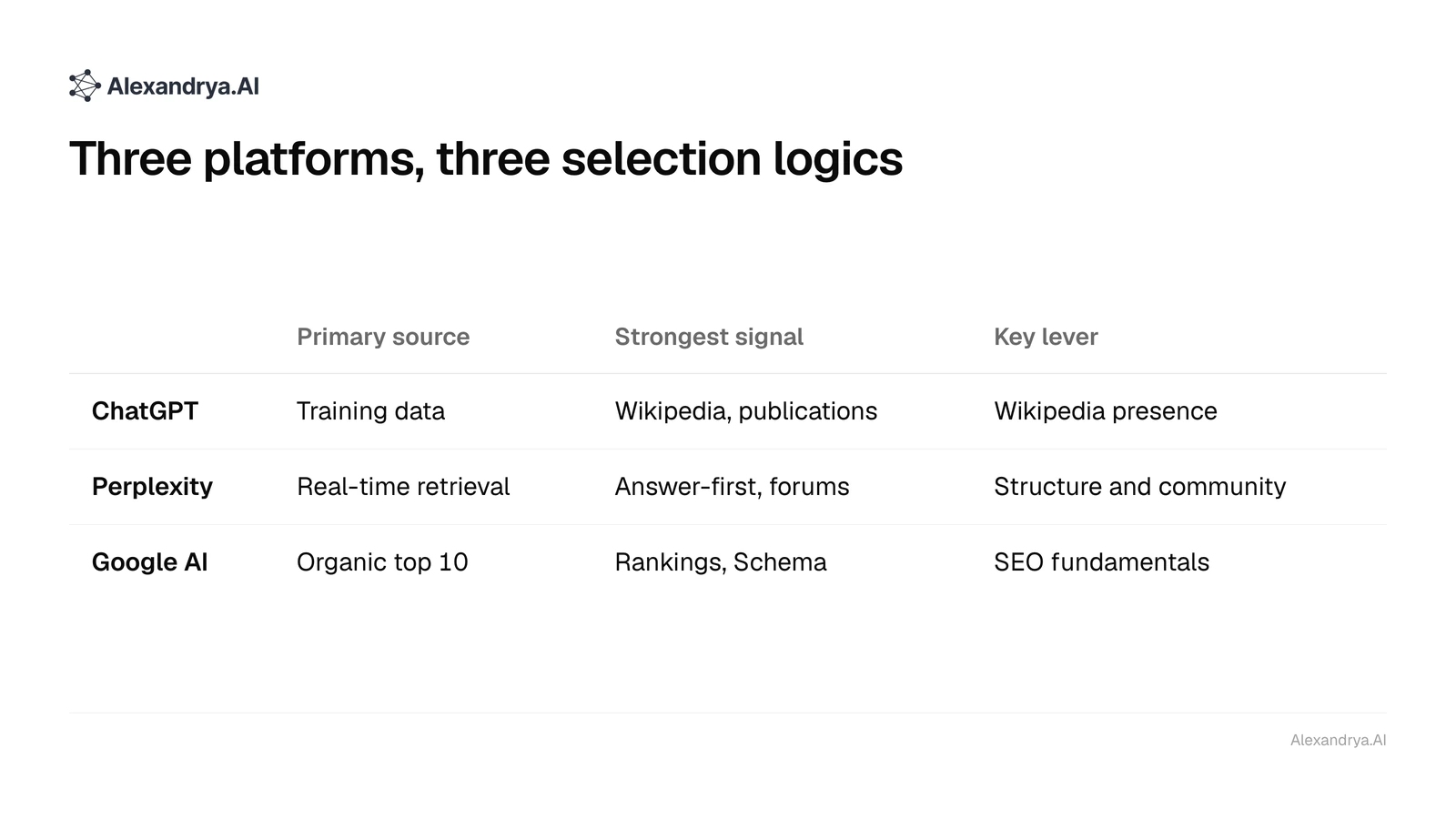
Treating ChatGPT, Perplexity, and Google AI as equivalent is the most common structural error in AI visibility strategy. Each platform has a distinct selection architecture: ChatGPT prioritizes training data quality and Wikipedia presence; Perplexity runs real-time retrieval with a bias toward structured, source-attributed content; Google AI Overviews correlates heavily with existing organic search authority. A one-size-fits-all approach underperforms on all three. The right answer depends on your industry, audience, and current organic position, but the analysis must start with understanding how each platform actually works.
Three major AI platforms (ChatGPT, Perplexity, and Google AI) operate with three fundamentally different brand selection mechanisms, which makes parallel optimization non-optional for serious AI visibility programs. ChatGPT reaches over 900 million weekly users (OpenAI, January 2026) and draws primarily from training data accumulated before its knowledge cutoff, making Wikipedia presence and authoritative publication mentions the most powerful citation signals. Perplexity processes over 500 million monthly queries (Perplexity, Q4 2025) using real-time retrieval, which is why it achieves the highest average brand citation rate at 19.1%, but also why its citations shift most rapidly. Google AI Overviews and AI Mode maintain the tightest correlation with organic search authority: 92% of AI Overview citations come from existing top-10 organic rankings, making SEO fundamentals the primary lever. Only 11% of domains appear in both ChatGPT and Google AI Overview citations (Ahrefs analysis, December 2025), while Google Gemini records the lowest average brand citation rate at 7.8%. These divergent mechanisms require platform-specific optimization strategies in addition to a cross-platform foundation. (Sources: OpenAI 2026; Perplexity Q4 2025; Ahrefs December 2025; Alexandrya.AI Q1 2026)
How Does ChatGPT Select What Brands to Mention?
ChatGPT selects brands based primarily on training data quality and recency, with Wikipedia and high-authority publications functioning as the strongest citation signals. Because ChatGPT operates primarily from pre-trained knowledge rather than live web retrieval, brand mentions in its responses reflect what was present in the training corpus, not what your website currently says.
How Does Training Data Dominance Work for Brand Selection?
ChatGPT's core citation mechanism favors brands that appear frequently, accurately, and consistently in high-quality text across the training corpus. The practical implication: brands mentioned in academic papers, Wikipedia, news coverage, and established industry publications before the knowledge cutoff are cited more reliably than brands that exist only in their own web content. This is a fundamentally different dynamic from Google search, where your own domain authority matters significantly.
Why Do Wikipedia and Reddit Signals Matter for ChatGPT?
Wikipedia is a primary training data source and functions as a trust anchor: ChatGPT uses Wikipedia entries to verify brand descriptions and extract factual attributes. Brands with Wikipedia pages describing their market position, products, and distinctions are cited with concrete attributes, not just as generic category names. Reddit content also carries outsized influence in ChatGPT training data, particularly for product comparisons, tool recommendations, and subjective assessments. Brands with strong Reddit discussion history (especially positive mentions in relevant subreddits) achieve meaningfully higher citation rates in conversational ChatGPT queries.
When Does Web Search Activate in ChatGPT?
ChatGPT's Browse/Web Search feature activates when users explicitly request current information or when the query context indicates time-sensitive data. For brand visibility, this creates a secondary channel: when ChatGPT searches the web, it behaves more like Perplexity, prioritizing structured, citable content from authoritative domains. Brands optimizing for this activation state should ensure that live web content meets the same structural requirements as Perplexity optimization (definition sentences, FAQ blocks, Schema.org markup, external citations).
How Does Perplexity Decide What to Cite?
Perplexity decides what to cite through real-time retrieval and source ranking, making it the most dynamic and most responsive platform for content-based optimization. Changes to page structure and content can impact Perplexity citations within days rather than weeks, giving it the shortest optimization feedback loop of the three platforms.
What Is Perplexity's Real-Time Retrieval Logic?
Perplexity retrieves multiple sources for each query, then synthesizes a response that cites the sources it used. The selection logic prioritizes: pages with clear answer structure matching the query intent, pages with high domain authority in the topic category, and pages with source attribution signals (citations within the page, Schema.org markup, external links). The most critical optimization factor for Perplexity is answer-first structure: pages that provide a direct answer in the first 50 to 100 words are significantly more likely to be cited than pages that build to the answer.
How Does Reddit and Forum Weighting Affect Perplexity Citations?
Perplexity weights community-sourced content (particularly Reddit, Quora, and specialized forums) more heavily than most competing AI systems. For B2B brands, this means that discussions in professional communities (LinkedIn articles, industry forums, specialist newsletters) contribute disproportionately to Perplexity citation likelihood. A practical implication: seeding authoritative perspectives in community spaces is a Perplexity-specific optimization tactic.
Why Does Perplexity Cite Most Frequently Across All Platforms?
Perplexity achieves the highest average brand citation rate (19.1%, Alexandrya.AI Q1 2026) because its real-time retrieval model is more inclusive than ChatGPT's training-data-limited approach and less restrictive than Google AI's organic-authority requirement. The trade-off: Perplexity citations are more volatile: they can disappear quickly if a competitor produces better-structured content targeting the same queries. → GEO Audit Framework
AI Platform Comparison: Selection Mechanisms and Brand Citation Rates
Only 11% of domains appear in both ChatGPT and Google AI Overview citations. Three platforms require three distinct optimization strategies (Ahrefs December 2025; Alexandrya.AI Q1 2026).
How Does Google AI (Overviews + AI Mode) Select Sources?
Google AI selects sources primarily through correlation with existing organic search authority, making it the platform where traditional SEO fundamentals translate most directly into AI citation likelihood. However, Google AI Mode (the expanded conversational interface) and Google AI Overviews (the inline answer boxes) use somewhat different selection logic.
What Is the 92% Organic Top-10 Correlation in Google AI Overviews?
92% of Google AI Overview citations come from pages already ranking in the organic top 10 for that query (Alexandrya.AI analysis, Q1 2026). This is the tightest platform-to-SEO correlation of the three systems, meaning Google AI Overviews largely rewards existing SEO performance. For brands with strong organic rankings, Google AI Overviews often follow without dedicated GEO work. For brands with weak organic rankings, Google AI Overviews cannot be effectively accessed without first improving organic performance.
How Does Schema Markup Influence Google AI Selection?
Schema.org markup influences Google AI selection through two distinct mechanisms: structured data enables AI parsing of specific entities (products, organizations, reviews, FAQs) and satisfies Google's preference for machine-readable content. Pages with comprehensive Schema markup are selected at higher rates for AI Overview inclusion even when controlling for organic ranking position, suggesting that Schema functions as an independent selection signal on top of SEO authority.
What Is the Distinction Between Google AI Mode and AI Overviews?
Google AI Overviews are the inline answer boxes triggered by specific search queries. They pull from top-10 organic sources primarily. Google AI Mode is the full conversational interface (available via the AI tab in Google Search) that operates more similarly to Perplexity, conducting multi-source retrieval and synthesis. AI Mode shows somewhat lower correlation with organic rankings (approximately 71%) and greater responsiveness to content structure quality, making it a more traditional GEO target.
Which Platform Should B2B Brands Prioritize?
B2B brands should prioritize platforms in order of their target audience's actual AI research behavior, not platform user volume. Prioritization should also account for current organic authority, available optimization resources, and competitive dynamics in the specific query categories.
What Decision Matrix Applies by Industry?
The platform prioritization matrix for B2B brands: if your target audience makes high-intent research queries ("Which [category] solution is best for [use case]?"), prioritize Perplexity: its real-time retrieval most directly serves active purchase research. If your brand has weak organic authority, avoid over-investing in Google AI Overviews until organic rankings improve. If your brand lacks Wikipedia presence, making ChatGPT optimization a priority while Wikipedia remains unaddressed will yield limited returns.
Which Queries Matter for High-Intent B2B AI Search?
High-intent B2B queries in AI search follow predictable patterns: comparison queries ("X vs. Y for [use case]"), recommendation queries ("best [solution type] for [industry]"), and specification queries ("which [product] handles [requirement]"). Perplexity dominates this query type: its real-time retrieval and source-citation model aligns with the research-oriented intent behind these queries. ChatGPT handles definitional and educational queries at higher rates; Google AI handles navigational queries with strong brand-keyword correlation.
What Platform Recommendation Applies by Use Case?
Prioritize Perplexity first if your B2B audience is research-intensive (SaaS buyers, technical decision-makers, procurement teams) and your organic authority is moderate (not top-5 rankings in your category). Prioritize Google AI Overviews second if you have strong organic authority already: the optimization overhead is minimal and the impact can be immediate. Invest in ChatGPT signals (Wikipedia, training-data-quality content) in parallel because ChatGPT's user base is the largest and training-data signals take the longest to build, and delay compounds the disadvantage.
What Optimization Tactics Work Across All Three Platforms?
Four optimization tactics create citation lift across all three platforms simultaneously: answer-first content structure, Schema.org FAQPage markup, external authority signals from authoritative domain-specific publications, and consistent brand entity definition across all online mentions.
Answer-first structure: Place the direct answer to the page's primary question within the first 60 words. All three platforms extract the most readable, direct passage available. Answer-first structure maximizes extraction probability.
Schema.org FAQPage markup: FAQPage schema is interpreted by all three platforms' retrieval and ranking systems. Consistent FAQPage implementation across all major content pages increases citation rate across the board.
External authority signals: 15+ authoritative external domains mentioning a brand with consistent attribute descriptions improve citation rate across ChatGPT (training data), Perplexity (retrieval authority weighting), and Google AI (link authority correlation).
Consistent brand entity definition: A consistent, concise brand description (what the brand is, what category it serves, what its key differentiators are) appearing identically across all key touchpoints (website, Wikipedia, press mentions) reduces AI ambiguity and improves citation accuracy. → What Is GEO
Track your visibility across all three platforms in real time with Alexandrya.AI. → All Features
Track your visibility across all three platforms: start 7-day free trial →
Frequently asked questions
Should I optimize for all three platforms simultaneously?
Yes, but with different content tactics. The cross-platform foundation (answer-first structure, Schema markup, external authority) is the same. Platform-specific investment (Wikipedia for ChatGPT, community content for Perplexity, organic SEO for Google AI) should be prioritized based on your audience's platform preferences and your current competitive position.
Which AI platform has the highest brand citation rate?
Perplexity consistently achieves the highest average brand citation rate at 19.1% (Alexandrya.AI Q1 2026), followed by ChatGPT and Google AI Overviews. Google Gemini records the lowest at 7.8%. However, average rates vary significantly by industry and query type.
Does traditional SEO help AI visibility?
It depends on the platform. For Google AI Overviews, strong organic rankings are the most important predictor (92% correlation). For Perplexity, organic authority helps but content structure is equally important. For ChatGPT, traditional SEO metrics are largely irrelevant; training data quality and Wikipedia presence matter more.
How quickly do Perplexity citations respond to content changes?
Perplexity's real-time retrieval means content changes can impact citations within days to weeks, the fastest feedback loop of the three platforms. ChatGPT training data updates are much slower (months between significant updates). Google AI Overviews reflect organic ranking changes, which typically take weeks to months.
Can a brand with no Wikipedia page rank well in AI search?
Yes, on Perplexity and (partially) Google AI Overviews, which rely on real-time retrieval and organic authority rather than training data. On ChatGPT, the absence of Wikipedia significantly limits citation depth and attribute accuracy. Building Wikipedia presence is a high-priority long-term investment for all three platforms.
How visible is your brand in AI?
Try Alexandrya.AI free for 7 days and see how ChatGPT, Gemini, Perplexity, AI Overviews and Copilot talk about your brand.
- 7 days free
- No credit card required
- All features included
- Cancel anytime
About the author
Talaal Max Habib
Managing Director at Alexandrya.AI
Talaal Max Habib has advised companies in industry, the Mittelstand and e-commerce on SEO and Generative Engine Optimization since 2015. With his team he built Alexandrya.AI, the Munich-based platform that measures how brands appear in ChatGPT, Perplexity and Gemini.
LinkedIn