How to Track Your Brand Mentions in AI Search Results
AI responses aren't crawlable. Classic brand monitoring misses them. Learn how AI visibility tracking works, the 4 metrics that matter, and how to get started.

Managing Director at Alexandrya.AI
Why Is Tracking Brand Mentions in AI Search Different from Classical Brand Monitoring?
Tracking brand mentions in AI search results is fundamentally different from classical brand monitoring. While traditional tools crawl social media, news sites, and forums, AI language models like ChatGPT, Google Gemini, and Perplexity generate their answers dynamically (based on training data and retrieval mechanisms) and do not index URLs in real time. A brand mention within an AI-generated response cannot be captured by a crawler. It requires active prompting: the questions that real buyers ask must be replicated and the responses systematically evaluated. The relevant metrics are citation frequency (how often does the brand appear across relevant queries?), citation position (is the brand the primary recommendation or a secondary mention?), and sentiment accuracy (does the AI's description match the brand's actual product and positioning?). Manual tracking becomes unmanageable beyond three models and ten prompts. Automated platforms run these queries on a regular schedule, aggregate the results, and surface changes over time in a trackable dashboard.
For a full explanation of what AI visibility means and why it has become the most important unmeasured metric in B2B marketing, see our foundational article.
Why Does Classical Brand Monitoring Miss AI-Generated Results?
Tools like Mention, Brand24, Talkwalker, or Google Alerts operate on a shared principle: they crawl the public web and social media platforms for occurrences of a defined term and notify you when one is found.
This principle does not work for AI-generated responses, for a simple technical reason: AI-generated answers do not exist as static, crawlable web pages. ChatGPT generates a response at the moment a user asks a question. That response is not publicly indexed, does not appear in Google Search, and is completely invisible to classical monitoring crawlers.
The implication: if ChatGPT is recommending your competitors instead of your brand to your target audience every day, that signal appears nowhere in your brand monitoring dashboard. No alert. No mention. No data point.
That is the blind spot that AI visibility tracking closes.
Why Does Manual AI Tracking Break Down at Scale?
Manual AI tracking is where most teams start: you open ChatGPT, ask the question your buyers would ask, and check whether your brand appears.
This is a valid first step. But it is a snapshot, not a tracking system.
How Do You Design Effective Prompts for Manual AI Tests?
For manual tests to produce usable results, the prompts must be buyer-oriented, not brand-oriented. Not: "Tell me about alexandrya.ai." But: "Which tools help B2B companies measure their visibility in AI search results?"
Effective test prompts follow these patterns:
- Category queries: "Which [product category] tools do you recommend for [target audience]?"
- Comparison queries: "What are the best alternatives to [competitor]?"
- Problem queries: "How can I find out whether my brand appears in AI search answers?"
- Use-case queries: "How do I track AI visibility for my marketing agency?"
For each category, test at least three phrasing variations. AI systems respond to phrasing differences with noticeably different outputs.
Why Does Manual Tracking Fail Across Multiple Models, Languages, and Countries?
This is where manual tracking breaks down. Suppose you track:
- 3 AI platforms: ChatGPT, Gemini, Perplexity
- 10 prompt variations per platform
- 2 languages: German, English
- Frequency: weekly
That is 60 manual queries per week: for a single tracking scenario. For an agency with five clients: 300 queries per week, plus documentation, analysis, and reporting.
There is another problem: AI responses are not deterministic. The same question asked to ChatGPT may include your brand on Monday and omit it on Wednesday, depending on training data weighting and retrieval logic. Manual spot-checks do not capture this volatility. Only continuous tracking makes it visible.
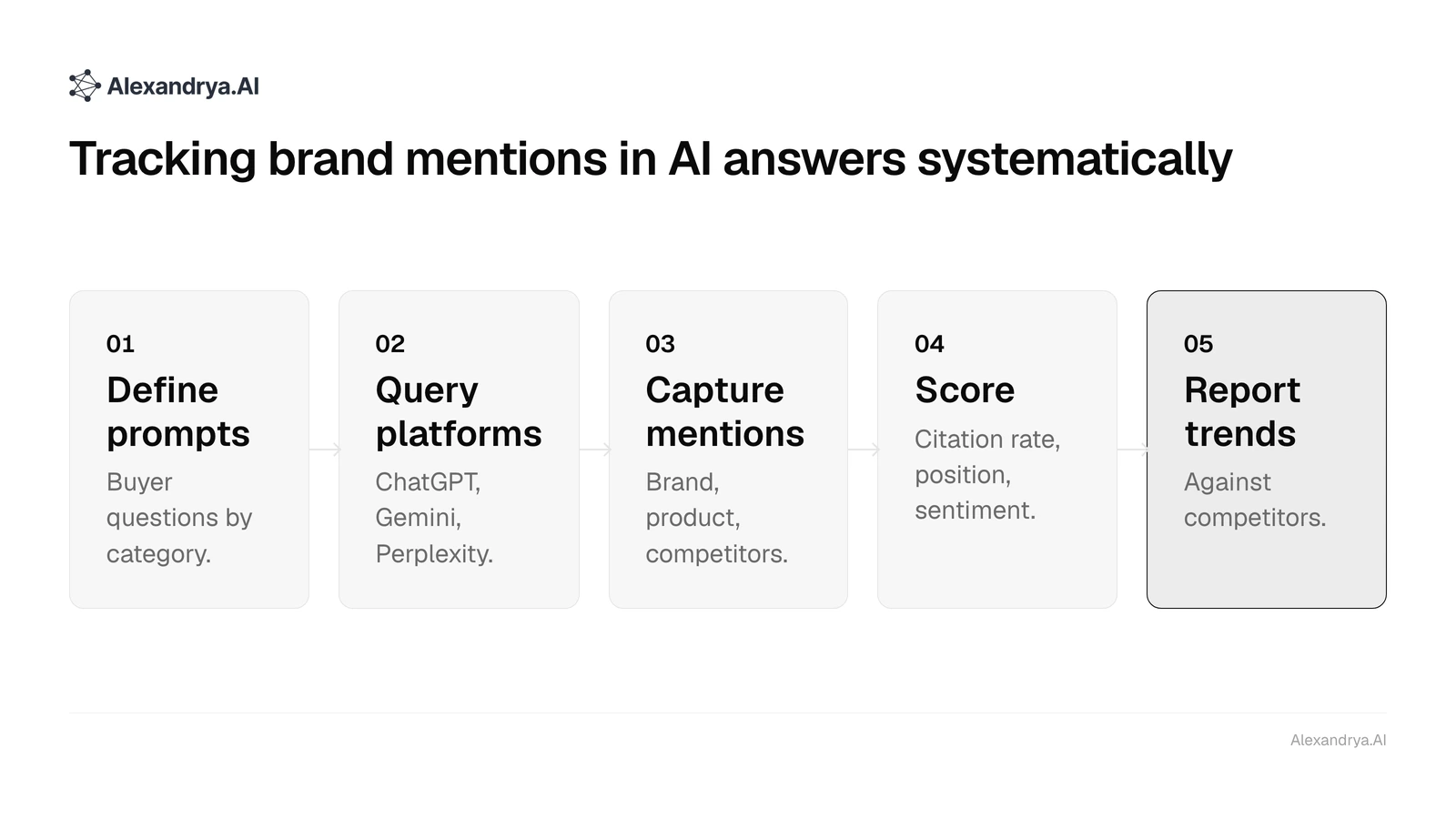
If you're not systematically tracking your brand mentions in AI search results, you don't know whether your brand is being recommended, ignored, or misrepresented.
How Does Automated AI Visibility Tracking Solve the Scaling Problem?
Automated tracking solves the scaling problem: a platform sends your defined prompts to all AI systems on a regular schedule, aggregates the responses, and presents the results in a dashboard.
For a detailed comparison of manual versus automated approaches (including a concrete cost calculation), see: alexandrya.ai vs. Manual AI Tracking: Why Spreadsheets Don't Scale.
What Must an AI Tracking Tool Measure to Be Useful?
Not every platform that promises "AI monitoring" measures the right things. The four mandatory metrics for serious AI visibility tracking:
- Citation frequency: In what share of your defined prompts does your brand appear in the response? (Target: > 50% for competitive categories)
- Citation position: Is your brand named as the first recommendation, second, or somewhere in a list?
- Sentiment accuracy: Does the AI system describe your brand correctly? Do product features, pricing, and positioning match reality?
- Competitive share: What share of relevant AI citations does your brand receive compared to competitors?
A tool that only reports "your brand was mentioned" provides no actionable insight. You need position, context, and competitive comparison. alexandrya.ai covers all four dimensions with daily automated tracking.
Which Metrics Actually Matter for AI Visibility Tracking?
From experience tracking more than 130 brands on the alexandrya.ai platform, the most impactful single metric is not citation frequency. It is competitive share in combined recommendation prompts.
When a user asks ChatGPT "Which tool do you recommend for AI visibility tracking?", the response falls into one of three scenarios:
- Your brand is named as the first or only recommendation
- Your brand appears in a list alongside competitors
- Your brand is absent entirely
Only the first scenario produces measurable purchase consideration. Tracking that does not differentiate between these three scenarios is measuring the wrong thing.
How Do You Set Up Your First AI Visibility Tracking in 4 Steps?
Setting up systematic AI visibility tracking follows four sequential steps that move from prompt definition through competitive baseline measurement. Each step builds on the previous one: without a defined prompt set you cannot establish a baseline, and without a baseline you cannot calculate competitive share. The entire setup process typically takes under two hours for a single brand.
Step 1: How Do You Define Your Tracking Prompts?
Start with ten prompts that replicate real buyer questions in your category. Use three sources:
- Sales conversations: What questions do prospects ask before they buy?
- Support tickets: What misunderstandings arise about your product?
- Competitor reviews (G2, Capterra): What alternatives do buyers search for?
Write each prompt the way a real user would phrase it: conversationally, not keyword-optimized.
Step 2: Which AI Models Should You Track?
Minimum set for B2B markets:
| Platform | Why It Matters |
|---|---|
| ChatGPT (GPT-4o) | Largest user base; highest B2B decision-maker penetration |
| Google Gemini | Integrated into Google Workspace and Search; critical for European markets |
| Perplexity | Preferred by research-intensive buyers and technology decision-makers |
| Bing Copilot | Relevant for Microsoft-aligned enterprise customers |
Step 3: How Do You Establish a Baseline?
Run all defined prompts once and document for each response:
- Does your brand appear? (Yes / No)
- At what position?
- How is it described? (Accurate / Partially accurate / Inaccurate)
- Which competitors appear in the same response?
This baseline is your starting point. Without it, you cannot determine whether later changes represent improvement or decline.
Step 4: How Do You Add Competitors to Your Tracking?
Run the same prompts for your three to five strongest direct competitors. This gives you competitive share and shows whether you are not being cited because you are underperforming, or because the entire category still has low AI visibility.
The latter is more common than expected: in many B2B niches, few vendors have actively invested in GEO. This creates a first-mover advantage for the first company to implement a structured AI visibility strategy.
What Do Your AI Visibility Results Tell You?
Once you have a baseline and initial follow-up measurements, three operational conclusions emerge:
Low citation frequency → Content problem. Your website and the sources AI systems reference contain no structured, citable content on the relevant topics. The solution is Generative Engine Optimization (GEO), the process of optimizing content for AI citation. For a full explanation: What Is Generative Engine Optimization (GEO)?
Inaccurate sentiment description → Positioning problem. AI systems are not describing your product correctly because the primary sources they use do not accurately reflect your positioning. This requires targeted content corrections on your own website and on third-party sources (G2, Capterra, industry directories).
Low competitive share despite adequate frequency → Brand differentiation problem. You are being cited, but as the second or third choice. The signal: your differentiating features are not coming through in AI-generated responses. GEO measures that translate your specific differentiators into citable content blocks address this systematically.
Start Now: Run Your First AI Visibility Scan
The first step takes less than an hour. Set up your ten most important buyer prompts, select your tracking platforms, and let alexandrya.ai automatically generate the first baseline.
Start your free AI visibility scan: 7 days free →
No credit card. No commitment. Just clarity on how ChatGPT, Gemini, and Perplexity describe your brand today.
Frequently asked questions
Why isn't Google Search Console enough to measure AI visibility?
Google Search Console measures impressions and clicks on traditional search result pages. AI-generated answers in AI Overviews, ChatGPT, or Perplexity do not appear as separate measurement points within GSC. A brand that relies exclusively on GSC has no visibility into how frequently or how it appears in AI-generated responses.
How often should I track AI visibility?
At minimum, weekly. AI-generated responses can shift within days due to model updates or retrieval logic changes. Daily automated tracking gives you the granularity to measure cause and effect when you implement GEO optimizations.
What should I do if my brand is described inaccurately in AI responses?
First, identify which sources the AI system uses for its description: frequently review platforms, outdated press releases, or Wikipedia-adjacent pages. Corrections at these primary sources have more impact than changes made exclusively on your own website.
Can I measure AI visibility without a dedicated tool?
Yes, manually, for a limited number of prompts on one or two platforms. Beyond ten prompts across more than two platforms, the personnel cost of manual measurement typically exceeds the cost of a tracking platform.
How does AI visibility tracking differ for agencies?
Agencies need multi-client dashboards with a unified view of AI visibility across all clients, white-label reporting, and shared benchmark reference values. alexandrya.ai for agencies is built for this with a multi-tenant structure and no per-client setup overhead.
How visible is your brand in AI?
Try Alexandrya.AI free for 7 days and see how ChatGPT, Gemini, Perplexity, AI Overviews and Copilot talk about your brand.
- 7 days free
- No credit card required
- All features included
- Cancel anytime
About the author
Talaal Max Habib
Managing Director at Alexandrya.AI
Talaal Max Habib has advised companies in industry, the Mittelstand and e-commerce on SEO and Generative Engine Optimization since 2015. With his team he built Alexandrya.AI, the Munich-based platform that measures how brands appear in ChatGPT, Perplexity and Gemini.
LinkedIn