LinkedIn in AI answers: which content ChatGPT, Google and Perplexity cite
LinkedIn in AI answers: which articles, posts and pages ChatGPT, Google and Perplexity cite, what their crawlers may read and how to measure it.

Managing Director at Alexandrya.AI
Across the 45 prompts Alexandrya.AI tracks for its own brand, LinkedIn shows up in AI answers mainly through public articles: on 21 November 2026, 16 of 17 LinkedIn citations came from Google AI Overviews and Google AI Mode, 12 of them articles, and none from ChatGPT. Larger studies find different patterns, such as LinkedIn in 14.3% of ChatGPT Search answers (Semrush, March 2026).
Alexandrya.AI is our own product. Our figures come from the project we use to track our own brand, so they cover prompts about AI visibility tools and marketing software, not the whole web (Alexandrya.AI's own measurement, as of 20 and 21 November 2026, 45 tracked prompts). Why B2B buyers start their research in AI systems in the first place is covered in our piece on B2B purchase decisions in AI search. This article is the LinkedIn to-do list: which formats crawlers may read, which ones actually get cited and how to measure it.
How often is LinkedIn cited in AI answers?
LinkedIn is cited in AI answers regularly, but in Alexandrya.AI's own data it is not the largest source. The action plan of 20 November 2026 counts 438 citations for linkedin.com and 206 for de.linkedin.com across all 45 tracked prompts and platforms, 644 in total. Ahead of it sit youtube.com with 2,172, blog.hubspot.de with 1,194, technologyadvice.com with 1,097, omr.com with 773 and reddit.com with 691 citations.
Treat both domains as one. If your monitoring only filters for linkedin.com, you miss almost a third of LinkedIn citations, because AI answers often link German-language articles and posts under de.linkedin.com.
A single scan shows where those citations come from. On 21 November 2026 all 45 prompts ran across six platforms. Of 1,766 counted sources, 17 went to LinkedIn, about 1%, spread over 13 of the 45 prompts.
| Platform | Answers citing LinkedIn (of 45) | Counted sources in total |
|---|---|---|
| Google AI Overviews | 10 | 376 |
| Google AI Mode | 6 | 380 |
| Perplexity | 1 | 454 |
| ChatGPT | 0 | 297 |
| Gemini | 0 | 116 |
| Microsoft Copilot | 0 | 143 |
Each of those answers cited exactly one LinkedIn page, so 16 of the 17 citations came from Google's two AI surfaces. The median position in the source list was 5, and only two of the 17 citations made it into the top three. In these answers LinkedIn backs up the response more often than it leads it.
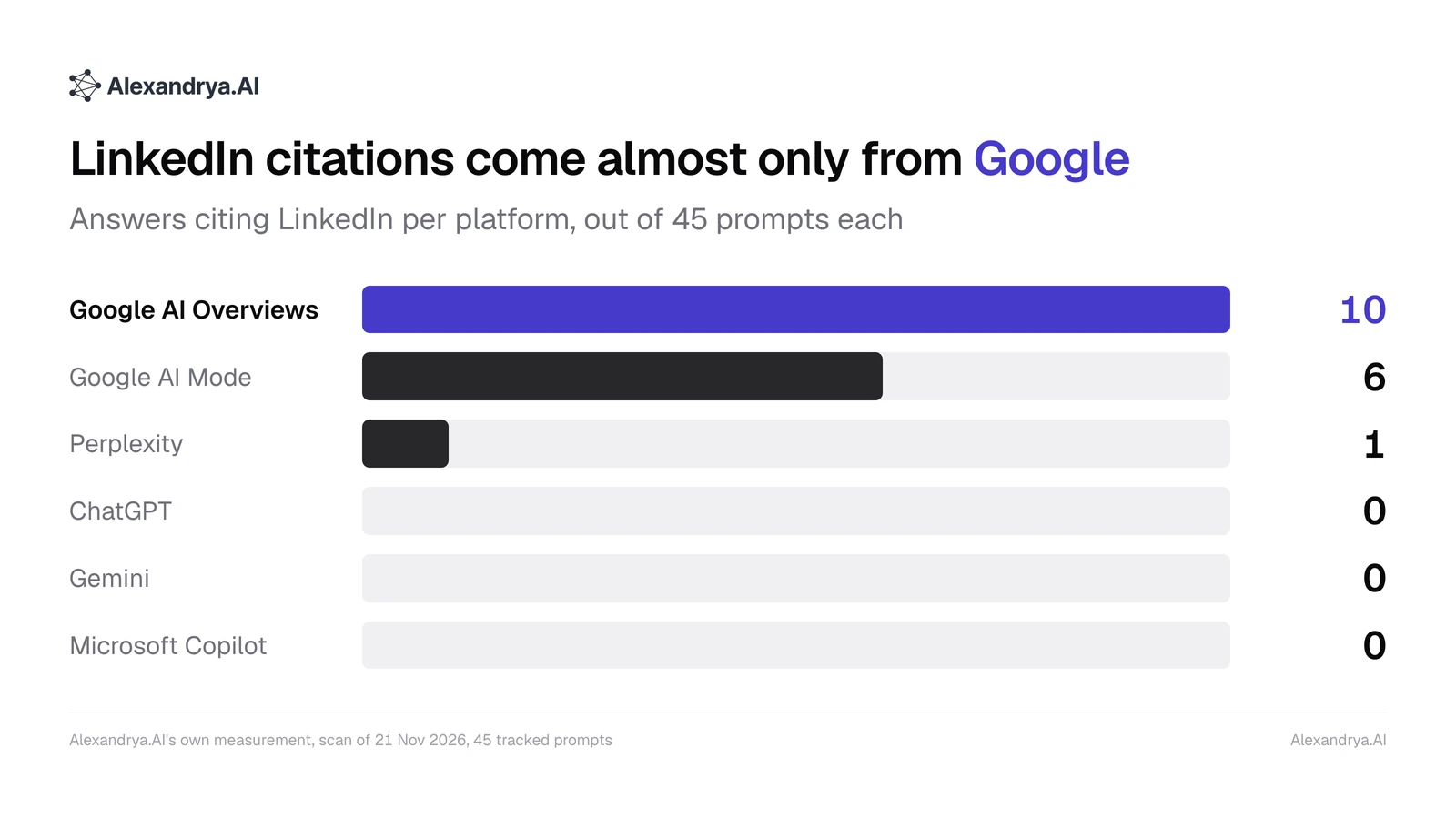
16 of 17 LinkedIn citations came from Google AI Overviews and Google AI Mode. Source: Alexandrya.AI's own measurement, scan of 21 November 2026, 45 tracked prompts.
Does ChatGPT cite LinkedIn posts?
ChatGPT is allowed to cite public LinkedIn posts, but how often it does so varies widely between measurements. LinkedIn's help centre names ChatGPT as a search tool that may display posts set to "Anyone", and LinkedIn's robots.txt lets OAI-SearchBot crawl articles and posts. Even so, ChatGPT did not cite a single LinkedIn page across Alexandrya.AI's 45 prompts on 21 November 2026.
The help page Availability of your content off LinkedIn says search tools "such as Google, Bing, or ChatGPT" may show posts set to "Anyone" and include them in AI-generated summaries. According to OpenAI's Overview of OpenAI Crawlers, OAI-SearchBot decides whether a page can appear in ChatGPT's search answers, while GPTBot collects training data. Both pages were accessed on 25 November 2026. OpenAI does not publish how ChatGPT chooses among the pages it is allowed to cite.
Third-party studies land far apart because their prompt sets, periods and counting methods differ:
| Study (published) | Period and scope | Finding on LinkedIn |
|---|---|---|
| Semrush (10 March 2026) | January to February 2026, 325,000 prompts, 89,000 cited LinkedIn URLs | LinkedIn in 14.3% of ChatGPT Search answers, 13.5% for Google AI Mode, 5.3% for Perplexity |
| Meltwater (22 June 2026) | four weeks, 9.5 million citations from B2B prompts, six models | 75% of LinkedIn citations from members, 25% from company pages |
| BrightEdge (13 August 2026) | 17 May to 2 August 2026, ChatGPT and Google AI Overviews | in ChatGPT about 80% company and jobs pages, about 12% articles and posts |
| Meltwater, August 2026 report (11 September 2026) | August 2026, about 7.3 million citations, eight platforms | 100,200 LinkedIn citations, 69,302 of them from Perplexity, none from ChatGPT or Gemini |
| Alexandrya.AI (21 November 2026) | one scan, 45 prompts about AI visibility tools, six platforms | 17 LinkedIn citations, 16 from Google AI Overviews and AI Mode, none from ChatGPT |
The range runs from 14.3% of all ChatGPT answers down to zero. A third-party study therefore cannot tell you whether ChatGPT cites LinkedIn for your buyers' questions. Only measurement on your own prompts can, and the answer can flip within a few months.
Which LinkedIn formats AI answers cite
For professional questions, AI models mostly cite LinkedIn articles, the long-form pieces published under linkedin.com/pulse. In Alexandrya.AI's scan of 21 November 2026, 12 of 17 LinkedIn citations were articles, 4 were feed posts and 1 was a video. Company pages and personal profiles were not cited once across the 45 prompts about AI visibility tools.
The two most-cited LinkedIn URLs in the action plan are articles as well. On linkedin.com the leader is a piece the vendor Brantial published on its company page on 18 August 2026, "AI Search Monitoring Tools vs. Traditional SEO Rank Trackers: What Do You Actually Need?". It has twelve subheadings, nearly all phrased as a question or a plain statement. On de.linkedin.com the leader is "5/5 KI für das Monitoring von Marken" by Fabian Bertschinger, a short German article from 22 October 2024. A two-year-old article still gets cited in November 2026 when its title carries the question being asked.
The studies disagree on format. Semrush puts articles at 50 to 66% of cited LinkedIn content, Meltwater puts text posts at 72% and articles at 12%, and BrightEdge sees mostly company and jobs pages in ChatGPT. Question type explains part of the gap. BrightEdge classifies 14.0% of LinkedIn's cited ChatGPT prompts as entity questions, such as who is behind a company. A company page answers those. Questions about tools, methods or comparisons are answered by articles. For a B2B brand, the company page carries the facts about you, and articles carry your answers to category questions.
Which LinkedIn content can AI crawlers actually read?
AI search systems can only read LinkedIn content that is reachable without logging in and whose crawler LinkedIn admits. On 25 November 2026, LinkedIn's robots.txt allows Googlebot, Bingbot, OAI-SearchBot and Claude-SearchBot onto the paths for articles, posts, company pages and profiles. GPTBot, ChatGPT-User, PerplexityBot, ClaudeBot and Google-Extended are blocked completely.
| Crawler or token | Operator and purpose | Articles (/pulse/) and posts (/posts/) | Company pages (/company/) and profiles (/in/) |
|---|---|---|---|
| Googlebot | Google Search, the basis for AI Overviews and AI Mode | allowed | allowed |
| Bingbot | Microsoft, Bing search | allowed | allowed |
| OAI-SearchBot | OpenAI, search in ChatGPT | allowed | allowed |
| Claude-SearchBot | Anthropic, search in Claude | allowed | allowed |
| GPTBot | OpenAI, training | blocked | blocked |
| ChatGPT-User | OpenAI, fetches on user request | blocked | blocked |
| ClaudeBot | Anthropic, training | blocked | blocked |
| PerplexityBot | Perplexity, search results | blocked | blocked |
| Google-Extended | Google, a token (not a separate crawler) for Gemini training and grounding in the Gemini apps | blocked | blocked |
The rules are in LinkedIn's robots.txt, accessed on 25 November 2026 and unchanged since 21 November. Googlebot and Bingbot are also kept out of the alternative post path /feed/update/, while the short form /posts/ stays open. Google describes Google-Extended in its documentation on common crawlers: training future Gemini models and grounding in the Gemini apps, with no effect on Google Search. For AI Overviews and AI Mode, Google's page AI features and your website (accessed on 25 November 2026) only requires that a page is indexed and eligible to show with a snippet.
Allowed does not mean reachable. A post is only public when its audience is set to "Anyone". A personal profile only shows search engines the sections enabled in its public profile settings. Logged out on 25 November 2026, both most-cited articles were fully readable in a browser. A cited post and a video also returned their full text to a plain page request. The only company page we tested, a large corporation's, redirected to the sign-in screen when opened directly. LinkedIn does not document when it shows that sign-in wall.
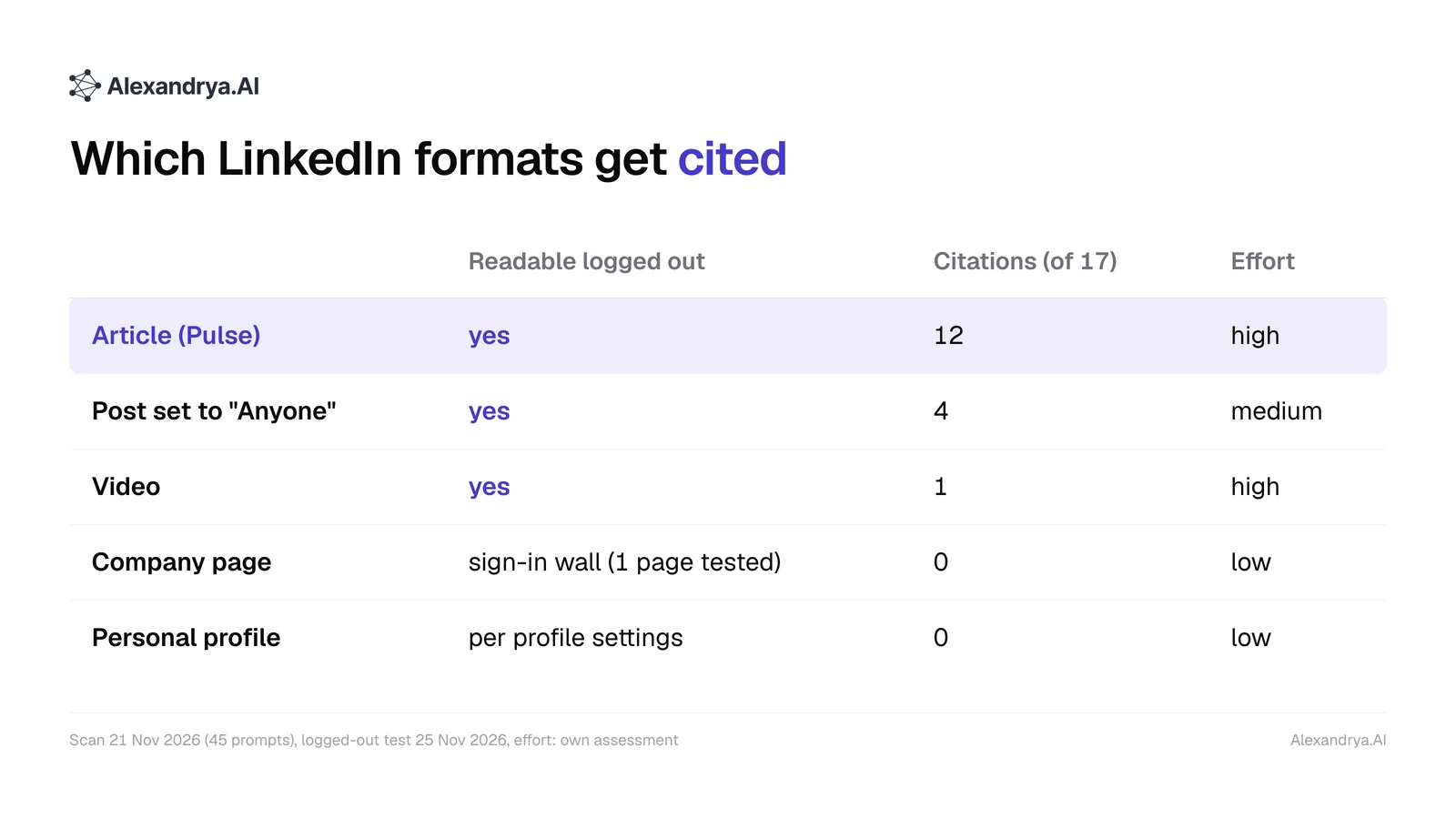
Articles are readable without logging in and accounted for 12 of 17 LinkedIn citations. Source: Alexandrya.AI's own measurement (scan of 21 November 2026, 45 prompts), logged-out test of 25 November 2026, effort as our own assessment.
We rate the effort as high for articles and videos, because each one needs its own research, and medium for posts. Company pages and profiles cost little, since you set them up carefully once and only touch them when something changes. Measured against the citations in our scan, articles are where the high effort pays off most clearly.
Two questions remain open. LinkedIn blocks PerplexityBot, yet Meltwater's August 2026 report attributes about 69% of all LinkedIn citations to Perplexity. Neither LinkedIn nor Perplexity documents how Perplexity gets that content. Gemini never cited LinkedIn in our scan, and Google does not say whether that is connected to the Google-Extended block.
LinkedIn for AI visibility in B2B: what makes content citable
LinkedIn for AI visibility in B2B works through public content that fully answers one specific professional question. The pieces that get cited are mostly articles with the question in the title, a direct answer up front, original figures and a recognisable expert as author. Reach matters less than you might expect: in a Semrush study from March 2026, the median cited post had 15 to 25 reactions and no more than one comment.
The data points to six steps, ordered by what was cited in our scan:
- Write one question per article, in your buyers' words, and answer it in the first 30 to 80 words. LinkedIn itself recommends that length for an answer block at the start of each larger section in its guide to optimising owned content for AI search (accessed on 25 November 2026).
- Bring an original figure with a date and a method. Of the most-cited LinkedIn articles in Meltwater's study, 67% contained quantitative data, 92% had clear headings and all of them used bullet points.
- Size each format on purpose. Semrush found most article citations between 500 and 2,000 words and most post citations between 50 and 299 words.
- Set the audience to "Anyone" and write your own text. About 95% of cited posts were originals, not reshares, according to Semrush.
- Write the company page's About text as an entity statement: what you offer, for whom and from where, in the same wording as your website. For questions like "who is behind company X?", that is the page that can be cited.
- Let subject-matter experts publish under their own names. Semrush found that authors with fewer than 500 followers are cited at least as often as larger profiles.
Engagement pods, bought reactions and second profiles are not needed according to these figures, and they break the rules. LinkedIn's Professional Community Policies, accessed on 25 November 2026, rule out fake profiles ("We don't allow fake profiles or entities"), artificially inflated engagement and agreements to like or reshare each other's content.
How to measure LinkedIn in AI answers
You measure LinkedIn in AI answers by running a fixed set of prompts on several platforms at regular intervals and filtering the source lists for linkedin.com and de.linkedin.com. You need URL-level detail: only when you see which article or post is cited, and who wrote it, do you know whether your content, a colleague's or a competitor's is carrying the answer.
Report each platform separately. In our scan, a single total would have hidden that 16 of 17 LinkedIn citations came from Google and ChatGPT contributed none. How to read source lists per platform and calculate positions is covered in our guide to AI source analysis by platform. Clicks from these answers often never show up in web analytics, and our article on the invisible channel of AI search in B2B explains why. After you publish a new article, keep running the same prompts and compare the cited URLs with the earlier state.
Alexandrya.AI is an AI visibility tool from Munich that measures brand mentions in ChatGPT, Gemini, Perplexity, Google AI Overviews, Google AI Mode and Microsoft Copilot and turns them into content and citation tasks. Under Sources & Domains you see how often linkedin.com and de.linkedin.com are cited and at which position in the source list. In the action plan, LinkedIn appears as an outreach target with its most-cited URL, a reason and a suggested angle, and a recommendation becomes a task with the status Open, In Progress or Done.
Alexandrya.AI does not measure LinkedIn reach, does not read LinkedIn analytics, does no social listening and publishes nothing on LinkedIn. You only see citations for the prompts you track. The features are listed on the product page and the plans on the Alexandrya.AI pricing page.
Frequently asked questions
Do LinkedIn posts need lots of likes to get cited by AI?
No. According to Semrush, the median cited LinkedIn post had 15 to 25 reactions and no more than one comment. Meltwater found that 51% of cited authors have fewer than 10,000 followers. Lots of likes are not a prerequisite according to these figures. Bought likes or engagement pods also break LinkedIn's Professional Community Policies on artificially inflated engagement.
Should the company page or employees post on LinkedIn?
Both, with different jobs. Semrush found that company pages account for 59% of LinkedIn citations on Perplexity, while individuals account for 59% on ChatGPT Search and Google AI Mode. Meltwater counted 75% members and 25% company pages across six models. The company page carries the facts about the business, and experts carry the answers to professional questions.
Do AI tools still cite older LinkedIn articles?
Yes. In Alexandrya.AI's scan of 21 November 2026, Google AI Overviews cited a LinkedIn article published on 22 October 2024. Freshness still helps: Meltwater found that 48% of cited LinkedIn content was less than three months old. If an older article carries outdated figures, updating it is usually better than publishing a new one next to it.
Why does de.linkedin.com show up separately from linkedin.com?
de.linkedin.com is LinkedIn's German-language subdomain, and AI answers often link German articles and posts there. In Alexandrya.AI's project, de.linkedin.com accounted for 206 of 644 LinkedIn citations in the action plan of 20 November 2026. Always filter for both domains, and for other country subdomains you serve, or you miss almost a third.
Does Perplexity cite LinkedIn even though LinkedIn blocks PerplexityBot?
Yes. Perplexity cited LinkedIn in one of 45 answers in Alexandrya.AI's scan of 21 November 2026, and 69,302 times in Meltwater's August 2026 report. LinkedIn's robots.txt still blocks PerplexityBot completely. Neither LinkedIn nor Perplexity documents how Perplexity reaches that content, so treat this as an open question rather than a loophole.
How much does it cost to track LinkedIn citations with Alexandrya.AI?
Alexandrya.AI starts at €79 a month for 50 prompts and three selectable AI models. Professional costs €199 for 150 prompts and five models. Citations of linkedin.com and de.linkedin.com appear under Sources & Domains. You can test the full feature set free for seven days, and no credit card is needed.
Check which LinkedIn pages carry your AI answers
Want to know whether ChatGPT, Gemini, Perplexity and Google cite LinkedIn for your buyers' questions, and whether the cited pieces are yours or your competitors'? Add your prompts and competitors in the trial. After the first scan you see which domains and URLs are cited, and the action plan turns that into your next tasks. Seven days, no credit card. Check your LinkedIn citations for free
Frequently asked questions
Do LinkedIn posts need lots of likes to get cited by AI?
No. According to Semrush, the median cited LinkedIn post had 15 to 25 reactions and no more than one comment. Meltwater found that 51% of cited authors have fewer than 10,000 followers. Lots of likes are not a prerequisite according to these figures. Bought likes or engagement pods also break LinkedIn's Professional Community Policies on artificially inflated engagement.
Should the company page or employees post on LinkedIn?
Both, with different jobs. Semrush found that company pages account for 59% of LinkedIn citations on Perplexity, while individuals account for 59% on ChatGPT Search and Google AI Mode. Meltwater counted 75% members and 25% company pages across six models. The company page carries the facts about the business, and experts carry the answers to professional questions.
Do AI tools still cite older LinkedIn articles?
Yes. In Alexandrya.AI's scan of 21 November 2026, Google AI Overviews cited a LinkedIn article published on 22 October 2024. Freshness still helps: Meltwater found that 48% of cited LinkedIn content was less than three months old. If an older article carries outdated figures, updating it is usually better than publishing a new one next to it.
Why does de.linkedin.com show up separately from linkedin.com?
de.linkedin.com is LinkedIn's German-language subdomain, and AI answers often link German articles and posts there. In Alexandrya.AI's project, de.linkedin.com accounted for 206 of 644 LinkedIn citations in the action plan of 20 November 2026. Always filter for both domains, and for other country subdomains you serve, or you miss almost a third.
Does Perplexity cite LinkedIn even though LinkedIn blocks PerplexityBot?
Yes. Perplexity cited LinkedIn in one of 45 answers in Alexandrya.AI's scan of 21 November 2026, and 69,302 times in Meltwater's August 2026 report. LinkedIn's robots.txt still blocks PerplexityBot completely. Neither LinkedIn nor Perplexity documents how Perplexity reaches that content, so treat this as an open question rather than a loophole.
How much does it cost to track LinkedIn citations with Alexandrya.AI?
Alexandrya.AI starts at €79 a month for 50 prompts and three selectable AI models. Professional costs €199 for 150 prompts and five models. Citations of linkedin.com and de.linkedin.com appear under Sources & Domains. You can test the full feature set free for seven days, and no credit card is needed.
How visible is your brand in AI?
Try Alexandrya.AI free for 7 days and see how ChatGPT, Gemini, Perplexity, AI Overviews and Copilot talk about your brand.
- 7 days free
- No credit card required
- All features included
- Cancel anytime
About the author
Talaal Max Habib
Managing Director at Alexandrya.AI
Talaal Max Habib has advised companies in industry, the Mittelstand and e-commerce on SEO and Generative Engine Optimization since 2015. With his team he built Alexandrya.AI, the Munich-based platform that measures how brands appear in ChatGPT, Perplexity and Gemini.
LinkedIn