Why 67% of B2B Purchase Decisions Now Start in AI Search
New data shows 67% of B2B buyers now begin purchase research in AI systems like ChatGPT and Perplexity, not Google. Here is what it means for B2B marketing.

Managing Director at Alexandrya.AI
Why Are B2B Buyers Starting Their Research in AI Search?
B2B purchase research has shifted fundamentally. According to Forrester's Q1 2026 B2B Buyer Survey, 67% of B2B buyers now initiate vendor research in an AI system (ChatGPT, Perplexity, or Google AI Overviews) rather than entering a keyword into traditional search. This is not a marginal shift at the edges of buyer behavior. It is the majority behavior across industries, company sizes, and seniority levels. For B2B marketing teams that have spent years optimizing for Google keyword rankings, this shift represents the most significant change in organic acquisition since the mobile transition of 2014 to 2016. The brands being cited in AI responses to buyer queries are establishing first-mover advantages in buyer awareness that traditional SEO cannot replicate.
How Has the B2B Buyer Journey Changed in 2026?
The B2B buyer journey has structurally reorganized around AI as the entry point. AI-powered research now precedes Google in the majority of purchase cycles, while traditional search has shifted into a secondary validation role. The sections below trace how this reordering happened and what buyers are actually doing inside AI systems today.
What Did the Traditional B2B Buyer Journey Look Like?
The traditional B2B buyer journey followed a predictable pattern: a buying signal (a pain point, a budget cycle, a trigger event) was followed by a keyword search on Google, landing on a vendor comparison page or a top-ranking blog post, followed by progressive research across multiple sessions before contacting sales. This journey was optimized for by most B2B marketing teams through keyword targeting, content marketing, and landing page conversion rate optimization.
That journey is now a minority pattern.
How Do B2B Buyers Start Research Today?
B2B Buyer Research Starting Points 2026
(Forrester Q1 2026 B2B Buyer Survey, n=2,847)
| Starting point | Share |
|---|---|
| AI-powered search (ChatGPT, Perplexity, Google AI Overviews, Bing Copilot) | 67% |
| Traditional Google keyword search | 28% |
| Direct navigation to known vendor | 9% |
| Social media / LinkedIn | 5% |
| Colleague recommendation (offline) | 5% |
(Multi-select: respondents could select all that apply)
The data reveals three critical patterns:
- AI-first research is now majority behavior: not a niche early-adopter habit
- Traditional search has not disappeared: it is the secondary step, not the starting point
- AI and traditional search are sequential, not competitive: buyers start in AI, then validate in Google
What Questions Are B2B Buyers Asking AI Systems?
B2B buyers are not searching for vendor brand names in AI systems. They are asking categorical and comparative questions:
- "What is the best tool for tracking brand mentions in AI search?"
- "How do companies measure their visibility in ChatGPT?"
- "What does generative engine optimization cost for a mid-market B2B company?"
- "Compare the top AI visibility tracking platforms"
These are purchase-intent queries. The vendors cited in the AI responses to these questions are being evaluated before the buyer has visited a single vendor website.
What Is the Commercial Impact of AI Search on B2B Pipeline?
AI citation directly accelerates pipeline velocity and increases lead quality. Vendors named in AI responses reach buyers who have already done more research and formed stronger vendor preference, producing measurable differences in sales cycle length, demo conversion, and average contract value. The data below quantifies these effects and explains the underlying mechanism.
How Does AI Citation Translate to Pipeline Velocity?
Pipeline Velocity Comparison: AI-Cited vs. Non-Cited Vendors
(Demand Gen Report, B2B SaaS Study, Q4 2025, n=180 vendors)
| Metric | AI-Cited Vendors | Non-Cited Vendors | Difference |
|---|---|---|---|
| Avg. sales cycle length | 47 days | 68 days | (-31%) |
| Demo request rate | 8.4% | 3.1% | (+171%) |
| Free trial conversion rate | 22% | 9% | (+144%) |
| Avg. ACV at close | $18,400 | $14,200 | (+30%) |
| Deals sourced from AI channel | 34% of pipeline | <2% of pipeline |
The pipeline velocity data is striking. Vendors cited in AI responses to relevant buyer queries close deals 31% faster, convert demos at 171% higher rates, and see average contract values 30% higher than non-cited vendors. The explanation is pre-qualification: a buyer who has already received an AI recommendation has done more research before first contact, has higher intent, and arrives with pre-formed vendor preference.
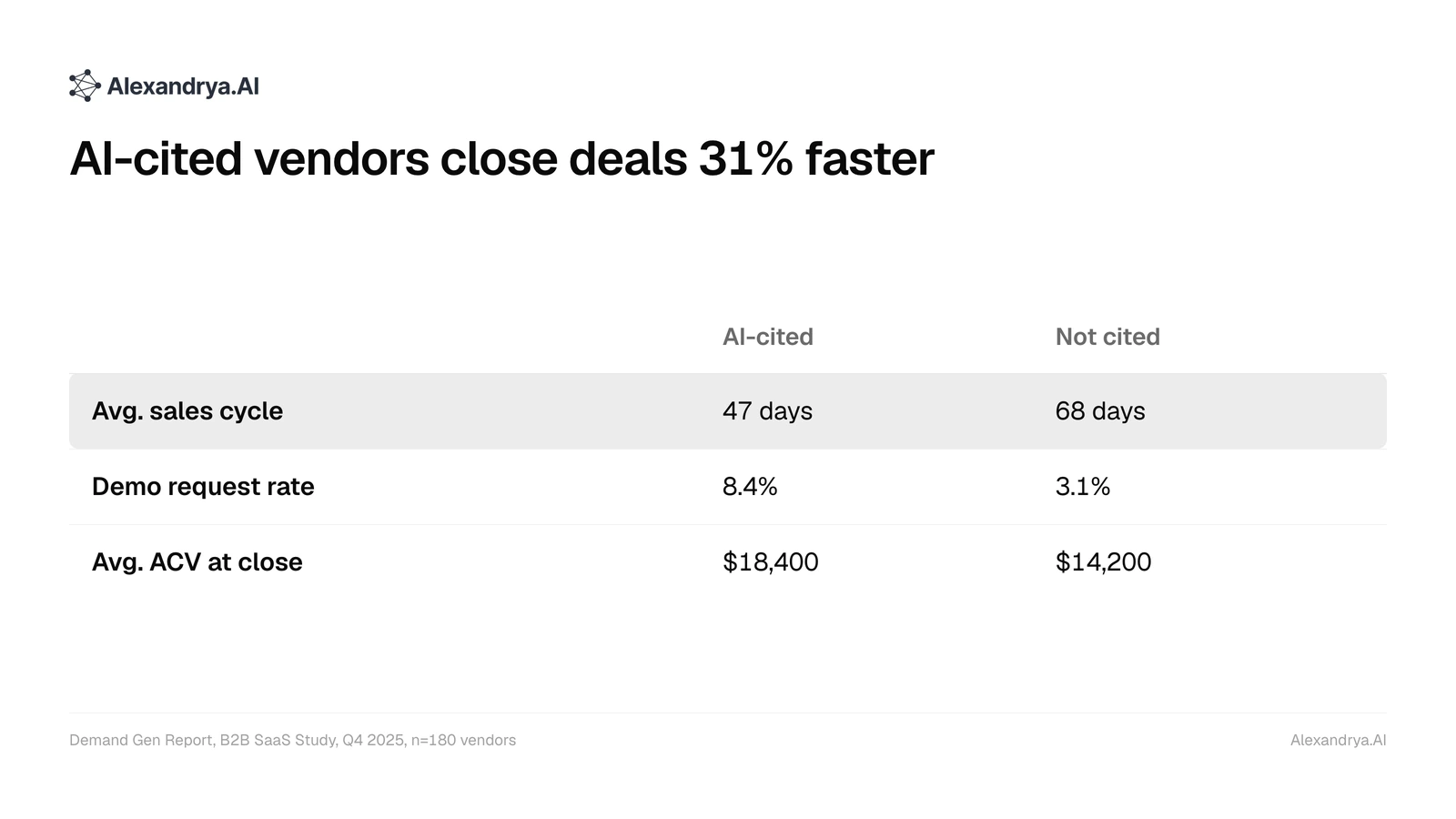
B2B buyers who arrive via AI citation convert to demo requests at 171% higher rates and complete the sales cycle 31% faster than buyers from traditional search.
Why Does AI Citation Produce Higher-Intent Leads?
AI citation produces higher-intent leads because the AI system has already performed the vendor selection step. When ChatGPT recommends a specific tool in response to a buyer query, it has effectively pre-qualified the vendor for the buyer. The buyer arrives at the vendor's website already convinced that the vendor is relevant. The question is no longer "should I consider this vendor?" but "is this vendor the right choice?"
This is fundamentally different from a buyer who found a vendor by clicking a Google ad or an organic listing. In that case, the buyer is still in consideration mode. The AI-citation buyer is in decision mode.
How Are B2B Categories Affected Differently by AI Search?
Not all B2B verticals are equally exposed to the AI search shift. Adoption rates range from 38% in construction to 79% in marketing technology, a 41-percentage-point gap driven by differences in buyer AI fluency, query density, and early GEO investment. The following sections break down adoption by category and seniority level.
Which B2B Categories See the Highest AI Search Adoption?
AI Search Adoption by B2B Category (% of buyers starting research in AI)
(IDC AI Buyer Behavior Report, January 2026)
| Category | AI search adoption |
|---|---|
| Marketing Technology | 79% |
| Sales Enablement | 76% |
| Analytics & Data | 74% |
| Cybersecurity | 71% |
| HR & People Ops | 65% |
| ERP / Finance | 58% |
| Manufacturing Tech | 48% |
| Construction / Real Estate | 38% |
Marketing technology (the category where alexandrya.ai competes) has the highest AI search adoption of any B2B vertical at 79%. This is logical: marketing technology buyers are often digital marketing practitioners who are simultaneously early adopters of AI tools. They use the technology they buy.
The implication: in MarTech, the shift to AI-first buying behavior is not approaching. It has already arrived. A MarTech vendor not optimizing for AI citation is systematically absent from the channel where the majority of its target buyers start research.
How Does AI Search Behavior Vary by Buyer Seniority?
The Forrester data shows a counterintuitive finding on seniority: C-suite buyers (CMOs, CDOs, CTOs) show higher AI search adoption rates than mid-level managers, not lower. CMOs report using AI systems for vendor research 74% of the time, versus 61% for marketing directors and 58% for marketing managers.
The explanation is time scarcity: senior buyers use AI to compress the research phase. Rather than spending four sessions reading vendor comparison blogs, a CMO enters one well-formed question into ChatGPT and gets a structured answer in 30 seconds. The vendors named in that answer get a demo call. The vendors not named do not.
What Does This Mean for B2B Marketing Strategy?
The strategic implication is clear: AI visibility must become a tracked, optimized channel alongside traditional SEO, not a future consideration. This section covers the four concrete actions B2B marketing teams should take now and quantifies the risk of remaining inactive while competitors establish AI citation defaults.
How Should B2B Marketing Teams Respond to the AI Search Shift?
The strategic response to AI-first buyer behavior is not to abandon traditional SEO. It is to add AI visibility as a parallel channel with dedicated measurement and optimization resources. Specifically:
1. Define your AI keyword set. Identify the categorical and comparative queries your buyers ask AI systems. These are different from your SEO keyword targets. They are conversational questions, not search terms.
2. Measure your AI citation baseline. Before optimizing, establish where you currently appear (or do not appear) in AI responses to your target queries. Track this across ChatGPT, Perplexity, Google AI Overviews, and Bing Copilot.
3. Optimize content for AI citation. Apply GEO principles to your highest-traffic pages: answer-first structure, self-contained passages, FAQ schema, and question-based headings. See: The GEO Content Framework
4. Track changes in AI visibility weekly. AI citation frequency changes in response to content changes, competitor actions, and platform algorithm updates. Weekly tracking is the minimum cadence for actionable signal.
What Is the Risk of Inaction for B2B Brands?
B2B AI Visibility Gap: Early Movers vs. Laggards (Projected 2026 to 2027)
(Illustrative based on observed first-mover citation concentration)
| Group | Optimization | AI Citation Share |
|---|---|---|
| Early movers | optimized Q1 to Q2 2026 | 80% |
| Late movers | optimized Q3 to Q4 2026 | 40% |
| Laggards | not yet optimized | 20% |
AI citation is subject to the same first-mover concentration effects as traditional SEO, but compressing faster. In traditional SEO, a late entrant can take 12 to 18 months to overtake an established competitor's rankings. In AI citation, the concentration period is shorter because AI systems develop "default answers" to common queries rapidly, and changing those defaults requires sustained content authority that takes time to build.
Brands that delay GEO implementation are not losing ground gradually. They are allowing competitors to establish citation defaults that will become progressively harder to displace.
How Do You Measure Your Current B2B AI Visibility?
Measuring B2B AI visibility requires four specific metrics that differ fundamentally from traditional SEO KPIs. Citation frequency, citation position, competitive share, and sentiment accuracy together provide a complete picture of your brand's standing across AI platforms. The section below defines each metric and explains what to do with the data.
What Metrics Should B2B Teams Track for AI Search?
AI visibility in B2B contexts requires four specific metrics:
Citation Frequency: How often does your brand appear when AI systems respond to relevant buyer queries? Measured as a percentage across multiple runs of the same prompt.
Citation Position: When your brand is cited, where in the response does it appear? First mention carries significantly higher buyer attention weight than a mention in a list of alternatives in paragraph 4.
Competitive Share: What percentage of citations in your category go to your brand versus defined competitors? This is the AI equivalent of share of voice.
Sentiment Accuracy: When your brand is cited, is the description accurate and positive? AI systems sometimes cite brands with incorrect descriptions or outdated positioning. Sentiment accuracy tracks whether citations are commercially useful.
For systematic measurement of all four metrics across all major AI platforms, see: alexandrya.ai features
Start Measuring Your B2B AI Visibility Today
The shift to AI-first buying behavior is not theoretical. It is happening now, in your category, with your buyers. The question is whether your brand appears when they ask.
No credit card. Cancel anytime. First citation frequency report in minutes.
Frequently asked questions
Is the 67% AI search figure specific to any industry or global?
The 67% figure from Forrester's Q1 2026 B2B Buyer Survey covers North American and Western European B2B buyers across 14 industries. Industry-specific breakdown shows higher rates in technology and marketing (74 to 79%) and lower rates in construction and manufacturing (38 to 48%). The 67% is the aggregate.
Does AI search replace Google for B2B research entirely?
No. 67% of buyers start in AI search, then use traditional search as a secondary verification step. The buyer journey is AI → Google → vendor website, not AI instead of Google. B2B brands need to optimize for both channels.
How quickly can B2B companies see results from GEO optimization?
Real-time retrieval platforms like Perplexity and Google AI Overviews respond to GEO changes within 2 to 6 weeks. ChatGPT base model citations change more slowly. A 30-day GEO sprint typically produces measurable citation improvement in Perplexity and AI Overviews within the sprint period.
What is the first step for a B2B company with zero AI visibility?
Run your five highest-intent buyer queries through ChatGPT, Perplexity, and Google AI Overviews manually. Record whether your brand appears. Identify which competitors do appear. If uncited, prioritize restructuring top landing pages with answer-first content and FAQ schema.
How visible is your brand in AI?
Try Alexandrya.AI free for 7 days and see how ChatGPT, Gemini, Perplexity, AI Overviews and Copilot talk about your brand.
- 7 days free
- No credit card required
- All features included
- Cancel anytime
About the author
Talaal Max Habib
Managing Director at Alexandrya.AI
Talaal Max Habib has advised companies in industry, the Mittelstand and e-commerce on SEO and Generative Engine Optimization since 2015. With his team he built Alexandrya.AI, the Munich-based platform that measures how brands appear in ChatGPT, Perplexity and Gemini.
LinkedIn