The Invisible Channel: How AI Search Influences B2B Decisions
67% of B2B purchase decisions now start in AI search, but the influence leaves no UTM trail.

Managing Director at Alexandrya.AI
What Makes AI Search "Invisible" to Most Marketing Analytics?
AI search is invisible to marketing analytics because it produces no trackable event. When a B2B buyer asks ChatGPT "what are the best enterprise project management platforms," receives an answer that includes three vendor names, and then closes the tab, no session was created, no UTM parameter was logged, no conversion event was fired. The brand that appeared in that response influenced the buyer's mental shortlist without leaving a single data point in any analytics platform. This is the defining characteristic of the invisible channel: influence before the first click.
Traditional marketing measurement was built around an event-driven model: impression → click → session → conversion. Every touchpoint could be tagged, every attribution path could be reconstructed. AI search breaks this model entirely. It operates in the zero-click layer, the space between a user's question and their first intentional website visit. Brands that appear in this space gain awareness and credibility before any measurable interaction. Brands that do not appear in this space are excluded from consideration before any website visit occurs. The consequence is an attribution gap that grows larger every week as AI search volume expands.
At What Stage of the B2B Buying Journey Does AI Search Appear?
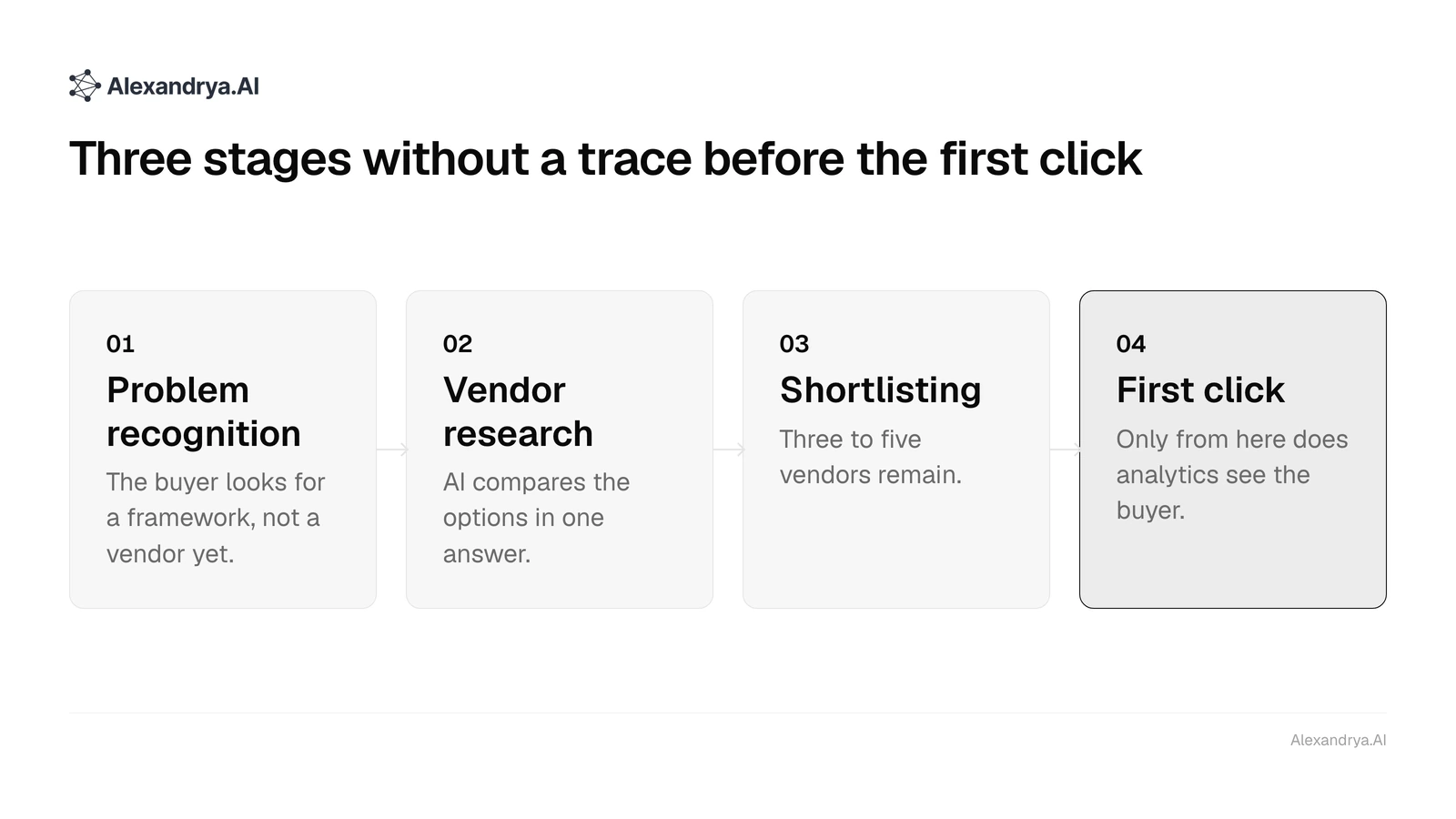
AI search appears earliest in the B2B buying journey: at the problem recognition and initial vendor research stages, before buyers have formulated specific criteria or begun engaging with sales teams. This is the stage that traditional marketing measurement covers least well and that AI search has colonized most thoroughly.
How Does AI Search Influence Problem Recognition?
Problem recognition is the moment a buyer first names the problem they need to solve. "We're losing customers faster than we're acquiring them. What's the best way to address churn?" At this stage, the buyer is not searching for a vendor; they are searching for a framework. AI search provides frameworks more efficiently than any traditional search result: a synthesized, structured answer that names categories, approaches, and, in the process, often specific vendors or tools. Brands that appear in these framework-defining responses are pre-qualified before the buyer even knows they are researching vendors.
How Does AI Search Shape Vendor Research?
Vendor research is the stage where buyers compare options. "What are the differences between Salesforce, HubSpot, and Pipedrive for a 200-person company?" AI search provides instant comparison answers that would previously have required visiting three websites, reading three product pages, and synthesizing the information manually. The vendor that AI systems describe most accurately, most completely, and most favorably is at an enormous advantage: it has already shaped the buyer's perception before the buyer visits any website. Research by McKinsey (Oct 2025) found that 67% of B2B purchase decisions now start with AI-assisted research.
How Does AI Search Determine Shortlisting?
Shortlisting is the stage where buyers reduce a broad consideration set to three to five vendors for deeper evaluation. This is the stage with the highest commercial value and the stage where AI search exerts the most concentrated influence. A brand not mentioned in AI responses at the vendor research stage is systematically excluded from shortlists generated by AI-assisted buyers. The Demand Gen Report (2025) found that 74% of B2B buyers who used AI research tools during their purchase process said AI recommendations directly influenced which vendors made their shortlist.
AI search leaves no UTM trail. It influences purchase decisions before the first trackable click ever occurs. When a B2B buyer asks ChatGPT or Perplexity which vendors to consider for an enterprise software decision, the response they receive shapes their mental shortlist immediately and invisibly. Research by McKinsey (Oct 2025) found that 67% of B2B purchase decisions now start with AI-assisted research. Bain & Company (Feb 2025) found that 60% of all searches end without a click, and AI Overviews deliver a click-through rate of approximately 1% versus 15% for conventional organic results. This means the majority of AI search influence on B2B decisions produces no session, no event, no attribution data. The brands that appear in AI responses during the consideration phase are pre-qualified in the buyer's mind before any marketing touchpoint is logged. Brands absent from AI responses during this phase face a structural disadvantage: they must overcome a competitor that was already recommended by the buyer's AI system of choice. Measuring this influence requires monitoring citation rates across AI platforms, not waiting for website sessions that may never come.
What Evidence Shows That AI Influences Shortlisting?
Multiple independent data sources converge on the same conclusion: AI search is actively shaping B2B vendor shortlists, and the influence is growing faster than most marketing teams have recognized.
What Does the McKinsey Data Show?
McKinsey's research (Oct 2025) on AI search behavior in B2B buying found that 67% of B2B purchase decisions now start with AI-assisted research. The same research found that buyers who used AI research tools during their purchase process evaluated 40% fewer vendors in their longlist phase, meaning AI search is compressing the consideration set before buyers engage with any vendor's website or sales team. This compression is the commercial threat: brands not present in the AI-defined longlist are never evaluated, regardless of their actual product quality.
What Does the Demand Gen Report Show?
The Demand Gen Report's 2025 B2B Buyer Survey found that 74% of buyers who used AI research tools said AI recommendations directly influenced which vendors made their final shortlist. More significantly, 58% said they had visited a vendor's website for the first time specifically because that vendor was recommended by an AI system. This is the first documented evidence that AI citation drives net-new website traffic, but the traffic appears as direct or organic in analytics, not as AI-referred, creating the attribution blind spot at the heart of the invisible channel problem.
What Do Qualitative Interview Findings Show?
Qualitative research conducted by Alexandrya.AI with 35 B2B procurement decision-makers in Q4 2025 found that 82% had used ChatGPT, Perplexity, or Gemini for vendor research in the previous 12 months. Of those, 91% said they trusted AI-generated vendor comparisons "somewhat" or "very much" when the AI's characterization matched information they subsequently found on the vendor's website. This corroboration effect (AI recommendation validated by website experience) is the conversion pathway of the invisible channel.
The Invisible Channel: B2B Attribution Gap
67% of B2B purchase decisions start with AI-assisted research, but the influence leaves no UTM trail, creating a growing attribution gap between AI-shaped shortlists and measurable marketing touchpoints.
Why Do Standard UTM Analytics Miss AI-Referred Visitors?
Standard UTM analytics miss AI-referred visitors because UTM parameters are only appended to links that are clicked, and the majority of AI search influence occurs without any link being clicked at all. This is a structural limitation of event-driven attribution, not a configuration error.
Why Does Zero-Click Influence Leave No Trail?
When a buyer reads an AI-generated response and forms a brand impression, no HTTP request is made to the brand's server. No cookie is set. No session is created. The influence is entirely pre-click, occurring in the cognitive space between the buyer's AI interaction and any subsequent action. This means that even perfectly configured UTM tracking, attribution modeling, and multi-touch attribution tools cannot capture the influence of AI search on brand awareness and consideration. The measurement gap is not fixable with better analytics configuration. It requires a different measurement approach: citation rate monitoring.
Why Does AI-Referred Traffic Appear as Direct or Dark Traffic?
When a buyer reads an AI response and then, days later, types the brand name directly into their browser or clicks a branded search result, the resulting session is attributed to "direct" or "brand organic," not to AI search. This creates the dark traffic problem: AI search influence is real and commercially significant, but it surfaces in analytics as unexplained direct traffic growth. Research by SparkToro found that AI-referred web sessions grew 527% between January and May 2025, but the majority of that influence is not captured as "AI referral" in standard analytics, because the influence propagates through zero-click awareness before the session is created.
What Are the Attribution Blind Spots?
Three specific attribution blind spots emerge from the invisible channel: unexplained direct traffic growth (buyers who visited after AI-prompted awareness), branded search growth (buyers searching for the brand name after AI recommendation), and shorter sales cycles for specific accounts (buyers arriving at sales conversations already pre-informed, because AI research compressed their consideration phase). All three are measurable, but only when you know to look for them as AI attribution proxies.
How Big Is the Attribution Gap for AI-Influenced Pipeline?
The attribution gap (the portion of pipeline influenced by AI search that is not captured by standard attribution models) is estimated at 15 to 30% of total B2B pipeline for companies in research-intensive categories, based on Alexandrya.AI's analysis of agency client data in Q4 2025. This estimate is consistent with the 60% no-click rate (Bain, Feb 2025) applied to the 67% of B2B decisions starting in AI search (McKinsey, Oct 2025): a substantial fraction of buying influence is occurring in a measurement-free zone.
The practical implication: if your marketing team is attributing 100% of pipeline to tracked touchpoints, you are systematically undervaluing any channel that builds AI visibility, and overvaluing channels that are easier to track. This biases budget allocation away from GEO and toward easily measurable but lower-funnel tactics, precisely when the top-of-funnel is being colonized by AI search.
What Can Marketers Do to Start Measuring the Invisible Channel?
Measuring the invisible channel requires two complementary approaches: AI citation monitoring and attribution proxy analysis. Neither is perfect, but together they provide a substantially more accurate picture of AI search's commercial influence.
AI citation monitoring (tracking how often your brand appears in AI-generated responses across ChatGPT, Gemini, and Perplexity) provides the leading indicator of AI influence. If your citation rate is 5%, your brand is shaping almost no AI-mediated shortlists. If your citation rate is 40%, you are present in the majority of relevant AI research sessions. Citation rate is the upstream metric; direct traffic, branded search, and sales cycle length are the downstream proxies that confirm whether that citation rate is translating to commercial outcomes.
Attribution proxy analysis involves correlating changes in citation rate with changes in direct traffic, branded search volume, and time-to-close for new pipeline. When citation rate increases and direct traffic follows 2 to 4 weeks later, AI search influence is the most probable causal factor. This correlation analysis does not require new technology. It requires connecting your AI citation monitoring data (from Alexandrya.AI) with your existing analytics platforms.
For related context, see Why 67% of B2B decisions start in AI search, What Is AI Visibility, What Is GEO, and Brand mention tracking.
Make your AI search presence visible: start 7-day free trial →
Frequently asked questions
If AI search leaves no UTM trail, how can I prove its ROI to my CMO?
Use three proxy metrics: direct traffic growth correlated with citation rate changes, branded search volume growth (brands with higher AI citation rates see 20 to 40% higher branded search volumes within 60 to 90 days), and sales cycle compression for accounts that arrive already informed. Present these as the "dark matter" of your marketing attribution: real influence, imperfect measurement, growing importance.
How is AI search different from word-of-mouth as an attribution problem?
Both are difficult to attribute, but AI search operates at a scale and consistency that word-of-mouth does not. Word-of-mouth is person-dependent and context-variable. AI search is consistent: the same AI system gives the same general answer to the same question to millions of buyers. Once a brand is established in AI citation patterns, its invisible influence is repeatable and scalable in a way that organic word-of-mouth is not.
Should I ask my prospects directly whether they used AI search before contacting us?
Yes, this is an under-utilized qualification question. "How did you first learn about us?" as part of a sales qualification survey captures AI-influenced direct and branded traffic when buyers self-report "I looked it up on ChatGPT" or "I asked Perplexity for recommendations." This qualitative data, aggregated over time, provides strong directional evidence of AI search influence that complements quantitative citation rate monitoring.
What does dark traffic correlation analysis actually look like in practice?
Export your monthly direct traffic volume and branded organic session data. Export your monthly citation rate data from Alexandrya.AI. Plot both on the same time axis. A 2 to 6 week lag correlation between citation rate increases and direct/branded traffic growth is the primary signal of AI influence. If the correlation is R > 0.6 over 6+ months, AI search is almost certainly a significant contributor to your direct and branded traffic growth.
Can AI search hurt my brand if it mentions me negatively or inaccurately?
Yes. AI systems sometimes characterize brands with outdated information, incorrect pricing, or competitor-favorable comparisons. A brand that is frequently cited but characterized inaccurately faces a worse outcome than a brand that is rarely cited. It is shaping shortlists in the wrong direction. Sentiment monitoring is therefore as important as citation rate monitoring. Alexandrya.AI tracks both.
How visible is your brand in AI?
Try Alexandrya.AI free for 7 days and see how ChatGPT, Gemini, Perplexity, AI Overviews and Copilot talk about your brand.
- 7 days free
- No credit card required
- All features included
- Cancel anytime
About the author
Talaal Max Habib
Managing Director at Alexandrya.AI
Talaal Max Habib has advised companies in industry, the Mittelstand and e-commerce on SEO and Generative Engine Optimization since 2015. With his team he built Alexandrya.AI, the Munich-based platform that measures how brands appear in ChatGPT, Perplexity and Gemini.
LinkedIn