How to Build an AI Visibility Strategy for 2026: The Complete Guide
A step-by-step AI visibility strategy: from baseline audit to content optimization to ongoing monitoring.

Managing Director at Alexandrya.AI
What Is an AI Visibility Strategy, and Why Do You Need One Now?
An AI visibility strategy is a structured, ongoing program to ensure your brand is accurately, frequently, and positively cited by AI systems like ChatGPT, Perplexity, and Google AI Overviews. You need one now because 67% of B2B buyers use AI search as their primary research tool (McKinsey, 2025), yet only 11.4% of brands are cited when relevant queries are asked (Alexandrya.AI Q1 2026).
Without a deliberate strategy, AI visibility is random. Your brand may appear in some queries and be entirely absent from others, with no clear reason and no way to improve without data. A strategy turns AI visibility from a passive outcome into a managed competitive asset, giving marketing and brand teams the same level of control over AI search that SEO gave them over traditional search.
What Does a Complete AI Visibility Strategy Cover?
A complete AI visibility strategy covers four interdependent layers: measurement, content, authority, and monitoring. Implementing only one or two layers produces partial results. All four must operate in parallel to generate compounding returns in citation rate and Share of AI Voice.
An effective AI visibility strategy requires four layers operating simultaneously. The measurement layer establishes which queries matter, what baseline citation rate exists, and how competitors compare. Without measurement, there is no way to prove progress or prioritize effort. The content layer produces and optimizes pages that AI systems can extract, synthesize, and cite: definitional content that answers "what is X", data-driven content that provides original statistics, and FAQ infrastructure that mirrors the exact phrasing AI users apply. The authority layer builds the external signals (Wikipedia presence, structured data markup, citations in trade publications) that AI systems use as quality proxies. According to Alexandrya.AI Q1 2026 research (500 B2B brand queries), brands with a Wikipedia presence achieve a 4.1× higher citation rate than those without one. The monitoring layer tracks weekly shifts across ChatGPT, Perplexity, Google AI Overviews, and Gemini, because AI responses change within days. With only 11.4% average brand citation rate across B2B (Alexandrya.AI Q1 2026), the opportunity gap is substantial, but it closes only for brands that act systematically. (Sources: McKinsey 2025; Alexandrya.AI Q1 2026)
What Does the Measurement Foundation Look Like?
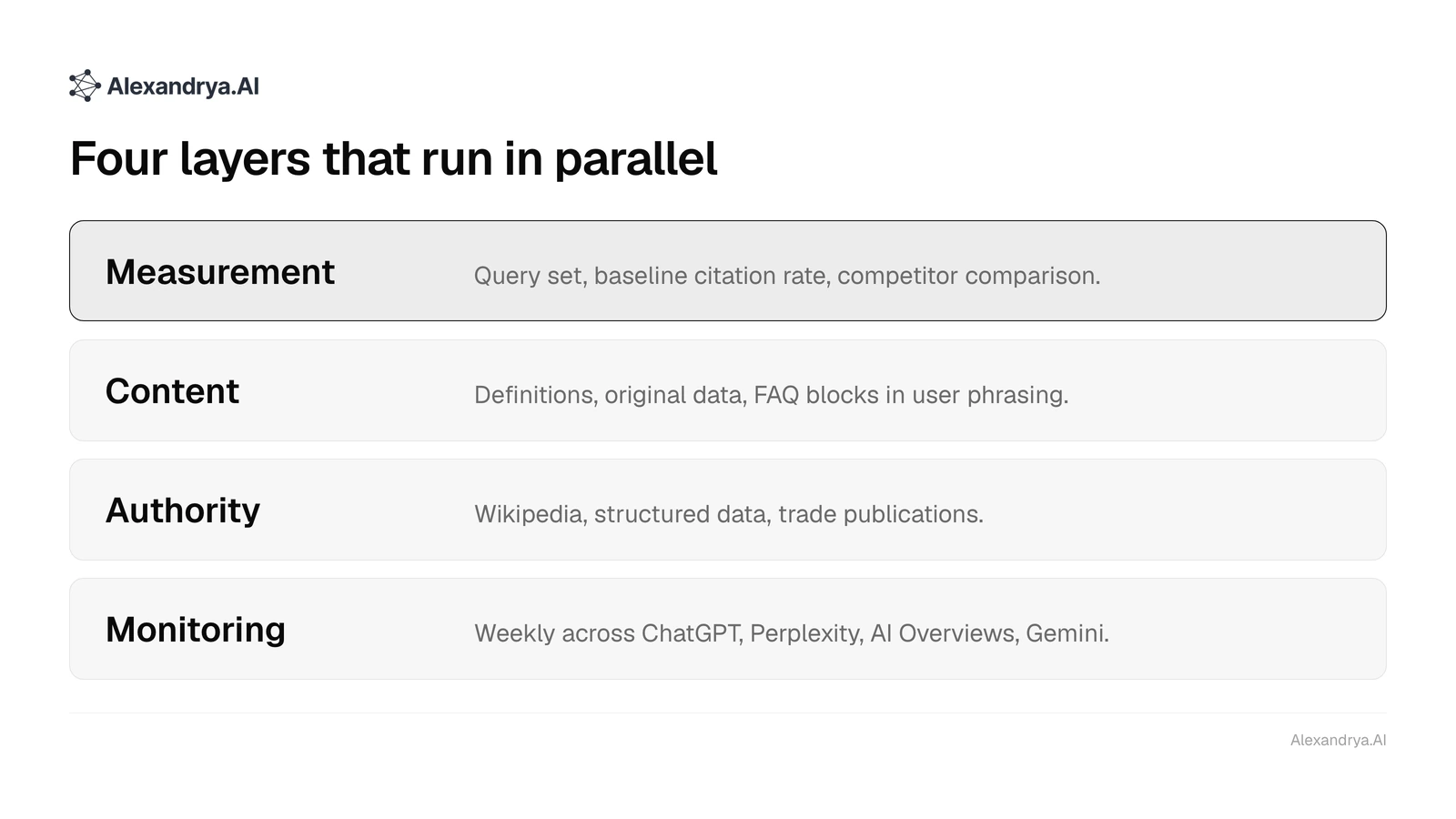
The measurement foundation answers three questions before any content work begins: Which queries does your target audience ask AI systems? What is your current citation rate across those queries? How do competitors compare? This requires running a structured query set (typically 100 to 200 queries across your core topic clusters) through all four major AI platforms and recording appearance, position, and sentiment for each result. Alexandrya.AI automates this process. → What Is AI Visibility
What Is the Content Layer of an AI Visibility Strategy?
The content layer produces and optimizes three content types that AI systems preferentially cite: definitional content (precise answers to "what is X" queries), data-driven content (pages with original statistics and research findings), and FAQ infrastructure (question-and-answer blocks mirroring real AI user phrasing). Each content type targets a different citation mechanism across the four major platforms. → GEO Content Framework
What Is the Authority Layer?
The authority layer establishes external signals that AI systems use as quality and credibility proxies. The three most impactful: Wikipedia presence (4.1× citation rate lift), Schema.org structured data markup (2.7× citation rate lift), and external links from authoritative domain-specific publications (15+ external domains = 3.2× higher citation rate).
What Does the Monitoring Layer Require?
The monitoring layer requires weekly tracking of all four core GEO KPIs (Citation Rate, Share of AI Voice, Sentiment Score, and Model Coverage) across ChatGPT, Perplexity, Google AI Overviews, and Gemini. AI responses shift within days; monthly monitoring misses critical changes. → GEO Metrics and KPIs Explained
The 4-Layer AI Visibility Strategy Framework
Brands implementing all four layers of an AI visibility strategy achieve on average 3.1× higher Citation Rates within 6 months compared to single-layer approaches (Alexandrya.AI Benchmarks 2026).
How Do You Start: The 30-Day AI Visibility Baseline Sprint?
The 30-Day Baseline Sprint establishes the data foundation for every subsequent strategy decision. The goal is not optimization in this phase but accurate measurement: what is the current state across all four platforms, all major query clusters, and versus key competitors? This data then drives prioritization for months 2 to 6.
What Happens in Week 1: Setup?
Week 1 involves three setup tasks: defining the query set (100 to 200 queries across 4 to 6 topic clusters relevant to your target audience's AI research behavior), setting up tracking in Alexandrya.AI to run weekly automated cycles, and identifying 3 to 5 direct competitors to include in the monitoring set. The query set is the most critical input. Poorly defined queries produce misleading baselines. → GEO Audit Framework
What Happens in Weeks 2 to 3: Audit?
Weeks 2 and 3 are the audit phase: the first three weekly tracking cycles complete, generating a Citation Rate, Share of AI Voice, Sentiment Score, and Model Coverage baseline for your brand and each competitor. Simultaneously, the content audit begins: which existing pages have the structural prerequisites for AI citation (definition sentences, FAQ blocks, Schema.org markup)? Which topic clusters have zero citation coverage, the blind spots?
What Happens in Week 4: Prioritization?
Week 4 produces the prioritized action list. Not all content gaps are equal: prioritize query clusters with (a) high relevance to your target audience, (b) current zero citation coverage for your brand, and (c) competitor citation rates above 30%. These three criteria identify the highest-impact content opportunities. A typical output is 20 to 35 prioritized content optimization tasks, ranked by expected citation impact.
How Do You Build the Content Layer of an AI Visibility Strategy?
The content layer is built in three content type categories, each targeting different AI citation mechanisms. Definitional content creates citation lift for informational queries; data-driven content generates citations for research-type queries; FAQ infrastructure mirrors the conversational phrasing that AI users apply most often.
What Is Definitional Content, and Why Does It Matter?
Definitional content consists of pages that provide precise, authoritative definitions for the core concepts in your market category. AI systems prioritize definitional content because it directly satisfies "what is X" queries, the most common AI search pattern. Each definitional page needs: a clear, self-contained definition in the first paragraph, a brief explanation of why it matters, and a structured FAQ block below. Internal links should point to deeper content. → What Is GEO
How Does Data-Driven Content Generate More Citations?
Data-driven content (pages containing original research, proprietary statistics, or aggregated industry data) is cited by AI systems at a significantly higher rate because it provides information that cannot be easily found elsewhere. To generate citable statistics: run your own surveys or analysis (even small-scale), publish the methodology alongside the data, and present findings in a scannable format with specific numbers. Original statistics from Alexandrya.AI research are cited in AI responses at 2.4× the rate of opinion content.
What Is FAQ Infrastructure and How Do You Build It?
FAQ infrastructure means adding question-and-answer blocks to all major content pages, structured in FAQPage Schema.org markup. The questions should mirror the exact phrasing that your target audience uses in AI chat interfaces: full sentences, natural language, specific intent. The goal is matching the query pattern of AI users, not the keyword patterns of traditional search users. A minimum of 5 to 7 well-structured FAQ pairs per major content page is recommended.
How Do You Build Authority Signals for AI Search?
Authority signals are the external credibility markers that AI systems use to decide whether a brand's content is worth citing. Three signals have the strongest measured impact: Wikipedia presence, Schema.org structured data, and external citation density from authoritative domains.
Why Does Wikipedia Presence Create a 4.1× Citation Lift?
Wikipedia is a primary training data source for virtually every major AI model. Brands with a Wikipedia entry are cited 4.1× more often in AI responses than brands without one (Alexandrya.AI Q1 2026, 500 B2B brand queries). The lift occurs because Wikipedia pages are pre-indexed as authoritative references by AI training pipelines: they function as trust signals that persist across model updates.
How Does Structured Data Markup Drive a 2.7× Citation Lift?
Schema.org markup (particularly Organization, Article, FAQPage, and Product schemas) makes content semantically interpretable by AI retrieval systems. Brands with comprehensive structured data markup achieve a 2.7× higher citation rate (Alexandrya.AI Q1 2026). The mechanism: structured data reduces the ambiguity that AI systems must resolve when deciding whether and how to cite a source. → GEO Audit Framework
What Does External Citation Density Mean for AI Visibility?
External citation density refers to the number of distinct authoritative external domains that link to or mention a brand in a topic-relevant context. Brands cited by 15 or more authoritative external domains within their topic category achieve a 3.2× higher AI citation rate. The practical priority: trade publication features, industry directories, partner mentions, and press coverage. Each contributes to the external authority signal that AI systems interpret as a proxy for credibility.
What Does Ongoing AI Visibility Monitoring Look Like?
Ongoing monitoring is what separates one-time GEO projects from durable competitive advantage. AI systems update their responses continuously. A Citation Rate gain achieved in month 3 can erode by month 6 without monitoring and iteration.
What Does Weekly Monitoring Cover?
Weekly monitoring covers all four core GEO KPIs across all tracked platforms, delivered automatically by Alexandrya.AI. Alert thresholds flag significant drops (> 5 percentage points in Citation Rate) or competitive changes (Share of AI Voice shift > 3 points). Weekly monitoring is the operational pulse of the AI visibility strategy. → All Alexandrya.AI Features
What Does a Monthly Report Include?
Monthly reports aggregate weekly data into trend lines, compare progress against the baseline established in the 30-Day Sprint, and highlight which content changes correlated with Citation Rate movements. Monthly reports are the primary artifact for stakeholder communication, showing directional progress without the noise of week-over-week fluctuations.
What Does a Quarterly Audit Cover?
Quarterly audits refresh the query set (new AI user behavior patterns emerge every quarter), incorporate new competitors, and recalibrate the content prioritization list. Quarterly audits also review Model Coverage: has the brand maintained or improved presence across all four major platforms, or has concentration risk increased on one platform?
How Do You Report AI Visibility Progress to Stakeholders?
Report AI visibility progress using three metrics that stakeholders can connect to business outcomes: Share of AI Voice (competitive market share in AI responses, analogous to Share of Voice in traditional media), Citation Rate Trend (directional improvement line over 6 months), and Sentiment Score (quality of brand representation). Avoid presenting raw query-level data to non-specialist stakeholders. Aggregate to cluster-level and always show competitor context.
The most effective framing for executive reporting: "Our brand is now cited in X% of relevant AI research queries in our category, up from Y% six months ago. We rank second behind [competitor] in overall Share of AI Voice and lead in [specific query cluster] relevant to [target segment]." This gives context, shows progress, and identifies competitive opportunity simultaneously.
For a free trial to begin measuring these metrics immediately → Alexandrya.AI Features
Launch your AI visibility strategy with Alexandrya.AI: 7-day free trial →
Frequently asked questions
How is an AI visibility strategy different from SEO?
SEO optimizes for algorithmic ranking in search result lists. AI visibility strategy optimizes for selection and citation by generative AI systems. The mechanisms are different: AI systems prioritize answer structure, external authority signals, and semantic clarity over backlink count and keyword density. Both disciplines share some foundations (quality content, external authority) but diverge significantly in tactical implementation.
How much budget does an AI visibility strategy require?
A minimum viable AI visibility strategy requires investment in three areas: tracking tools (Alexandrya.AI starts with a 7-day free trial), content production (restructuring existing pages is more cost-efficient than creating new content), and authority building (outreach to trade publications). Restructuring 20 to 30 existing pages typically costs significantly less than creating new content from scratch.
Can a small B2B brand compete with large established players in AI visibility?
Yes, and this is one of GEO's most important dynamics. AI systems are not biased toward brand size in the same way that traditional search algorithms favor established domains. A smaller brand with superior content structure, FAQ coverage, and external citations can outperform a larger competitor with weak GEO signals. The ThyssenKrupp Schulte case shows the reverse: a market leader invisible in AI because content structure was wrong.
How quickly can AI visibility improve?
First measurable improvements typically appear within 4 to 8 weeks. Substantial Citation Rate gains (above 50% improvement from baseline) generally require 3 to 6 months of consistent strategy execution across all four layers. Platform-specific improvements on Perplexity (which uses real-time retrieval) can appear faster than on ChatGPT (which relies more on training data).
Do I need to optimize for all four AI platforms simultaneously?
Yes, this is what the Model Coverage KPI measures. Over-indexing on one platform creates concentration risk: a platform update can eliminate all AI visibility overnight. Start with the platform most used by your specific target audience (ChatGPT for English-language B2B globally, Perplexity for research-heavy users), but build toward 4/4 platform presence as a strategic goal.
How visible is your brand in AI?
Try Alexandrya.AI free for 7 days and see how ChatGPT, Gemini, Perplexity, AI Overviews and Copilot talk about your brand.
- 7 days free
- No credit card required
- All features included
- Cancel anytime
About the author
Talaal Max Habib
Managing Director at Alexandrya.AI
Talaal Max Habib has advised companies in industry, the Mittelstand and e-commerce on SEO and Generative Engine Optimization since 2015. With his team he built Alexandrya.AI, the Munich-based platform that measures how brands appear in ChatGPT, Perplexity and Gemini.
LinkedIn