The best AI visibility tracking tools for e-commerce brands, compared
AI visibility tracking tools for e-commerce with ChatGPT Shopping product tracking start at €85 a month, nine tools compared on price, as of October 2026.

Managing Director at Alexandrya.AI
Which of the AI visibility tracking tools for e-commerce fits depends on whether you want to follow individual products in shopping answers or your brand in buying prompts. As of 27 October 2026, Peec AI documents product tracking from €85 a month, Rankscale from €99, Promptwatch from €499 and Profound on its Enterprise plan. For category prompts, cited sources and follow-up tasks, Alexandrya.AI, Otterly.AI or an SEO suite add-on will do.
Our sources are the nine vendors' pricing, product and help pages and Alexandrya.AI's own tracking, all from 27 October 2026, with euro prices as shown to visitors from Germany. We ran no hands-on tests. We have only used Peec AI ourselves, for about six months in client projects at our agency NX Digital, and Alexandrya.AI is our own product.
What AI visibility tools measure for e-commerce brands at prompt and product level
AI search visibility tracking for e-commerce brands measures how often a product or a store is named, and linked as a source, when ChatGPT, Perplexity, Gemini or Google AI Mode answer a buying question. A tracking tool sends the same buying prompts every day, such as “best running shoes for beginners under £120”. The full definition, with metrics and prompt types, is in our guide to AI visibility tracking for e-commerce. For choosing a tool, what matters most is the level a vendor measures at.
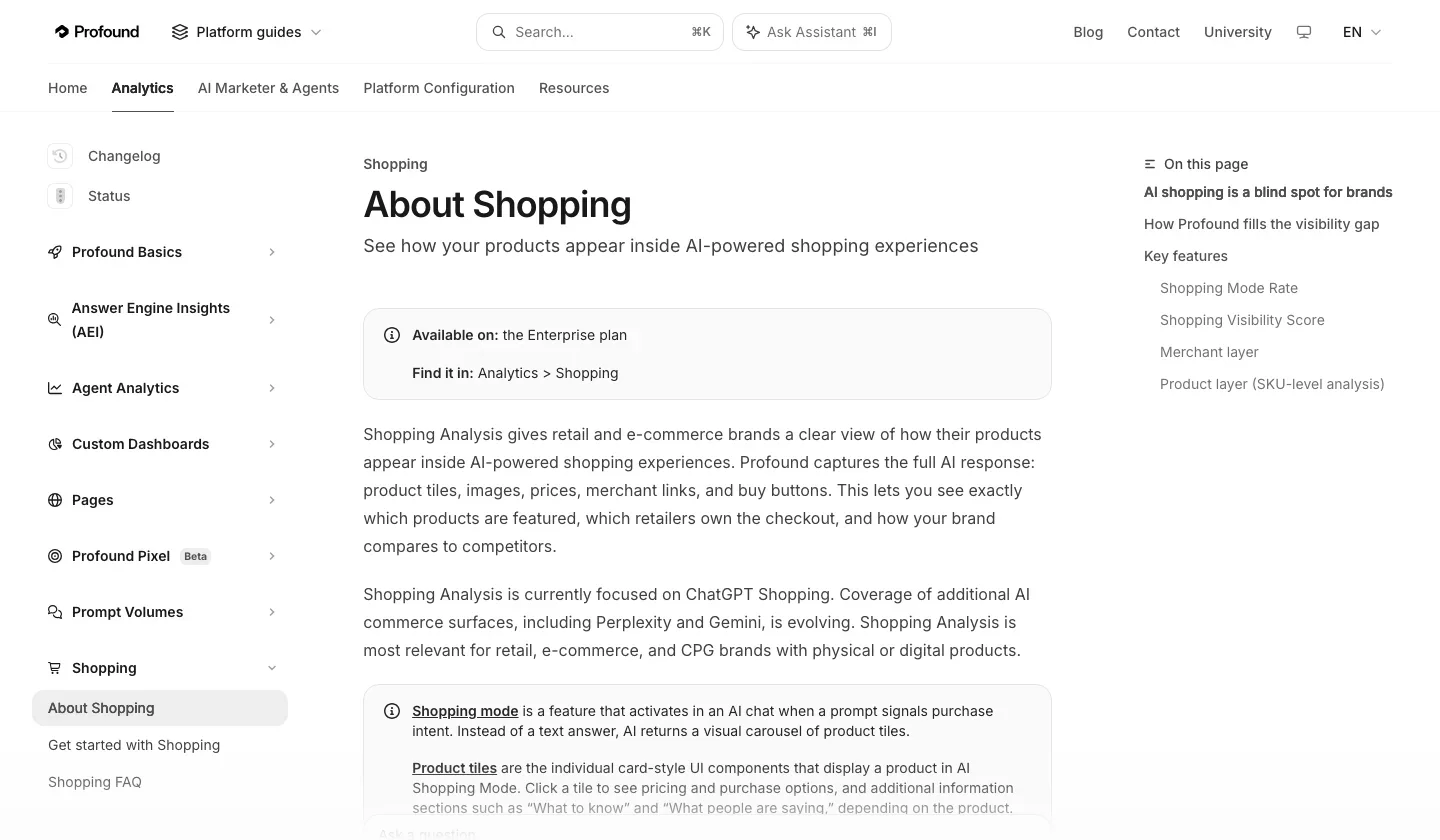
Prompt-level tracking shows whether your brand appears in the answer text, next to which competitors and with which cited domains. Product-level tracking reads the product cards an assistant shows when a prompt signals buying intent, with price, merchant and carousel position, and matches them to your catalogue. Profound's documentation describes this shopping mode as a carousel of product tiles shown in place of a text answer (Profound, About Shopping, accessed 27 October 2026).
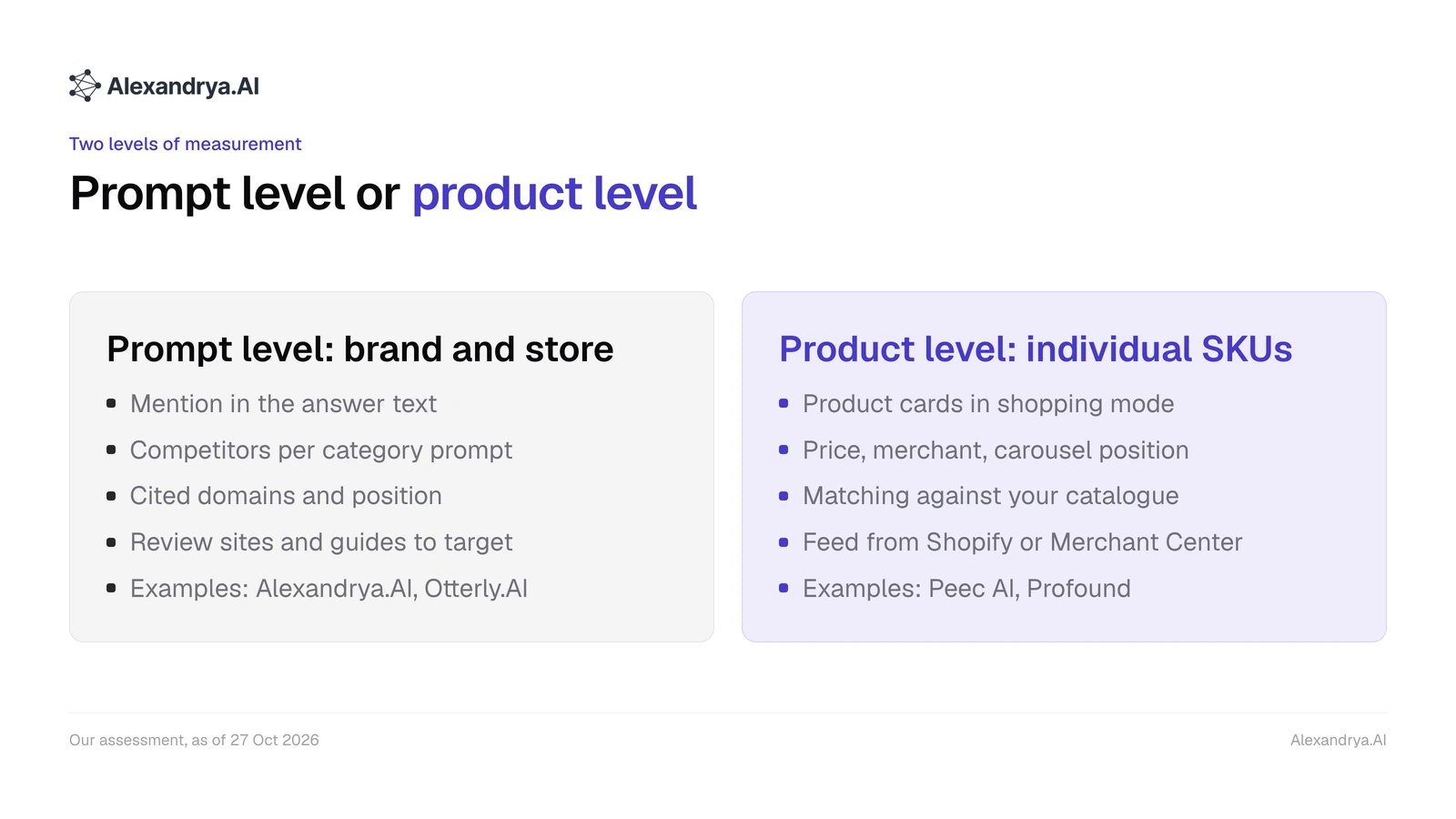
Prompt level and product level measure different things. Our assessment, as of 27 October 2026.
How does AI visibility affect which products get recommended?
E-commerce brands lose visibility when AI assistants name only competitors in answers to buying questions. An AI answer recommends a short list and has no second page. Daily tracking shows which prompts this happens on and which sources the AI cites instead. Those sources are where the work starts: a brand missing from the comparisons, reviews and lists an assistant cites is usually missing from its recommendation too.
An example from our own category shows a mechanism that applies to stores too. Alexandrya.AI tracks the buying prompt “Best AI visibility tracking tool for e-commerce” in its own project. On 27 October 2026, ChatGPT recommended Promptwatch, Peec AI, Profound, Otterly.AI and Triple Whale, in that order. Its first source was Promptwatch's own e-commerce tool list, its second a guide by Triple Whale, and both vendors made the list. Google AI Mode named Ranketta, Alhena AI, Profound, Writesonic and Semrush for the same prompt that day. Only Profound appeared in both, Alexandrya.AI in neither (Alexandrya.AI's own measurement, as of 27 October 2026, 43 tracked prompts).
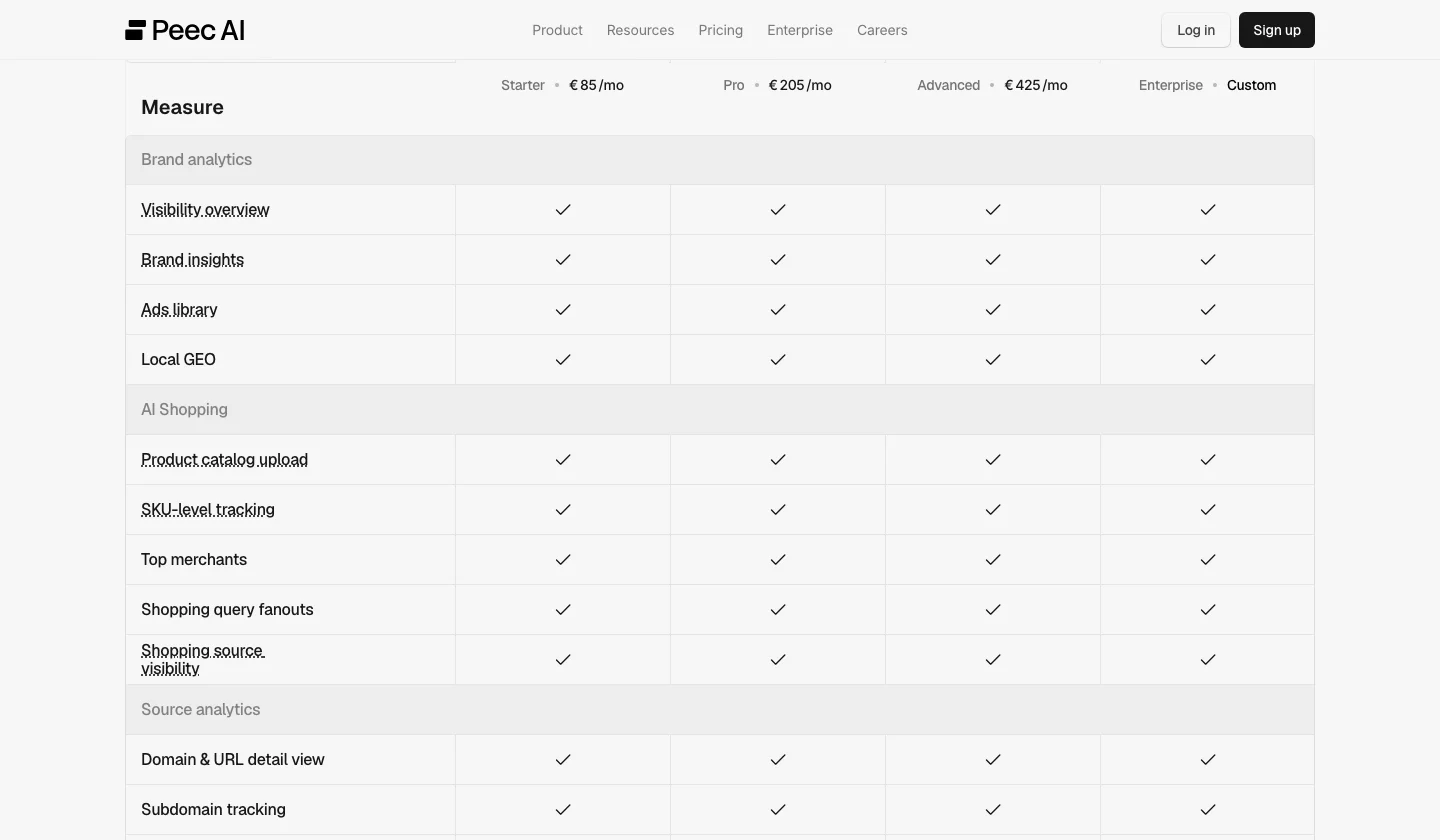
The ChatGPT answer also carried a pricing claim that was wrong at the time: that Peec AI lists SKU tracking and catalogue upload under Enterprise on its pricing page. On the same day, Peec AI's pricing page ticked both features on all four plans, starting with Starter at €85.
For a store, this means assistants repeat product and price details from lists and guides, outdated ones included, and each platform leans on different sources, so watching ChatGPT alone is not enough. Why online retailers are hit harder than B2B companies is covered in our piece on why e-commerce brands are especially exposed to losing AI visibility.
What to check before you buy an AI visibility tool for e-commerce
Before you buy an AI visibility tool for e-commerce, check whether the vendor documents product tracking in shopping answers and on which plan. Next come the platforms in the entry plan, the prompt allowance, the number of countries and whether the tool shows cited sources and next steps. A store with 2,000 SKUs needs a different tool from a brand that wants to appear in 20 category recommendations.
The general checklist, from daily measurement to task management, is in our guide to AI visibility tracking for e-commerce. Between the nine tools in this comparison, three points decide, because they differ most from vendor to vendor:
- Product tracking: shopping or SKU analysis, for which surfaces, from which plan.
- Platforms in the entry plan: ChatGPT plus at least one Google model, since the two named almost entirely different tools in the example.
- Prompts and price: 15 prompts cover one category, not a whole range.
AI visibility tracking tools for e-commerce compared
Of the nine AI visibility tracking tools for e-commerce checked on 27 October 2026, four document product-level analysis of shopping answers: Peec AI on every plan from €85 a month, Rankscale from its Pro plan at €99, Promptwatch from its Business plan at €499 and Profound on Enterprise only. Alexandrya.AI, Otterly.AI, SE Visible, the Semrush AI Visibility Toolkit and Nightwatch track at prompt and brand level.
| Tool | Entry price per month | Prompts on entry plan | Platforms on entry plan | Product tracking per vendor | Trial |
|---|---|---|---|---|---|
| Peec AI | €85 | 50 | 3 of your choice, more at €25 each | SKU tracking with catalogue upload, all plans | free trial |
| Profound | custom | custom | up to 9 | ChatGPT Shopping with SKU analysis, Enterprise only | 7 days, 50 prompts |
| Rankscale | €17 (annual only) | credit-based | 17+ of your choice | ChatGPT, Google AI Mode and Copilot Shopping, from Pro at €99 | free Pro trial |
| Promptwatch | €85 | 50 | all models | ChatGPT and Amazon Alexa, from Business at €499 | 7 days |
| Alexandrya.AI | €79 | 50 | 3 of 9, your choice | none, prompt-level tracking | 7 days, no card |
| Otterly.AI | €29 | 15 | 4 | not documented | free trial |
| SE Visible | €80 | 75 | 5 | not documented | 10 days |
| Semrush AI Visibility Toolkit | $99 | 25 | ChatGPT and Google AI Mode named | not documented | none |
| Nightwatch | €79, billed annually | 50 | 6 | not documented | 14 days |
The spread in what product tracking costs stands out: Peec AI includes it on Starter, Rankscale adds it on its second plan, Promptwatch requires the €499 plan and Profound an Enterprise contract.
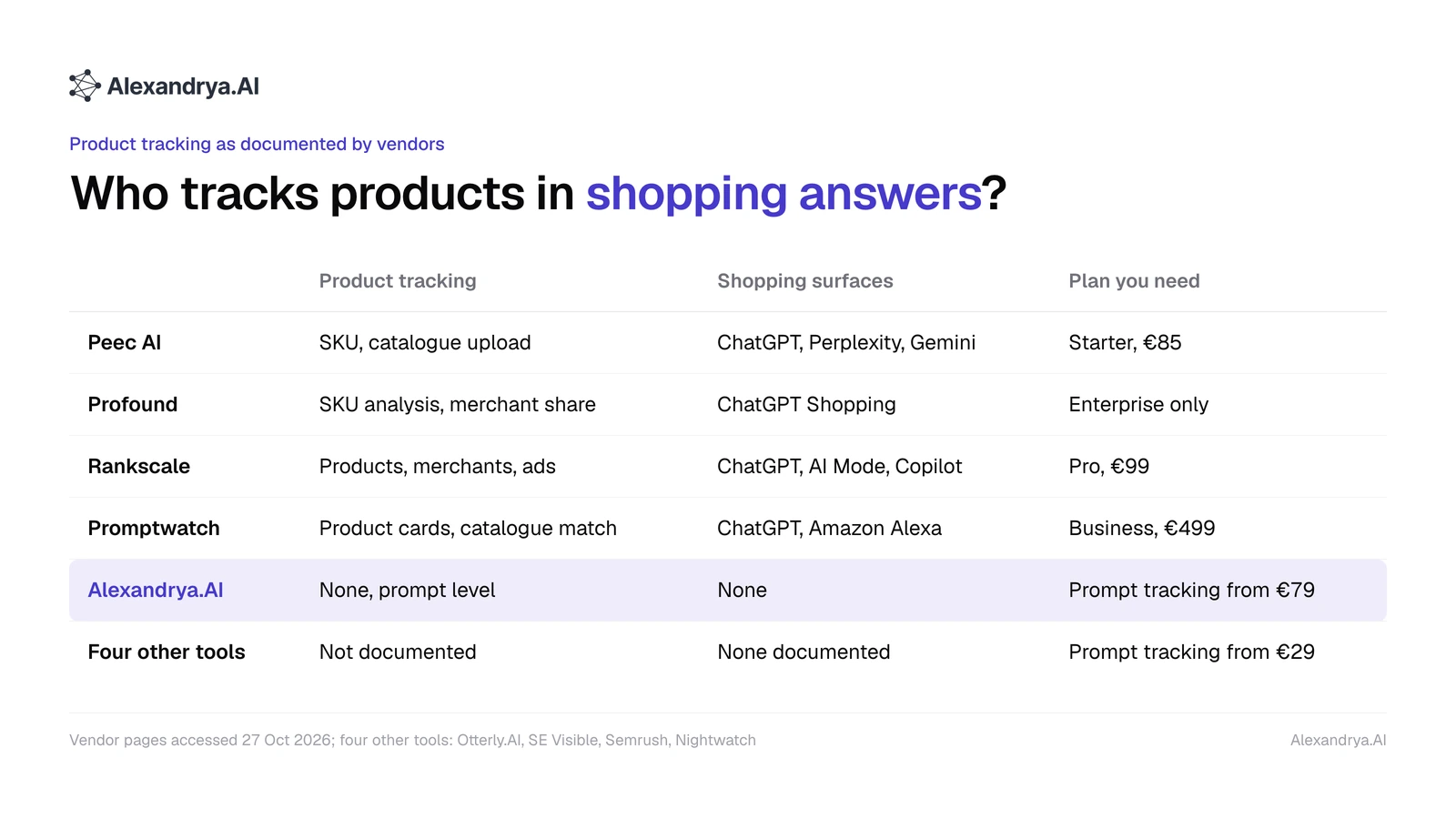
Product tracking as documented on vendor pages. Our assessment, as of 27 October 2026.
Which tools handle daily multi-platform tracking of products and stores?
All nine tools can run daily. They differ in product tracking, platforms per prompt and what happens after the measurement.
Peec AI, with SKU tracking from the Starter plan
Peec AI documents the cheapest product tracking of the nine tools. Since 17 June 2026 it has offered AI Shopping Analytics, with catalogue upload from Shopify, as a CSV or from Google Merchant Center, plus visibility, position and win rate per product. The pricing page lists it on every plan, and Starter costs €85 for 50 prompts and three models of your choice (Peec AI pricing, accessed 27 October 2026).
The launch post also compares the price a model quotes with your catalogue price and is framed around ChatGPT, while the product page names ChatGPT, Perplexity and Gemini. Each extra model costs €25 a month on Starter. In our client projects from autumn 2025 to spring 2026 we missed prioritisation by impact, which Peec has since added as “Recommended actions”. A fit for brands with their own catalogue that want to know which products ChatGPT recommends.
Profound, with ChatGPT Shopping analysis on Enterprise
Profound documents the most detailed shopping analysis on the list. It records product tiles, prices, merchant links and buy buttons, measures the Shopping Mode Rate (how often category prompts trigger shopping mode) and shows which retailers own the checkout. Its documentation limits Shopping to the Enterprise plan, focused on ChatGPT Shopping, with Perplexity and Gemini in progress.
The free seven-day trial runs 50 preset prompts on ChatGPT, Gemini and Google AI Overviews, without ChatGPT Shopping according to the pricing page. Enterprise prices are not published. A fit for manufacturers and retailers with many categories and budget for an annual contract.
Rankscale, with shopping analysis across three surfaces
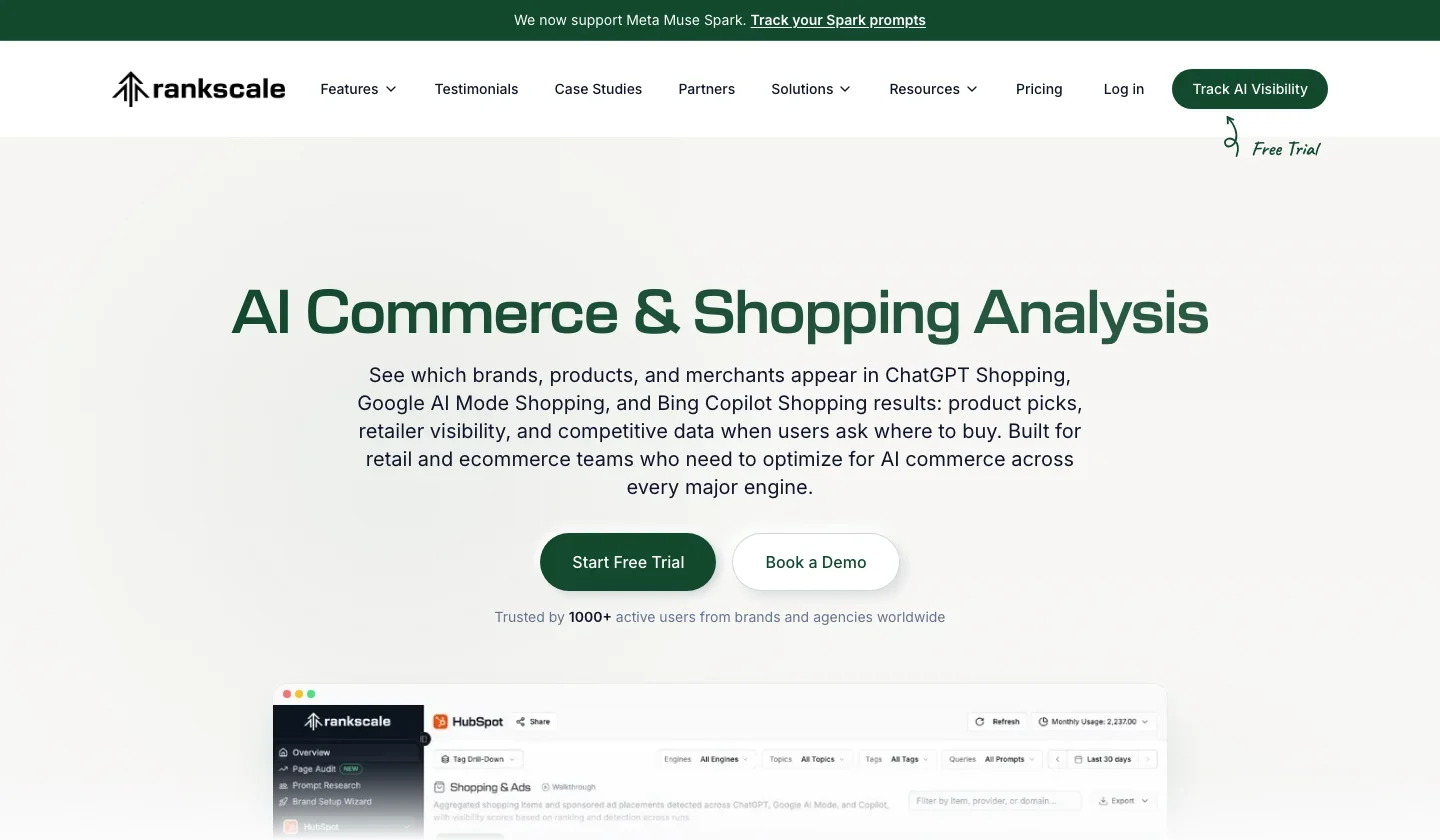
Rankscale is the only one of the nine tools that documents shopping analysis for Google AI Mode and Bing Copilot as well. Its shopping analysis shows which brands, products and merchants appear in ChatGPT Shopping, Google AI Mode Shopping and Bing Copilot Shopping, ads included (Rankscale, Shopping Analysis, accessed 27 October 2026). It comes with Pro at €99 a month and 1,200 credits, and is not part of Essentials at €17 billed annually.
You set the frequency per prompt, from hourly to monthly. An answer from ChatGPT, Perplexity, Gemini or AI Mode costs 0.25 credits, so 50 daily prompts on three of them use about 1,125 of the 1,200 credits. The feature page says it shows which recommendations match your catalogue, but describes no catalogue upload like Peec AI's. A fit for stores that want to watch Google and Copilot next to ChatGPT. More in our Rankscale review.
Promptwatch, with Shopping Insights from the Business plan
Promptwatch tracks 50 prompts on all models on its €85 Essential plan, but Shopping Insights only comes with the Business plan at €499 (Promptwatch pricing, accessed 27 October 2026). According to its own blog post from October 2026, the feature reads product cards from ChatGPT and Amazon Alexa, with price, merchant, rating and carousel position, and matches them to your catalogue by product ID. Shopping results in Google AI Overviews and AI Mode are not yet analysed. A fit for brands that want to watch Amazon Alexa as a sales channel.
Alexandrya.AI for category prompts, sources and tasks
Alexandrya.AI is an AI visibility tool from Munich that measures brand mentions in ChatGPT, Gemini, Perplexity and Bing Copilot and turns them into content and citation tasks. Stores use it to track buying prompts per category, optionally also in Google AI Mode, AI Overviews, Claude, Meta AI or Grok, and see which domains get cited and where their own site sits in the source list.
The action plan turns this into content briefs, a pitch list of outreach targets and quick wins, worked through as tasks with a status. Starter costs €79 for 50 prompts, three models and one country, and Professional €199 for 150 prompts, five models and three countries (Alexandrya.AI pricing). The limits: no ChatGPT Shopping tracking, no SKU tracking, no crawler logs, no prompt search volume, and API access only on Enterprise. A fit for stores that want to get into category recommendations through review sites and buying guides.
Otterly.AI as the entry point from €29
Otterly.AI is the cheapest way in on this list, at €29 a month for 15 prompts on ChatGPT, Google AI Overviews, Perplexity and Microsoft Copilot (Otterly.AI pricing, accessed 27 October 2026). Gemini and Google AI Mode cost €9 a month each on top of the Lite plan. Otterly.AI does not document product tracking on its home or pricing page. A fit for small stores with one main category. How cheap plans compare per answer is worked out in our look at AI visibility tools under €100.
SE Visible, Semrush and Nightwatch for teams already in an SEO suite
Three vendors come from search engine optimisation and do not document product tracking. SE Visible by SE Ranking tracks 75 prompts a day on its Basic plan at €80 a month, across ChatGPT, Google AI Overviews, Google AI Mode, Gemini and Copilot, with no Perplexity (SE Visible pricing, accessed 27 October 2026). SE Ranking's SEO plans from €87 include SE Visible.
Semrush charges $99 for the AI Visibility Toolkit with 25 prompts in one project, names ChatGPT and Google AI Mode and offers no trial (Semrush, AI Visibility Toolkit). Nightwatch bundles 50 AI prompts with 500 keywords for €79 a month billed annually, but collects only 1,500 AI answers a month, one per prompt per day (Nightwatch pricing). A fit for SEO teams that want AI visibility inside the tool they already use.
What an AI benchmarking tool for e-commerce should show every day
An AI benchmarking tool for e-commerce compares how visible your brand or products are in AI answers against your competitors, per category prompt and per platform. The term is loose. For the German version of the query “AI benchmarking tool for e-commerce”, ChatGPT named five tools on 27 October 2026, and only one of them, Semly, measures visibility in AI answers. The other four assess AI readiness, store technology or conversion benchmarks.
Alexandrya.AI was missing from all five answers that day, across ChatGPT, Perplexity, Gemini, Google AI Mode and Copilot. For daily benchmarking against competitors, three metrics per category and platform are enough: mention rate, citation rate and source position. Formulas and reference values are in GEO metrics explained.
Alexandrya.AI's own measurement shows how far apart these values can be (as of 27 October 2026, 43 tracked prompts): the brand is named in the answer text for 10 of 43 prompts, cited as a source for 11 and listed first among the sources for 4. Being cited and being recommended are separate events. Peec AI documents per-product benchmarking with a win rate and Profound with its Shopping Visibility Score, while all nine tools compare competitors at brand level.
The best AI visibility tracking tool for e-commerce depends on your store
The deciding factor is the question your team has to answer every morning.
- You run a catalogue in Shopify or Merchant Center and want to know which products ChatGPT recommends at what price: Peec AI.
- You have many categories and an enterprise budget and want to see which retailers win the checkout: Profound.
- You also want shopping results from Google AI Mode and Copilot: Rankscale from Pro.
- You want to see product recommendations in Amazon Alexa: Promptwatch Business.
- You want to reach category recommendations through review sites and guides and turn that into team tasks, in up to three countries: Alexandrya.AI.
- You have one main category and a small budget: Otterly.AI Lite.
- Your team already works in SE Ranking, Semrush or Nightwatch: the AI module there, until you need product tracking.
None of the four vendors with product tracking says how stable product cards are from day to day. During a trial, add the same 20 buying prompts to two tools and check after a week whether both see the same products and retailers.
Frequently asked questions
Is AI visibility tracking worth it for a small online store?
AI visibility tracking is worth it for a small online store once one category drives a large share of revenue and shoppers compare options before buying. As of October 2026, entry plans cost €29 for 15 prompts at Otterly.AI, €79 for 50 prompts at Alexandrya.AI and €85 for 50 prompts with SKU tracking at Peec AI. Start with five to ten prompts for your main category.
Which AI visibility tool tracks ChatGPT Shopping?
As of 27 October 2026, four vendors document product tracking in ChatGPT Shopping: Peec AI on every plan from €85, Rankscale from Pro at €99 with Google AI Mode and Copilot Shopping as well, Promptwatch from Business at €499 and Profound on Enterprise. Alexandrya.AI, Otterly.AI, SE Visible, Semrush and Nightwatch do not document shopping tracking.
Do I need SKU-level tracking or is prompt-level tracking enough?
You need SKU-level tracking if you sell many products and want to know which of them an assistant shows in shopping mode, at what price and from which retailer. Prompt-level tracking is enough if your question is whether your brand or store appears in category recommendations and which review sites and guides the model cites for them.
Can Alexandrya.AI track individual products?
No. Alexandrya.AI does not track individual products or ChatGPT Shopping. It tracks buying prompts per category on three to nine platforms, depending on the plan, shows mentions, citations, cited domains and your position in the source list, and turns them into tasks in the action plan. For product cards and catalogue matching, Peec AI, Rankscale, Promptwatch or Profound fit better.
Does any AI visibility tool track shopping in Google AI Mode?
Of the nine tools checked in October 2026, only Rankscale documents shopping analysis for Google AI Mode, next to ChatGPT and Copilot, from its Pro plan at €99. Promptwatch's blog says it does not yet analyse shopping results in AI Overviews or AI Mode, and Profound focuses on ChatGPT Shopping. Alexandrya.AI tracks mentions and citations in Google AI Mode, not product cards.
Free GEO audit for your category prompts
Add the buying prompts for your two most important categories to Alexandrya.AI and see, after a week, which competitors and sources ChatGPT, Gemini and Perplexity name instead of your store. Seven days free, no credit card needed. Start your category audit
Frequently asked questions
Is AI visibility tracking worth it for a small online store?
AI visibility tracking is worth it for a small online store once one category drives a large share of revenue and shoppers compare options before buying. As of October 2026, entry plans cost €29 for 15 prompts at Otterly.AI, €79 for 50 prompts at Alexandrya.AI and €85 for 50 prompts with SKU tracking at Peec AI. Start with five to ten prompts for your main category.
Which AI visibility tool tracks ChatGPT Shopping?
As of 27 October 2026, four vendors document product tracking in ChatGPT Shopping: Peec AI on every plan from €85, Rankscale from Pro at €99 with Google AI Mode and Copilot Shopping as well, Promptwatch from Business at €499 and Profound on Enterprise. Alexandrya.AI, Otterly.AI, SE Visible, Semrush and Nightwatch do not document shopping tracking.
Do I need SKU-level tracking or is prompt-level tracking enough?
You need SKU-level tracking if you sell many products and want to know which of them an assistant shows in shopping mode, at what price and from which retailer. Prompt-level tracking is enough if your question is whether your brand or store appears in category recommendations and which review sites and guides the model cites for them.
Can Alexandrya.AI track individual products?
No. Alexandrya.AI does not track individual products or ChatGPT Shopping. It tracks buying prompts per category on three to nine platforms, depending on the plan, shows mentions, citations, cited domains and your position in the source list, and turns them into tasks in the action plan. For product cards and catalogue matching, Peec AI, Rankscale, Promptwatch or Profound fit better.
Does any AI visibility tool track shopping in Google AI Mode?
Of the nine tools checked in October 2026, only Rankscale documents shopping analysis for Google AI Mode, next to ChatGPT and Copilot, from its Pro plan at €99. Promptwatch's blog says it does not yet analyse shopping results in AI Overviews or AI Mode, and Profound focuses on ChatGPT Shopping. Alexandrya.AI tracks mentions and citations in Google AI Mode, not product cards.
How visible is your brand in AI?
Try Alexandrya.AI free for 7 days and see how ChatGPT, Gemini, Perplexity, AI Overviews and Copilot talk about your brand.
- 7 days free
- No credit card required
- All features included
- Cancel anytime
About the author
Talaal Max Habib
Managing Director at Alexandrya.AI
Talaal Max Habib has advised companies in industry, the Mittelstand and e-commerce on SEO and Generative Engine Optimization since 2015. With his team he built Alexandrya.AI, the Munich-based platform that measures how brands appear in ChatGPT, Perplexity and Gemini.
LinkedInKeep reading
All E-Commerce articles
October 22, 2026
AI search visibility tracking for e-commerce brands: what it measures and why it matters now
June 5, 2026
E-Commerce AI Visibility Benchmark 2026: Platform Rankings, Category Data & GEO Impact
June 3, 2026