AI search visibility tracking for e-commerce brands: what it measures and why it matters now
AI visibility tracking for e-commerce measures how often ChatGPT, Gemini and Perplexity mention and cite your shop: metrics, daily routine, tool choice.

Managing Director at Alexandrya.AI
AI search visibility tracking for e-commerce measures how often, and in what form, a shop or brand appears in answers from ChatGPT, Perplexity, Gemini and Google AI Mode. A brand can appear as a mention in the answer text or as a citation in the source list. A tracking tool sends the same shopper prompts per product category to the models every day and reports share of voice, citation rate and source position.
What is AI search visibility tracking for e-commerce brands?
AI search visibility tracking for e-commerce brands is the repeated check of whether a language model names a shop, brand or product when buyers ask about a category. Two events are recorded separately: the mention, meaning the brand name in the answer text, and the citation, meaning one of your URLs in the source list. The same prompts run daily on several models, so a single odd answer is not mistaken for a trend.
For online shops the split matters most. A mention sells the brand, and a citation can bring the click to your product page. A model may recommend your brand and still link to Amazon or a comparison site.
How shops with hundreds of categories organise prompt volume is covered in our piece on scaling AI tracking for e-commerce. The business cases that follow from the data, from marketplace routing to seasonal monitoring, are in six e-commerce use cases for AI visibility.
How does AI visibility differ from a classic SEO ranking?
A classic SEO ranking measures where a URL sits in a results list for a keyword. AI visibility measures whether a brand appears inside a generated answer, where it sits in that answer and which sources the model used. A page ranking third on Google can be missing from the AI answer on the same topic, because the model summarises a handful of brands drawn from reviews, forums and marketplaces.
| Attribute | Classic SEO ranking | AI visibility tracking |
|---|---|---|
| What is measured | position of a URL in the results list | brand name in the answer text and URL in the source list |
| Input | keyword, usually two to four words | prompt phrased like a real shopper question |
| Output per query | ten blue links plus shopping modules | one answer with a few brands and a source list |
| Stability | positions move over days or weeks | answers can differ between two runs of the same prompt |
| Main metric | ranking position, visibility index | share of voice, citation rate, source position |
The row that stands out is output per query. An AI answer has no position 11. If your brand is not among the names in the answer, it is not in that answer at all.
Which metrics should e-commerce teams check every day?
E-commerce teams tracking AI visibility should follow three metrics per product category: share of voice, citation rate and average position in the source list. Share of voice is your share of all brand mentions, citation rate is the share of answers that cite one of your URLs, and source position shows how high that URL sits. Measured daily and reviewed weekly per category, the three give a stable picture.
The full set of metrics, with benchmarks, is in our guide to GEO metrics and KPIs; for a shop, this subset is enough.
| Metric | Formula | Question it answers | Review rhythm |
|---|---|---|---|
| Mention rate | prompts with a brand mention divided by all prompts in the category | does the shop appear at all? | daily, for outliers |
| Share of voice | your mentions divided by all brand mentions in the category | how big is my share against competitors? | weekly |
| Citation rate | answers with your URL in the source list divided by all answers | does the model send buyers to my pages? | weekly |
| Source position | average rank of your URL among the cited sources | is my source near the top or buried? | weekly |
| Cited domains | how often third-party domains appear in the category's source lists | where do I need to be present for the model to find me? | monthly |
Source position is the metric most teams underrate. In Alexandrya.AI's own measurement (21 October 2026, 38 tracked prompts about AI visibility tools), Alexandrya.AI is mentioned in 7 of 38 prompts and cited in 7 of 38, yet it holds position 1 in the source list in only 3 of 38. In the same data set, seranking.com collects 2,416 citations at an average position of 4.32. Many citations low in the list and a few at the very top are two different situations, and each calls for different work.
A worked example for one category
A sports retailer tracks 8 prompts in its running shoes category on three models, which gives 24 answers a day. The shop is mentioned in 9 of them, and the 24 answers contain 60 brand mentions in total. The mention rate is 37.5% (9 of 24) and the share of voice is 15% (9 of 60). If 4 answers cite one of the shop's URLs, the citation rate is 16.7%. These figures are made up to show the arithmetic.
Five prompt types belong in the tracking for each product category
E-commerce tracking needs five prompt types per product category: category recommendation, comparison, problem or use case, purchase with a price or location detail, and your own brand. Five to ten prompts per category are enough for a first baseline. Write them the way real buyers ask, with details such as budget, audience or use, because models name different brands for short keywords than for full questions.
| Prompt type | Example for running shoes | What it shows |
|---|---|---|
| Category recommendation | “Which running shoes for beginners under £100 are worth buying?” | whether the shop makes the shortlist |
| Comparison | “Cushioned running shoes: which brand is better for long distances?” | which brands you are up against |
| Problem or use case | “Which running shoes help with knee pain after jogging?” | whether your guides count as a source |
| Purchase with price or location | “Where can I buy running shoes online with free returns?” | whether the shop or a marketplace gets recommended |
| Own brand | “Is [your shop] reliable and how fast does it deliver?” | what picture the model has of your brand |
Two rules have held up in our own work. Do not rephrase prompts every week, or the time series becomes useless. Add new prompts as a separate group instead of replacing old ones.
A shop with six main categories and eight prompts each needs 48 prompts, which fits a 50-prompt plan. Fifteen categories with ten prompts each come to 150. With even more categories, pick a sample of the highest-revenue ones.
How often is my brand currently mentioned in ChatGPT, Perplexity and Gemini?
How often a brand is currently mentioned in ChatGPT, Perplexity and Gemini can only be answered with a fixed prompt set that runs on every model each day and stores mention, citation and position separately. Spot checks in your own browser do not work, because answers vary between runs and between accounts. A per-model figure you can compare with competitors only emerges over several days.
Alexandrya.AI tracks 38 prompts daily in its own project, and the run on 21 October 2026 produced 152 answers from ChatGPT, Gemini, Google AI Mode and Microsoft Copilot for those 38 prompts. For the prompt “Best AI visibility tracking tool for e-commerce”, Gemini, Google AI Mode and Copilot gave no answer that day naming Alexandrya.AI. Gaps like that are the work list.
For online shops we recommend a three-level rhythm:
- Daily, ten minutes: which prompts no longer name the brand, and which new domain sits at the top of a source list?
- Weekly, one hour: share of voice and citation rate per category against the previous week, split by model. A category that falls on one model for two weeks running gets a task.
- Monthly, half a day: which review sites, forums and guides do the models cite for your categories, and where is your shop missing?
You measure daily and judge weekly. Yotpo's guide (updated 20 October 2026) also suggests comparing two or three reads across a few weeks (Yotpo, How to Track AI Visibility for Brands, accessed 22 October 2026).
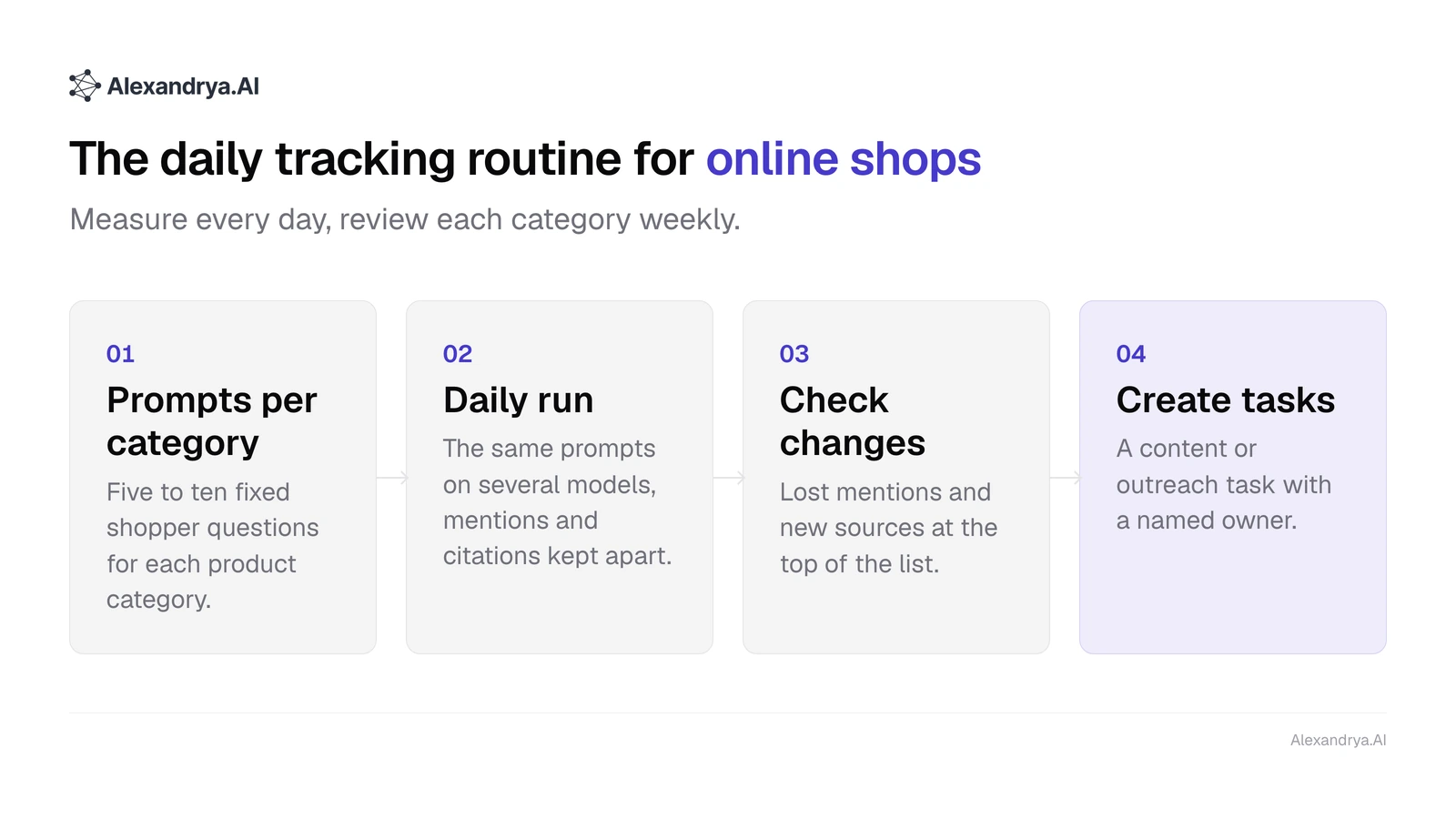
The tracking routine for online shops in four steps, from fixed prompts per category to a task with an owner.
Why is a classic search visibility tool not enough?
A classic search visibility tool turns keyword rankings into a visibility index for search results pages. For AI answers, that index lacks the thing being measured: it records neither whether a model names your brand in the text nor which sources it cites. A shop can climb in the index and still be absent from ChatGPT, because the model summarises reviews and marketplaces instead of mirroring rankings.
SEO suites now build their own modules for this. SE Ranking's AI Visibility Tracker page (as of October 2026) describes tracking linked and unlinked mentions, position among cited sources and source analysis for Google AI Overviews, Google AI Mode, ChatGPT and Gemini (SE Ranking, AI Visibility Tracker, accessed 22 October 2026). The page gives no tracking interval, and Perplexity and Copilot are not in its list of platforms. SE Ranking also states on its German AI visibility tools page that there is no industry-wide benchmark for an AI visibility score yet, and recommends comparing against direct competitors (SE Ranking, KI-Sichtbarkeit Tools, accessed 22 October 2026).
For a team already working in an SEO suite, a module like this is a reasonable start. Neither page offers e-commerce help such as prompt templates per category. As sources, though, the SEO suites are very strong: in our own measurement, seranking.com is the most cited domain for questions about AI visibility tools.
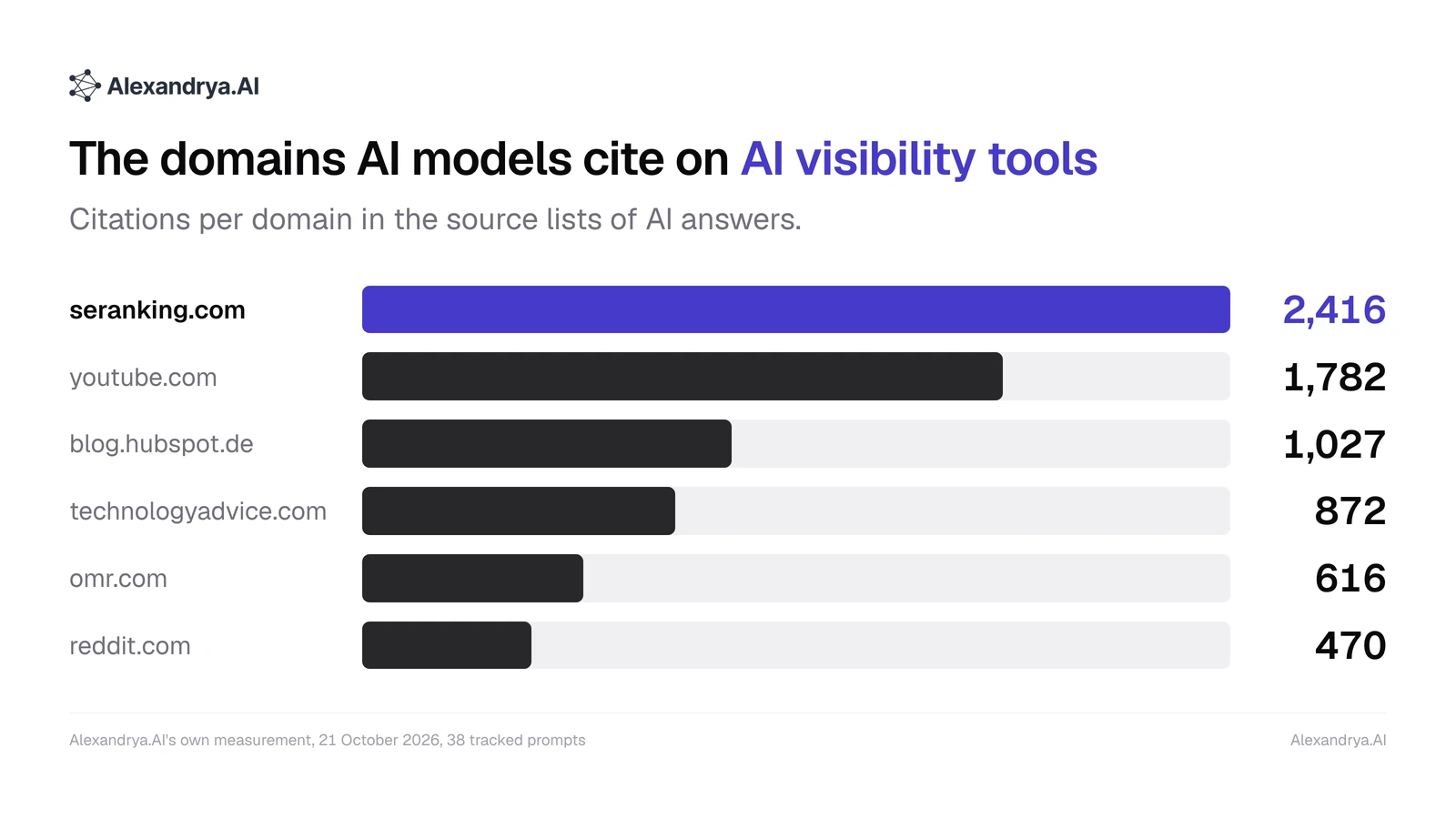
Most cited domains in AI answers about AI visibility tools. Alexandrya.AI's own measurement, 21 October 2026, 38 tracked prompts.
| Domain | Citations | Average position in the source list |
|---|---|---|
| seranking.com | 2,416 | 4.32 |
| youtube.com | 1,782 | not analysed |
| blog.hubspot.de | 1,027 | not analysed |
| technologyadvice.com | 872 | 2.21 |
| omr.com | 616 | not analysed |
| reddit.com | 470 | not analysed |
Look at the gap between volume and position. technologyadvice.com is cited less often than seranking.com but sits more than two places higher on average. The same analysis for your own category shows where your shop needs to appear.
What makes good AI visibility tracking tools for e-commerce?
A good AI visibility tracking tool for e-commerce meets seven criteria: daily measurement, at least three models including Google AI Mode or AI Overviews, separate tracking of mentions and citations, source position, prompts in several countries, analysis of cited domains, and recommendations that turn into tasks. For large catalogues, an eighth criterion applies: shopping tracking at SKU level.
| Buying criterion | What to look for | Why it matters for shops |
|---|---|---|
| Measurement rhythm | daily, with history | a drop in one category shows within a day |
| Models | ChatGPT, Gemini, Google AI Mode, Perplexity, Copilot selectable | shoppers use different assistants, and Google's modules sit close to shopping search |
| Mentions and citations kept apart | two separate metrics | a mention without your link brings no click to the shop |
| Source position | average rank per domain | separates many weak citations from a few strong ones |
| Countries | several markets in one project | shops shipping across the EU or UK see different answers per country |
| Source analysis | domains and source types per category | gives you the outreach list of review sites and guides |
| Recommendations and tasks | actions with status and owner | measurement has to end in finished work |
| Product and SKU tracking | visibility of single items in AI shopping results | matters for large catalogues, and not every tool offers it |
Before you buy, work out the price per answer. A €79 a month plan with 50 prompts on three models produces 4,500 answers in 30 days if every prompt runs daily, which is about 1.8 cents per answer. It makes differently bundled offers comparable.
Alexandrya.AI is an AI visibility tool from Munich that measures brand mentions in ChatGPT, Gemini, Perplexity and Bing Copilot and turns them into content and citation tasks. Plans start at €79 a month for 50 prompts and three selectable models. Professional costs €199 for 150 prompts, five models and three countries, and Business costs €399 for 350 prompts with multi-country tracking. Every plan tracks daily, includes unlimited users and comes with a 7-day trial without a credit card; details are on the Alexandrya.AI pricing page. How the platform is used specifically by shops is described in Alexandrya.AI as an e-commerce AI visibility specialist. Source analysis shows the citation mix by source type and the position in the source list, and the action plan turns it into content briefs, outreach targets and quick wins that are worked through as tasks with a status.
One limit belongs in the buying decision. Alexandrya.AI does not track product visibility at SKU level in AI shopping results. If your main question is which individual items a model shows in its shopping module, you need a tool with shopping tracking. For the question of whether, and through which sources, your shop appears in category recommendations, prompt-level tracking is enough.
What remains open is how far AI answers already shift buying behaviour in individual categories. We have no reliable figures on that for the UK or German markets. If you start measuring now, you will have that figure for your own category in a year.
Frequently asked questions
What is the best AI visibility tracking tool for e-commerce?
A good AI visibility tracking tool for e-commerce measures daily, separates mentions from citations, shows source position and covers the models your buyers use. For large catalogues focused on individual items, you also need SKU-level shopping tracking. Run two tools side by side on the same 20 prompts from your most important categories before deciding.
How much does AI visibility tracking for e-commerce cost?
As of October 2026, Alexandrya.AI costs €79 a month for 50 prompts, €199 for 150 prompts and €399 for 350 prompts, each with daily tracking and unlimited users. Annual billing saves 15%. Enterprise, with API access and all models, is priced individually. SE Ranking does not list prices on its AI visibility pages.
How much effort does it take to set up AI tracking for a shop?
AI tracking needs no code in your shop, because the tool queries the models from outside. The real work is the prompt list: five to ten prompts per main category, written like genuine shopper questions. Allow half a day for six categories. After one to two weeks of daily runs, you have a first reliable baseline.
Are 50 prompts enough for an online shop?
Fifty prompts are enough for six main categories. An online shop needs five to ten prompts per main category, spread across category recommendation, comparison, problem, purchase with price or location, and own brand. Six categories with eight prompts give 48 prompts. Shops with 15 categories end up at around 150 prompts and need a larger plan.
Is weekly measurement of AI visibility enough?
Weekly review is enough, but weekly measurement usually is not. AI answers can differ between two runs of the same prompt, so one reading per week shows chance more than trend. Daily runs give seven values per week and model, from which share of voice and citation rate per category can be read reliably.
Does Alexandrya.AI track Perplexity and Google AI Mode?
Yes. Alexandrya.AI tracks ChatGPT, Gemini, Google AI Mode, Google AI Overviews, Perplexity, Microsoft Copilot and Claude, plus Meta AI and Grok. The Starter plan lets you select three models at once, Professional and Business five, and Enterprise all of them. You choose which models are active.
Free GEO audit for your shop
Add your main product categories as prompts and see after a week which answers name your competitors but not you. Try it free for seven days, no credit card needed
Frequently asked questions
What is the best AI visibility tracking tool for e-commerce?
A good AI visibility tracking tool for e-commerce measures daily, separates mentions from citations, shows source position and covers the models your buyers use. For large catalogues focused on individual items, you also need SKU-level shopping tracking. Run two tools side by side on the same 20 prompts from your most important categories before deciding.
How much does AI visibility tracking for e-commerce cost?
As of October 2026, Alexandrya.AI costs €79 a month for 50 prompts, €199 for 150 prompts and €399 for 350 prompts, each with daily tracking and unlimited users. Annual billing saves 15%. Enterprise, with API access and all models, is priced individually. SE Ranking does not list prices on its AI visibility pages.
How much effort does it take to set up AI tracking for a shop?
AI tracking needs no code in your shop, because the tool queries the models from outside. The real work is the prompt list: five to ten prompts per main category, written like genuine shopper questions. Allow half a day for six categories. After one to two weeks of daily runs, you have a first reliable baseline.
Are 50 prompts enough for an online shop?
Fifty prompts are enough for six main categories. An online shop needs five to ten prompts per main category, spread across category recommendation, comparison, problem, purchase with price or location, and own brand. Six categories with eight prompts give 48 prompts. Shops with 15 categories end up at around 150 prompts and need a larger plan.
Is weekly measurement of AI visibility enough?
Weekly review is enough, but weekly measurement usually is not. AI answers can differ between two runs of the same prompt, so one reading per week shows chance more than trend. Daily runs give seven values per week and model, from which share of voice and citation rate per category can be read reliably.
Does Alexandrya.AI track Perplexity and Google AI Mode?
Yes. Alexandrya.AI tracks ChatGPT, Gemini, Google AI Mode, Google AI Overviews, Perplexity, Microsoft Copilot and Claude, plus Meta AI and Grok. The Starter plan lets you select three models at once, Professional and Business five, and Enterprise all of them. You choose which models are active.
How visible is your brand in AI?
Try Alexandrya.AI free for 7 days and see how ChatGPT, Gemini, Perplexity, AI Overviews and Copilot talk about your brand.
- 7 days free
- No credit card required
- All features included
- Cancel anytime
About the author
Talaal Max Habib
Managing Director at Alexandrya.AI
Talaal Max Habib has advised companies in industry, the Mittelstand and e-commerce on SEO and Generative Engine Optimization since 2015. With his team he built Alexandrya.AI, the Munich-based platform that measures how brands appear in ChatGPT, Perplexity and Gemini.
LinkedIn