How to find the prompts where AI answers name your competitors but not you
An AI search competitor analysis shows in six steps which prompts get your competitors named by AI assistants instead of you, and which sources they cite.

Managing Director at Alexandrya.AI
An AI search competitor analysis shows which prompts lead ChatGPT, Perplexity, Gemini, Google AI Mode and Microsoft Copilot to name your competitors but not your brand, and which sources they cite when they do. It takes six steps: set your competitor list, collect prompts by intent, record co-mentions, analyse the sources, prioritise each gap as content or outreach, and repeat the measurement.
For the German prompt “Wettbewerbsanalyse für AI-Suche kaufen” (buy AI search competitor analysis), four of five AI systems named Peec AI and Semrush on 27 October 2026, and none named Alexandrya.AI. Across all tracked prompts, Alexandrya.AI is named in the answer text for 10, cited as a source for 11 and listed first in the source list for 4 (Alexandrya.AI's own measurement, as of 27 October 2026, 43 tracked prompts). The examples below come from this project.
What an AI search competitor analysis delivers
An AI search competitor analysis compares how often AI assistants name your brand and your competitors in answers to the same prompts, and which sources they draw on. Each answer is one data point: one prompt, one platform, one day. The output is a gap list of prompts where at least one competitor appears and your brand does not, with platform, brands named and domains cited.
AI benchmarking of this kind is the basis for any AI content gap analysis, because it shows which buying-advice prompts name competitors and leave your brand out. A traditional SEO competitor analysis compares rankings, keywords and backlinks of pages. You need both: one shows where your pages rank, the other where your brand appears in answers.
Every row in the gap list becomes a task. The full audit process with crawler access and technical checks is set out in the GEO audit framework. How to turn the same answers into a metric is covered in calculating AI share of voice, and if your brand is missing across all prompts, start with finding out why your brand is not mentioned in AI answers.
How to find prompts where competitors are mentioned but your brand is not
To find prompts where competitors are mentioned but your brand is not, run a fixed set of unbranded prompts on several AI platforms and check every answer for all the brands you track. Any answer that names at least one competitor and leaves out your brand is a gap. Thirty prompts on five platforms give you 150 answers per run, which six steps turn into a gap list.
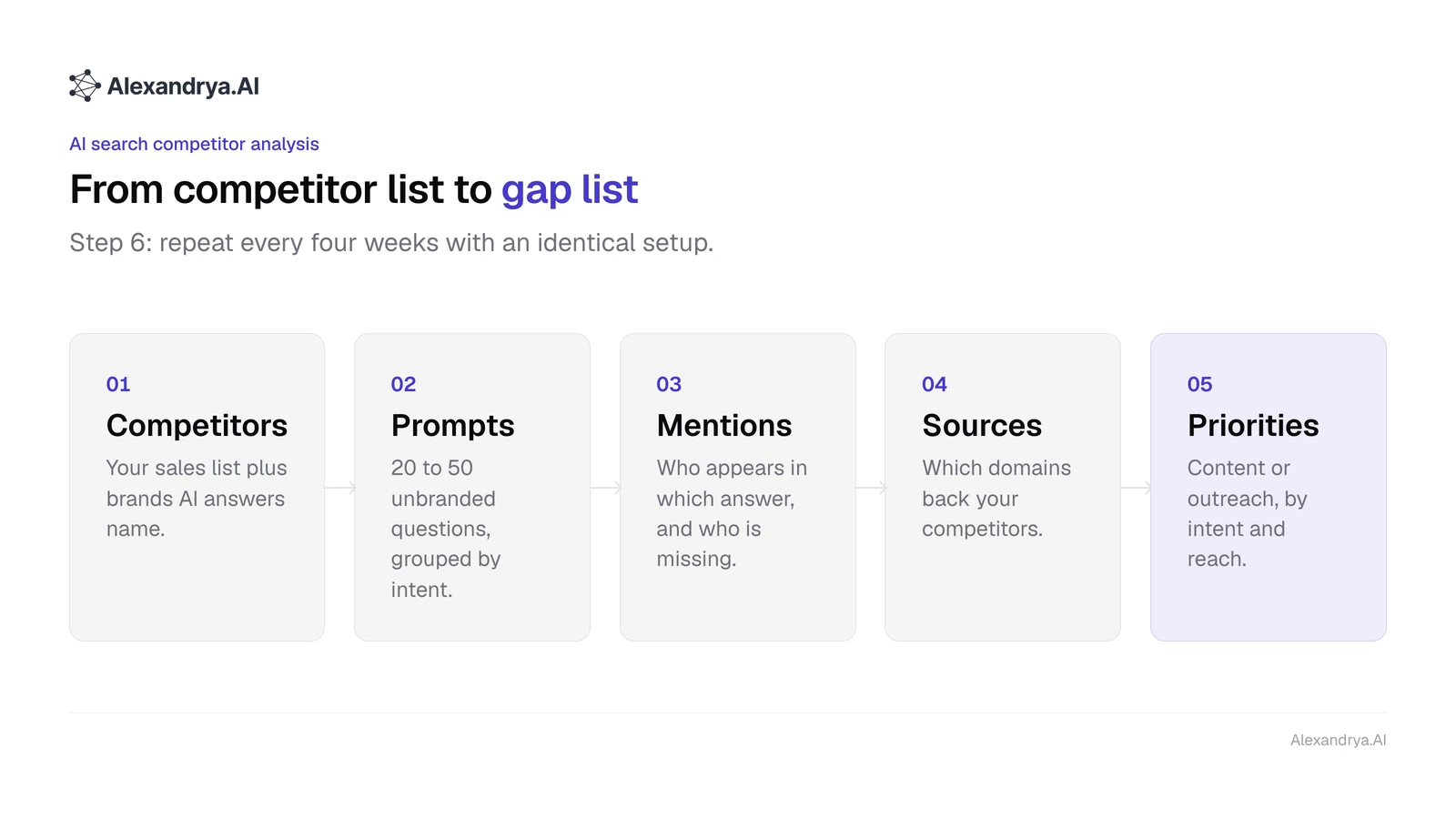
1. Set your competitor list, including the brands AI answers name on their own
The competitor list for an AI search competitor analysis is built in two passes. First, add the three to five vendors your sales team meets in deals. Then add the brands AI answers name for your prompts on their own. For “Best AI visibility tracking tool for e-commerce”, five AI systems named 14 products on 27 October 2026, and only 4 were on the list of eight competitors Alexandrya.AI tracks.
A German prompt for an AI benchmarking tool for e-commerce produced 20 products the same day, with only Profound on our list; the rest included Cognizo, Maya and the analytics tool Triple Whale. A German prompt about buying a competitor analysis for AI search brought 16 vendors, five tracked, plus competitive intelligence software such as Crayon and Klue.
Sort every new brand into one of three groups. Direct competitors solving the same problem for the same audience go onto your tracking list. Adjacent categories such as Crayon get noted, not counted. Misreadings, like the textbook on competitor analysis that Microsoft Copilot recommended, mean the prompt needs sharpening.
2. Build a prompt set by intent
A prompt set for AI competitor analysis has 20 to 50 questions without brand names, spread across buying, comparison, problem and research intent. At least half should carry buying or comparison intent, because that is where shortlists form. Every prompt runs on every platform: 30 prompts on five systems produce 150 answers per run.
Good sources for prompts are questions from your sales team, Google Search Console queries and the sub-queries AI systems run while researching an answer. In Alexandrya.AI's own measurement, the sub-query “ai visibility tracking tools for e-commerce” appeared 89 times up to 27 October 2026, so it belongs in the set as a prompt of its own. Prompts that contain a competitor's name get a separate analysis.
3. Record co-mentions and who appears next to whom
A gap in AI search is an answer that names at least one tracked competitor and not your brand. For every answer, log which brands appear in which order, whether yours is among them and which domains sit in the source list. Those rows give you two outputs: the gap list per prompt and the list of brands that get named together.
| Column in the log | Example from 27 October 2026 |
|---|---|
| Prompt | Wettbewerbsanalyse für AI-Suche kaufen (buy a competitor analysis for AI search) |
| Platform and date | ChatGPT, 27 October 2026 |
| Brands named, in order | Peec AI, Otterly.AI, Semrush AI Visibility Toolkit, Profound |
| Own brand named | no |
| Cited domains with position | honeyb.ai (1), aiseocompare.com (2), oppin.ai (3) |
| Gap | yes, four tracked competitors |
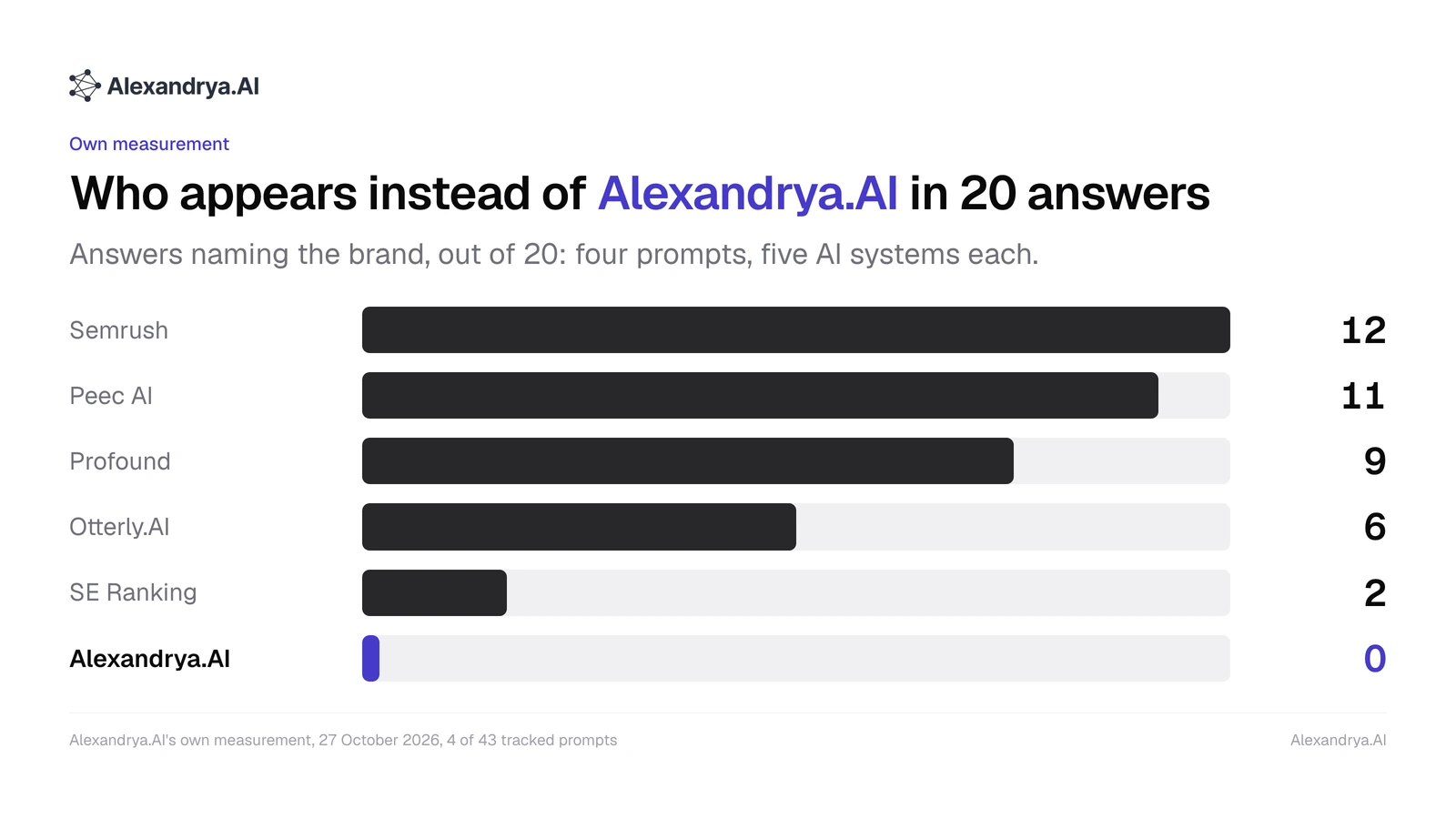
All three cited domains are best-of lists or comparison sites, and none belongs to a brand in the answer. Co-mentions also show which brands a model compares you with. In the 20 answers in our example, Peec AI appeared 11 times, 9 of them alongside Semrush, so Alexandrya.AI's first comparison content targets these two.
4. Analyse the sources behind your competitors
The cited sources explain why an AI system names a competitor. For each gap, log the source-list domains with their position and assign a type: competitor's own guide, independent best-of list or comparison site, trade media or blog, forum or video, shop or marketplace. In Alexandrya.AI's own measurement, seranking.com is the most-cited domain, with 2,434 citations at an average position of 4.37.
In the 20 answers from our example, two competitors got in by different routes. SE Ranking was named twice, yet seranking.com was cited three times, twice with a blog guide and once with its product page, all in Gemini at positions 1, 2 and 5. Peec AI was named 11 times, but peec.ai never appeared in a source list. Those slots went to third-party lists such as aiseocompare.com in ChatGPT, or saaswelt.de and g2.com in Microsoft Copilot.
The English e-commerce prompt adds a third pattern: vendors whose own best-of list gets cited end up first in the answer. ChatGPT cited a Promptwatch list at position 1 and recommended Promptwatch first, Google AI Mode did the same with Ranketta and Perplexity with Alhena. How sources differ between ChatGPT, Perplexity and Google is covered in the per-platform AI source analysis.
5. AI content gap analysis: prioritise content or outreach
Whether a gap needs content or outreach depends on the source the AI system cites when it names the competitor. If that source is the competitor's own guide, publish a page of the same kind, because you will not get onto a rival's website. If it is an independent best-of list, a comparison site or a trade publication, the action is outreach: ask to be included, supply data, set up a profile.
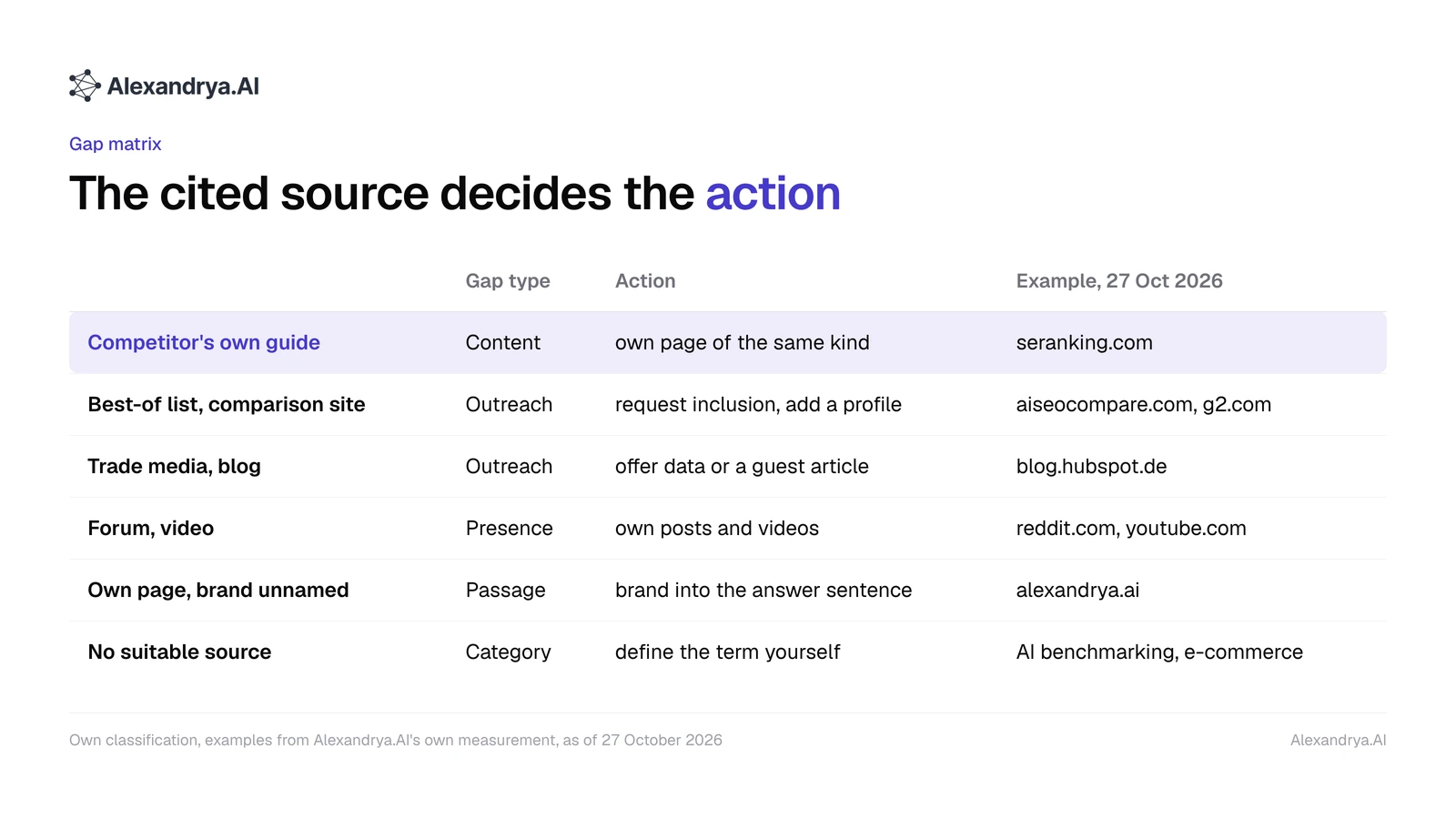
| Cited source | Gap type | Action | Example, 27 October 2026 |
|---|---|---|---|
| Competitor's own guide | Content | own page of the same kind | seranking.com in Gemini, position 1 |
| Best-of list, comparison site | Outreach | request inclusion, add a profile | aiseocompare.com, g2.com |
| Trade media, blog | Outreach | offer data or a guest article | blog.hubspot.de in ChatGPT, position 1 |
| Forum, video | Presence | own posts and videos | youtube.com (1,785 citations) |
| Own page, brand unnamed | Passage | brand into the answer sentence | alexandrya.ai in Copilot, position 5 |
| No suitable source | Category | define the term yourself | “KI-Benchmarking-Tool für E-Commerce” |
You can work through five of the six rows yourself. Only lists and trade media leave the decision to someone else's editors.
A simple calculation sets the order: intent weight times the number of platforms with a gap. In our example, buying prompts count 3, comparison prompts 2, research and problem prompts 1. A buying-prompt gap on all five platforms scores 15, a research-prompt gap on one platform scores 1. These weights are our choice for this example, not a standard, so adjust them to your business.
On a tie, passage gaps go first, because your page is already cited and only needs the brand name in the right sentence. Content gaps you can close yourself come next, outreach last.
6. Repeat the measurement and compare gap lists
An AI search competitor analysis only becomes reliable once you compare two measurements, because answers can differ between days and platforms. Repeat it every four weeks with the same prompts, competitors and platforms, then compare the gap lists. Similarweb suggests monthly reviews in its article on why competitors dominate AI search, published on 15 January 2026 (accessed 9 November 2026).
Between two runs, log every action with a date: new page, edited passage, new list entry. Without that log you see that a gap has closed but not why. Change the setup only once a quarter, or you end up comparing two different analyses.
Four prompts, 20 answers and no mention of Alexandrya.AI
For this example, Alexandrya.AI analysed four German prompts from its own project on five AI systems, 20 answers from 27 October 2026. Alexandrya.AI was named in none and cited in one. Semrush appeared in 12, Peec AI in 11, Profound in 9, Otterly.AI in 6, SE Ranking and finseo.ai in 2 each, Useomnia in one and Nightwatch in none (Alexandrya.AI's own measurement, as of 27 October 2026, 43 tracked prompts).
| Prompt (English gloss) | Intent | Platforms with a gap | Most-named competitors | Priority | Main action |
|---|---|---|---|---|---|
| ki sichtbarkeit tool für ecommerce kaufen (buy AI visibility tool, e-commerce) | Buying | 5 of 5 | Peec AI (4), Profound, Otterly.AI, Semrush (3 each) | 15 | Outreach to blog.hubspot.de and basicthinking.de |
| Wettbewerbsanalyse für AI-Suche kaufen (buy AI search competitor analysis) | Buying | 4 of 5 | Peec AI, Semrush (4 each), Profound (2) | 12 | Outreach to best-of lists |
| vergleich ai-monitoring anbieter vs klassisches seo-tool (AI monitoring vs SEO tool) | Comparison | 5 of 5 | Semrush (5), Peec AI, Profound (3 each) | 10 | Brand name into the cited own article |
| KI-Benchmarking-Tool für E-Commerce (AI benchmarking tool, e-commerce) | Buying | 1 of 5 | Profound (1) | 3 | Define the term on its own page |
The e-commerce buying prompt comes first with 15 points. There, ChatGPT cited blog.hubspot.de at position 1 and Copilot cited basicthinking.de, two editorial blogs and so outreach targets. The comparison prompt ranks third but holds the smallest fix: Copilot cited an Alexandrya.AI blog article at position 5 without naming the brand. The benchmarking prompt scores 3, because the tracked competitors barely occupy it. A page defining the term helps there, and this article is one.
One day is a sample: the numbers show the method, not a vendor ranking.
Buying an AI search competitor analysis or doing it yourself
Doing an AI search competitor analysis yourself costs mostly reading time. Thirty prompts on five AI systems give you 150 answers per run; at around two minutes per answer for brands, order and sources, that is about five hours (our own estimate). A spreadsheet will do for a one-off snapshot. To compare the gap list every month, buy a tool that stores answers daily and detects competitors and sources per prompt.
In a trial on your own project, check that the tool lists these gaps, shows cited domains per competitor and lets you read full answers. Without the list, you rebuild it by hand every month.
Tools that measure brand visibility in ChatGPT answers against competitors
Tools that measure brand visibility in ChatGPT answers send fixed prompts to ChatGPT and other systems at regular intervals and detect brands and linked sources in every answer. For a competitor analysis you also need a view of the prompts where only competitors appear. Semrush, Ahrefs and Alexandrya.AI document such a view, with different platform coverage (as of 9 November 2026).
Semrush's Competitor Research report shows prompts where competitors are cited and your brand is not, for your domain and up to four competitors on Google AI Overviews, AI Mode, Gemini and ChatGPT, according to the Semrush knowledge base. The AI Visibility Toolkit costs $99 a month. Ahrefs describes an “Others only” filter for Brand Radar in a German-language guide of 22 October 2026, and custom prompts start at $50 a month (all accessed 9 November 2026).
Alexandrya.AI is an AI visibility tool from Munich that measures brand mentions in ChatGPT, Gemini, Perplexity and Bing Copilot and turns them into content and citation tasks. In the competitor view of Alexandrya.AI, brand mention and link visibility sit side by side per competitor, above a “Competitive Gaps” panel listing prompts where competitors appear and your brand does not. The sources view groups citations by source type, and the recommendations turn them into content briefs, outreach targets with a pitch angle and quick wins, handled as tasks marked Open, In Progress or Done.
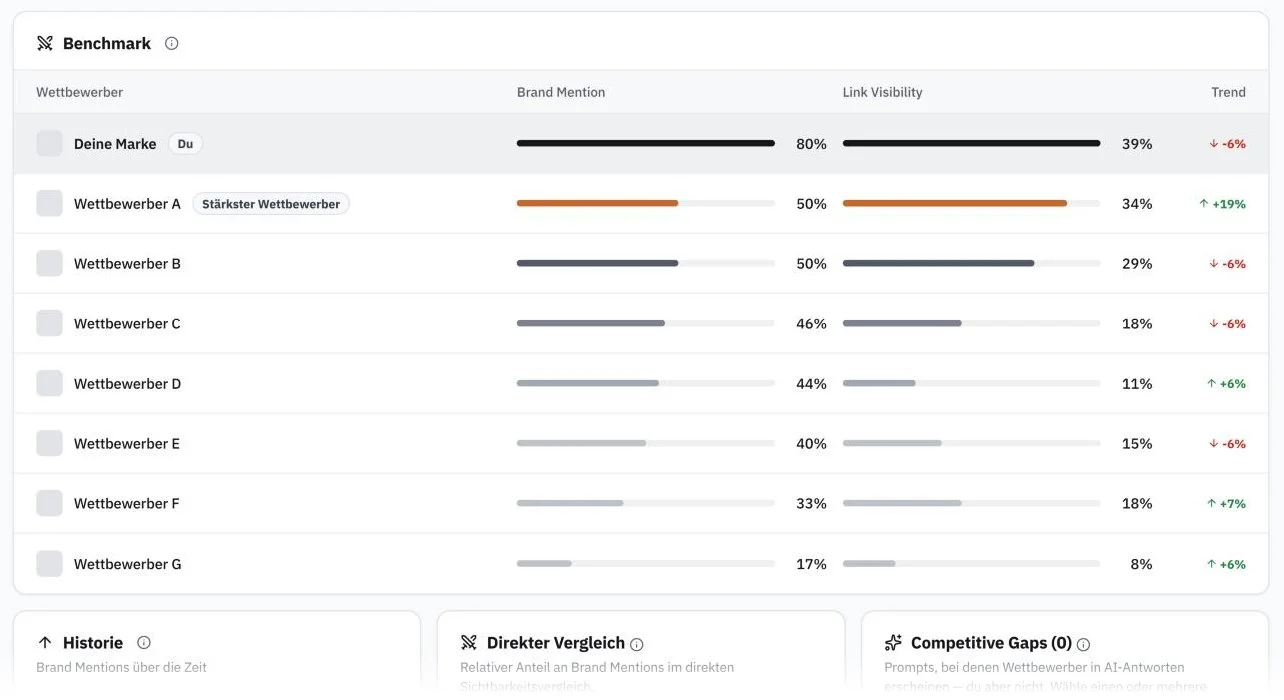
Alexandrya.AI shows no search volume per prompt, so you cannot weight gaps by demand as Semrush does with AI Volume. Starter costs €79 a month for 50 prompts on three selectable models with daily tracking, Professional €199 for 150 prompts on five models; all plans are on the pricing page (as of 9 November 2026).
What an AI benchmarking tool for e-commerce needs on top
An AI benchmarking tool for e-commerce compares how often AI assistants name your shop, brands and competitors for buying prompts at category and product level. On 27 October 2026, five AI systems read a German prompt for such a tool in at least four ways: an AI maturity check, a shop-metrics benchmark such as conversion rate, a market and price comparison, and visibility in AI answers. Decide which question you need answered before you buy.
For the visibility question, shops need category prompts such as “best cordless lawn mower for a small garden” and a competitor list that includes marketplaces. Marketplaces even turn up as sources for software questions: for a German prompt about buying an AI visibility tool for e-commerce, Copilot filled its first six source slots with offers from Etsy, Amazon, Galaxus and beck-shop.de.
Alexandrya.AI measures brand and shop mentions and sources per prompt. For tracking individual SKUs and for ChatGPT Shopping, Alexandrya.AI is the wrong tool, since it covers neither.
Frequently asked questions
How many competitors should an AI competitor analysis include?
An AI competitor analysis works best with four to eight direct competitors: the vendors from your sales pipeline plus the brands AI answers name most often for your prompts. More brands fill the gap list with adjacent categories. Alexandrya.AI tracks eight competitors in its own project, and Semrush's Competitor Research report compares your domain with up to four.
Does it count as a gap if my site is cited but my brand is not named?
A cited site without a brand mention is a gap type of its own, and closing it needs no new source. On 27 October 2026, Microsoft Copilot cited an Alexandrya.AI blog article at position 5 but did not name the brand. The fix is a passage that puts the brand name into the sentence that answers the question.
Should prompts with a competitor's name be part of the analysis?
Prompts with a competitor's name, such as “alternatives to Peec AI”, belong in a separate block. They always name that competitor and skew any comparison, but they show whether your brand makes the alternatives list. In Alexandrya.AI's own measurement, the German sub-query “alternativen zu peec ai” (alternatives to Peec AI) appeared 52 times up to 27 October 2026.
Do the gaps differ between ChatGPT and Google AI Mode?
The gaps differ by platform, because each system draws on other sources and reads the prompt its own way. For a German prompt about buying a competitor analysis for AI search, ChatGPT named four AI visibility tools on 27 October 2026, while Google AI Mode suggested Crayon and an Etsy template. Keep a separate gap list per platform.
How is an AI search competitor analysis different from AI share of voice?
AI share of voice is a metric: your share of all brand mentions across a prompt set. An AI search competitor analysis is the process behind it. It shows which prompts name competitors and leave you out, which sources drive those mentions and whether content or outreach closes each gap. Share of voice then tells you whether the fixes work.
How often should you repeat an AI competitor analysis?
Repeat an AI competitor analysis monthly, with the same prompt set, the same competitor list and the same platforms. Similarweb suggests monthly reviews, and Ahrefs recommends a monthly or quarterly rhythm in its brand gap guide of 22 October 2026. Store the answers themselves more often, because a single day of measurement is only a sample.
Free GEO audit of your competitor gaps
Add your brand, four to eight competitors and 30 buying and comparison prompts, and the first scan shows which prompts name only your competitors and which domains sit behind them. Alexandrya.AI is free for seven days, no credit card required. Find your competitor gaps for free
Frequently asked questions
How many competitors should an AI competitor analysis include?
An AI competitor analysis works best with four to eight direct competitors: the vendors from your sales pipeline plus the brands AI answers name most often for your prompts. More brands fill the gap list with adjacent categories. Alexandrya.AI tracks eight competitors in its own project, and Semrush's Competitor Research report compares your domain with up to four.
Does it count as a gap if my site is cited but my brand is not named?
A cited site without a brand mention is a gap type of its own, and closing it needs no new source. On 27 October 2026, Microsoft Copilot cited an Alexandrya.AI blog article at position 5 but did not name the brand. The fix is a passage that puts the brand name into the sentence that answers the question.
Should prompts with a competitor's name be part of the analysis?
Prompts with a competitor's name, such as “alternatives to Peec AI”, belong in a separate block. They always name that competitor and skew any comparison, but they show whether your brand makes the alternatives list. In Alexandrya.AI's own measurement, the German sub-query “alternativen zu peec ai” (alternatives to Peec AI) appeared 52 times up to 27 October 2026.
Do the gaps differ between ChatGPT and Google AI Mode?
The gaps differ by platform, because each system draws on other sources and reads the prompt its own way. For a German prompt about buying a competitor analysis for AI search, ChatGPT named four AI visibility tools on 27 October 2026, while Google AI Mode suggested Crayon and an Etsy template. Keep a separate gap list per platform.
How is an AI search competitor analysis different from AI share of voice?
AI share of voice is a metric: your share of all brand mentions across a prompt set. An AI search competitor analysis is the process behind it. It shows which prompts name competitors and leave you out, which sources drive those mentions and whether content or outreach closes each gap. Share of voice then tells you whether the fixes work.
How often should you repeat an AI competitor analysis?
Repeat an AI competitor analysis monthly, with the same prompt set, the same competitor list and the same platforms. Similarweb suggests monthly reviews, and Ahrefs recommends a monthly or quarterly rhythm in its brand gap guide of 22 October 2026. Store the answers themselves more often, because a single day of measurement is only a sample.
How visible is your brand in AI?
Try Alexandrya.AI free for 7 days and see how ChatGPT, Gemini, Perplexity, AI Overviews and Copilot talk about your brand.
- 7 days free
- No credit card required
- All features included
- Cancel anytime
About the author
Talaal Max Habib
Managing Director at Alexandrya.AI
Talaal Max Habib has advised companies in industry, the Mittelstand and e-commerce on SEO and Generative Engine Optimization since 2015. With his team he built Alexandrya.AI, the Munich-based platform that measures how brands appear in ChatGPT, Perplexity and Gemini.
LinkedIn