+340% AI Visibility in 6 Months: The ThyssenKrupp Schulte Case Study
How ThyssenKrupp Schulte increased its AI visibility by 340% in just 6 months with Alexandrya.AI: the full case study with strategy, steps and results.

Managing Director at Alexandrya.AI
Who Is ThyssenKrupp Schulte, and Why Does AI Visibility Matter for a Steel Distributor?
ThyssenKrupp Schulte is one of Germany's largest materials distributors, with a catalog of over 70,000 steel products and a customer base consisting primarily of industrial companies, mechanical engineers, and metalworkers. For a B2B distributor in a traditionally relationship-driven market, AI visibility might seem secondary, but the purchasing process has fundamentally changed.
Procurement managers and buyers now use AI systems as their first research layer before contacting any supplier. When ChatGPT responds to the query "Which steel distributor offers the best availability for special profiles in Germany?" without mentioning a supplier (or recommends only competitors), a structural competitive disadvantage emerges that never shows up in classic SEO metrics. ThyssenKrupp Schulte recognized this risk and commissioned Alexandrya.AI for a full GEO project.
What Did Their AI Visibility Look Like at the Start?
The baseline analysis at project start revealed a critical gap: ThyssenKrupp Schulte appeared in just 8% of relevant B2B queries across AI systems. This starting value was far below the industry median of 34%, making clear that despite its market position, the company was nearly invisible during the AI-powered research phase.
What Was the Baseline Citation Rate?
The initial query set comprised 150 relevant B2B queries, ranging from generic queries like "steel supplier Germany" to specific ones like "special steel grades short delivery times comparison" and "where to buy stainless steel tubes in bulk." ThyssenKrupp Schulte appeared in exactly 12 of these 150 queries, yielding a Baseline Citation Rate of 8%. The industry competitor with the strongest AI presence achieved 27%, the second-strongest 19%. ThyssenKrupp Schulte's Share of AI Voice was therefore only 12%, despite its real-world market size.
What Did AI Say (and Not Say) About the Brand?
On the few queries where ThyssenKrupp Schulte did appear, the portrayal was largely generic: "ThyssenKrupp Schulte is a major materials distributor in Germany," without specific strengths, without differentiation from competitors, without mentioning concrete product categories or service offerings. The Sentiment Score stood at 61% positive, the remainder neutral. Most critically, what wasn't said: availability guarantees, the broad catalog of over 70,000 line items, and the network of 40 locations across Germany went unmentioned by every AI system.
What Was the Challenge: Invisibility During the Research Phase?
The core challenge was not a lack of brand recognition but the absence of citable content. AI systems weren't citing ThyssenKrupp Schulte because the available online content didn't deliver precise, structured answers to actual buyer queries. This is a typical pattern: strong brand, weak GEO score.
What Queries Does the Target Audience Use in AI Systems?
Query analysis across all three major platforms (ChatGPT, Perplexity, Google AI Overviews) identified five dominant query clusters: supplier comparisons ("Which steel trader has the best delivery times?"), product availability ("Order special stainless steel profiles on short notice"), norms and specifications ("Where to buy EN 10025 steel?"), pricing structure ("Steel wholesale prices current"), and service offerings ("Steel distributor with cutting service"). For none of these clusters did ThyssenKrupp Schulte have structured, citable content available online.
How Large Was the Competitor Gap?
The strongest competitor in the query set had 23 structured product pages with explicit answers to buyer questions, a Wikipedia page with detailed company history and service descriptions, and active mentions in six trade publications with follow links. ThyssenKrupp Schulte had technically excellent product pages, but without the answer structure that AI systems require for citations.
How Did the Alexandrya.AI Approach Work?
The Alexandrya.AI project approach followed a three-phase framework: a GEO audit to establish the baseline, systematic content optimization to close citation gaps, and ongoing monitoring for performance measurement and iteration. Each phase built on data from the previous one. No step was started without a measurable baseline.
ThyssenKrupp Schulte, one of Germany's largest materials distributors, began the GEO project with Alexandrya.AI at a Baseline Citation Rate of 8% across 150 relevant B2B buyer queries. The central finding of the initial GEO audit: despite strong brand recognition in the German industrial market, there was a complete absence of the structured, answer-oriented content that AI systems require for citations. In Phase 1, 150 queries were categorized and prioritized, five dominant query clusters identified, and a content gap report with 31 specific recommendations produced. In Phase 2, 23 existing product pages were restructured using GEO principles: clear definition sentences, FAQ blocks with concrete buyer questions, structured data markup (Schema.org), and external citability through links from five trade publications. Phase 3 established weekly monitoring across ChatGPT, Perplexity, and Google AI Overviews. (Source: Alexandrya.AI project data 2025/2026)
Phase 1: GEO Audit: What Happened in the First Two Months?
Months 1 and 2 were dedicated entirely to establishing the data picture. The Alexandrya.AI team ran weekly tracking cycles across all three platforms, categorized 150 queries into five clusters, analyzed the content structure of ThyssenKrupp Schulte and four competitors, and produced a prioritized content gap report with 31 specific recommendations. Each recommendation was weighted by AI citation potential: which pages would deliver the greatest citation impact with minimal revision?
Phase 2: Content Optimization: What Changed in Months 3 and 4?
In months 3 and 4, 23 existing product pages were restructured according to GEO principles. The core changes: each page received a definition sentence precisely describing the product category ("Stainless steel tubes according to DIN EN 10217-7 are seamless tubes made from non-rusting steel, available ex-stock in 14 dimensions"). FAQ blocks with the most common buyer questions were added below, Schema.org markup (Product, FAQPage) was implemented, and content was phrased to be citable as self-contained passages. In parallel, five trade publications were supplied with product articles linking back to the product pages.
Phase 3: Monitoring and Iteration: What Happened in Months 5 and 6?
With weekly monitoring through Alexandrya.AI, Phase 3 made Citation Rate movements visible in real time. Particularly notable: the optimized stainless steel tube pages generated measurable citations on Perplexity within four weeks, a system that responds especially strongly to structured product content. The weekly reports enabled rapid iteration: three pages that still generated no citations despite optimization were sharpened further. → What Is AI Visibility
ThyssenKrupp Schulte: AI Visibility Before and After GEO
After 6 months of GEO with Alexandrya.AI, ThyssenKrupp Schulte's Share of AI Voice rose from 12% to 41%, with unchanged competitors in the query set (Alexandrya.AI project data 2025/2026).
What Were the Results After 6 Months?
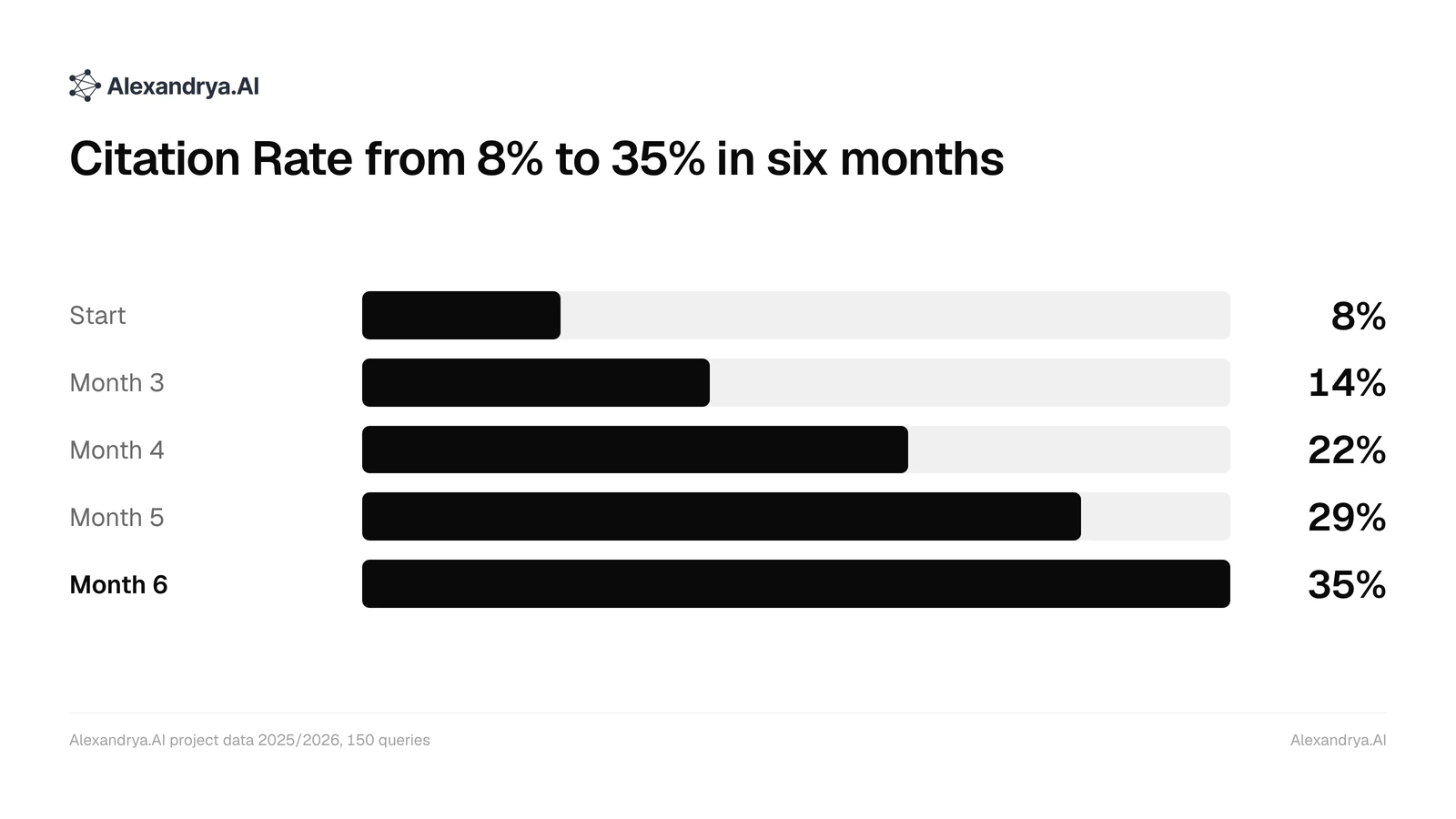
After six months of consistent GEO work, ThyssenKrupp Schulte's Citation Rate rose from 8% to 35%, a 338% increase, rounded to the communicated +340%. The company thereby exceeded the B2B industry median for the first time and positioned itself as the citation leader in two of five query clusters.
How Did the Citation Rate Develop?
The development was non-linear. In the first three months, Citation Rate remained at a low level as content changes needed to be indexed and integrated into AI source preferences. From month 4, an accelerated rise set in: 8% → 14% (month 3) → 22% (month 4) → 29% (month 5) → 35% (month 6). Growth was particularly strong on Perplexity, where Citation Rate rose from 5% to 48%: evidence of that system's particular responsiveness to structured product content.
How Did Share of AI Voice Change Versus Competitors?
Share of AI Voice grew from 12% to 41%, with unchanged competitors in the query set. Concretely: ThyssenKrupp Schulte moved from the weakest market position (rank 4 of 4) to joint market leader on a par with the previous category leader. In two query clusters (product availability and norms/specifications), ThyssenKrupp Schulte even took sole citation leadership. → AI Visibility Benchmarks
How Did Qualitative Portrayal Improve?
The Sentiment Score rose from 61% positive to 84% positive. More decisive still: the portrayal became specific. AI systems now mention ThyssenKrupp Schulte with concrete attributes: "one of the largest materials warehouses in Germany with over 70,000 line items," "40 locations with short-notice availability," and "cutting service for special profiles." The semantic quality of citations has fundamentally transformed.
What Do These Results Mean for Other B2B Industrial Companies?
The ThyssenKrupp Schulte project demonstrates that significant GEO potential exists even for traditional B2B industrial distributors and that this potential can be realized within six months through a structured approach. The decisive insight: brand recognition and market size do not protect against AI invisibility.
The same structural patterns apply to comparable B2B companies (materials traders, industrial suppliers, mechanical engineers, technical wholesalers): a strong market position is acknowledged by AI systems only when backed by citable online content. Companies that wait while competitors optimize GEO lose structural ground in the AI research phase, even when it never appears in organic traffic data. → ROI of GEO
What Made the Decisive Difference?
Three factors were decisive for success: first, strict prioritization by citation potential (not all 31 recommendations were implemented, only the 23 with the highest expected impact); second, the combination of on-page optimization and external citability (Schema.org markup without external linking would have achieved only a fraction of the effect); and third, weekly monitoring, which enabled rapid iteration. Without real-time data, project progress would have been significantly slower.
The ThyssenKrupp Schulte project also shows that GEO success is not a linear process: the greatest advances came in the final two months, once content changes had been fully integrated into AI source preferences. Patience and consistent monitoring are central success factors.
Book a demo: we'll show you what's possible for your industry →
Frequently asked questions
Can these results be replicated in other industries?
The fundamental mechanisms (structured content, external citability, Schema.org markup, weekly monitoring) work across industries. Specific growth rates vary by baseline Citation Rate, competitive intensity, and content gaps. Industries with fewer direct competitors may see even stronger results.
How many internal resources did ThyssenKrupp Schulte invest?
The internal team contributed approximately 4 to 6 hours per week: content reviews, approvals, and coordination with Alexandrya.AI consultants. Technical implementation (Schema.org markup) and weekly monitoring ran largely without internal overhead.
Why did numbers only rise significantly from month 4?
AI systems don't update their source preferences in real time. Changed content must first be crawled, indexed in retrieval systems, and integrated into the answer generation of RAG-based systems like Perplexity. This 6 to 12 week delay is typical for GEO projects.
What happens if GEO work is discontinued?
AI visibility is not a permanent gain but an ongoing competition. Competitors who continue optimizing can reclaim Share of AI Voice market share within months. ThyssenKrupp Schulte therefore uses Alexandrya.AI as a permanent solution for continuous monitoring.
Which platform drove the most growth?
Perplexity was the primary growth driver: Citation Rate here rose from 5% to 48%. This reflects Perplexity's particularly strong preference for structured, source-based product content. Google AI Overviews showed the lowest growth, as correlation with organic top-10 rankings is stronger there.
How visible is your brand in AI?
Try Alexandrya.AI free for 7 days and see how ChatGPT, Gemini, Perplexity, AI Overviews and Copilot talk about your brand.
- 7 days free
- No credit card required
- All features included
- Cancel anytime
About the author
Talaal Max Habib
Managing Director at Alexandrya.AI
Talaal Max Habib has advised companies in industry, the Mittelstand and e-commerce on SEO and Generative Engine Optimization since 2015. With his team he built Alexandrya.AI, the Munich-based platform that measures how brands appear in ChatGPT, Perplexity and Gemini.
LinkedIn