The State of Brand Visibility in AI Search: Original Research 2026
Alexandrya.AI analyzed 500+ brands across 10,000+ AI queries in Q1 2026. The key findings, benchmarks and takeaways from our original research study.

Managing Director at Alexandrya.AI
What Is the Methodology Behind This Research?
This research analyzed how frequently and under what conditions brands appear in AI-generated responses across the three dominant AI search platforms. The study was conducted by Alexandrya.AI in Q1 2026 using a systematic query-based methodology across ChatGPT (GPT-4o), Google Gemini 1.5 Pro, and Perplexity Pro. All queries were run in controlled conditions (logged-out, private browsing, standardized geographic location) to minimize personalization effects.
What Was the Scope of the Study?
The study covered 500 brands across 12 B2B and B2C industry categories, including SaaS, professional services, financial services, healthcare, manufacturing, and consumer electronics. Each brand was evaluated against a minimum of 20 standardized queries per category, yielding more than 10,000 individual AI response observations. Brands were selected to represent a spectrum from enterprise (500+ employees) to mid-market (50 to 500 employees) to ensure findings are generalizable.
Which AI Models Were Included?
Three platforms were included: ChatGPT (GPT-4o with Browse, logged-out), Google Gemini 1.5 Pro (AI Overviews, US-English), and Perplexity Pro (default model, web search enabled). These three represent the AI search platforms with the highest documented traffic volume in English-speaking markets as of Q1 2026. Model responses were captured and analyzed using Alexandrya.AI's automated monitoring infrastructure, with human review of a random 10% sample for quality validation.
What Types of Queries Were Used?
Queries were classified into four types: category-level research queries ("best B2B project management software"), vendor comparison queries ("Salesforce vs. HubSpot for mid-market"), problem-identification queries ("how to reduce customer churn"), and expert recommendation queries ("what tools do enterprise CFOs use for FP&A"). Citation rates were calculated separately for each query type, revealing significant differences in how query intent affects brand inclusion probability.
Research conducted by Alexandrya.AI in Q1 2026 analyzed more than 10,000 AI-generated responses across ChatGPT, Gemini, and Perplexity, covering 500 brands in 12 industry categories. The study measured four dimensions of AI brand visibility: citation rate (how often a brand appears), share of AI voice (relative dominance vs. competitors), sentiment accuracy (whether the AI's characterization is correct), and model coverage (which platforms cite the brand). The core finding is striking in its inequality: the average brand appears in only 11.4% of relevant AI-generated responses. The top decile of brands achieves a 68.3% citation rate: a 6× gap that cannot be explained by brand size, marketing budget, or traditional SEO performance alone. Instead, the gap is driven by five structural signals: Wikipedia presence, structured data coverage, topical authority depth, external citation volume, and content freshness. Each signal is independently actionable, making the gap addressable, but only for brands that begin systematic GEO work before AI search patterns calcify around current market leaders.
Finding 1: How Rarely Do Brands Appear in AI Responses?
The single most important finding from this research is how infrequently the average brand appears in AI-generated responses, even when a query is directly relevant to their category. Across all 500 brands and 10,000+ observations, the average citation rate was 11.4%, meaning that for every 100 relevant queries, a typical brand is cited fewer than 12 times.
What Are the Actual Citation Rate Distributions?
The distribution is highly unequal. The bottom quartile of brands achieves citation rates below 3%, essentially invisible in AI search. The median brand achieves 8.7%. The top quartile begins at 24.1%, and the top decile (50 brands) averages 68.3%. The top five brands in the most competitive categories achieve citation rates above 80% for their core query set.
Why Are Most Brands Underrepresented in AI Responses?
Two structural causes explain the underrepresentation. First, AI models have a strong recency and authority bias: they preferentially cite brands that appear in sources with high training data representation: Wikipedia, major trade publications, widely-referenced case studies. Brands that have not systematically built presence in these sources are systematically underrepresented regardless of their actual market position. Second, AI responses exhibit extreme concentration: in a typical category, three brands capture 51% of all citations. This is not because they are objectively better. It is because they crossed the citation threshold first and benefited from compounding visibility effects in training data.
The Five Citation Predictors
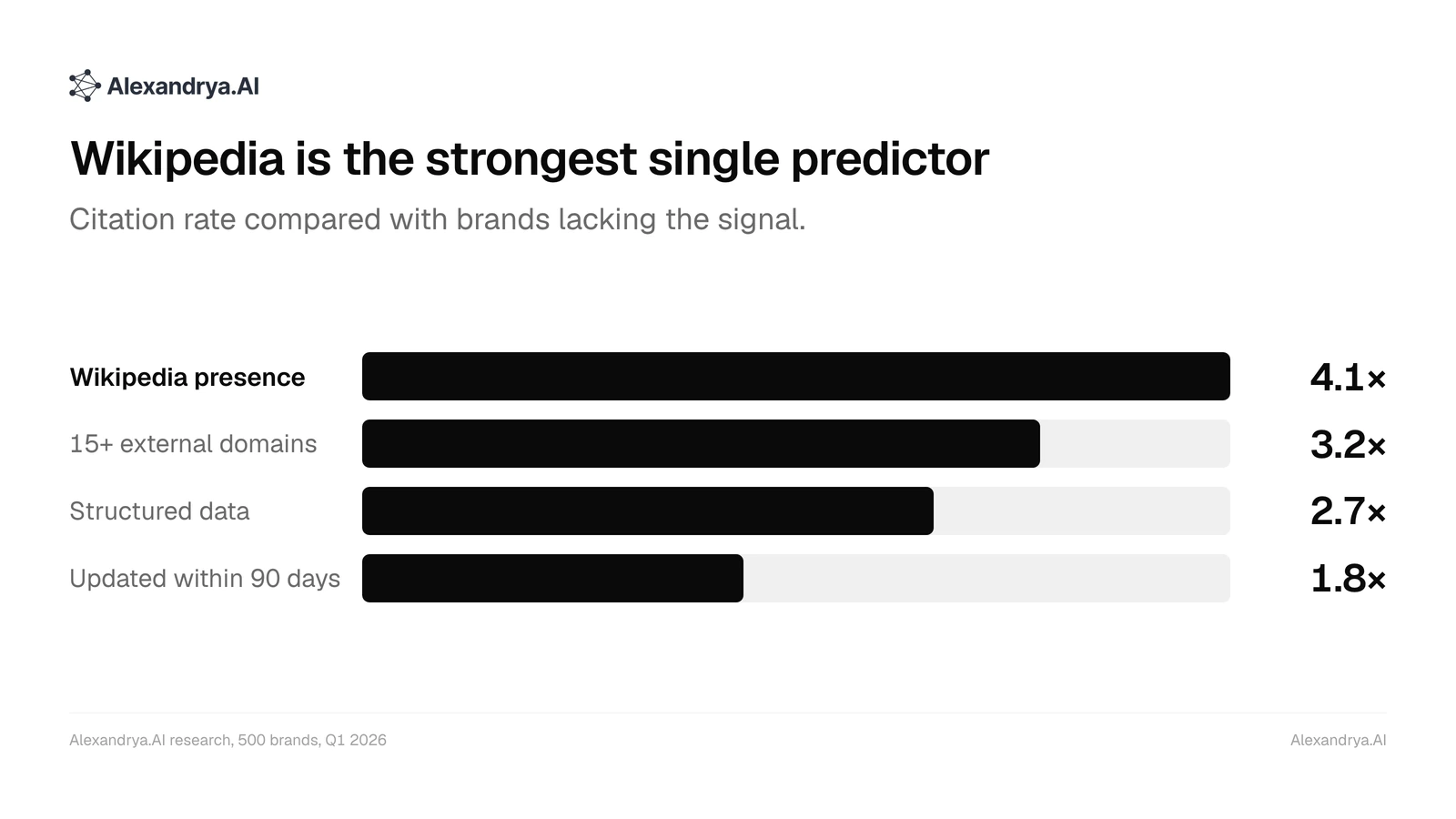
Wikipedia presence alone makes a brand 4.1× more likely to appear in AI responses, the largest single signal in the Alexandrya.AI Q1 2026 citation predictor analysis.
Finding 2: How Do ChatGPT, Gemini, and Perplexity Differ for Brand Citations?
The three platforms produce meaningfully different citation patterns. A brand that performs well on ChatGPT does not automatically perform well on Perplexity or Gemini. This platform divergence is one of the most actionable findings for GEO practitioners.
ChatGPT (GPT-4o) shows the strongest training-data dependence: citation patterns align closely with brand representation in the Common Crawl and Wikipedia corpora that fed GPT-4's training. Wikipedia-present brands see a 4.8× citation rate advantage on ChatGPT specifically. Gemini 1.5 Pro shows the strongest correlation with Google Search signals: brands with high domain authority, structured data, and strong Google rankings show higher citation rates on Gemini than their training-data representation alone would predict. Perplexity shows the most volatile citation patterns, with the highest sensitivity to content freshness: brands that published relevant content within the past 90 days show a 2.1× citation advantage on Perplexity vs. 1.4× on ChatGPT. This means Perplexity rewards an active publishing cadence more than the other two platforms.
The practical implication: brands optimizing for a single platform may appear strong in one AI environment while being nearly invisible in others. Multi-platform monitoring is not optional for a complete picture of AI visibility.
Finding 3: What Are the Top 5 Predictors of AI Citation?
Five structural signals independently predict AI citation rate, with each signal quantified against the baseline of brands possessing none of these advantages. The five predictors are ordered by impact magnitude.
Does Wikipedia Presence Really Matter That Much?
Wikipedia presence is the strongest single predictor of AI citation rate. Brands with a Wikipedia page show a 4.1× higher citation rate than brands without one, controlling for industry, company size, and marketing spend. The mechanism is not the Wikipedia page itself. It is that Wikipedia content is included in virtually all major LLM training corpora with high reliability. A well-maintained Wikipedia entry functions as a canonical factual reference that AI models consistently reproduce.
How Much Does Structured Data Increase Citation Rates?
Brands with comprehensive Schema.org markup (Organization, Product, Article, and FAQPage schema on all key pages) show a 2.7× higher citation rate than brands with minimal or no structured data. Structured data provides machine-readable context that retrieval-augmented AI systems parse directly. It reduces ambiguity about what a brand does, who it serves, and what its products are. This is one of the most immediately actionable signals, implementable within days.
What Is Topical Authority and Why Does It Predict Citations?
Topical authority (the depth and completeness of a brand's content coverage within a defined subject area) is the third strongest predictor. Brands with deep topical authority (comprehensive content clusters covering a topic and its sub-topics completely) are cited in 68% of relevant queries, vs. 11% for brands with fragmented, keyword-scattered content. AI models preferentially cite sources that provide comprehensive answers to a topic. A single exhaustive piece outperforms ten thin pages every time.
How Do External Citations Affect AI Visibility?
Brands cited by 15 or more unique external domains show a 3.2× higher AI citation rate than brands with fewer external references. The mechanism mirrors the Wikipedia effect: external citations from credible sources signal that a brand's claims have been independently verified or referenced. This is the most difficult signal to build quickly: it requires earning mentions in publications, case studies, and research that AI models recognize as authoritative.
Does Content Freshness Matter for AI Citation?
Content freshness (pages updated within the past 90 days) produces a 1.8× citation rate advantage, primarily driven by retrieval-augmented systems like Perplexity and Google AI Overviews. The effect is smaller for base model responses (which depend on training data, not live retrieval) but becomes significant in aggregate when a substantial portion of AI-generated responses include live retrieval components. A consistent publishing and update cadence of at least 4 to 6 substantive pieces per month is the operational minimum to capture this signal.
Finding 4: Why Do 3 Brands Capture 51% of Citations?
In every industry category analyzed, three brands consistently captured more than half of all AI citations for that category. This extreme concentration is not a function of objective quality or market leadership. It reflects how citation momentum compounds in AI systems. The first brands to appear frequently in authoritative sources during a model's training window gain a structural citation advantage that persists through subsequent training cycles. As AI models are retrained or fine-tuned, they learn from output data that already reflects citation concentration, reinforcing the advantage of early movers. Brands outside the top three face a diminishing-returns challenge: they must build more authority signals than the leaders simply to achieve proportional representation. For brands not currently in the top three, early and systematic GEO investment is the only mechanism to break into the citation concentration before patterns solidify.
Finding 5: How Do Language and Country Variations Affect AI Visibility?
AI citation patterns vary significantly by language and geographic query context. Brands visible in English-language AI responses often have substantially lower citation rates in German, French, or Spanish responses to equivalent queries, even when those brands have native-language websites and marketing materials.
The study found that citation rates for German-language queries were on average 34% lower than for equivalent English-language queries for the same brands. The primary driver is training data density: English-language content constitutes the majority of major LLM training corpora, meaning English-language authority signals transfer poorly to non-English AI response contexts. Brands operating in German-speaking markets must build GEO signals specifically in German: German-language Wikipedia entries, German-language publication citations, German-language structured data, and German-language topical authority content. Cross-language GEO optimization is a distinct workstream, not an automatic benefit of strong English-language visibility.
What Do These Findings Mean for B2B Marketers?
These five findings together point to a clear strategic implication: AI search has created a new competitive surface that operates largely independently of traditional marketing investment. Brands with strong traditional SEO rankings, high marketing spend, and large sales teams are not automatically visible in AI-generated responses. The determinants of AI visibility (Wikipedia presence, structured data, topical authority, external citations, and content freshness) are distinct from the determinants of traditional search performance.
The practical priority for B2B marketers in 2026 is measurement first. Without baseline citation rate data across ChatGPT, Gemini, and Perplexity, it is not possible to identify gaps, track progress, or allocate GEO optimization effort effectively. Alexandrya.AI provides this baseline automatically, along with competitive benchmarking and weekly trend monitoring. See What Is AI Visibility, What Is GEO, and AI Visibility Benchmarks 2026 for additional context.
Get your brand's AI visibility score free: start 7-day trial →
Frequently asked questions
How was this research conducted? Is it reproducible?
The methodology used standardized query sets, logged-out sessions, and controlled geographic conditions. The full methodology document is available upon request. Citation rates are probabilistic and will vary by query set design, timing, and model version, but the directional findings are consistent across repeated measurement cycles.
Does the 11.4% average citation rate apply to my industry?
Industry averages vary significantly. Financial services and healthcare show lower average citation rates (7 to 9%) due to AI models applying higher caution thresholds. SaaS and professional services show higher averages (14 to 17%) due to denser content ecosystems and more authoritative industry publications.
Can a brand improve its AI citation rate without being on Wikipedia?
Yes, but Wikipedia delivers the largest single-signal impact (4.1×). Brands that cannot or choose not to maintain a Wikipedia presence can compensate partially through structured data, topical authority, and external citations, but the composite effect is smaller than Wikipedia alone.
How frequently do AI citation patterns change?
Platform-level patterns change with model updates, which occur on irregular schedules. Week-to-week citation rates fluctuate by 10 to 30% without any brand-side changes, driven by retrieval system variations. This is why monthly trend monitoring is the minimum cadence for meaningful measurement.
What does "topical authority" mean in practice?
Topical authority means having comprehensive, interconnected content that covers a subject area completely (definitions, comparisons, sub-topics, objections, use cases, and expert perspectives) rather than isolated pages targeting individual keywords. It is assessed by whether your content cluster answers the full range of related queries a user might pose, not just the primary query.
How visible is your brand in AI?
Try Alexandrya.AI free for 7 days and see how ChatGPT, Gemini, Perplexity, AI Overviews and Copilot talk about your brand.
- 7 days free
- No credit card required
- All features included
- Cancel anytime
About the author
Talaal Max Habib
Managing Director at Alexandrya.AI
Talaal Max Habib has advised companies in industry, the Mittelstand and e-commerce on SEO and Generative Engine Optimization since 2015. With his team he built Alexandrya.AI, the Munich-based platform that measures how brands appear in ChatGPT, Perplexity and Gemini.
LinkedIn