YouTube in AI answers: why Google keeps citing videos and what brands can do about it
YouTube in AI answers: in our 45-prompt scan, Google AI Mode linked a video in 34 answers and ChatGPT in none. What the most-cited videos share.
Managing Director at Alexandrya.AI
YouTube in AI answers is mostly a Google story. Across the 45 prompts Alexandrya.AI tracks for its own brand, Google AI Mode linked a YouTube video in 34 answers on 21 November 2026, AI Overviews in 21, and ChatGPT, Perplexity, Gemini and Copilot in none. Google shows indexed watch pages as sources and often jumps to a key moment. The eleven most-cited videos all had captions; seven had chapters.
Alexandrya.AI is our own product. Every first-party number in this article comes from the project we use to track our own brand: German and English prompts about AI visibility tools and marketing software. Recipes, repair guides or news questions may produce a very different picture.
YouTube in AI answers: how often is it cited?
YouTube is the most-cited domain across the 45 prompts Alexandrya.AI tracks. The action plan of 20 November 2026 counts 2,172 citations for youtube.com, almost twice the 1,194 for blog.hubspot.de. A single day's scan shows where that number comes from: on 21 November 2026, all 126 counted YouTube links came from Google AI Mode and Google AI Overviews, and the other four platforms contributed none.
| Platform | Answers with a YouTube link | YouTube links out of all linked sources | Videos and timestamped links |
|---|---|---|---|
| Google AI Mode | 34 of 45 | 74 of 380 (19.5%) | 50 videos, 40 timestamped links |
| Google AI Overviews | 21 of 45 | 52 of 376 (13.8%) | 33 videos, 30 timestamped links |
| ChatGPT | 0 of 45 | 0 of 297 (0%) | none |
| Perplexity | 0 of 45 | 0 of 454 (0%) | none |
| Gemini | 0 of 45 | 0 of 116 (0%) | none |
| Microsoft Copilot | 0 of 45 | 0 of 143 (0%) | none |
In Google AI Mode, almost one linked source in five was a video. With 74 links, youtube.com was far ahead of the next domains, alexandrya.ai with 20 and seranking.com with 17. Even so, YouTube took the first slot in the source list in just one answer on each Google surface, and its median position was 6. Only linked sources are counted here. Unlinked footnotes were checked as well, and none of them pointed to YouTube on ChatGPT, Perplexity, Gemini or Copilot.
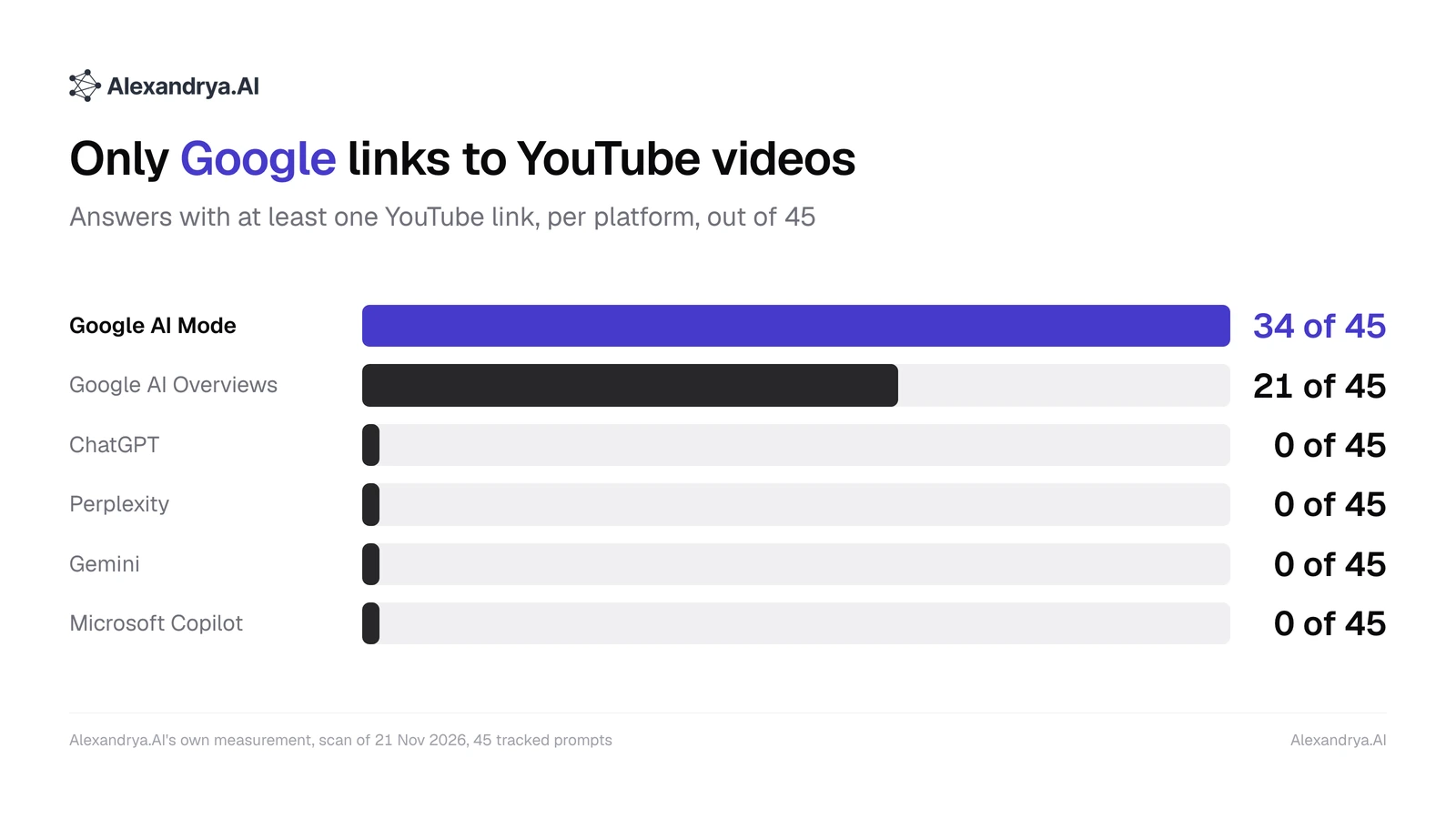
Only the two Google surfaces linked to YouTube videos. Source: Alexandrya.AI's own measurement, scan of 21 November 2026, 45 tracked prompts, 45 answers per platform.
Other measurements see different splits. Tinuiti found that YouTube's share of citations in Google AI Mode more than quadrupled between January and April 2026, and more than doubled in AI Overviews (Digiday, 23 September 2026, accessed 25 November 2026). According to the study WebFX linked to in March 2026, Perplexity accounted for 38.7% of YouTube citations, closely followed by Google AI Overviews at 36.6%, with ChatGPT at 4.4%; neither prompt set nor time frame is stated (accessed 25 November 2026). Whether video matters for your brand therefore depends on topic, language and platform, and only your own prompt list can answer it. For the broader picture of how source lists differ between platforms, see the AI source analysis by platform.
Why do AI answers cite YouTube videos?
AI answers cite YouTube videos mainly where Google generates them. According to Google, AI Overviews and AI Mode split a question into several related searches through query fan-out and can show any page as a source if it is indexed and eligible to appear in Google Search with a snippet. YouTube watch pages meet that bar. Google does not disclose whether it favours its own video platform when selecting sources.
What Google and YouTube document, as of 25 November 2026:
- Google Search Central lists no additional technical requirements for AI Overviews or AI Mode and suggests supporting text with images and videos where it helps.
- Google detects segments of a video on its own as "key moments" and gives priority to timestamps you set in the YouTube description or through structured data (Google, video SEO best practices).
- None of these pages says anything about transcripts, captions, view counts or channel size as a factor for AI answers.
The measurement fits the key moments logic. 70 of the 126 YouTube links carried a timestamp, so they sent the reader to a particular minute of the video. That is an observation about the links, not a statement from Google about how the answer is built. Why ChatGPT, Perplexity, Gemini and Copilot linked no video for these prompts remains open, because none of the vendors gives us a basis to explain it.
What the most-cited videos have in common
We read the watch pages of the eleven videos that Google AI Mode and AI Overviews linked most often on 21 November 2026. The pages were accessed on 25 November 2026, so view counts are from that day. Titles appear in the original language, and long ones are shortened with an ellipsis.
| Video and channel | Links on 21 Nov | Length and views | Chapters and captions |
|---|---|---|---|
| 7 Best AI Search Tracking and Visibility Tools (Rank in ChatGPT & Perplexity!), GEO Mastery with Adam | 9 | 3:41, 1,336 views | chapters, automatic |
| Ich teste DIE BESTEN 5 KI-Tracking-Tools für dich!, ithelps | 9 | 11:36, 370 views | no chapters, automatic |
| AI Search Visibility Tools You Should Be Using in 2026, SMA Marketing | 8 | 21:56, 79,303 views | chapters, automatic |
| 5 Key SEO / AI Visibility Tools Compared (2026), Style Factory | 7 | 13:33, 759 views | chapters, manual |
| GEO-Audit: So misst du deine Sichtbarkeit in ChatGPT und Google AI, Sandro Huber Digital | 6 | 11:46, 121 views | chapters, manual |
| How to Measure AI Search Visibility in 13 Minutes, Searchable | 5 | 13:17, 742 views | chapters, manual |
| 7 Best AI Visibility Tools in 2026 (Which Should You Choose?), Semrush | 5 | 5:35, 1,363 views | chapters, automatic |
| Sentiment in KI-Systemen: So steuerst du dein Markenimage in ChatGPT & Co. …, Claneo | 4 | 18:58, 2,151 views | chapters, automatic |
| What Are the Best Peec AI Alternatives? (2026), a Short by Alex Ninja | 4 | 1:00, 83 views | no chapters, manual |
| KI-Sichtbarkeit messen – ganz einfach? [Search Camp 421], Bloofusion Germany | 3 | 14:47, 286 views | no chapters, automatic |
| GEO-Tracking Schritt für Schritt: KI-Sichtbarkeit messen wie eine Agentur (2026), ithelps | 3 | 13:46, 311 views | no chapters, automatic |
All eleven videos have captions, and seven rely on the automatically generated track alone. That says little, because YouTube usually creates an automatic caption track for any video with speech. Seven list chapters in the description. The ithelps video "Ich teste DIE BESTEN 5 KI-Tracking-Tools" has no chapters, yet Google linked it at 4:12 and 6:17, so Google sets the jump point itself when it needs to. Seven of the eleven had fewer than 1,000 views, with a median of 742. Reach was not a precondition here.
Question titles were rare: only three of the eleven are phrased as a question. Ten name the category word for word, such as "AI Visibility Tools", "KI-Sichtbarkeit messen" or "KI-Tracking-Tools"; the Claneo video names its topic instead, sentiment in AI systems. Ten were published in 2026, and three were no more than two weeks old at the time of the scan. Two descriptions open with a sentence that answers the question outright. The one-minute Short on Peec AI alternatives names four tools in its first sentence, each with a use case. The channels belong to agencies, consultants and software vendors, Semrush among them.
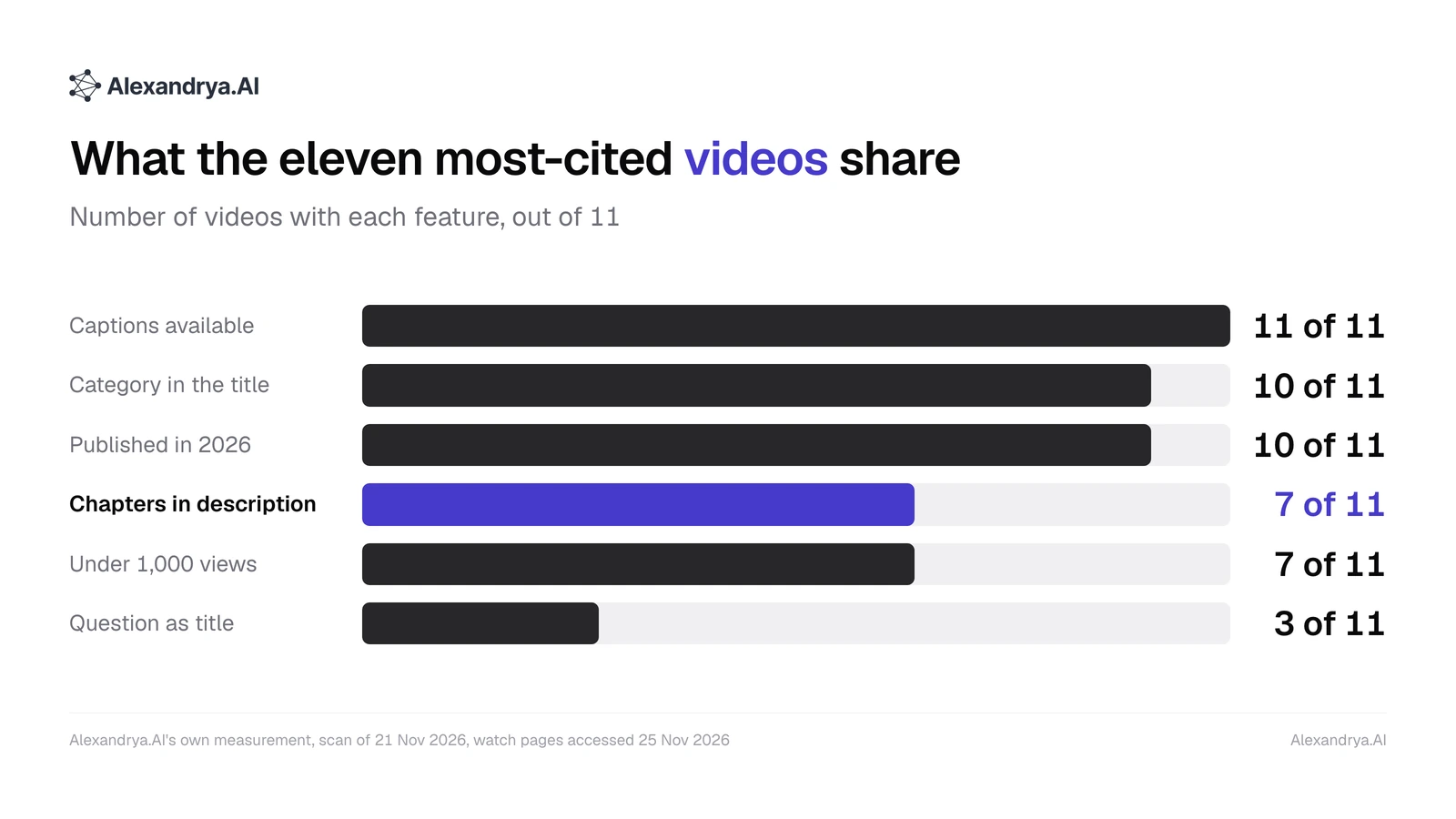
All eleven videos had captions, seven had chapters and only three used a question as the title. Source: Alexandrya.AI's own measurement, scan of 21 November 2026, watch pages accessed 25 November 2026.
Eleven videos from one subject area cannot prove that any feature causes a citation. They do show what was enough for these prompts: a video on the category people asked about, with readable text behind it.
YouTube for AI search visibility through your own videos or other channels
YouTube for AI search visibility works in two ways: through videos on your own brand channel, or through mentions in other channels' videos that Google AI Mode and AI Overviews already link for your prompts. Across the 45 prompts Alexandrya.AI tracks, seven of the eleven most-cited videos had fewer than 1,000 views. A brand channel does not need a large audience, but it does need videos on exactly the questions you track.
| Route | Control over the content | Disclosure | What you need |
|---|---|---|---|
| Video on your own brand channel | full | none, the brand is clearly the publisher | a presenter, recording, chapters, checked captions |
| Unpaid mention in someone else's video | none, the creator forms their own view | depends on what they receive; even free access can trigger it | trial access, verifiable data, a contact person |
| Paid partnership with a creator | limited, by agreement | required, on YouTube through the paid promotion setting | budget, contract, brief |
Other channels' videos follow the same logic as trade publications. Approach the channels whose videos are already linked for your prompts, not the ones with the most subscribers. The article on digital PR for AI visibility shows how a source list becomes a pitch list.
Paid placements have to be disclosed. YouTube asks creators to tick "My video contains paid promotion like a product placement, sponsorship, or endorsement" in YouTube Studio, which adds a disclosure label at the beginning of the video (YouTube Help, accessed 25 November 2026). Advertising disclosure laws apply on top of that. One of the eleven videos carries this label and was still linked three times. Over time, paid videos seem to lose ground, though: according to Digiday, the citation rate of sponsored YouTube videos tracked by Scrunch fell from 18.4% to 10.5% between May and July 2026. Hidden advertising, bought comments and fake channels break YouTube's rules and put the brand at risk, so leave them out.
Building blocks of a video Google AI Mode can cite
Some of these building blocks come from Google and YouTube documentation (chapters, watch pages), others from the eleven videos above. The derived points are hypotheses and are labelled as such.
- Pick topics from your own prompt list where Google already links videos today. In our project that applied to 38 of the 45 prompts on at least one of the two Google surfaces.
- Put the category term word for word in the title and the first sentence of the description. A question title is fine but not required (hypothesis based on the eleven videos).
- Say the answer in the first seconds and write it into the first lines of the description, as the two descriptions with a direct answer do (hypothesis).
- Add chapters: first timestamp at 00:00, at least three, each at least ten seconds long (YouTube Help on video chapters). Word chapter titles like the sub-questions people ask.
- Check the captions. The automatic track, which YouTube usually creates without any action from you, was enough in seven of eleven cases, but correct brand names and technical terms there, because speech recognition easily gets them wrong (hypothesis).
- Say and write the brand name: in the audio, in the description and in one chapter title. A video that supports an answer without delivering your name creates the gap described in cited but not mentioned.
- Embed the video on a dedicated page of your own website with its own title and description, as Google recommends for watch pages.
How to track whether your videos are cited in AI answers
You track whether your videos are cited in AI answers through the answers' source lists, not through YouTube Analytics. Run the same prompts every day in Google AI Mode, Google AI Overviews and the other platforms, then filter the linked sources for youtube.com. The video ID and the timestamp in each link tell you which video and which minute support the answer. Leave unlinked footnotes out of the count.
Alexandrya.AI is an AI visibility tool from Munich that measures brand mentions in ChatGPT, Gemini, Perplexity, Google AI Overviews, Google AI Mode and Microsoft Copilot and turns them into content and citation tasks. Under Sources and Domains you see, per platform, which domains and URLs your prompts cite, with the citation mix by source type and each source's position in the list. In the action plan, youtube.com appears as an outreach target with its most-cited URL and a reason, and a recommendation becomes a task with the status Open, In Progress or Done.
The limits belong here too. Alexandrya.AI does not read YouTube Analytics, does not show views or subscribers and does not do social listening. It measures only the prompts you set up. The Starter plan at €79 (EUR) a month lets you choose three AI models; if YouTube matters to you, include Google AI Mode and Google AI Overviews. Professional costs €199 a month with 150 prompts and five models (plans and pricing). What Search Console adds for AI Overviews is covered in the guide to Google AI Overviews tracking tools.
Whether ChatGPT and Perplexity will start linking videos for this subject later is an open question. If you plan a video for AI visibility today, you are planning for Google AI Mode and AI Overviews, and you should watch the source lists of the same prompts for two weeks after each upload.
Frequently asked questions
Does ChatGPT cite YouTube videos?
Across the 45 prompts Alexandrya.AI tracks for its own brand, ChatGPT linked no YouTube video at all on 21 November 2026, out of 297 linked sources. In the study WebFX linked to, ChatGPT accounted for 4.4% of YouTube citations. Whether ChatGPT uses video for your topic only shows up when you check your own prompts over several days.
Do YouTube Shorts help with AI answers?
Shorts play a minor role. Of 126 YouTube links in Google AI Mode and AI Overviews, 9 pointed to a Short, which is 7.1%. OtterlyAI put the figure at 5.7%, according to Digiday. Even so, a one-minute Short on Peec AI alternatives was linked four times, with a description that answers the question in its first sentence.
Does a video need lots of views to be cited in AI answers?
No. Of the eleven videos that Google AI Mode and AI Overviews linked most often on 21 November 2026, seven had fewer than 1,000 views and the median was 742. The least-watched one had 83. Ten of the eleven named the category people asked about in the title.
How quickly can a new YouTube video be cited in AI answers?
Google does not state a time frame. In our data, three videos published on 7, 9 and 10 November 2026 were already linked in Google AI Mode or AI Overviews on 21 November, so within two weeks at most. Whether a video keeps its place only becomes clear from daily tracking over several weeks.
Does a paid creator video need to be disclosed?
Yes. YouTube requires creators to tick the paid promotion box in YouTube Studio for product placements, sponsorships and endorsements, which adds a disclosure label at the beginning of the video. Advertising disclosure laws apply as well. A labelled video can still be cited: in our data, one was linked three times.
Can Alexandrya.AI report YouTube citations separately?
Yes, through its source analysis. Alexandrya.AI shows, per platform, which youtube.com URLs your tracked prompts cite, at which position and how often. It does not pull YouTube views, subscribers or channel data. You can try the full feature set free for seven days without a credit card.
Which videos does Google cite for your prompts?
Set up your own prompts in the trial and choose Google AI Mode and Google AI Overviews as platforms. After the first scan you can see which YouTube videos your prompts cite, at which position and which minute, and whether your brand appears in them. Seven days, no credit card. See the video sources for your prompts
Frequently asked questions
Does ChatGPT cite YouTube videos?
Across the 45 prompts Alexandrya.AI tracks for its own brand, ChatGPT linked no YouTube video at all on 21 November 2026, out of 297 linked sources. In the study WebFX linked to, ChatGPT accounted for 4.4% of YouTube citations. Whether ChatGPT uses video for your topic only shows up when you check your own prompts over several days.
Do YouTube Shorts help with AI answers?
Shorts play a minor role. Of 126 YouTube links in Google AI Mode and AI Overviews, 9 pointed to a Short, which is 7.1%. OtterlyAI put the figure at 5.7%, according to Digiday. Even so, a one-minute Short on Peec AI alternatives was linked four times, with a description that answers the question in its first sentence.
Does a video need lots of views to be cited in AI answers?
No. Of the eleven videos that Google AI Mode and AI Overviews linked most often on 21 November 2026, seven had fewer than 1,000 views and the median was 742. The least-watched one had 83. Ten of the eleven named the category people asked about in the title.
How quickly can a new YouTube video be cited in AI answers?
Google does not state a time frame. In our data, three videos published on 7, 9 and 10 November 2026 were already linked in Google AI Mode or AI Overviews on 21 November, so within two weeks at most. Whether a video keeps its place only becomes clear from daily tracking over several weeks.
Does a paid creator video need to be disclosed?
Yes. YouTube requires creators to tick the paid promotion box in YouTube Studio for product placements, sponsorships and endorsements, which adds a disclosure label at the beginning of the video. Advertising disclosure laws apply as well. A labelled video can still be cited: in our data, one was linked three times.
Can Alexandrya.AI report YouTube citations separately?
Yes, through its source analysis. Alexandrya.AI shows, per platform, which youtube.com URLs your tracked prompts cite, at which position and how often. It does not pull YouTube views, subscribers or channel data. You can try the full feature set free for seven days without a credit card.
How visible is your brand in AI?
Try Alexandrya.AI free for 7 days and see how ChatGPT, Gemini, Perplexity, AI Overviews and Copilot talk about your brand.
- 7 days free
- No credit card required
- All features included
- Cancel anytime
About the author
Talaal Max Habib
Managing Director at Alexandrya.AI
Talaal Max Habib has advised companies in industry, the Mittelstand and e-commerce on SEO and Generative Engine Optimization since 2015. With his team he built Alexandrya.AI, the Munich-based platform that measures how brands appear in ChatGPT, Perplexity and Gemini.
LinkedIn