LLM SEO vs. Traditional SEO: What's Different and What Still Works
LLM SEO adds a new layer above traditional SEO: optimizing for AI citation, not just ranking.

Managing Director at Alexandrya.AI
What Is LLM SEO, and Why Does It Need Its Own Name?
LLM SEO is the practice of optimizing content and brand signals so that large language models cite, recommend, or summarize your brand in AI-generated responses. It is distinct from traditional SEO because the goal is not a ranking position on a results page; it is inclusion in a synthesized answer that may never produce a click at all. The term emerged as practitioners noticed that standard ranking tactics had no reliable impact on whether ChatGPT, Gemini, or Perplexity mentioned a brand.
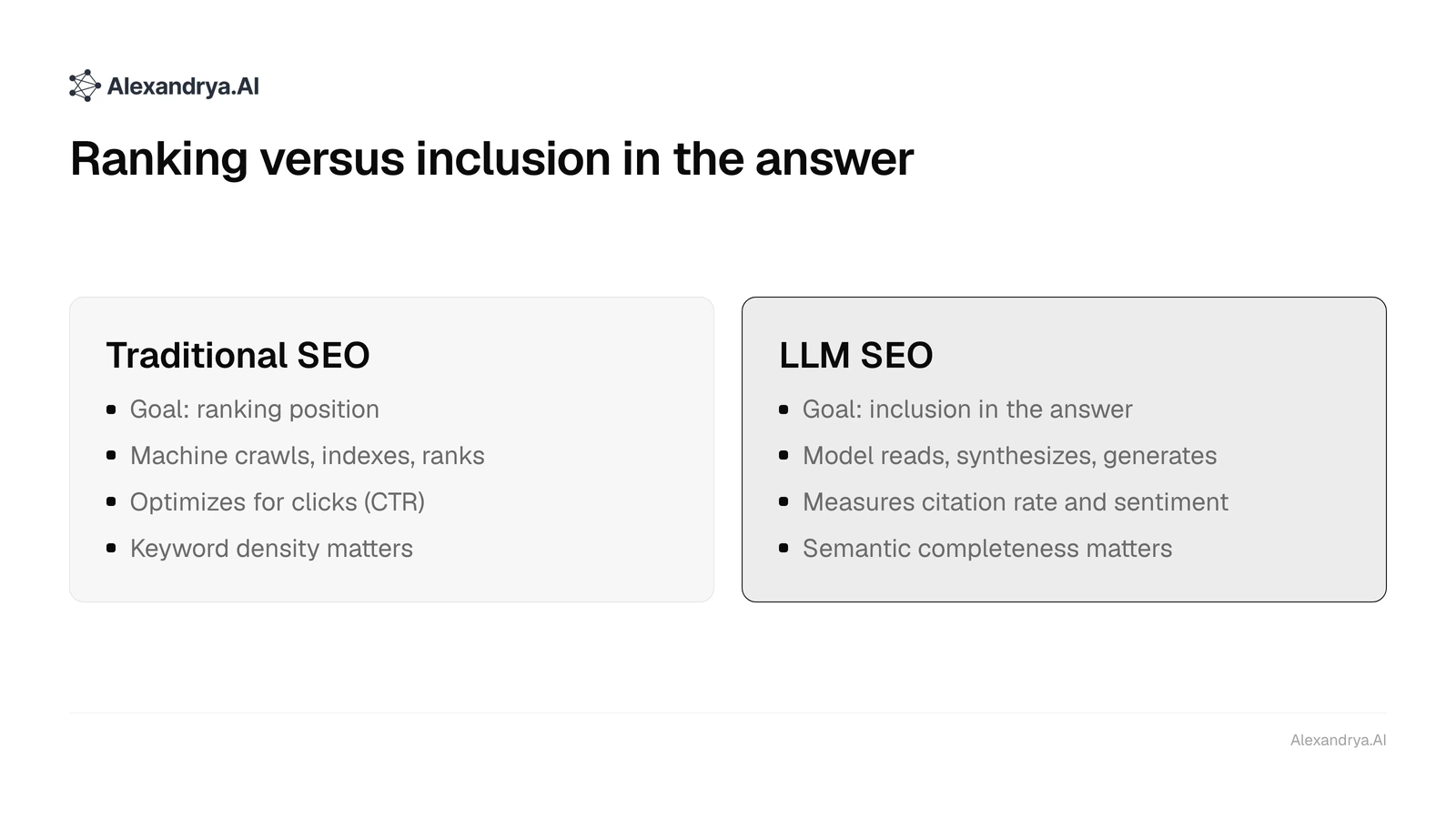
Traditional SEO optimizes for a machine that crawls, indexes, and ranks documents. LLM SEO optimizes for a machine that reads, synthesizes, and generates. The mechanism of influence is fundamentally different even when some of the raw inputs (high-quality content, authoritative sources, structured data) overlap.
According to SparkToro, AI-referred web sessions grew 527% between January and May 2025 alone. That velocity means LLM SEO is not a theoretical future concern; it is an active channel shaping brand perception right now, largely invisible to conventional analytics.
LLM SEO (sometimes called Generative Engine Optimization, or GEO) is the discipline of making your brand consistently citable in AI-generated responses across platforms such as ChatGPT, Google Gemini, Perplexity, and Claude. Unlike traditional SEO, which aims for a ranked position on a search results page, LLM SEO targets inclusion probability: the likelihood that an AI model mentions your brand when a relevant query is posed. The distinction matters because AI responses are synthesized, not ranked: a brand either appears in the generated answer or it does not. There is no page 2. Inclusion depends on factors that traditional SEO has never had to optimize for: training data representation, corroboration across authoritative third-party sources, semantic completeness on a topic, and structured-data signals that models can parse without ambiguity. Brands that rely solely on traditional SEO in 2026 risk being invisible in the channel that now influences 67% of B2B purchase decisions before a single website visit occurs (McKinsey, Oct 2025).
How Do Large Language Models Differ from Search Engines?
Large language models do not crawl and rank documents in real time. They generate responses by predicting plausible text based on patterns learned during training, sometimes augmented by live retrieval. This means that your ranking on Google has no direct causal relationship to whether an LLM cites your brand. The pathways of influence are indirect, operating through the volume and authority of sources that mentioned your brand before or during a model's training window.
How Do LLMs Build Knowledge Without Crawling?
LLMs like GPT-4o or Gemini 1.5 Pro are trained on large corpora of text collected before a cutoff date. When a user asks a question, the model generates an answer based on statistical associations learned during training. It does not visit your website at query time. This matters because optimizing for an LLM means ensuring that your brand, claims, and expertise appeared frequently and authoritatively in the sources that fed the training data: Wikipedia, peer-reviewed content, major publications, and heavily cited web pages.
For models with live retrieval (Perplexity, Google AI Overviews with Search Grounding), the question becomes which pages the retrieval layer selects. Here, traditional SEO signals like page authority and crawlability re-enter the equation, but they operate as a floor, not a ceiling.
What Does "Inclusion Probability" Mean?
Inclusion probability is the core metric of LLM SEO: across a defined set of relevant queries, in what percentage of AI-generated responses does your brand appear? Research by Alexandrya.AI in Q1 2026 found that the average brand appears in just 11.4% of relevant AI responses. The top decile of brands achieves 68.3% inclusion, a 6× gap driven almost entirely by off-site authority signals, not on-site content alone.
This metric replaces rank position as the primary KPI for AI visibility. A brand can rank #1 on Google for a target keyword while appearing in 0% of ChatGPT responses to the same query.
LLM SEO vs. Traditional SEO: Key Metrics
The average brand is cited in only 11.4% of relevant AI responses, while the top decile reaches 68.3%, revealing a 6× performance gap driven by off-site authority signals.
What Does Traditional SEO Still Get Right for LLMs?
Traditional SEO is not wasted investment for LLM visibility: several of its core outputs directly feed the signals that LLMs rely on. The key is understanding which traditional SEO outputs transfer and which do not.
Do Backlinks Still Work as Authority Proxies?
Yes. Backlinks from high-authority domains remain one of the strongest predictors of AI citation, but for a different reason than in traditional SEO. In traditional SEO, backlinks pass PageRank. In LLM SEO, backlinks from authoritative publications increase the probability that those publications mentioned or described your brand in content that was included in training data. Brands cited by 15 or more unique referring domains show a 3.2× higher citation rate in AI responses than brands with fewer external citations (Alexandrya.AI, Q1 2026). The link matters less as a ranking signal and more as an indicator that your brand was considered credible enough to reference.
Does Technical Accessibility Still Matter?
Yes, especially for retrieval-augmented AI systems. If Googlebot and AI crawlers cannot access your content (due to robots.txt blocks, JavaScript rendering issues, or slow server response times), your content cannot be included in live retrieval. Google AI Overviews, Perplexity, and Microsoft Copilot all use retrieval layers. Pages that are technically inaccessible are disqualified before any quality assessment occurs.
Are Content Quality Fundamentals Still Relevant?
Absolutely. E-E-A-T signals (demonstrable experience, expertise, authoritativeness, and trustworthiness) were Google's quality framework before they became predictors of LLM citation. LLMs tend to reproduce content patterns from sources they were trained to treat as authoritative. Well-structured, factually grounded, expert-attributed content is more likely to be represented in training corpora and more likely to be selected by retrieval layers.
What Does Traditional SEO Get Wrong for LLMs?
Traditional SEO optimizes for signals (keyword density, meta tags, page speed scores) that have minimal or no impact on LLM citation probability. Applying these tactics alone to an LLM SEO strategy produces measurable effort with immeasurable results.
Why Does Keyword Density Fail in AI Search?
LLMs do not parse keyword frequency the way search engine algorithms do. A page that repeats a target keyword 15 times does not become more likely to be cited. It may be less likely, because semantic completeness matters more than term frequency. LLMs reward content that thoroughly covers a topic from multiple angles, answers related sub-questions, and provides factual grounding. A single comprehensive piece written with semantic depth outperforms ten keyword-stuffed pages.
What Happens to CTR Optimization in a Zero-Click Environment?
Click-through rate optimization (writing title tags and meta descriptions to maximize clicks from search results) has zero relevance in AI-generated responses. Bain & Company (Feb 2025) found that 60% of searches now end without any click. AI Overviews produce a click-through rate of approximately 1%, compared to 15% for conventional organic results. In this environment, the value of being cited in an AI response is brand-level exposure, not traffic generation. CTR is the wrong metric; citation rate and sentiment accuracy are the right ones.
What Are the 6 Core Differences Between LLM SEO and Traditional SEO?
The table below distills the fundamental divergences between the two disciplines. Both are necessary in 2026, but confusing their mechanics leads to misallocated effort and unmeasurable results.
For a deeper foundation, read What Is Generative Engine Optimization?
What Does a Practical LLM SEO Checklist Look Like?
A practical LLM SEO checklist addresses the six core signal categories that predict citation probability. Each item maps directly to a measurable input.
1. Wikipedia and authoritative reference presence: Is your brand described accurately on Wikipedia? Do major industry publications mention it by name? These are the highest-leverage sources for training data inclusion.
2. Structured data coverage: Do all key pages carry appropriate Schema.org markup (Organization, Product, Article, FAQPage)? Structured data increases citation rate by 2.7× in controlled studies (Alexandrya.AI, Q1 2026).
3. Topical authority depth: Does your content cluster cover a topic completely, including sub-questions, definitions, comparisons, and objections? Brands with deep topical authority achieve 68% citation rates vs. 11% for fragmented content.
4. External citations: Are your original claims, statistics, or frameworks referenced by at least 15 independent domains? External corroboration is the primary signal LLMs use to assign credibility.
5. Content freshness: Is your most important content updated within the last 90 days? Fresh content is 1.8× more likely to be selected by retrieval-augmented AI systems.
6. Technical crawlability: Are all key pages accessible to AI crawlers? Check robots.txt, Core Web Vitals, and rendering for crawler compatibility.
For a full implementation guide, see the GEO Content Framework and GEO Audit Framework.
How Do You Measure Whether Your LLM SEO Is Working?
LLM SEO performance is measured by tracking citation behavior across AI platforms, not by monitoring rank positions. The three primary metrics are citation rate, share of AI voice, and sentiment accuracy.
Citation rate measures the percentage of relevant queries on which your brand appears in an AI response. Run a standardized query set monthly across ChatGPT, Gemini, and Perplexity. Track appearance rate per model and in aggregate.
Share of AI voice compares your citation frequency to named competitors within the same query set. If you appear in 18% of responses and your main competitor appears in 34%, your share of AI voice is approximately 35%.
Sentiment accuracy assesses whether the AI's characterization of your brand is accurate, positive, and aligned with your positioning. Brands are sometimes cited with incorrect claims or outdated information. Monitoring this prevents reputational drift.
Alexandrya.AI automates all three metrics across platforms, surfacing weekly trend data and competitive benchmarks. See Alexandrya.AI features for a full breakdown.
See how your brand performs in LLM search: start your 7-day free trial →
Frequently asked questions
Is LLM SEO the same as GEO (Generative Engine Optimization)?
The terms are used interchangeably. GEO was coined in academic research (Princeton, 2023) and tends to be used in practitioner communities. LLM SEO is more descriptive of the mechanism. Alexandrya.AI uses GEO as the primary term but treats them as synonymous.
Does ranking on Google still help with LLM citation?
Indirectly. High Google rankings often correlate with the authority signals (backlinks, structured data, content quality) that also predict LLM citation. But ranking itself does not cause citation. A page can rank #1 and never be cited, and a page outside the top 10 can appear in most AI responses if its off-site authority signals are strong.
How quickly do LLM SEO changes take effect?
For retrieval-augmented systems like Perplexity and AI Overviews, improvements in crawlability and content quality can affect results within weeks. For base model knowledge, changes only propagate at training update cycles, which vary from weeks (for fine-tuned models) to months or longer.
What is a realistic citation rate target for a mid-size B2B brand?
The average across all brands studied by Alexandrya.AI in Q1 2026 was 11.4%. A realistic 6-month target for a brand starting systematic GEO work is 25 to 35%. Top-tier brands in well-documented categories reach 50 to 70%.
Can I do LLM SEO without a dedicated tool?
Manually. You can run queries on ChatGPT, Gemini, and Perplexity and log appearances in a spreadsheet. At scale, this becomes infeasible: tracking 50 queries × 3 models × weekly cadence requires automation to be actionable.
How visible is your brand in AI?
Try Alexandrya.AI free for 7 days and see how ChatGPT, Gemini, Perplexity, AI Overviews and Copilot talk about your brand.
- 7 days free
- No credit card required
- All features included
- Cancel anytime
About the author
Talaal Max Habib
Managing Director at Alexandrya.AI
Talaal Max Habib has advised companies in industry, the Mittelstand and e-commerce on SEO and Generative Engine Optimization since 2015. With his team he built Alexandrya.AI, the Munich-based platform that measures how brands appear in ChatGPT, Perplexity and Gemini.
LinkedIn