How to Create GEO Reports That Actually Win Clients
A GEO report that wins clients connects AI visibility metrics to real business outcomes. Here is the 3-layer structure that turns raw data into client buy-in.

Managing Director at Alexandrya.AI
Why Is GEO Reporting Different from SEO Reporting?
GEO reporting is different because there are no ranking positions to show. Traditional SEO reporting lives on the clarity of a single number: "We're ranking #3." GEO reporting must instead translate probabilistic metrics (citation rates, share of AI voice, sentiment accuracy) into business relevance. Clients encountering these metrics for the first time do not know whether an 18% citation rate is good or bad without context. That makes the structure of the report the determining factor between a mandate retained and a mandate lost.
The challenge is communicative, not technical. GEO metrics are new. Clients have no reference points from previous campaigns. A GEO report that simply lists numbers loses the client by page two. A report that embeds numbers in competitive context, trend direction, and a concrete next step wins renewals and upsells. Agencies with GEO service lines achieve margins between 73% and 82% according to the Alexandrya.AI Agency Benchmark 2026, but only when reporting makes the perceived value visible.
What Are the 5 Core Metrics Every GEO Report Needs?
Five metrics form the foundation of every compelling GEO report: AI Citation Rate, Share of AI Voice, Sentiment Score, Model Coverage, and Trend. Together they describe how present, how dominant, how accurately positioned, and how stable your client's brand is in AI-generated responses.
AI Citation Rate: How Often Does the Brand Appear?
AI Citation Rate measures the percentage of a standardized query set for which the client's brand appears in an AI-generated response. Example: 24 of 100 relevant queries on ChatGPT, Gemini, and Perplexity return a brand mention. Citation Rate: 24%. Without a benchmark comparison, this number is meaningless. With an industry benchmark and competitive comparison, it becomes the strongest argument in the report.
Share of AI Voice: How Dominant Is the Brand?
Share of AI Voice sets the brand's citation rate against the citation rates of all named competitors within the same query set. If Brand A appears in 24% of responses, Brand B in 38%, and Brand C in 14%, Brand A's Share of AI Voice is approximately 32%. This relative metric creates urgency: no client stays passive when they see their main competitor being recommended twice as often by AI systems.
Sentiment Score: What Does the AI Say About the Brand?
Sentiment Score assesses whether the AI characterizes the brand positively, neutrally, or negatively, and whether the characterization is factually accurate. Brands are sometimes cited with outdated product information, incorrect pricing, or superseded positioning. Sentiment monitoring prevents reputational drift and gives the agency a concrete quality argument for continued engagement.
Model Coverage: Which Platforms Does the Brand Appear On?
Model Coverage shows which AI platforms (ChatGPT, Gemini, Perplexity, Claude, Copilot) return brand citations and which do not. Coverage gaps are direct optimization levers: if Perplexity consistently ignores a brand but ChatGPT cites it regularly, a platform-specific gap exists that is addressable through targeted content and structured data improvements.
Trend: How Is Visibility Developing Over Time?
Trend shows the development of Citation Rate, Share of AI Voice, and Sentiment Score over the previous four to twelve weeks. GEO citation rates can fluctuate by up to 30% week-over-week without active monitoring. Trend data is the only instrument for distinguishing genuine improvements from seasonal variation or model update effects.
A structured GEO report is more than a collection of citation rates. It is the strategic communication instrument that makes the perceived value of your agency's work visible. The 5 core metrics (AI Citation Rate, Share of AI Voice, Sentiment Score, Model Coverage, and Trend) together paint a complete picture of a brand's AI visibility. Each metric in isolation is incomplete: a high Citation Rate paired with negative sentiment is not a success; a strong Share of AI Voice on ChatGPT that is absent on Perplexity is half a presence. Only in combination, with benchmark comparison and trend direction, do the narrative arguments emerge that clients actually understand: "Your brand is being cited twice as often as six weeks ago, and your main competitor is behind you on three of five models." That is the reporting that renews contracts. Agencies integrating these 5 metrics into their monthly reports achieve approximately 40% higher client retention rates than agencies delivering only aggregated citation data, according to an internal Alexandrya.AI agency survey conducted in 2026.
What Does the 3-Level GEO Report Structure Look Like?
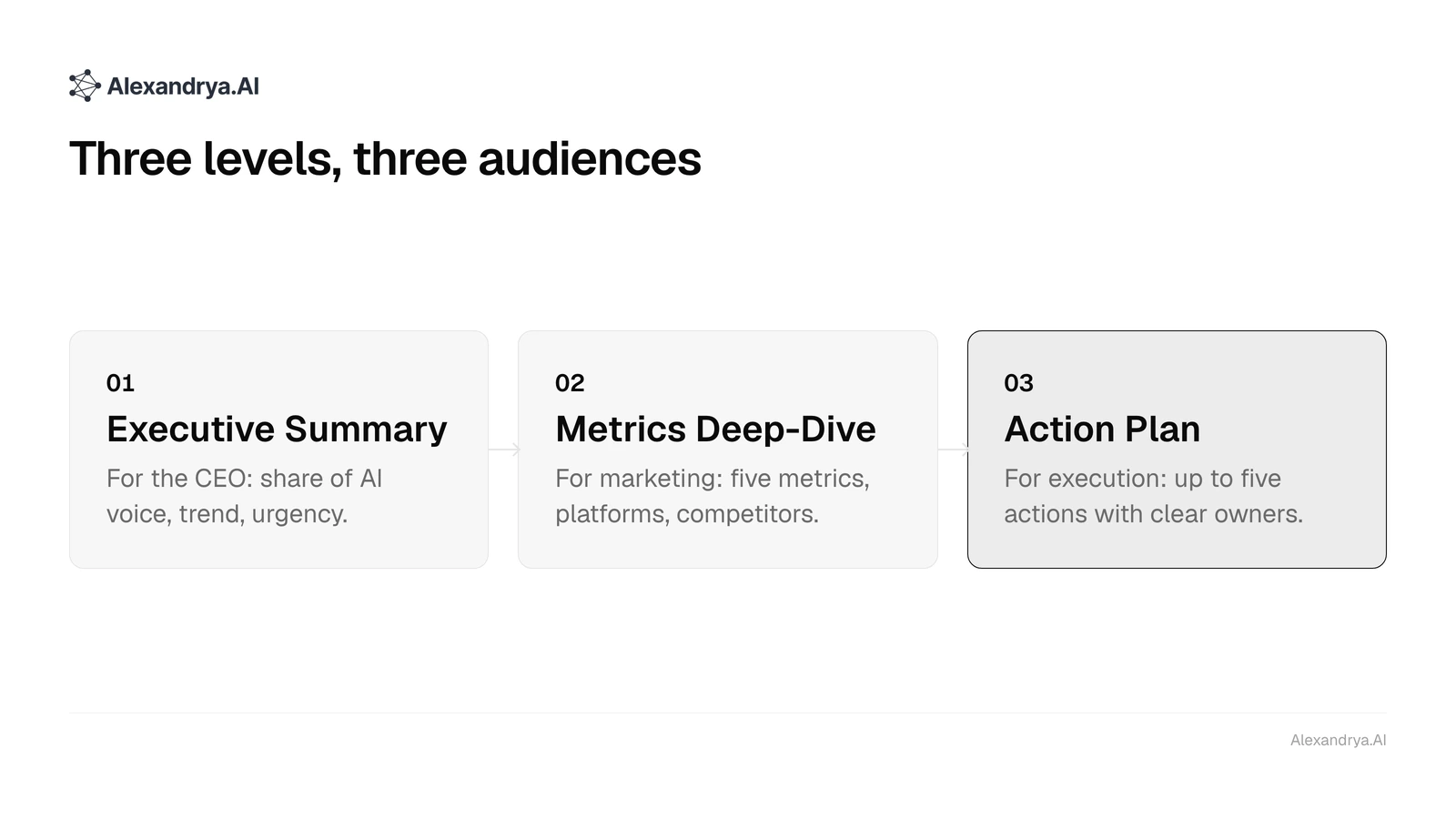
The 3-level structure separates the report by audience and decision layer: Executive Summary for leadership, Metrics Deep-Dive for the marketing team, and Action Plan for operational implementation. This separation ensures that each recipient receives exactly the information relevant to their decision role, without being overwhelmed by irrelevant detail.
Level 1: Executive Summary: What the CEO Needs in 60 Seconds
The Executive Summary contains exactly three pieces of information: the current Share of AI Voice compared to the main competitor, the change in Citation Rate versus the previous month, and an assessment of strategic urgency. Maximum one page, no raw data, no tables. The CEO uses this level to decide whether GEO is a strategic investment priority. Write in business language: "Your main competitor is being recommended by AI systems 2.3× more often than your brand. This influences purchase decisions before prospective clients ever visit your website."
Level 2: Metrics Deep-Dive: What the Marketing Team Needs
The Metrics Deep-Dive shows all five core metrics with an 8 to 12 week trend chart, platform-specific breakdown, and benchmarking against two to four competitors. This section answers "Why" and "Where": Why has the Citation Rate changed? On which platform is the biggest gap? Which content type is most frequently cited as a source? This level is the analytical foundation for Level 3.
Level 3: Action Plan: What to Do Next
The Action Plan contains a maximum of five prioritized actions with expected impact, ownership, and timeline. Each action traces directly to a metric from Level 2. Example: "Add structured data to 12 product pages → expected Citation Rate increase +8 to 12% in 6 weeks → Owner: Content team → Deadline: CW 23." This section transforms the report from a monthly documentation artifact into the foundation of a strategic conversation, and therefore into the basis for mandate renewal.
The 3-Level GEO Report Structure
The 3-level structure separates GEO reporting by audience (CEO, marketing team, operations) and increases client retention by approximately 40% according to the Alexandrya.AI Agency Benchmark 2026.
What Mistakes Ruin GEO Reports With Clients?
The most common GEO reporting failures are communicative rather than methodological. A technically correct report that does not meet the client where they are will lose the mandate, often after the second month.
Numbers Without Context: What Does 18% Mean?
A Citation Rate of 18% is meaningless without a benchmark. Is that strong for the industry? Better or worse than the competition? Rising or falling? Agencies that deliver raw data alone transfer the interpretation work to the client. Clients who have to interpret results question the value of the service. Every number in a GEO report must come with a reference point: industry benchmark, competitor comparison, or month-over-month delta.
Missing Benchmarks: No Verdict Without Comparison
GEO citation rates vary substantially by industry, category, and query type. A Citation Rate of 25% can mean top performer in a highly competitive category or underperformer in a low-competition niche. Without an industry benchmark, the client cannot assess whether action is required. Alexandrya.AI provides industry benchmarks derived from thousands of analyzed queries, enabling reports that deliver context within seconds.
No Next Step: A Report Without a Call to Action
A GEO report without a concrete next step ends as documentation, not as a strategic instrument. The client knows what was measured, but not what to do with it. Every report must end with a clear action directive: which three measures will move which metric in what timeframe. This next step is the entry point for the next strategic conversation, and therefore for mandate renewal.
What Tools and Templates Are Available for GEO Reports?
Three tool categories support professional GEO reporting: monitoring platforms, visualization tools, and report templates. Alexandrya.AI combines all three in an integrated solution.
Alexandrya.AI automatically tracks Citation Rate, Share of AI Voice, Sentiment Score, and Model Coverage across ChatGPT, Gemini, Perplexity, and additional platforms, with weekly trend updates and exportable data for report integration. The platform provides white-label reports in PDF and presentation format that can be branded directly with client logos.
For agencies preferring custom visualizations: Alexandrya.AI data integrates via API into Google Data Studio, Looker, or PowerBI. Templates for the 3-level structure are available in the agency documentation. See GEO Audit Framework and All Features for full details.
When Does White-Label GEO Reporting Make Sense?
White-label GEO reporting becomes worthwhile as soon as an agency manages more than three GEO clients simultaneously. Beyond that threshold, the effort for manual reporting outweighs the margin advantage. White-label automation scales reporting capacity without proportional staffing costs.
For agencies positioning GEO as a standalone service, white-label reporting is a direct differentiation factor: clients receive professionally branded reports under the agency's name, while the data foundation is supplied by Alexandrya.AI. The margin remains entirely with the agency. Alexandrya.AI appears neither in the report nor facing the end client.
Create professional GEO reports with Alexandrya.AI: book a demo →
Frequently asked questions
How often should a GEO report be created?
Monthly for Executive Summary and Action Plan; weekly for trend monitoring in the internal dashboard. Monthly client-facing reports are the industry standard. Weekly interim updates via email alert are optional and recommended when active optimization work is underway.
How many queries do I need for a representative GEO report?
A minimum of 30 to 50 standardized queries per query set for statistically meaningful results. Alexandrya.AI recommends 100+ queries for agencies with multiple clients in the same category, enabling competitive benchmarking on the basis of identical query sets.
Can I integrate GEO reports into my existing SEO reporting?
Yes, but with clear visual separation. GEO metrics and SEO metrics operate on different scales, timeframes, and optimization levers. In a combined report, both areas should be treated as separate chapters with a brief explanation of the relationship for the client.
How do I explain to my client why GEO metrics are different from SEO metrics?
Use this analogy: "SEO measures how often your website appears in the list. GEO measures whether the AI recommends your brand when someone no longer wants a list at all; they want a direct answer." This formulation works reliably in C-level client conversations.
What do I do when an AI incorrectly or negatively describes my client?
Document the erroneous passage and identify the probable source (outdated Wikipedia entry, incorrectly cited press article). Update the primary source, add correct structured data to the website, and track sentiment development in the next reporting cycle. Corrections can take 4 to 8 weeks to propagate.
How visible is your brand in AI?
Try Alexandrya.AI free for 7 days and see how ChatGPT, Gemini, Perplexity, AI Overviews and Copilot talk about your brand.
- 7 days free
- No credit card required
- All features included
- Cancel anytime
About the author
Talaal Max Habib
Managing Director at Alexandrya.AI
Talaal Max Habib has advised companies in industry, the Mittelstand and e-commerce on SEO and Generative Engine Optimization since 2015. With his team he built Alexandrya.AI, the Munich-based platform that measures how brands appear in ChatGPT, Perplexity and Gemini.
LinkedIn