How to Run a GEO Audit: Step-by-Step Framework for 2026
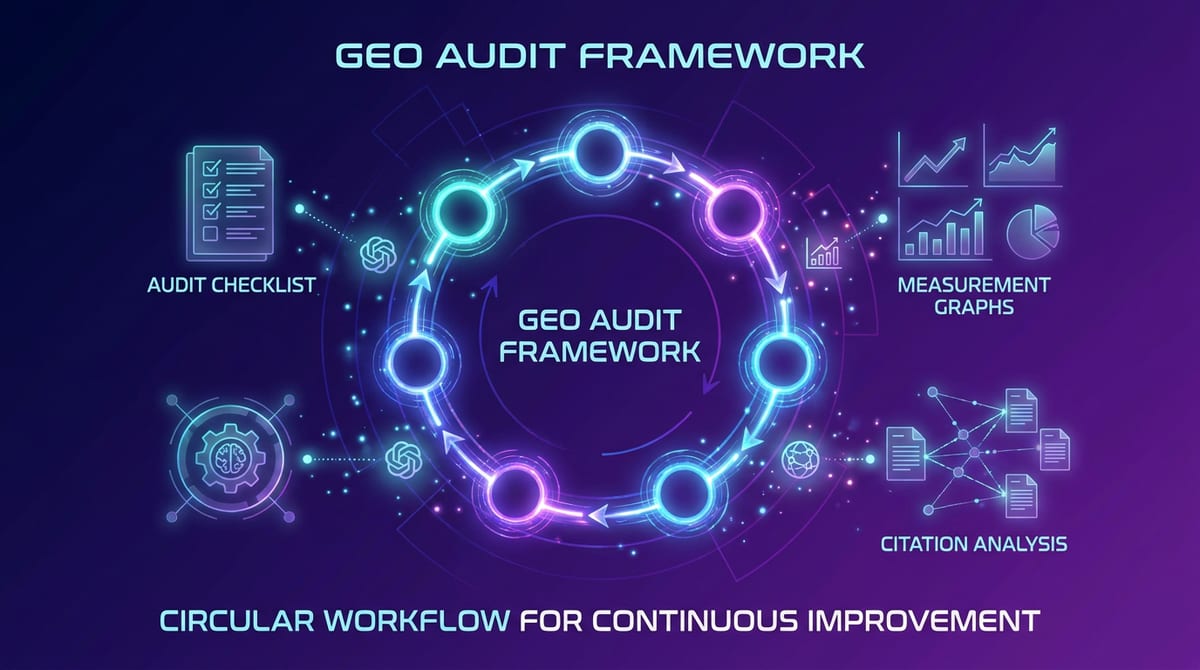
GEO Audit Framework: Seven steps to measure AI visibility
What Is a GEO Audit and Why Do You Need One?
A GEO audit is a structured assessment of how a brand currently appears in AI-generated search responses — and a systematic identification of the gaps between current AI visibility and the visibility of top-cited competitors. A GEO audit differs from a traditional SEO audit in its measurement approach: instead of analyzing keyword rankings and backlink profiles, it measures citation frequency, citation position, and sentiment accuracy across ChatGPT, Perplexity, Google AI Overviews, and Bing Copilot. The output of a GEO audit is a prioritized action list of content, structural, and technical changes that will measurably improve AI citation rates within 30–60 days. For any organization that has not previously measured its AI visibility, the GEO audit is the mandatory first step — optimization without a baseline produces changes without measurable outcomes.
For the foundational definition of GEO, see: What Is Generative Engine Optimization (GEO)?
What Are the Seven Steps of a GEO Audit?
A complete GEO audit follows seven sequential steps: defining a prompt set, running prompts across all four major AI platforms, building a visibility baseline, conducting a content gap analysis, performing a technical review, scoring and prioritizing recommendations, and tracking progress at 30-day intervals. Each step builds directly on the output of the previous one.
Step 1: How Do You Define Your GEO Audit Prompt Set?
The GEO audit begins with defining the prompt set — the specific buyer queries you will test across AI platforms. These are not SEO keywords. They are the natural-language questions your buyers enter into ChatGPT or Perplexity when researching your category.
How to build your prompt set:
- Interview your sales team: "What are the five questions prospects ask most before they're ready to book a demo?"
- Run your top SEO keywords through a question-conversion formula: "How does [keyword] work?", "What is the best [keyword] tool?", "Compare [keyword] options"
- Check competitors' FAQ sections: the questions they answer are often the exact queries buyers ask AI systems
Recommended prompt set size for an initial GEO audit:
GEO Audit Prompt Set — Recommended Structure
Category Prompt Count Purpose
─────────────────────────────────────────────────────
Definitional 3–5 prompts "What is [category]?"
Comparative 3–5 prompts "Compare [your tool] vs. [competitor]"
Best-of / Vendor 3–5 prompts "Best [category] tool for [use case]"
How-to / Procedural 3–5 prompts "How to [task your tool enables]"
Problem-aware 2–3 prompts "How do I solve [pain point]?"
─────────────────────────────────────────────────────
Total 14–23 prompts
Start with 15 prompts. That is enough to identify clear citation patterns without making the initial audit unwieldy.
Step 2: How Do You Run Prompts Across AI Platforms?
Run each prompt in the prompt set across all four major AI platforms: ChatGPT (web search mode), Perplexity, Google AI Overviews, and Bing Copilot. For each prompt × platform combination, record:
- Brand cited? (Yes / No)
- Citation position (1st mention / list item / not cited)
- Description accuracy (Correct / Partially correct / Incorrect)
- Competitor cited? (Which competitors appear when you do not?)
Important: Run each prompt 3× per platform. AI outputs are stochastic — the same prompt produces different responses across sessions. A single run cannot distinguish between genuine citation absence and natural output variation. Three runs per prompt gives a reliable citation frequency signal.
Step 3: How Do You Build Your GEO Visibility Baseline?
After running all prompts, calculate your GEO visibility baseline across four metrics:
GEO Audit Scorecard — Example Output (Illustrative)
Metric ChatGPT Perplexity Google AIO Bing Copilot
──────────────────────────────────────────────────────────────────────────────
Citation Frequency 23% 41% 35% 28%
Avg. Citation Position 3.2 2.1 1.8 3.7
Sentiment Accuracy 78% 91% 85% 72%
Competitor Visibility 67% 58% 71% 62%
(= % of prompts where a competitor appears but you do not)
──────────────────────────────────────────────────────────────────────────────
Overall GEO Score 31/100 54/100 47/100 38/100
This scorecard provides the baseline against which all GEO optimizations are measured. The gap between your citation frequency and competitor visibility percentage defines the competitive opportunity.
Step 4: How Do You Conduct a Content Gap Analysis?
The content gap analysis identifies which buyer queries produce competitor citations but not yours. For each such query:
- Record which competitor is cited
- Visit that competitor's cited page
- Identify the structural elements that enable citation: Do they have a direct definition in the first paragraph? Question-based H2 headings? An FAQ section with schema? Self-contained answer passages?
Content Gap Analysis — Diagnostic Questions
Structural Element Your Pages Competitor Pages Priority
──────────────────────────────────────────────────────────────────────
Answer in first 60 words ○ Missing ✓ Present HIGH
Question-based H2s ○ Missing ✓ Present HIGH
Self-contained passages ○ Missing ✓ Present HIGH
FAQ section + H3s ○ Missing ✓ Present HIGH
FAQPage schema ○ Missing ○ Missing MEDIUM
Article schema + author ✓ Present ✓ Present LOW
HowTo schema ○ Missing ✓ Present MEDIUM
Publication date visible ✓ Present ✓ Present LOW
──────────────────────────────────────────────────────────────────────
The structural elements marked HIGH (answer placement, heading format, passage self-containment, FAQ structure) produce the fastest citation improvement when retrofitted.
Step 5: How Do You Conduct a Technical GEO Review?
The technical GEO review checks whether AI crawlers can access your content and whether your schema implementation is correct.
AI crawler access check (robots.txt):
User-agent: GPTBot
Allow: /
User-agent: PerplexityBot
Allow: /
User-agent: ClaudeBot
Allow: /
User-agent: GPTBot
Disallow: /
Schema validation:
Run every primary content page through Google's Rich Results Test. Missing Article schema, broken FAQPage markup, or schema that does not match visible page content are common technical GEO gaps.
Step 6: How Do You Score and Prioritize GEO Recommendations?
Not all GEO gaps are equally valuable to close. Prioritize by the combination of citation impact and implementation effort:
GEO Recommendation Prioritization Matrix
HIGH Impact LOW Impact
┌─────────────────┬──────────────────────┐
LOW Effort │ DO FIRST │ Do if time allows │
│ • Answer-first │ • Add pub. dates │
│ structure │ • Fix sentiment- │
│ • Question H2s │ inaccurate quotes │
├─────────────────┼──────────────────────┤
HIGH Effort │ SCHEDULE │ DEPRIORITIZE │
│ • New GEO │ • Wikipedia │
│ landing pgs │ presence build │
│ • Original │ • Video content │
│ research │ series │
└─────────────────┴──────────────────────┘
For a typical B2B SaaS site, the first 5 days of GEO optimization should focus entirely on the top-left quadrant: answer-first restructuring and question-based headings on the 10 highest-traffic pages.
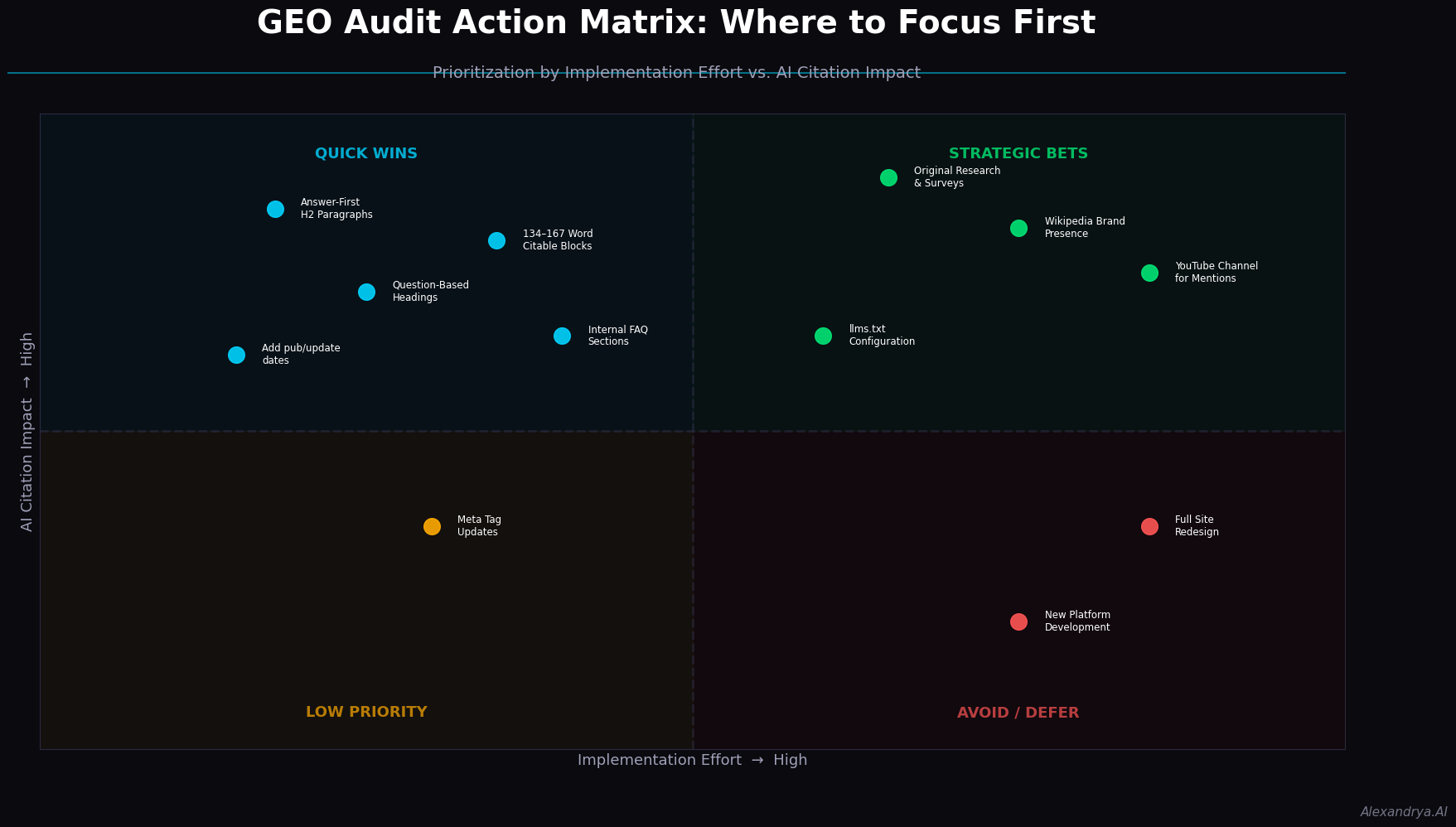
Answer-first restructuring and question-based headings sit in the high-impact/low-effort quadrant — the correct starting point for every GEO audit implementation plan.
Step 7: How Do You Track GEO Progress After Optimization?
After implementing GEO changes, re-run the full prompt set across all platforms at 30-day intervals. Measure the change in:
- Citation frequency (has the percentage increased?)
- Citation position (are you appearing earlier in responses?)
- Competitive visibility gap (has the gap to competitors narrowed?)
GEO Audit — 30-Day Progress Tracking Template
Prompt Platform Day 0 Day 30 Change
─────────────────────────────────────────────────────────────────────
"Best AI visibility tool" ChatGPT 0% 33% +33pp
"Best AI visibility tool" Perplexity 23% 67% +44pp
"How to track AI citations" ChatGPT 10% 40% +30pp
"How to track AI citations" Perplexity 33% 77% +44pp
"GEO tool comparison" Google AIO 0% 50% +50pp
─────────────────────────────────────────────────────────────────────
Real-time retrieval platforms (Perplexity, Google AI Overviews) typically show measurable improvement within 2–4 weeks of content changes. ChatGPT base model improvements depend on training data refresh cycles and take longer.
How Long Does a GEO Audit Take?
A manual GEO audit across 15 prompts and four platforms takes 2–3 working days; an automated audit delivers the same output in under 30 minutes. The difference is significant for any organization that needs ongoing, repeatable measurement rather than a one-time assessment. This section covers both options with realistic time and cost estimates.
What Is the Manual GEO Audit Timeline?
A manual GEO audit across 15 prompts and 4 platforms (3 runs each) requires 180 prompt runs. At 3–5 minutes per run, that is 9–15 hours of prompt execution alone — before analysis, content gap review, and prioritization. A full manual GEO audit takes 2–3 working days for a single person.
What Does an Automated GEO Audit Provide?
An automated GEO audit platform — like alexandrya.ai — runs all 180 prompt iterations simultaneously, aggregates results into a normalized scorecard, and delivers the competitive gap analysis and prioritized recommendation list within minutes. The human time investment drops from 2–3 days to 30 minutes of setup and interpretation.
For organizations with more than 15 target queries, more than 3 competitors to benchmark, or multiple languages to track, manual auditing is not a viable ongoing practice. The audit must be automated to be repeatable.
For automated GEO audits with competitive benchmarking: alexandrya.ai features
Run Your First GEO Audit Today
Your AI visibility baseline is the starting point for every GEO decision. Without it, you are optimizing blind.
Start your free 7-day trial → Get your GEO audit dashboard in minutes
No credit card. Cancel anytime. First competitive benchmark report in under 30 minutes.
Frequently Asked Questions
How often should you run a GEO audit?+
Run a full audit monthly for active GEO programs. Track citation frequency weekly using 5-10 core prompts. The trigger for an unscheduled audit is a drop of 10+ percentage points in citation frequency within two weeks.
Does a GEO audit replace an SEO audit?+
No. A GEO audit measures AI citation frequency, position, accuracy, and competitive share. An SEO audit measures keyword rankings, backlinks, and technical health. Run both in parallel — many GEO improvements also improve SEO signals.
What is the most common finding in a GEO audit for B2B SaaS companies?+
Buried answers: content that is topically relevant but buries the direct answer in paragraph 3 or 4. The second most common finding is missing FAQ sections. Both are retrofit-addressable using the GEO Content Framework.
Can a GEO audit identify why a specific competitor is being cited instead of you?+
Yes. The content gap analysis (Step 4) identifies the specific structural difference: whether competitors answer the question in the first 60 words, use question-based headings, or have FAQ schema. In 85% of cases, the citation gap is explained by one of five structural differences.
Run Your First AI Visibility Scan
No credit card. No commitment. Just clarity on how ChatGPT, Gemini and Perplexity describe your brand today.

Talaal Max Habib
Managing Director at Alexandrya.AI
Alexandrya.AI is a GEO and AI visibility tracking platform based in Munich, Germany.
LinkedIn