Why AI Search Doesn't Replace SEO: It Extends It
AI search and traditional SEO serve different user behaviors. Why AI search doesn't replace SEO but extends it, and what that means for your search strategy.
Managing Director at Alexandrya.AI
Is SEO Dead Because of AI Search?
No, but SEO needs a parallel strategy, not a replacement. AI search does not serve the same user behaviors as traditional search. It serves different query types, at different stages of the decision journey, and produces different outcomes for the brands that appear in it. The question is not "SEO or AI search"; it is "how do I allocate effort and measurement across two distinct channels that serve the same user at different moments?"
The narrative that AI search kills SEO confuses channel disruption with channel addition. Google still processes 8.5 billion queries per day as of January 2026. AI Mode, launched by Google in May 2025, is available in 180+ countries, but it sits alongside traditional results, not instead of them. Traditional SEO addresses the majority of queries that still require clicking through to a specific source. AI search addresses the growing volume of synthesis and research queries that resolve without a click. Both exist simultaneously. Both require investment. Neither replaces the other.
What Are the Two Different Channels Serving Two Different Behaviors?
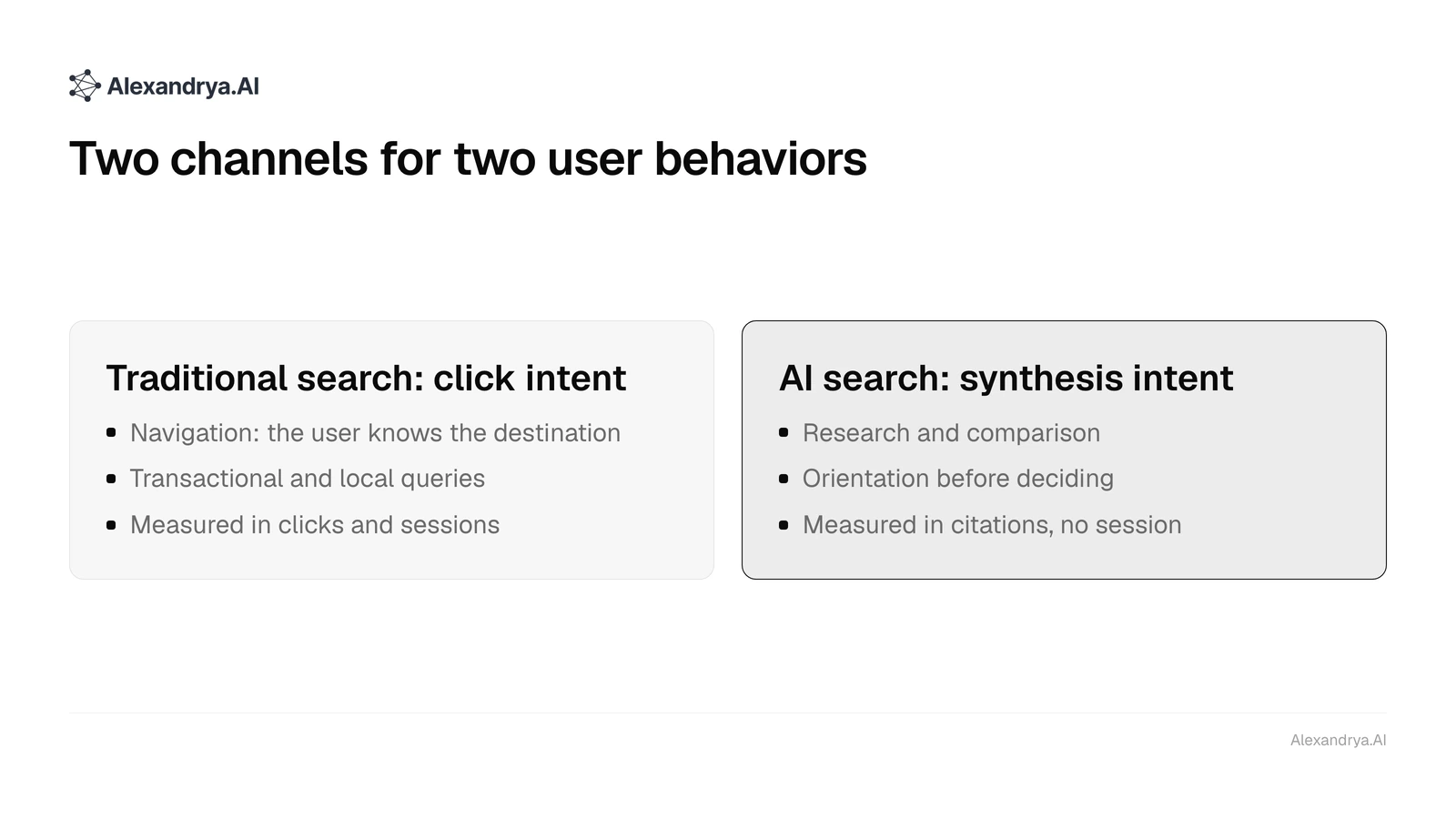
Traditional search and AI search are not competing for the same user intent. They are serving different moments in the same user's information journey. Traditional search serves click intent; AI search serves synthesis intent. Understanding this distinction is the foundation of any rational 2026 search strategy.
How Does Traditional Search Serve Click Intent?
Traditional search excels when a user knows they need to go somewhere: a specific website, a specific product page, a documentation article, a local business. These are navigational, transactional, and locally-specific queries: "Salesforce login," "buy running shoes under €100," "plumber near Munich." For these queries, the user's goal is not a synthesized answer. It is the destination. Traditional SEO's core metric, organic traffic, maps directly to this behavior. Clicks drive sessions drive conversions. The funnel is measurable.
How Does AI Search Serve Synthesis Intent?
AI search excels when a user wants to understand something before deciding where to go. "What are the best practices for reducing B2B churn?" "How does quantum key distribution work?" "What should I look for in an enterprise ERP system?" These are research, comparison, and orientation queries. The user does not want to visit ten pages; they want a synthesized answer now. Bain & Company (Feb 2025) found that 60% of searches now end without any click. For synthesis queries, AI search provides the answer directly. The brand that appears in that answer earns awareness and credibility, without generating a single session in Google Analytics.
AI search and traditional search are parallel channels, not substitutes, and treating them as competitors is the most expensive strategic mistake a marketer can make in 2026. Traditional search handles navigation and transaction queries: the user knows they need to click somewhere specific. AI search handles synthesis queries: the user wants a direct answer without visiting multiple pages. Bain & Company (Feb 2025) found that 60% of searches now end without a click, and AI Overviews deliver a click-through rate of approximately 1% versus 15% for conventional organic results. This does not mean traffic is being destroyed. It means traffic is being redirected to users who have already decided. The users who do click after seeing an AI response are higher-intent than average organic visitors. Meanwhile, McKinsey projects that AI search will influence $750 billion in commerce by 2028. Google still processes 8.5 billion queries daily, and Google's own AI Mode, launched in May 2025 and available in 180+ countries, sits alongside traditional results, not instead of them. Both channels require distinct measurement systems, distinct optimization tactics, and dedicated budget allocation.
What Does AI Search Take from SEO, and What Does It Ignore?
AI search inherits several foundational SEO signals and disregards others entirely. Knowing which signals transfer is the key to avoiding wasted effort in a dual-channel strategy.
Which SEO Signals Do AI Systems Inherit?
AI systems absorb SEO-adjacent signals through two mechanisms: training data and retrieval. High-authority backlinks signal credibility and increase the probability that authoritative publications cited a brand before the model's training cutoff. Technical crawlability determines whether retrieval-augmented AI systems can access and index content for live retrieval layers. Content quality signals (E-E-A-T markers, factual grounding, expert attribution) increase the probability that a piece of content was selected for high-quality training corpora. These signals transfer because they are proxies for real-world authority, which LLMs are designed to reflect.
Which SEO Signals Do AI Systems Ignore?
Keyword density, title tag optimization, meta descriptions, internal linking structure, and page speed scores have minimal or no direct effect on AI citation rate. AI systems do not parse your title tag when deciding whether to cite your brand. They reflect patterns from training data and retrieval results. Optimizing these elements for AI visibility produces negligible impact. Brands that assume their existing SEO work automatically protects their AI visibility are building on a false premise.
Why Do Both Channels Require Separate Measurement?
Traditional SEO and AI search require separate measurement because their KPIs, timeframes, and attribution models are fundamentally incompatible. Mixing them produces numbers that look like data but cannot support decisions.
What Are the Right SEO Metrics?
Traditional SEO is measured by rank position, organic traffic, click-through rate, and conversion rate from organic sessions. These metrics are event-driven: a user clicked, a session was created, a goal was completed. Attribution is possible through UTM parameters, session tracking, and goal completion data. The feedback loop is fast: rank changes are visible within days to weeks.
What Are the Right GEO Metrics?
AI search is measured by citation rate (percentage of relevant queries on which the brand appears in an AI response), share of AI voice (relative citation frequency vs. named competitors), sentiment accuracy (whether the AI's characterization is correct), and model coverage (which platforms cite the brand). These metrics are probabilistic, not event-driven. There is no UTM trail from an AI response. Measurement requires running standardized query sets across platforms and logging brand appearances, a process that Alexandrya.AI automates across ChatGPT, Gemini, Perplexity, and additional models. See What Is AI Visibility for a full explanation of these metrics.
SEO and GEO as Parallel Channels
Traditional search and AI search serve different user behaviors at different decision moments. Parallel investment in both channels is the rational 2026 search strategy.
How Should Marketers Split Budget Between SEO and GEO in 2026?
Budget allocation between traditional SEO and GEO depends on two variables: the share of your target audience's decision journey that is research-driven (high = more GEO) and the current AI citation rates of your brand and competitors (low = urgent GEO investment). A useful starting framework is the 70/30 rule for most B2B brands.
What Is the 70/30 Rule of Thumb?
Allocate 70% of search-related budget and effort to traditional SEO and 30% to GEO in 2026. This ratio reflects the current distribution of search volume: the majority of queries still resolve through traditional search. As AI search volume grows (McKinsey projects a significant share shift toward AI-mediated search by 2028), the ratio should shift toward 50/50. Brands in research-intensive B2B categories (SaaS, professional services, financial services) should consider moving to 50/50 immediately, as their buyers are disproportionately active in AI search during the consideration phase.
How Do You Build a Priority Matrix for Dual-Channel Investment?
Prioritize GEO investment first for: high-value content types (comparison pages, category definitions, expert guides); topics where competitors already dominate AI citations; and query types with high synthesis intent in your category. Maintain traditional SEO investment for: branded and navigational queries; product and service pages with transaction intent; and local SEO for any physical locations. Content that serves both channels simultaneously (comprehensive, structured, factually grounded, expert-attributed) is the highest-leverage investment of all.
What Is the Right Content Strategy for Both Channels Simultaneously?
The most efficient content strategy for 2026 serves both traditional search and AI search from the same assets, with structure optimized for each. Content that achieves this dual-channel optimization shares five characteristics.
First, it answers the question in the first sentence of every section: a direct answer that AI systems can extract as a standalone response and that traditional search users find immediately satisfying. Second, it uses structured formatting (H2/H3 hierarchy, comparison tables, numbered lists) that both Google's crawler and AI retrieval systems parse efficiently. Third, it includes original data or named expert attribution, the type of factual grounding that authoritative publications cite, which builds both traditional domain authority and AI training data representation. Fourth, it covers a topic completely at a depth that eliminates the need for additional queries. This signals topical authority to Google and satisfies AI synthesis requirements simultaneously. Fifth, it is technically accessible: fast-loading, crawlable, with comprehensive structured data markup.
For a full framework, see What Is GEO, GEO Content Framework, and Alexandrya.AI features.
Measure both your SEO and AI search visibility: start 7-day free trial →
Frequently asked questions
Will AI search eventually replace traditional search entirely?
Not in the foreseeable future. Traditional search handles query types (navigational, transactional, local) that AI synthesis cannot serve better than a direct link. Google processes 8.5 billion queries daily, and the majority remain click-intent queries. AI search will grow as a share of research and orientation queries, but both channels will coexist for years.
How do I know if my audience is using AI search for research?
The strongest indicator is attribution gap analysis: if your direct traffic has grown while organic traffic has stagnated, AI-referred research may be driving awareness without trackable sessions. Industry vertical is a stronger predictor: B2B SaaS, professional services, and financial services audiences use AI research tools at significantly higher rates than retail or food and beverage.
Does optimizing for AI search hurt traditional SEO rankings?
No. GEO optimization tactics (improving content depth, adding structured data, building topical authority, earning external citations) are consistent with or complementary to traditional SEO best practices. There are no known GEO tactics that produce negative SEO effects.
What happens to my organic traffic if Google AI Mode expands?
AI Overviews deliver approximately 1% CTR vs. 15% for conventional organic results (Bain, Feb 2025). Pages that previously ranked for informational queries may see traffic declines. The offset is that appearing in AI responses builds brand awareness among users who eventually convert through direct, branded, or referral channels, creating attribution blind spots that require GEO measurement to resolve.
Can small brands compete with large brands in AI search?
Yes, more so than in traditional SEO. AI citation concentration favors brands with deep topical authority and strong external citations, signals that a focused mid-size brand can build in a defined niche faster than a large brand can build across broad categories. Niche topical authority is the primary lever for smaller brands entering AI search.
How visible is your brand in AI?
Try Alexandrya.AI free for 7 days and see how ChatGPT, Gemini, Perplexity, AI Overviews and Copilot talk about your brand.
- 7 days free
- No credit card required
- All features included
- Cancel anytime
About the author
Talaal Max Habib
Managing Director at Alexandrya.AI
Talaal Max Habib has advised companies in industry, the Mittelstand and e-commerce on SEO and Generative Engine Optimization since 2015. With his team he built Alexandrya.AI, the Munich-based platform that measures how brands appear in ChatGPT, Perplexity and Gemini.
LinkedIn